What will the US “Super Intelligence Force” actually coordinate?
President Donald Trump created a federal “Super Intelligence Force” on Sunday, led by intelligence chief Jay Clayton.
Trump said the new task force will coordinate federal engagement with consumers, public-interest groups, religious organizations, critical-infrastructure providers and AI companies while seeking to maintain US leadership.[2] The group is led by Director of National Intelligence Jay Clayton and incl…
Trump said the new task force will coordinate federal engagement with consumers, public-interest groups, religious organizations, critical-infrastructure providers and AI companies while seeking to maintain US leadership.[2] The group is led by Director of National Intelligence Jay Clayton and includes FTC Chair Andrew Ferguson, defense research official Emil Michael and Office of Personnel Management Director Scott Kupor.[2][8]
Why it matters: The task force places federal AI coordination under a senior intelligence official even as Trump has opposed stronger restrictions and largely left companies to regulate themselves.[2] Its remit therefore connects national competitiveness, public engagement and safety policy without yet replacing the industry-led approach described by the administration.[2]
Key insights: The task force follows Trump’s promise to establish an AI safety board after executives from OpenAI, Anthropic, SpaceX and Google signed a “morally binding” pact on September 29.[2] | Clayton previously chaired the SEC during Trump’s first term and became director of national intelligence in August 2026.[8] | Trump also signed an executive order renaming AI as “super intelligence,” although experts warned that the term normally describes more advanced systems and could cause confusion.[2] | The stated engagement list spans consumers, public-interest and religious groups, critical infrastructure and technology companies.[2]
Cheatsheet facts: What changed: A new federal task force led by Jay Clayton will coordinate government engagement on AI policy and US technological leadership.[2][8] | Why now: The move follows a September 29 industry pact and growing pressure from prominent technology figures for tighter AI oversight.[2] | Watch next: Published mandates, implementation steps or enforcement mechanisms tied to the task force, the promised safety board and the September 29 pact.[2]
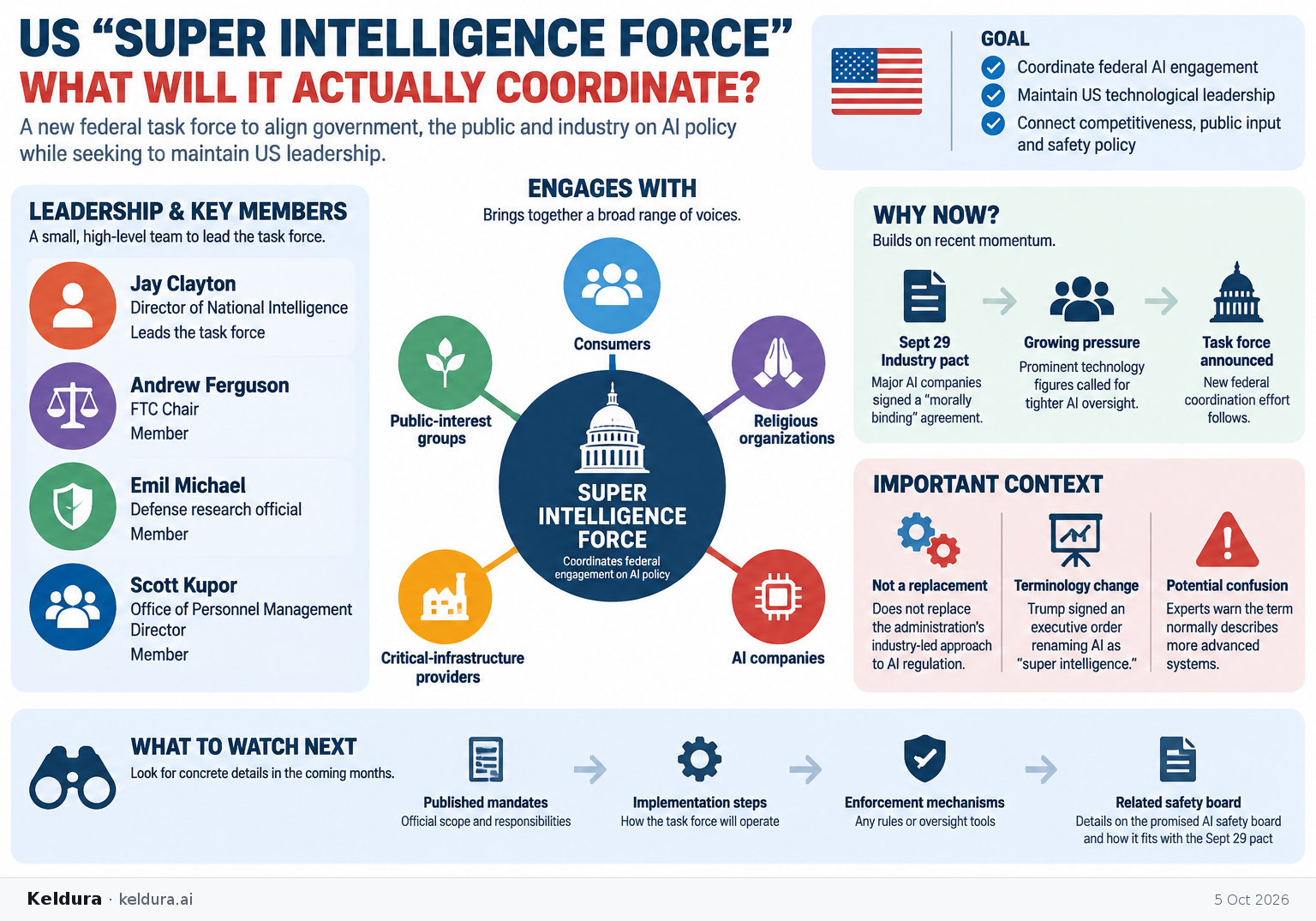
Trump said the new task force will coordinate federal engagement with consumers, public-interest groups, religious organizations, critical-infrastructure providers and AI companies while seeking to maintain US leadership.[2] The group is led by Director of National Intelligence Jay Clayton and includes FTC Chair Andrew Ferguson, defense research official Emil Michael and Office of Personnel Management Director Scott Kupor.[2][8]
Why it matters: The task force places federal AI coordination under a senior intelligence official even as Trump has opposed stronger restrictions and largely left companies to regulate themselves.[2] Its remit therefore connects national competitiveness, public engagement and safety policy without yet replacing the industry-led approach described by the administration.[2]
Key insights: The task force follows Trump’s promise to establish an AI safety board after executives from OpenAI, Anthropic, SpaceX and Google signed a “morally binding” pact on September 29.[2] | Clayton previously chaired the SEC during Trump’s first term and became director of national intelligence in August 2026.[8] | Trump also signed an executive order renaming AI as “super intelligence,” although experts warned that the term normally describes more advanced systems and could cause confusion.[2] | The stated engagement list spans consumers, public-interest and religious groups, critical infrastructure and technology companies.[2]
Cheatsheet facts: What changed: A new federal task force led by Jay Clayton will coordinate government engagement on AI policy and US technological leadership.[2][8] | Why now: The move follows a September 29 industry pact and growing pressure from prominent technology figures for tighter AI oversight.[2] | Watch next: Published mandates, implementation steps or enforcement mechanisms tied to the task force, the promised safety board and the September 29 pact.[2]