Iran-US escalation deepens after troop deaths, strikes, and shipping threats
Two US service members were killed and one remains missing after Iranian ballistic missile and drone attacks in Jordan, and the US responded with another round of air strikes against Iran for a seventh and then eighth consecutive night [5][2]. The conflict is now tied directly to commercial shippin…
Two US service members were killed and one remains missing after Iranian ballistic missile and drone attacks in Jordan, and the US responded with another round of air strikes against Iran for a seventh and then eighth consecutive night [5][2]. The conflict is now tied directly to commercial shipping and regional infrastructure, with Washington saying its strikes aim to degrade Iran’s ability to threaten the Strait of Hormuz, while Iran has declared the strait closed and accused the US of hitting civilian infrastructure [5][2].
Why it matters: This is no longer just a battlefield exchange; it is becoming a regional security crisis with implications for energy flows, allied territory, and maritime commerce [2][5]. The repeated casualties and infrastructure accusations raise the risk of wider escalation and make the security of the Strait of Hormuz a live geopolitical pressure point [2][5].
Key insights: The US death toll in the conflict rose after the Jordan attack, and Centcom said more strikes were intended to punish IRGC forces it blamed for the attack [5][2]. | Both sides are now using infrastructure as part of the conflict narrative, with allegations involving bridges, airports, train stations, power plants, and an under-construction nuclear power plant [2][5]. | The Strait of Hormuz has become a central lever in the confrontation, with the US saying it is targeting Iran’s ability to threaten shipping and Iran warning vessels that ignore its cautions may face “accidents” [2][5]. | Regional governments are being pulled in: Jordan summoned Iran’s charges daffaires, and the Gulf Cooperation Council accused Tehran of targeting civilian infrastructure [2][5].
Cheatsheet facts: What changed: US troops were killed in Jordan, the US expanded strikes on Iran, and both sides escalated attacks tied to shipping and infrastructure [2][5]. | Why now: The preliminary ceasefire collapsed, attacks have continued for days, and both capitals are signaling a broader fight over deterrence and maritime access [2][5]. | Watch next: Any new confirmed strikes, casualty updates, or shipping disruptions in or near the Strait of Hormuz [2][5].
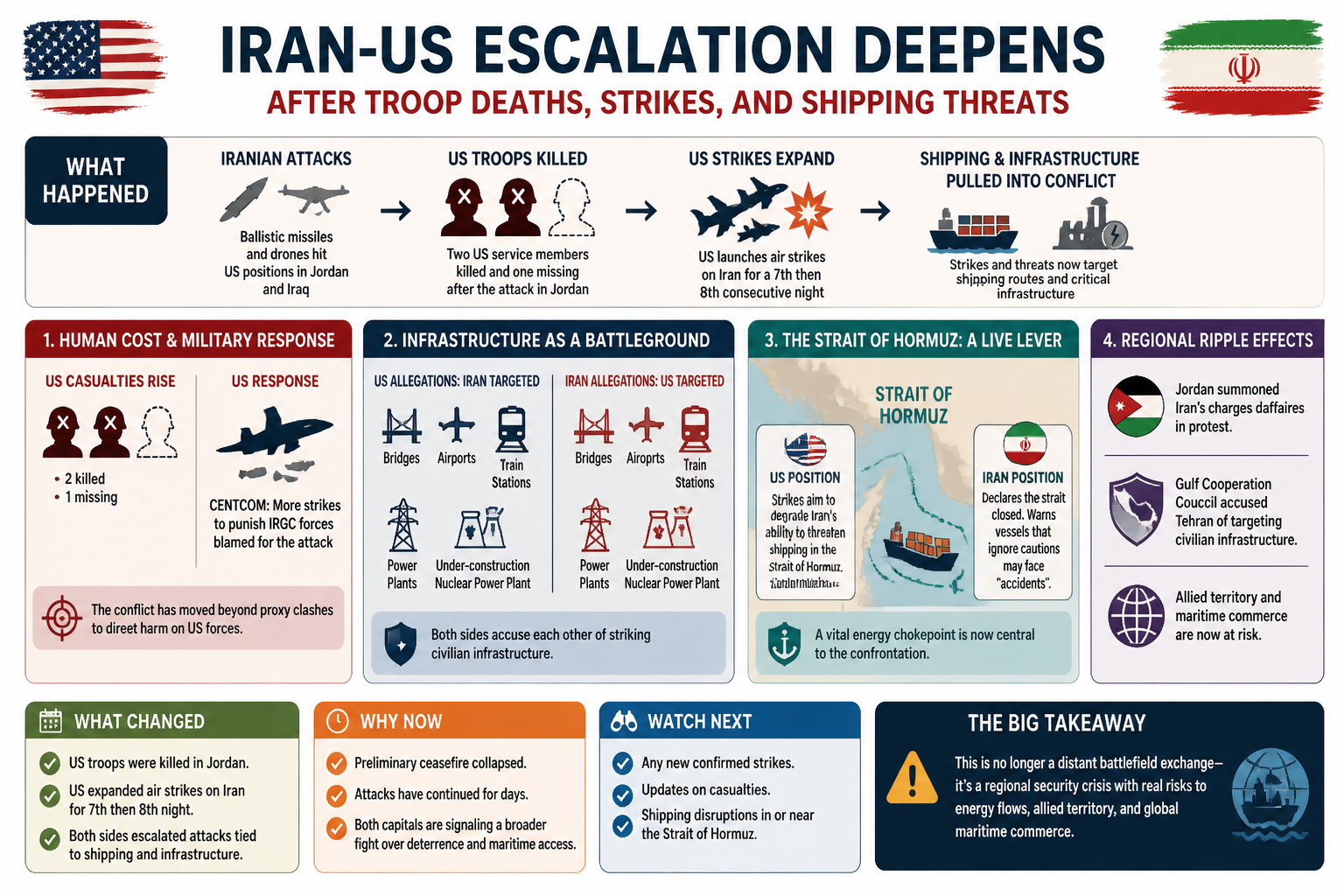
Two US service members were killed and one remains missing after Iranian ballistic missile and drone attacks in Jordan, and the US responded with another round of air strikes against Iran for a seventh and then eighth consecutive night [5][2]. The conflict is now tied directly to commercial shipping and regional infrastructure, with Washington saying its strikes aim to degrade Iran’s ability to threaten the Strait of Hormuz, while Iran has declared the strait closed and accused the US of hitting civilian infrastructure [5][2].
Why it matters: This is no longer just a battlefield exchange; it is becoming a regional security crisis with implications for energy flows, allied territory, and maritime commerce [2][5]. The repeated casualties and infrastructure accusations raise the risk of wider escalation and make the security of the Strait of Hormuz a live geopolitical pressure point [2][5].
Key insights: The US death toll in the conflict rose after the Jordan attack, and Centcom said more strikes were intended to punish IRGC forces it blamed for the attack [5][2]. | Both sides are now using infrastructure as part of the conflict narrative, with allegations involving bridges, airports, train stations, power plants, and an under-construction nuclear power plant [2][5]. | The Strait of Hormuz has become a central lever in the confrontation, with the US saying it is targeting Iran’s ability to threaten shipping and Iran warning vessels that ignore its cautions may face “accidents” [2][5]. | Regional governments are being pulled in: Jordan summoned Iran’s charges daffaires, and the Gulf Cooperation Council accused Tehran of targeting civilian infrastructure [2][5].
Cheatsheet facts: What changed: US troops were killed in Jordan, the US expanded strikes on Iran, and both sides escalated attacks tied to shipping and infrastructure [2][5]. | Why now: The preliminary ceasefire collapsed, attacks have continued for days, and both capitals are signaling a broader fight over deterrence and maritime access [2][5]. | Watch next: Any new confirmed strikes, casualty updates, or shipping disruptions in or near the Strait of Hormuz [2][5].