Russia’s wartime economy is being squeezed by cash use and internet shutdowns
Russians are increasingly turning to cash as mobile internet shutdowns disrupt card payments and more businesses try to hide income under financial strain more than four years into the war with Ukraine [6]. The BBC reports a 1.56tn rouble rise in cash in circulation since the start of the year, alo…
Russians are increasingly turning to cash as mobile internet shutdowns disrupt card payments and more businesses try to hide income under financial strain more than four years into the war with Ukraine [6]. The BBC reports a 1.56tn rouble rise in cash in circulation since the start of the year, alongside tax pressure, a widening budget deficit, and a downgraded 2026 growth forecast [6].
Why it matters: This shows how the war is feeding back into Russia’s domestic economy: security measures meant to counter drones are also making tax collection harder and pushing more activity into the shadow economy [6]. That weakens the state’s fiscal capacity at the same time it needs revenue to sustain the war effort [6].
Key insights: The biggest immediate driver of cash demand is repeated Ukrainian drone activity followed by Kremlin-ordered mobile internet shutdowns [6]. | The government says the shutdowns are meant to counter drone strikes, but the BBC says they are also undermining tax collection [6]. | Higher VAT and a lower VAT threshold are pushing small firms toward “grey schemes,” including avoiding receipts and paying cash wages [6]. | The shift to cash has been reinforced by earlier wartime shocks, including partial mobilization in 2022 and the Wagner mutiny in 2023 [6].
Cheatsheet facts: What changed: Cash withdrawals are rising sharply as internet shutdowns and tax pressure reshape business behavior [6]. | Why now: Drone attacks have triggered more shutdowns, while the Kremlin is trying to raise revenue during a slowing wartime economy [6]. | Watch next: Central bank cash-circulation data, further internet shutdowns, and signs of more firms moving into cash or “grey” accounting [6].
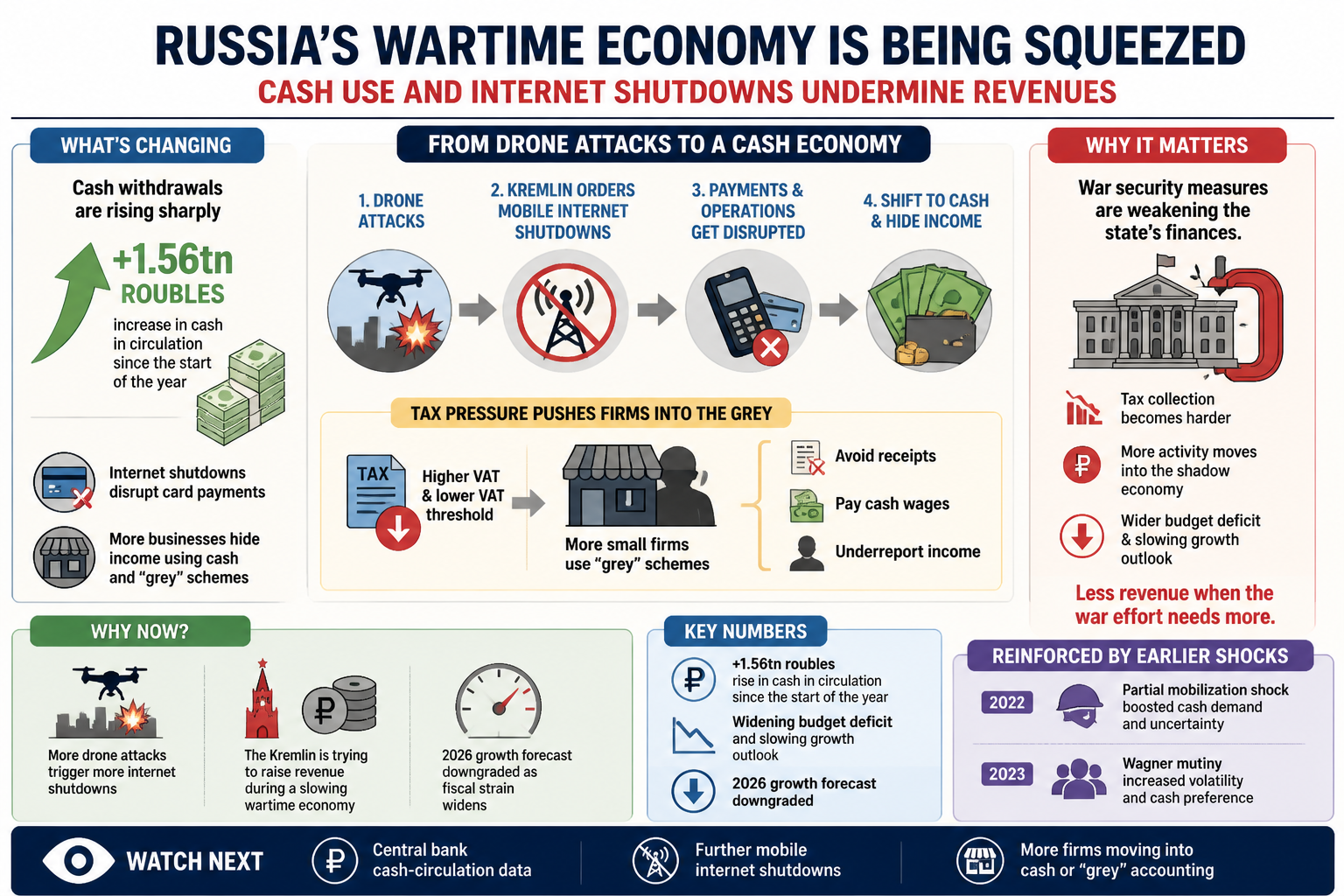
Russians are increasingly turning to cash as mobile internet shutdowns disrupt card payments and more businesses try to hide income under financial strain more than four years into the war with Ukraine [6]. The BBC reports a 1.56tn rouble rise in cash in circulation since the start of the year, alongside tax pressure, a widening budget deficit, and a downgraded 2026 growth forecast [6].
Why it matters: This shows how the war is feeding back into Russia’s domestic economy: security measures meant to counter drones are also making tax collection harder and pushing more activity into the shadow economy [6]. That weakens the state’s fiscal capacity at the same time it needs revenue to sustain the war effort [6].
Key insights: The biggest immediate driver of cash demand is repeated Ukrainian drone activity followed by Kremlin-ordered mobile internet shutdowns [6]. | The government says the shutdowns are meant to counter drone strikes, but the BBC says they are also undermining tax collection [6]. | Higher VAT and a lower VAT threshold are pushing small firms toward “grey schemes,” including avoiding receipts and paying cash wages [6]. | The shift to cash has been reinforced by earlier wartime shocks, including partial mobilization in 2022 and the Wagner mutiny in 2023 [6].
Cheatsheet facts: What changed: Cash withdrawals are rising sharply as internet shutdowns and tax pressure reshape business behavior [6]. | Why now: Drone attacks have triggered more shutdowns, while the Kremlin is trying to raise revenue during a slowing wartime economy [6]. | Watch next: Central bank cash-circulation data, further internet shutdowns, and signs of more firms moving into cash or “grey” accounting [6].