Gulf Conflict Spreads Across Shipping Lanes, Jordan and Saudi Arabia
US forces struck five Iranian tankers near the Gulf of Oman and Kharg Island after the IRGC allegedly tried twice to hit a US warship with ballistic missiles; US officials said the warship evaded the attacks and no American personnel were harmed.[1][2][6] Iran then launched missiles toward a US bas…
US forces struck five Iranian tankers near the Gulf of Oman and Kharg Island after the IRGC allegedly tried twice to hit a US warship with ballistic missiles; US officials said the warship evaded the attacks and no American personnel were harmed.[1][2][6] Iran then launched missiles toward a US base in Jordan, where Jordanian forces said they intercepted 18 missiles and two fell in unpopulated areas without reported casualties.[1][6] Separately, Iran-backed Houthis attacked four southern Saudi cities with missiles and drones, wounding 73 people and setting oil installations ablaze, according to Saudi authorities.[4]
Why it matters: The exchanges now directly threaten US forces, regional allies and energy infrastructure around the Strait of Hormuz, which carried about one-fifth of the world's oil before the war.[4][6] Oil benchmarks have returned toward $100 a barrel as renewed fighting and competing blockades constrain energy flows.[3][4]
Key insights: CENTCOM described the targeted tankers as part of a multibillion-dollar network funding the IRGC and regional proxies, framing commercial shipping as part of Iran's war-financing system.[1][7] | Iran claimed additional attacks on two US vessels and eight tankers, but the supplied evidence does not independently verify the reported damage.[2] | The IRGC warned crews aboard US-linked tankers near Kuwaiti and Bahraini ports to leave their vessels because they would be targeted.[1] | The Houthi operation extended pressure beyond the Strait of Hormuz by targeting a Saudi airbase and Saudi state oil company assets in Abha, Najran and Jazan.[4]
Cheatsheet facts: What changed: US attacks destroyed five Iranian tankers, Iran fired missiles toward a US base in Jordan, and the Houthis mounted major strikes on southern Saudi Arabia.[1][4][6] | Why now: Fighting resumed after a month of relative calm, following alleged Iranian missile attempts against US warships and earlier US attacks on Iranian tankers.[1][2][4] | Watch next: Track announced details of Iran's planned maritime exclusion zone, further attacks around Kuwaiti and Bahraini ports, and disruptions to Saudi energy facilities or Strait of Hormuz shipping.[1][4]
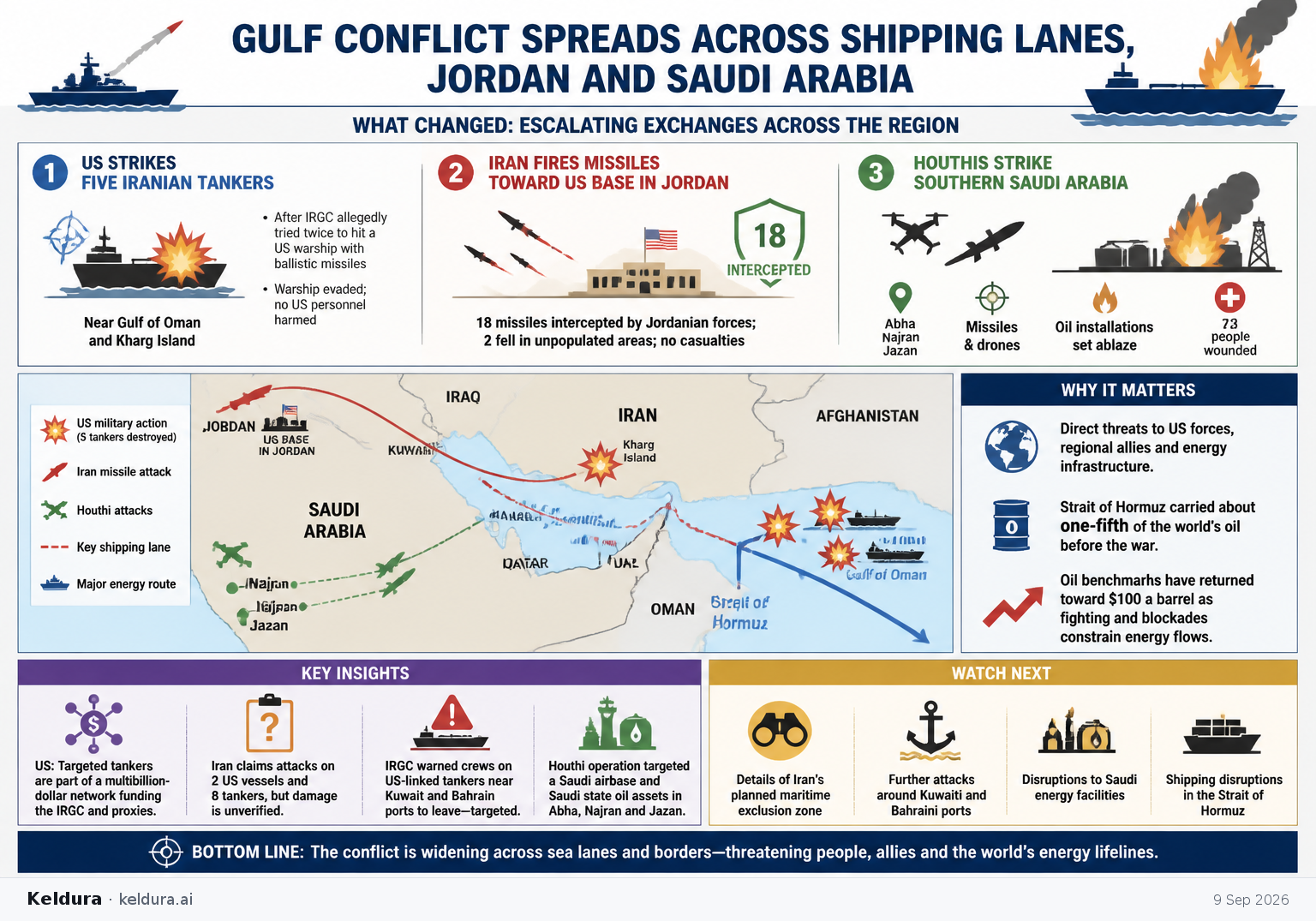
US forces struck five Iranian tankers near the Gulf of Oman and Kharg Island after the IRGC allegedly tried twice to hit a US warship with ballistic missiles; US officials said the warship evaded the attacks and no American personnel were harmed.[1][2][6] Iran then launched missiles toward a US base in Jordan, where Jordanian forces said they intercepted 18 missiles and two fell in unpopulated areas without reported casualties.[1][6] Separately, Iran-backed Houthis attacked four southern Saudi cities with missiles and drones, wounding 73 people and setting oil installations ablaze, according to Saudi authorities.[4]
Why it matters: The exchanges now directly threaten US forces, regional allies and energy infrastructure around the Strait of Hormuz, which carried about one-fifth of the world's oil before the war.[4][6] Oil benchmarks have returned toward $100 a barrel as renewed fighting and competing blockades constrain energy flows.[3][4]
Key insights: CENTCOM described the targeted tankers as part of a multibillion-dollar network funding the IRGC and regional proxies, framing commercial shipping as part of Iran's war-financing system.[1][7] | Iran claimed additional attacks on two US vessels and eight tankers, but the supplied evidence does not independently verify the reported damage.[2] | The IRGC warned crews aboard US-linked tankers near Kuwaiti and Bahraini ports to leave their vessels because they would be targeted.[1] | The Houthi operation extended pressure beyond the Strait of Hormuz by targeting a Saudi airbase and Saudi state oil company assets in Abha, Najran and Jazan.[4]
Cheatsheet facts: What changed: US attacks destroyed five Iranian tankers, Iran fired missiles toward a US base in Jordan, and the Houthis mounted major strikes on southern Saudi Arabia.[1][4][6] | Why now: Fighting resumed after a month of relative calm, following alleged Iranian missile attempts against US warships and earlier US attacks on Iranian tankers.[1][2][4] | Watch next: Track announced details of Iran's planned maritime exclusion zone, further attacks around Kuwaiti and Bahraini ports, and disruptions to Saudi energy facilities or Strait of Hormuz shipping.[1][4]
X copy pack
[1] US forces hit five Iranian tankers as Tehran targets American base in Jordan — BBC World[2] US destroys five Iranian tankers, Iran retaliates with attacks on Jordan | US-Israel war on Iran News | Al Jazeera — aljazeera.com[6] US destroys five Iranian tankers as Tehran launches retaliatory strikes on Jordan | Euronews — euronews.com[4] War expands as Iran-backed Houthis attack Saudi cities and US strikes Iranian tankers - CNA — channelnewsasia.com[3] U.S. strikes Iranian tankers after more attempted missile attacks on Navy warship - Los Angeles Times — latimes.com[7] US says Iranian tankers destroyed after ballistic missile attacks on American warship – The Irish Times — irishtimes.comRead in BriefingsPost to X