How Bab el-Mandeb pulled Yemen back toward full-scale war
Yemen’s Saudi-backed government announced a campaign to retake Houthi-held territory on October 4.
Yemen’s internationally recognised government announced a military campaign to recover all territory controlled by the Iran-backed Houthis.[5][7] The decision follows a Houthi offensive that captured the strategic Bab el-Mandeb strait and about 150 kilometres of Red Sea coastline, while further adv…
Yemen’s internationally recognised government announced a military campaign to recover all territory controlled by the Iran-backed Houthis.[5][7] The decision follows a Houthi offensive that captured the strategic Bab el-Mandeb strait and about 150 kilometres of Red Sea coastline, while further advances threaten the road linking Taiz and Aden.[5]
Why it matters: Bab el-Mandeb is the Red Sea’s southern exit and a key shipping route between Asia and the Mediterranean, making control of the strait internationally consequential.[5] Renewed fighting is also worsening Yemen’s humanitarian crisis: the World Food Programme says more than 150,000 people have been displaced, while three in four families in some areas are going hungry.[5][7]
Key insights: The government says de-escalation options have been exhausted, while the Houthis have been asked to surrender their weapons.[5] | The Houthis claimed missile and drone attacks on Saudi Aramco facilities after 50 Saudi-led strikes in Yemen within 12 hours.[5] | The United States is providing intelligence support for Saudi operations, and regional and European countries are supplying defensive assistance.[5] | Saudi Arabia’s intervention began in 2015 but failed to defeat the Houthis; a 2022 truce largely held until this year.[5]
Cheatsheet facts: What changed: The government announced a nationwide offensive after Houthi forces captured Bab el-Mandeb and expanded pressure around Taiz.[5] | Why now: Houthi territorial gains have given the movement leverage over Red Sea shipping and threaten the remaining Taiz-Aden road.[5] | Watch next: Watch control of the Taiz-Aden road, Houthi attacks on Saudi targets and the extent of US intelligence support for Saudi operations.[5]
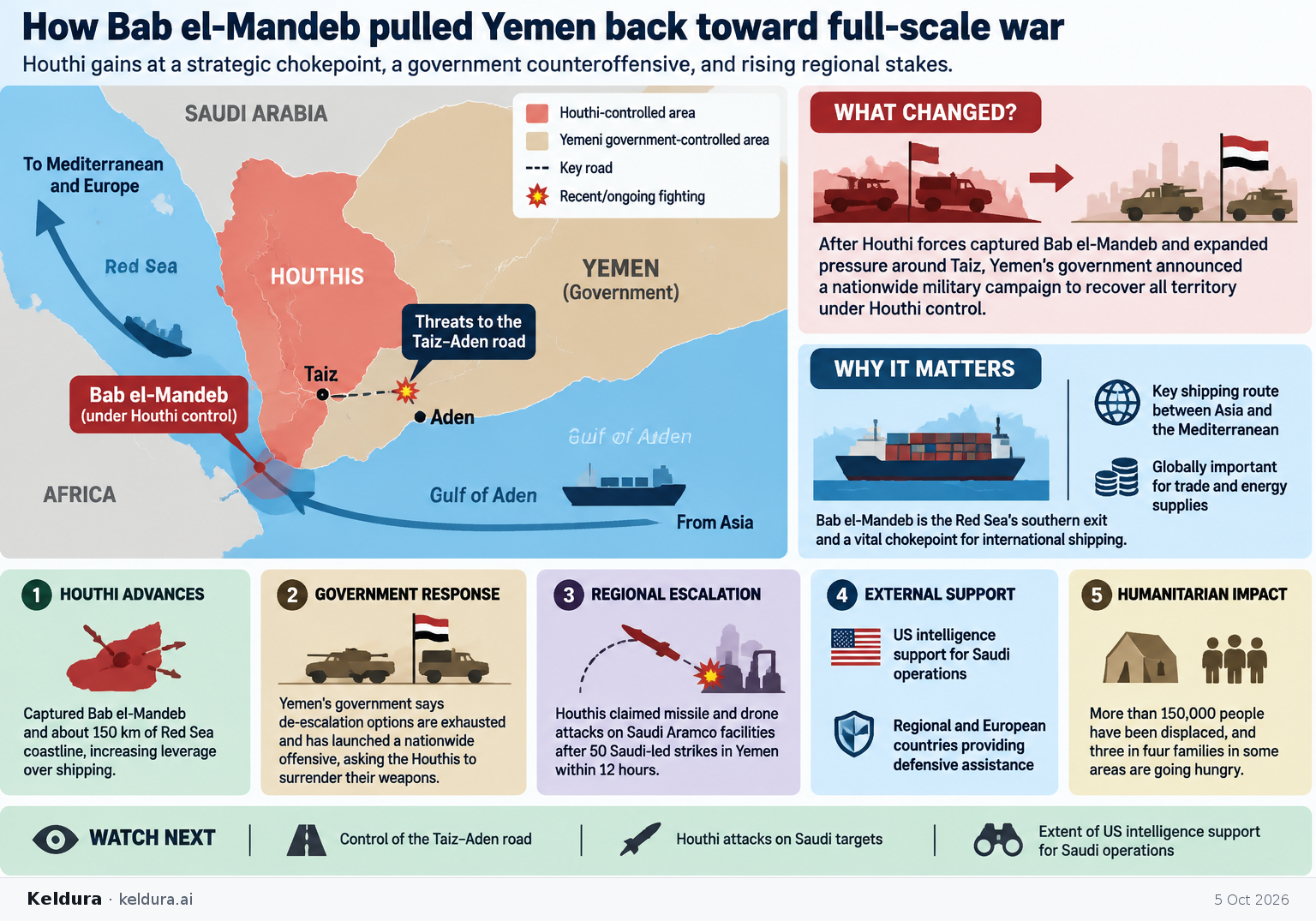
Yemen’s internationally recognised government announced a military campaign to recover all territory controlled by the Iran-backed Houthis.[5][7] The decision follows a Houthi offensive that captured the strategic Bab el-Mandeb strait and about 150 kilometres of Red Sea coastline, while further advances threaten the road linking Taiz and Aden.[5]
Why it matters: Bab el-Mandeb is the Red Sea’s southern exit and a key shipping route between Asia and the Mediterranean, making control of the strait internationally consequential.[5] Renewed fighting is also worsening Yemen’s humanitarian crisis: the World Food Programme says more than 150,000 people have been displaced, while three in four families in some areas are going hungry.[5][7]
Key insights: The government says de-escalation options have been exhausted, while the Houthis have been asked to surrender their weapons.[5] | The Houthis claimed missile and drone attacks on Saudi Aramco facilities after 50 Saudi-led strikes in Yemen within 12 hours.[5] | The United States is providing intelligence support for Saudi operations, and regional and European countries are supplying defensive assistance.[5] | Saudi Arabia’s intervention began in 2015 but failed to defeat the Houthis; a 2022 truce largely held until this year.[5]
Cheatsheet facts: What changed: The government announced a nationwide offensive after Houthi forces captured Bab el-Mandeb and expanded pressure around Taiz.[5] | Why now: Houthi territorial gains have given the movement leverage over Red Sea shipping and threaten the remaining Taiz-Aden road.[5] | Watch next: Watch control of the Taiz-Aden road, Houthi attacks on Saudi targets and the extent of US intelligence support for Saudi operations.[5]