Saudi Arabia investigates defenses after deadly Riyadh airport attack
Houthi drones preceded missiles aimed at Riyadh’s airport, but what allowed the barrage to pass Saudi air defenses?
On October 12, two regional officials said Saudi Arabia had opened an investigation into a Houthi attack on Riyadh’s airport.
Saudi Arabia is investigating how its air defenses did not intercept a Houthi missile-and-drone barrage that hit Riyadh’s King Khalid International Airport, two regional officials told the AP. The attack killed at least 13 people and wounded more than 300. [9] One initial finding described drones a…
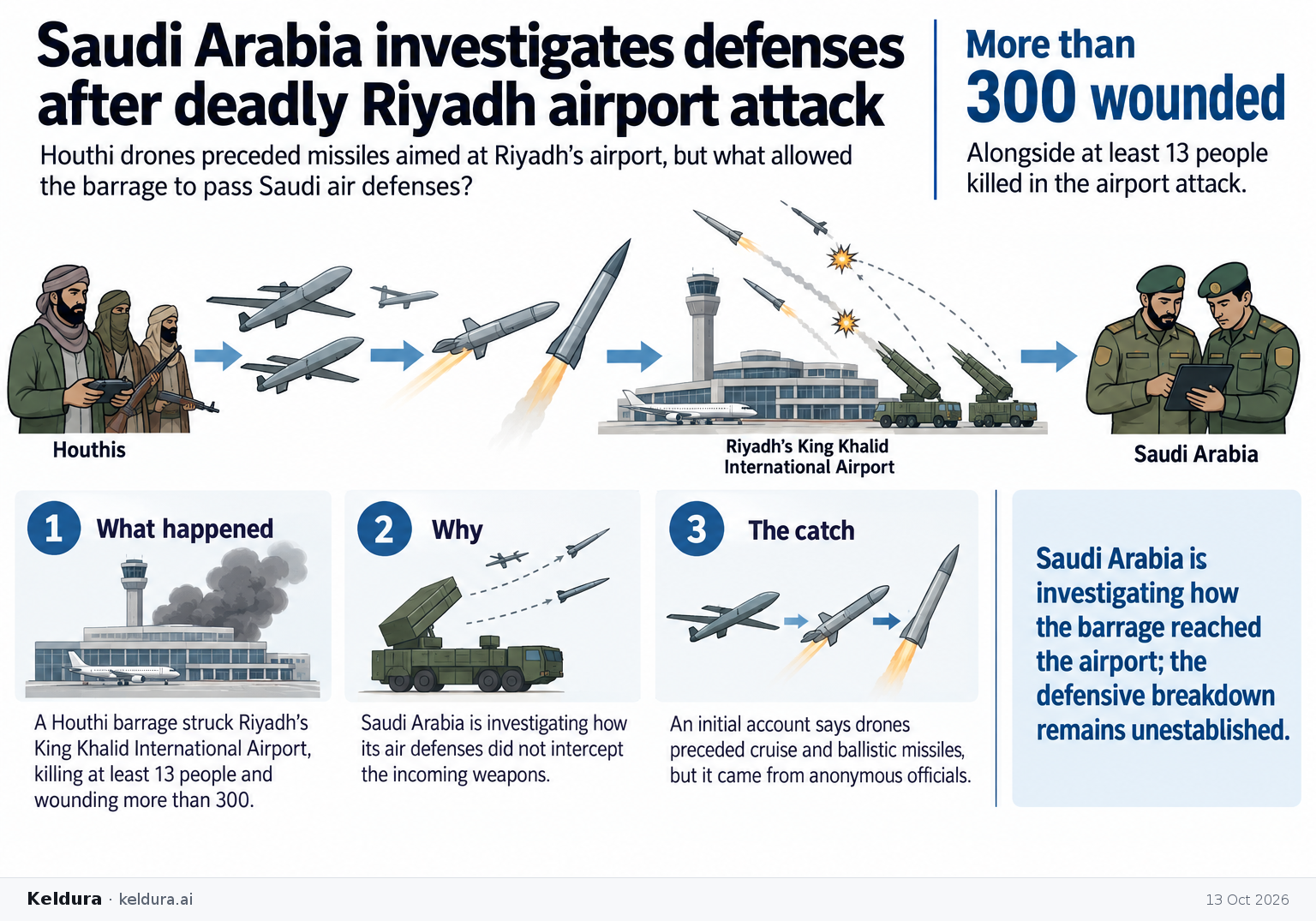
Saudi Arabia is investigating how its air defenses did not intercept a Houthi missile-and-drone barrage that hit Riyadh’s King Khalid International Airport, two regional officials told the AP. The attack killed at least 13 people and wounded more than 300. [9] One initial finding described drones arriving first to pave the way for cruise and ballistic missiles, although the officials spoke anonymously. [9]
Why it matters: The attack exposes a security problem at a major civilian transport facility: Saudi authorities must establish how a mixed barrage reached the airport before they can identify the appropriate defensive response. The reported casualty toll makes the consequences concrete, but the available account of the investigation is preliminary and anonymously sourced. [9]
Key insights: The initial account describes a sequence, not simply a large volley: multiple drones came first, followed by a mixture of cruise and ballistic missiles. [9] | The investigation concerns interception performance, but the evidence does not identify a particular radar, interceptor or operational decision responsible. [9] | The AP’s two regional sources were not authorized to speak publicly, so their description should not be treated as a published Saudi investigative finding. [9]
Cheatsheet facts: What happened: A Houthi barrage struck Riyadh’s King Khalid International Airport, killing at least 13 people and wounding more than 300. [9] | Why: Saudi Arabia opened an investigation to determine how its air defenses did not intercept the incoming weapons. [9] | The catch: Officials described drones preceding cruise and ballistic missiles, but that account comes from an initial probe and anonymous sources. [9]