UN court finds Myanmar responsible for Rohingya genocide
The UN’s top court has ruled for the Rohingya, but what will the judgment mean for families still living in refugee camps?
On November 19, the International Court of Justice ruled 9–6 that Myanmar committed genocide against the Rohingya in 2017 and ordered Myanmar to allow those who fled to return.
The International Court of Justice found that Myanmar violated the 1948 Genocide Convention during military operations in northern Rakhine State in 2017, the first time the court has found a state responsible for genocide. [2][6][9] The Gambia brought the case in 2019 with the backing of the Organi…
Open original (3 sources):
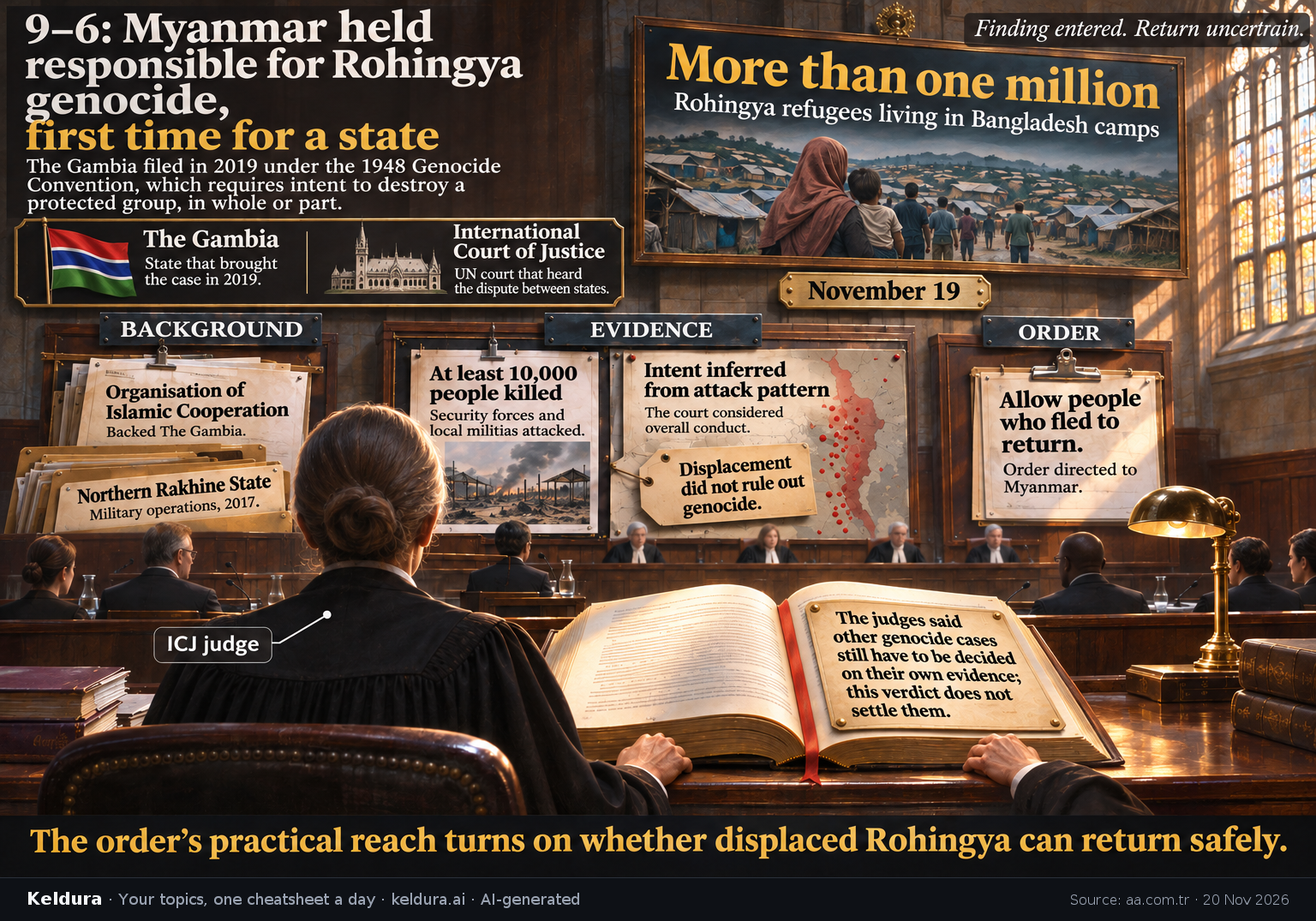
The International Court of Justice found that Myanmar violated the 1948 Genocide Convention during military operations in northern Rakhine State in 2017, the first time the court has found a state responsible for genocide. [2][6][9] The Gambia brought the case in 2019 with the backing of the Organisation of Islamic Cooperation, and the court ordered Myanmar to allow people who fled the violence to return. [6][9]
Why it matters: More than one million Rohingya refugees have been living in camps in Bangladesh since fleeing the violence; the return order directly concerns them, but whether families can actually go home safely remains open. [6][9]
Key insights: At least 10,000 people were killed in 2017 when Myanmar’s security forces and local militias attacked Rohingya communities. [6] | Atrocities alone do not prove genocide under the convention: the court inferred an intent to destroy the group, at least in part, from the overall pattern of conduct. [6] | The ruling shows how the court can assess intent in other cases, including South Africa’s case concerning Gaza, but judges said each case must be decided on its own evidence. [6][9]
Cheatsheet facts: What happened: In a 9–6 judgment, the UN’s top court found Myanmar responsible for genocide against the Rohingya in northern Rakhine State. [2][6][9] | Background: The Gambia brought the case in 2019 under the 1948 Genocide Convention, which requires proof of intent to destroy a protected group in whole or in part. [6] | Why: The judges inferred genocidal intent from the pattern of attacks; other possible motives, such as displacement, did not rule it out. [6] | The catch: Myanmar was ordered to allow people who fled to return, but more than one million Rohingya have been living in camps in Bangladesh and the practical effect of the order remains open. [6][9] | What we don't know: What steps will Myanmar take to let refugees return safely? [6][9]