Nepal’s Flood Disaster Tests the Loss and Damage Fund
Nepal has requested immediate support from the UN climate loss and damage fund after floods killed 1,250 people and left an estimated recovery bill of at least US$5 billion.[1] The fund, fully established in 2024, has received more than US$822 million in pledges but only about US$485 million in pai…
Nepal has requested immediate support from the UN climate loss and damage fund after floods killed 1,250 people and left an estimated recovery bill of at least US$5 billion.[1] The fund, fully established in 2024, has received more than US$822 million in pledges but only about US$485 million in paid contributions, and it is not scheduled to convene again until December.[1]
Why it matters: Nepal’s needs vastly exceed the fund’s available resources, exposing the gap between international climate-finance commitments and the rapid, large-scale assistance vulnerable countries require after disasters.[1] Access to such finance is also a key agenda item for COP31 in Turkey in November.[1]
Key insights: Nepal formally wrote to the fund’s co-chairs on Sept. 1, arguing that international promises must become concrete action.[1] | The fund must address immediate humanitarian and reconstruction needs as well as slow-moving harms such as sea-level rise and gaps in climate data and policy.[1] | Developing countries and climate advocates argue that wealthy, high-emitting nations bear greater responsibility for helping countries that contributed relatively little to global warming.[1]
Cheatsheet facts: What changed: Nepal sought an urgent payout from the UN loss and damage fund following catastrophic floods and an estimated US$5 billion recovery bill.[1] | Why now: The disaster killed 1,250 people, while climate-linked events such as glacial-lake floods have become more frequent in recent decades.[1] | Watch next: Watch whether the fund convenes before its scheduled December meeting, how much paid financing becomes available, and what climate-finance commitments emerge at COP31 in November.[1]
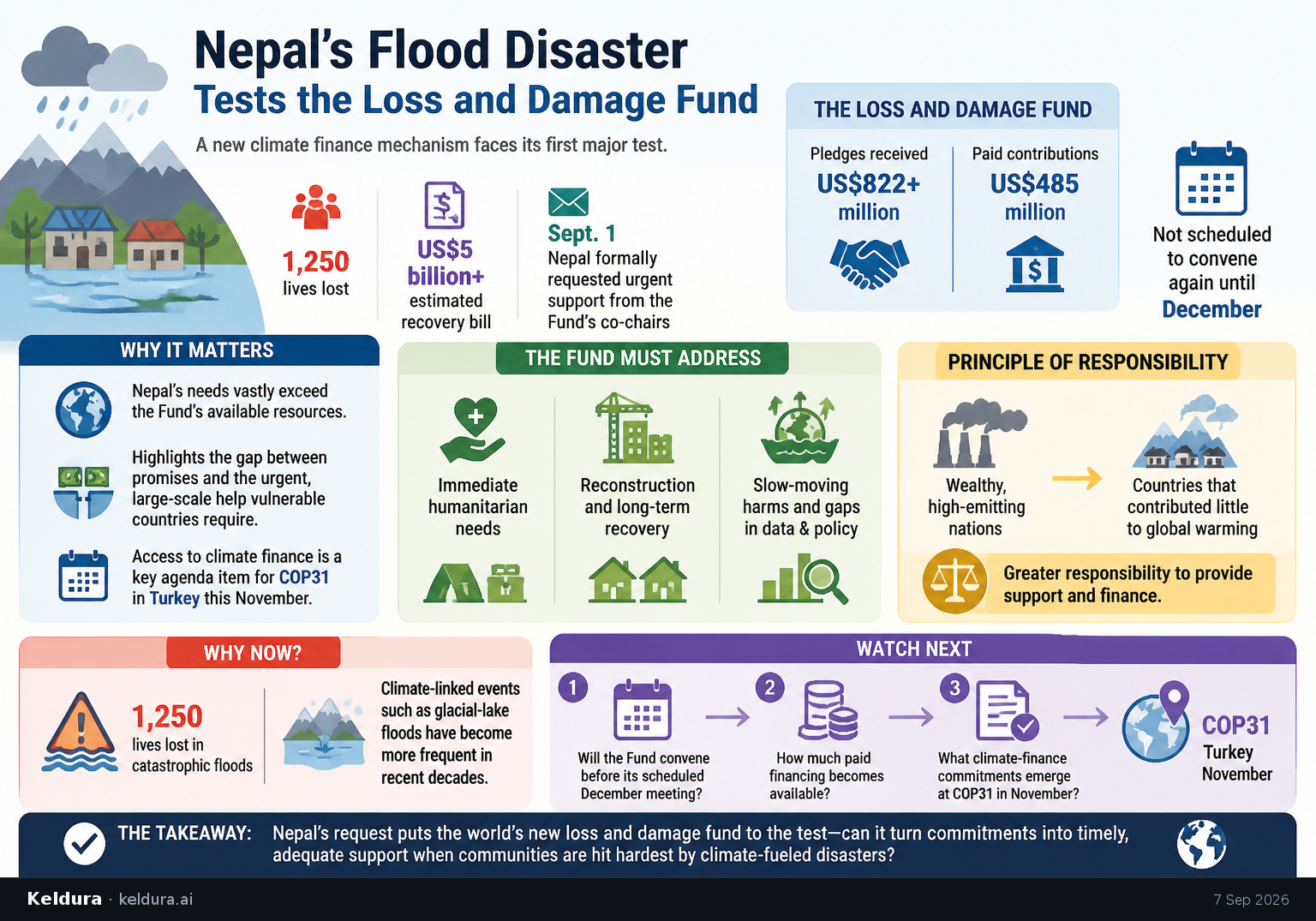
Nepal has requested immediate support from the UN climate loss and damage fund after floods killed 1,250 people and left an estimated recovery bill of at least US$5 billion.[1] The fund, fully established in 2024, has received more than US$822 million in pledges but only about US$485 million in paid contributions, and it is not scheduled to convene again until December.[1]
Why it matters: Nepal’s needs vastly exceed the fund’s available resources, exposing the gap between international climate-finance commitments and the rapid, large-scale assistance vulnerable countries require after disasters.[1] Access to such finance is also a key agenda item for COP31 in Turkey in November.[1]
Key insights: Nepal formally wrote to the fund’s co-chairs on Sept. 1, arguing that international promises must become concrete action.[1] | The fund must address immediate humanitarian and reconstruction needs as well as slow-moving harms such as sea-level rise and gaps in climate data and policy.[1] | Developing countries and climate advocates argue that wealthy, high-emitting nations bear greater responsibility for helping countries that contributed relatively little to global warming.[1]
Cheatsheet facts: What changed: Nepal sought an urgent payout from the UN loss and damage fund following catastrophic floods and an estimated US$5 billion recovery bill.[1] | Why now: The disaster killed 1,250 people, while climate-linked events such as glacial-lake floods have become more frequent in recent decades.[1] | Watch next: Watch whether the fund convenes before its scheduled December meeting, how much paid financing becomes available, and what climate-finance commitments emerge at COP31 in November.[1]