Why does Indonesia’s haze problem survive stronger fire controls?
Indonesia’s 2026 fires sent haze toward Singapore and Malaysia as the burned area approached 900,000 hectares by late August.
Nearly 900,000 hectares had burned by late August, still well below the 2.6 million hectares burned in 2015, while Indonesia’s earlier enforcement, peatland restoration and detection reforms have helped limit the scale of fires.[1] Yet cheap burning, recurring fires in concessions and gaps in fundi…
Nearly 900,000 hectares had burned by late August, still well below the 2.6 million hectares burned in 2015, while Indonesia’s earlier enforcement, peatland restoration and detection reforms have helped limit the scale of fires.[1] Yet cheap burning, recurring fires in concessions and gaps in funding, coordination, equipment and land management continue to undermine prevention.[1]
Why it matters: The consequences extend beyond burned land: Indonesia recorded 113,336 wildfire-related respiratory infections across seven provinces by Sept 9, with 12.5 million people exposed to haze, while 32 Malaysian areas reported unhealthy air on Sept 18.[1][4]
Key insights: Indonesia has become better at responding after fires ignite, but the economic incentive to clear land by burning remains because fire-free methods can cost considerably more.[1] | Drained peat can burn underground, making fires difficult to detect and extinguish while producing smoke for weeks or months.[1][4] | Hotspots identify possible fires but do not prove who caused them or establish which land use is responsible.[1][4] | Indonesia launched 219 fire-related criminal investigations and named 162 suspects, but licence revocation—the strongest sanction against companies—has remained rare.[1]
Cheatsheet facts: What changed: Post-2015 reforms reduced the scale of burning, but nearly 900,000 hectares had still burned by late August 2026.[1] | Why now: Human ignition remains the usual spark, while prolonged dry weather, drained peat and seasonal conditions allow fires to spread and persist.[1][4] | Watch next: Track burned-area totals and regional air-quality readings through early November, when Indonesia’s forestry minister said fires could continue as the rainy season arrives later than expected.[1][4]
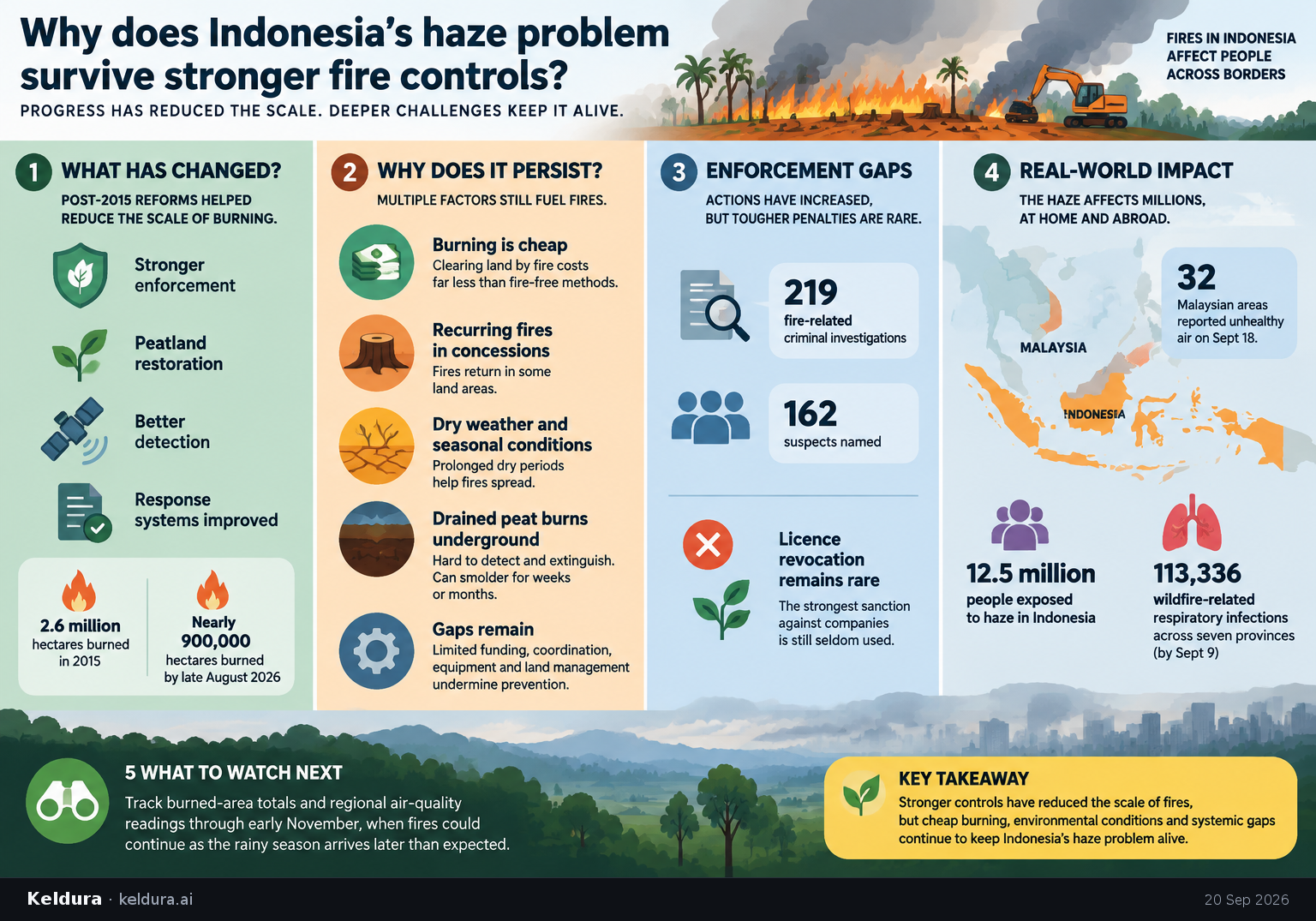
Nearly 900,000 hectares had burned by late August, still well below the 2.6 million hectares burned in 2015, while Indonesia’s earlier enforcement, peatland restoration and detection reforms have helped limit the scale of fires.[1] Yet cheap burning, recurring fires in concessions and gaps in funding, coordination, equipment and land management continue to undermine prevention.[1]
Why it matters: The consequences extend beyond burned land: Indonesia recorded 113,336 wildfire-related respiratory infections across seven provinces by Sept 9, with 12.5 million people exposed to haze, while 32 Malaysian areas reported unhealthy air on Sept 18.[1][4]
Key insights: Indonesia has become better at responding after fires ignite, but the economic incentive to clear land by burning remains because fire-free methods can cost considerably more.[1] | Drained peat can burn underground, making fires difficult to detect and extinguish while producing smoke for weeks or months.[1][4] | Hotspots identify possible fires but do not prove who caused them or establish which land use is responsible.[1][4] | Indonesia launched 219 fire-related criminal investigations and named 162 suspects, but licence revocation—the strongest sanction against companies—has remained rare.[1]
Cheatsheet facts: What changed: Post-2015 reforms reduced the scale of burning, but nearly 900,000 hectares had still burned by late August 2026.[1] | Why now: Human ignition remains the usual spark, while prolonged dry weather, drained peat and seasonal conditions allow fires to spread and persist.[1][4] | Watch next: Track burned-area totals and regional air-quality readings through early November, when Indonesia’s forestry minister said fires could continue as the rainy season arrives later than expected.[1][4]