How record ocean heat turns El Niño into a wider food-security threat
On September 22, new data showed that record global ocean heat had persisted for 100 consecutive days as El Niño intensified.
The global ocean outside polar regions recorded its highest average sea surface temperatures for 100 consecutive days between June 2 and September 10, with human-driven climate change identified as the primary cause and El Niño amplifying the warmth [2]. The intensifying climate cycle is already co…
The global ocean outside polar regions recorded its highest average sea surface temperatures for 100 consecutive days between June 2 and September 10, with human-driven climate change identified as the primary cause and El Niño amplifying the warmth [2]. The intensifying climate cycle is already contributing to wildfires, depleted water supplies and weaker fish catches in Southeast Asia, while drought could disrupt major rice and palm-oil producers [3].
Why it matters: More than 90 per cent of the excess heat associated with fossil-fuel emissions enters the ocean, affecting marine ecosystems, weather patterns and economies dependent on fisheries and coastal protection [2]. El Niño could push at least 49 million additional people into acute food insecurity by the end of 2027, while analysts estimate that global food commodity prices could rise by more than 15 per cent [3].
Key insights: Climate change supplies the long-term warming trend, while El Niño temporarily intensifies it by adding natural ocean-atmosphere warming on top [2]. | India, Vietnam and Thailand—the three largest rice exporters—are among the countries expected to be hit hard, making regional drought a potential global supply shock [3]. | Indonesia and Malaysia supply about 85 per cent of the world’s palm oil, connecting local rainfall and crop conditions to prices for food, cosmetics and household products [3]. | Scientists expect El Niño to peak near the end of 2026 and continue influencing conditions into 2027, but the underlying ocean-warming trend will persist without lower greenhouse-gas emissions [2].
Cheatsheet facts: What changed: Oceans outside polar regions sustained a record-high average surface temperature for 100 consecutive days from June 2 through September 10 [2]. | Why now: Human-caused warming remains the main driver, while a potentially very strong El Niño is amplifying heat, drought and rainfall disruption [2][3]. | Watch next: Track sea surface temperatures as El Niño approaches its expected late-2026 peak, alongside planting acreage and output in major Asian rice and palm-oil exporters [2][3].
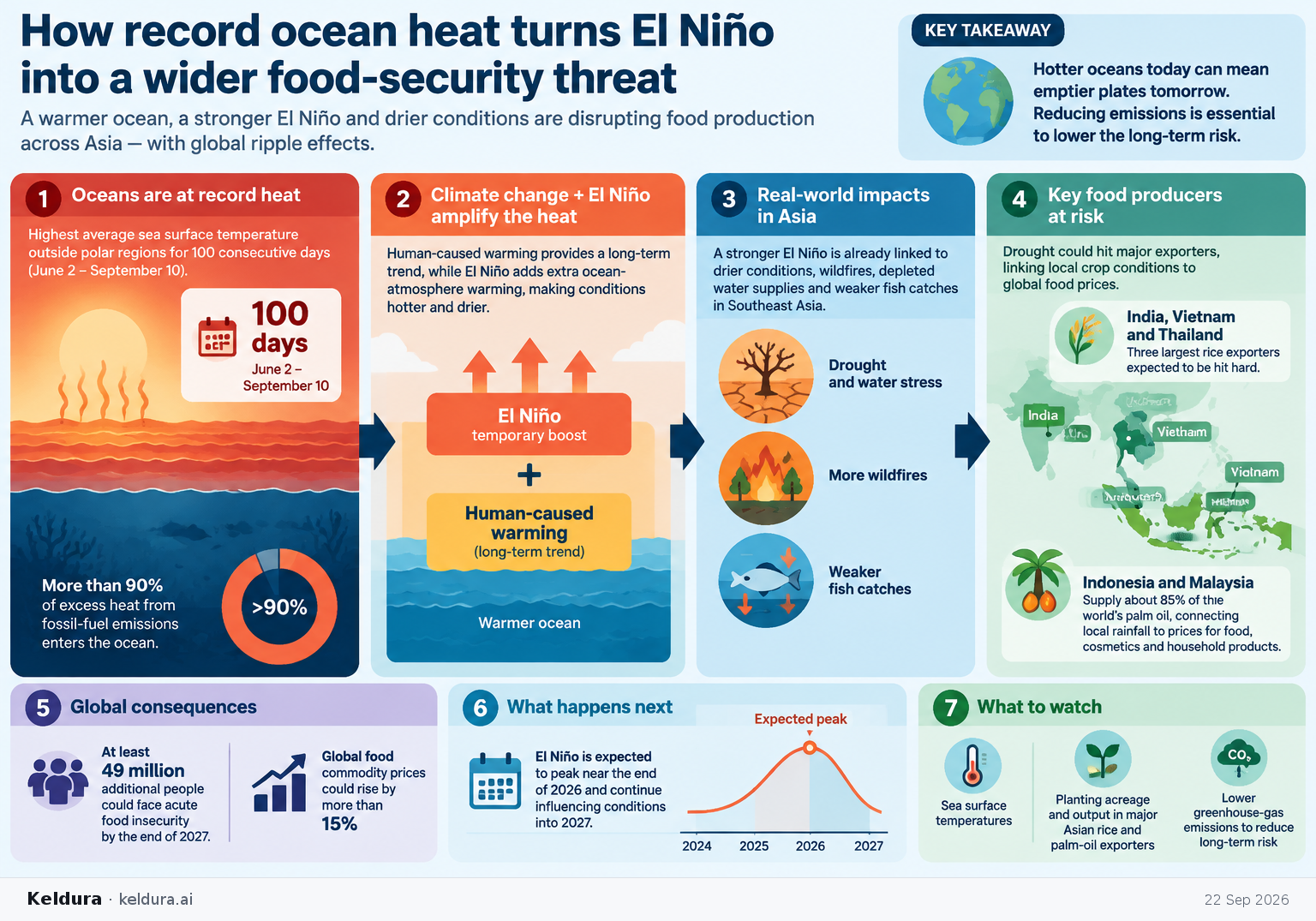
The global ocean outside polar regions recorded its highest average sea surface temperatures for 100 consecutive days between June 2 and September 10, with human-driven climate change identified as the primary cause and El Niño amplifying the warmth [2]. The intensifying climate cycle is already contributing to wildfires, depleted water supplies and weaker fish catches in Southeast Asia, while drought could disrupt major rice and palm-oil producers [3].
Why it matters: More than 90 per cent of the excess heat associated with fossil-fuel emissions enters the ocean, affecting marine ecosystems, weather patterns and economies dependent on fisheries and coastal protection [2]. El Niño could push at least 49 million additional people into acute food insecurity by the end of 2027, while analysts estimate that global food commodity prices could rise by more than 15 per cent [3].
Key insights: Climate change supplies the long-term warming trend, while El Niño temporarily intensifies it by adding natural ocean-atmosphere warming on top [2]. | India, Vietnam and Thailand—the three largest rice exporters—are among the countries expected to be hit hard, making regional drought a potential global supply shock [3]. | Indonesia and Malaysia supply about 85 per cent of the world’s palm oil, connecting local rainfall and crop conditions to prices for food, cosmetics and household products [3]. | Scientists expect El Niño to peak near the end of 2026 and continue influencing conditions into 2027, but the underlying ocean-warming trend will persist without lower greenhouse-gas emissions [2].
Cheatsheet facts: What changed: Oceans outside polar regions sustained a record-high average surface temperature for 100 consecutive days from June 2 through September 10 [2]. | Why now: Human-caused warming remains the main driver, while a potentially very strong El Niño is amplifying heat, drought and rainfall disruption [2][3]. | Watch next: Track sea surface temperatures as El Niño approaches its expected late-2026 peak, alongside planting acreage and output in major Asian rice and palm-oil exporters [2][3].