COP31 Ends Without a Global Climate Deal
Countries kept working on parts of the climate agenda, but what does losing the main deal mean for those most exposed?
On November 22, the COP31 climate summit in Turkey ended without a main agreement after dozens of nations objected to a draft that omitted fossil fuels.
The European Union and other countries rejected a final draft that did not name fossil fuels; Reuters reported that Saudi Arabia and others had pressed for that omission. The draft also lacked increased commitments to help vulnerable countries adapt, and the summit ended without a main agreement fo…
Open original (10 sources):
- [4] First Thing: Cop31 talks collapse without deal in blow to planet’s future climate | US news | The Guardian — theguardian.com
- [5] Experts say failed climate talks could worsen climate inequality, though all progress is not stalled — apnews.com
- [6] COP31 ends with no deal after negotiators fail to reach an agreement on fossil fuels : NPR — npr.org
- [10] COP31 climate talks fail to reach deal amid fossil fuel and money rows — bbc.com
- [11] COP31 collapse has shattered the pretence of a global climate consensus | New Scientist — newscientist.com
- [13] COP flop triggers backlash in Australia; Pacific nations express despair | Reuters — reuters.com
- [15] Why the failure to reach a major deal at UN climate talks matters as extreme weather worsens — apnews.com
- [12] UNEP Executive Director statement on closing of COP31 | UNEP - UN Environment Programme — unep.org
- [8] Climate alert: The U.N. climate talks collapsed. Now what? — static.nytimes.com
- [14] Analysis: The collapse of UN climate talks, over fossil fuels, was years in the making — apnews.com
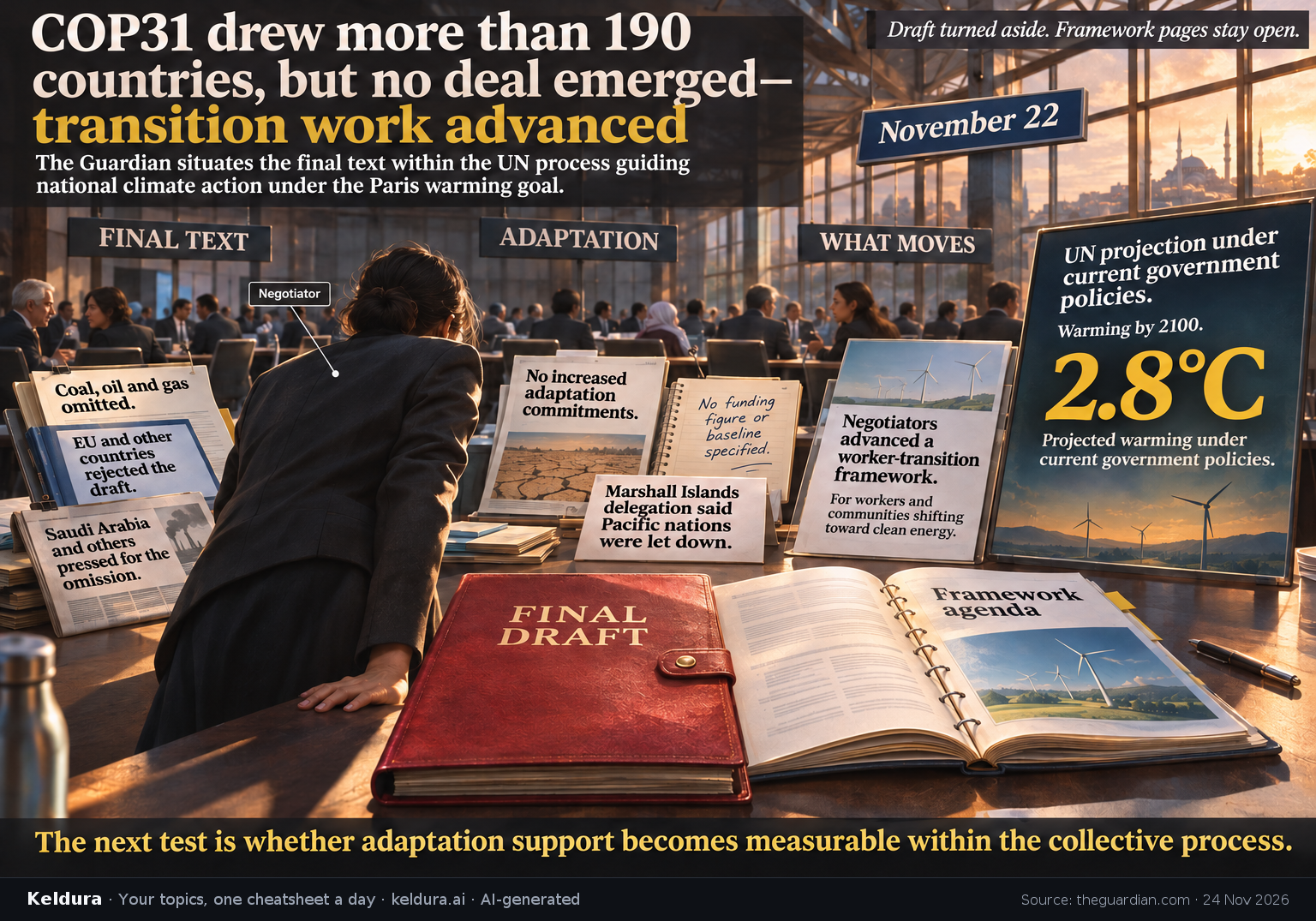
The European Union and other countries rejected a final draft that did not name fossil fuels; Reuters reported that Saudi Arabia and others had pressed for that omission. The draft also lacked increased commitments to help vulnerable countries adapt, and the summit ended without a main agreement for the first time since Copenhagen in 2009. [4] [5] [6] [10] [11] [13] [15]
Why it matters: Countries already hit hard by climate-related disasters left without a new collective funding commitment to prepare for more damage. Under current government policies, the UN projects about 2.8°C of warming by 2100, compared with the Paris goal of limiting warming to 1.5°C. [5] [10]
Key insights: The funding dispute was about accountability as well as money: the draft did not specify a figure or a starting point against which to measure the pledge. [10] | The Marshall Islands delegation said Pacific nations had been let down, while Australian opposition lawmakers called on Energy Minister Chris Bowen to resign. [13] | Negotiators still made progress on a framework to support workers and communities as economies shift toward clean energy. UNEP also pointed to work on protecting oceans and mountain ecosystems. [10] [12] | Some governments, investors and advocates are looking to smaller alliances, trade rules and markets for progress; AP noted that carbon capture currently handles far less than 1% of annual global greenhouse gas emissions. [8] [14]
Cheatsheet facts: What happened: More than 190 countries attended COP31, but the summit closed without an overarching deal. [13] [15] | Background: COP31 was the UN climate summit in Turkey. Its final text was meant to guide countries’ climate action under a process working toward the Paris warming goal of 1.5°C. [5] [10] [15] | Why: The EU and others would not accept a text that left out coal, oil and gas, while Saudi Arabia and others had pressed for the omission. [5] [13] | Who pays: Vulnerable countries left without increased commitments to help them adapt, and the draft gave no concrete funding figure or baseline. [5] [10] | The catch: The main deal fell through, but work advanced on a framework to help workers and communities through the shift to clean energy. [10]
X copy pack
Edition complete
You've reached the end of this edition.