NHS starts enrolling women in AI breast screening trial
AI could take over one of two mammogram reads, but can it find cancer earlier without sending more women for needless tests?
By November 23, 2026, the NHS had begun recruiting at Cambridge University Hospitals for a trial set to involve nearly 700,000 women at 30 UK sites.
The EDITH trial will test whether AI can help detect breast cancer earlier and allow most mammograms to be reviewed by one specialist instead of two. [6][7][8] The screening appointment itself will not change: at least one specialist will still review every scan, and women can opt out of the trial.…
Open original (3 sources):
- [6] Can AI spot breast cancer earlier? NHS launches world's largest trial to find out — bbc.com
- [7] NHS England » First women join world-leading AI-assisted NHS breast screening trial — NHS News
- [8] Can AI spot breast cancer earlier? NHS launches world's largest trial to find out - BBC News — bbc.co.uk
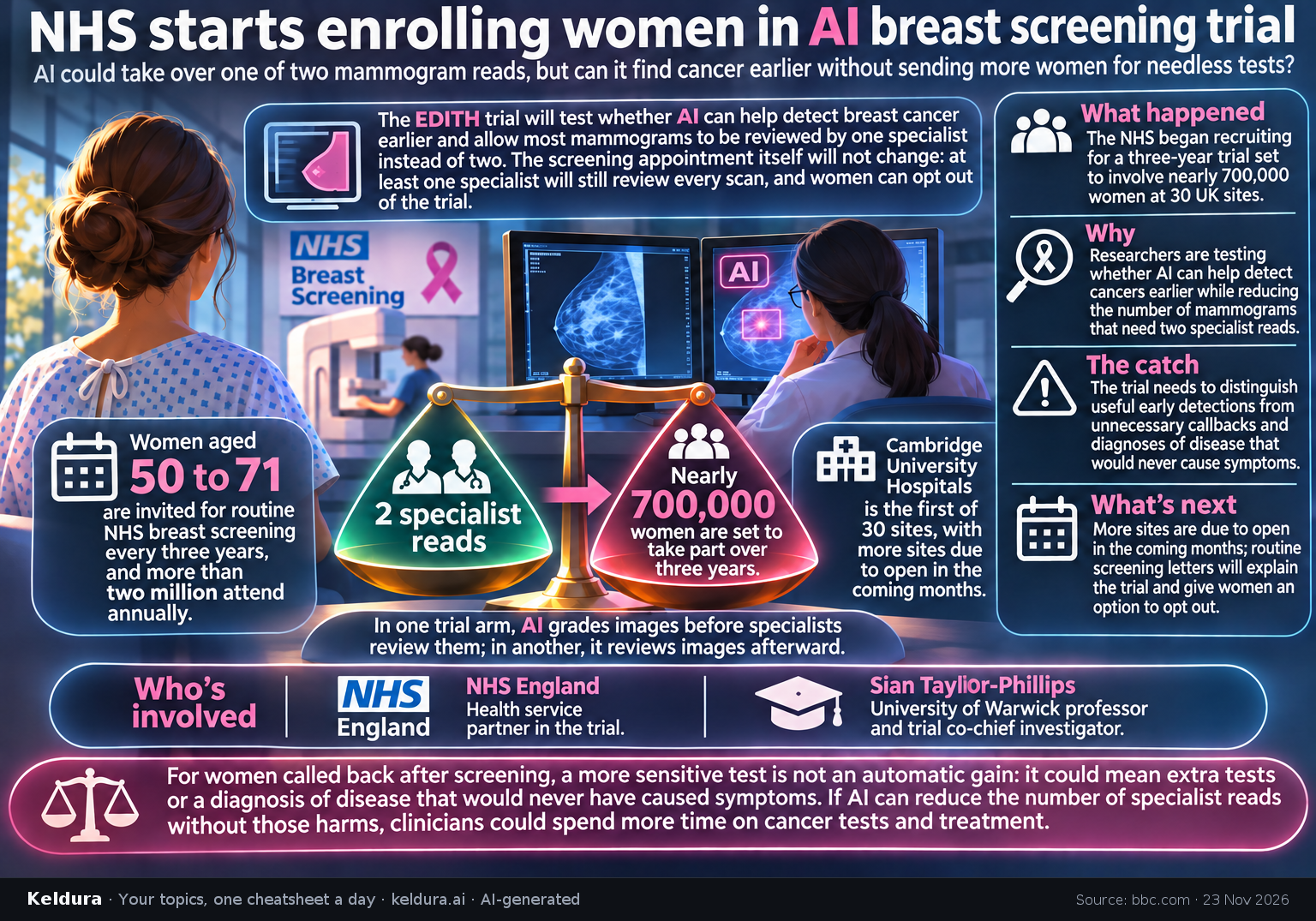
The EDITH trial will test whether AI can help detect breast cancer earlier and allow most mammograms to be reviewed by one specialist instead of two. [6][7][8] The screening appointment itself will not change: at least one specialist will still review every scan, and women can opt out of the trial. [7][8]
Why it matters: For women called back after screening, a more sensitive test is not an automatic gain: it could mean extra tests or a diagnosis of disease that would never have caused symptoms. If AI can reduce the number of specialist reads without those harms, clinicians could spend more time on cancer tests and treatment. [7][8]
Key insights: Women aged 50 to 71 are invited for routine NHS breast screening every three years, and more than two million attend annually. [6][7][8] | In one trial arm, AI grades images before specialists review them; in another, it reviews images afterward. [8] | Cambridge University Hospitals is the first of 30 sites, with more sites due to open in the coming months. [6][7][8]
Cheatsheet facts: What happened: The NHS began recruiting for a three-year trial set to involve nearly 700,000 women at 30 UK sites. [6][7][8] | Why: Researchers are testing whether AI can help detect cancers earlier while reducing the number of mammograms that need two specialist reads. [7][8] | The catch: The trial needs to distinguish useful early detections from unnecessary callbacks and diagnoses of disease that would never cause symptoms. [8] | What's next: More sites are due to open in the coming months; routine screening letters will explain the trial and give women an option to opt out. [7]
X copy pack
Edition complete
You've reached the end of this edition.