Orion’s Revised Return Path Reduced Heat-Shield Damage Tenfold
NASA changed Orion’s return path to protect its crew, but what does the improvement establish for future Moon flights?
On October 15, 2026, NASA detailed post-flight findings showing that Artemis II’s revised reentry trajectory reduced heat-shield cracking and char loss.
NASA’s post-flight assessment found that Orion’s heat shield performed as predicted during Artemis II, which carried four astronauts around the Moon and safely back to Earth. Shortening the allowable downrange distance during reentry reduced cracking and char loss by a factor of ten compared with A…
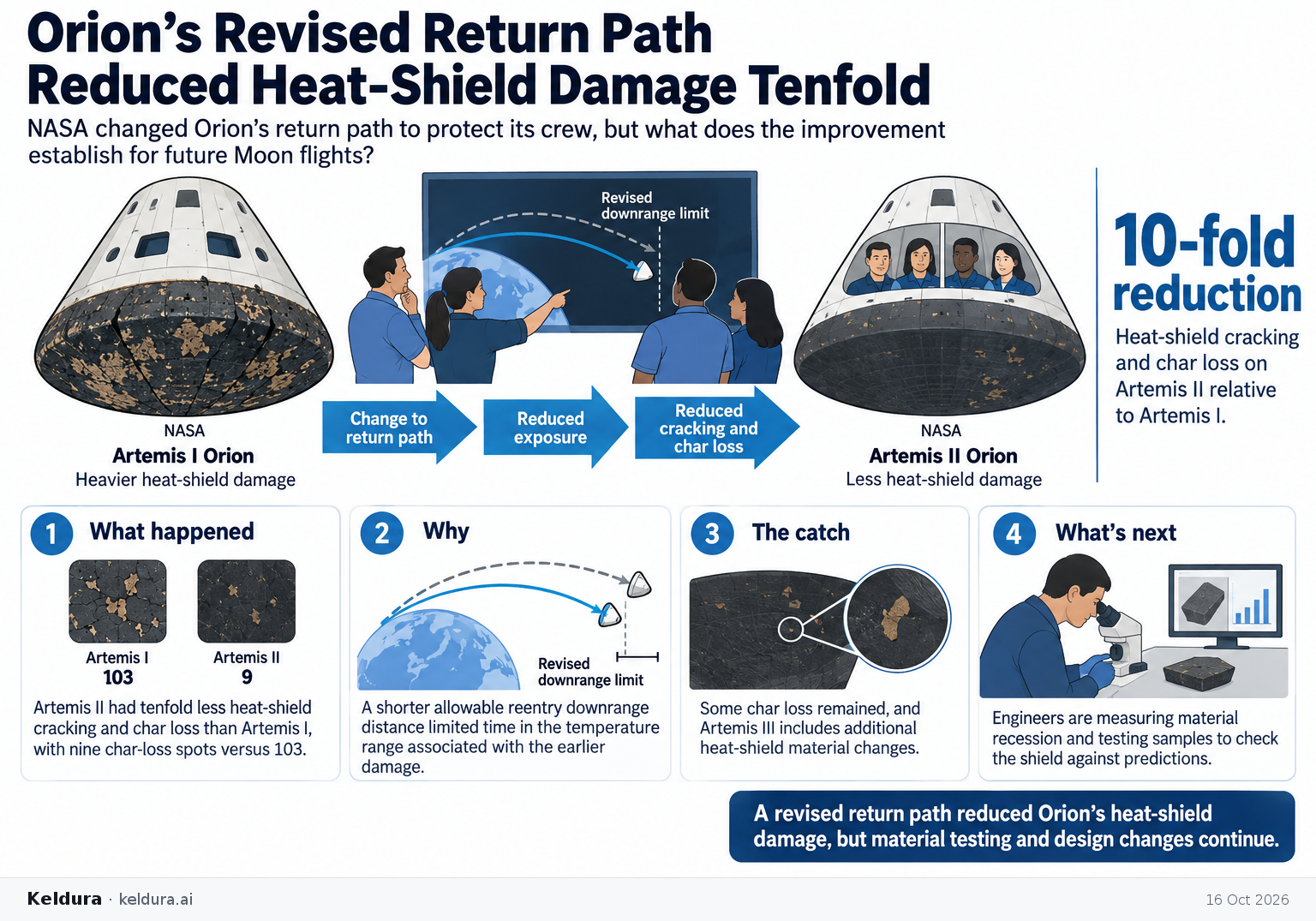
NASA’s post-flight assessment found that Orion’s heat shield performed as predicted during Artemis II, which carried four astronauts around the Moon and safely back to Earth. Shortening the allowable downrange distance during reentry reduced cracking and char loss by a factor of ten compared with Artemis I; engineers counted nine char-loss spots versus 103. Further sample testing and measurements of material recession remain underway. [1]
Why it matters: The result gives NASA flight evidence that changing Orion’s trajectory can reduce the heat-shield damage seen on Artemis I while protecting a crew. It also informs later missions, although Artemis III incorporates additional changes to the heat-shield material rather than relying on trajectory alone. [1]
Key insights: The intervention targeted time spent in a particular temperature range: NASA shortened the permitted downrange distance to limit exposure to conditions associated with the Artemis I damage. [1] | The improvement was substantial, not complete elimination: engineers still identified nine spots of char loss on the Artemis II heat shield. [1] | NASA found the backshell’s 1,300 ceramic tiles performed as expected, with no observed overheating around protected openings such as windows, vents and thrusters. [1] | Artemis III’s heat shield includes changes intended to make the Avcoat blocks more uniform and consistently permeable, alongside the lessons from Artemis II. [1]
Cheatsheet facts: What happened: NASA found tenfold less heat-shield cracking and char loss on Artemis II than on Artemis I, with nine char-loss spots versus 103. [1] | Why: A shorter allowable reentry downrange distance limited time in the temperature range associated with the earlier damage. [1] | The catch: The shield still experienced some char loss, and Artemis III uses additional design changes to improve Avcoat uniformity and permeability. [1] | What's next: Engineers are comparing post-flight laser scans with pre-flight measurements to establish material recession and check it against predictions. [1]