Dragon delivers new experiments and solar arrays to space station
New tissue experiments and power hardware have reached the station, but what must happen before crews can use them?
On October 15, SpaceX Dragon docked at the International Space Station, and Expedition 75 astronauts began unloading research supplies and power hardware.
Dragon delivered over 6,300 pounds of science, supplies and roll-out solar arrays to the International Space Station, docking at 10:27 a.m. EDT on October 15. Crew members transferred scientific samples into station freezers and research racks and began activating experiments, while the arrays awai…
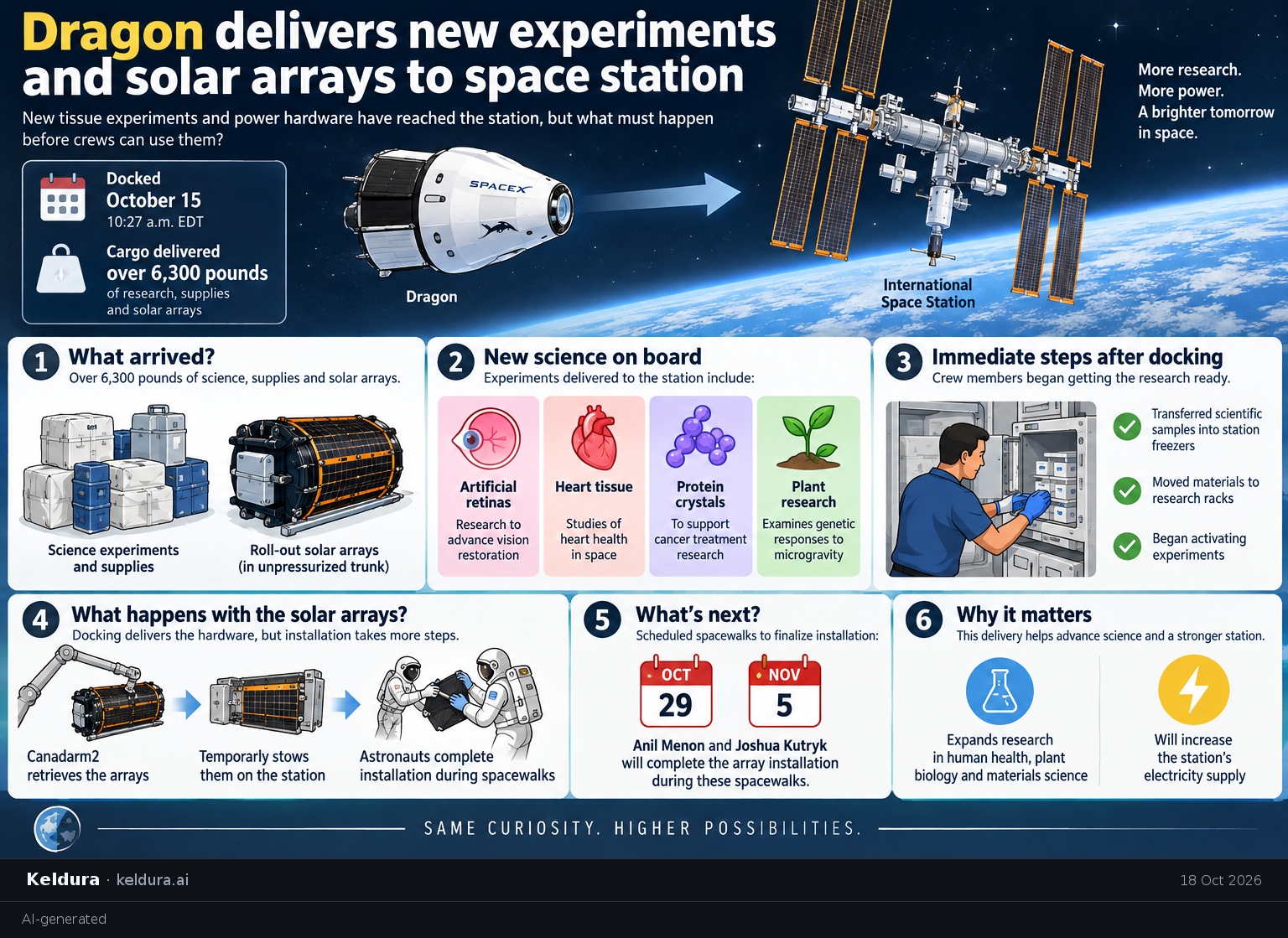
Dragon delivered over 6,300 pounds of science, supplies and roll-out solar arrays to the International Space Station, docking at 10:27 a.m. EDT on October 15. Crew members transferred scientific samples into station freezers and research racks and began activating experiments, while the arrays await robotic handling and installation spacewalks. [9]
Why it matters: The delivery supports research into artificial retinas, heart tissue, protein crystals for cancer treatment research and plant responses to microgravity, alongside hardware intended to increase the station’s electricity supply. These are separate benefits that depend on different activation and installation steps. [9]
Key insights: Moving samples from transport freezers and incubators into station research facilities was an immediate task after docking. [9] | Plant investigations will examine genetic responses to microgravity to help advance spacecraft life-support systems. [9] | The solar arrays arrived in Dragon’s unpressurized trunk; Canadarm2 must retrieve and temporarily stow them before astronauts complete installation. [9]
Cheatsheet facts: What happened: Dragon arrived with over 6,300 pounds of research cargo, supplies and solar arrays. [9] | Why: The cargo supports biomedical and plant research, while the arrays will augment station power generation. [9] | The catch: Docking delivers the hardware, but samples need laboratory transfer and the arrays require robotic handling and spacewalks. [9] | What's next: Anil Menon and Joshua Kutryk are scheduled to finalize array installation during spacewalks on October 29 and November 5. [9]