Starship reaches orbit, but SpaceX calls off booster recovery
Starship reached orbit again, but can its upper stage return safely to the same launch tower?
On November 13, SpaceX launched Starship Flight 15 from Texas, deployed 26 satellites and called off the booster's planned tower catch.
SpaceX's 15th Starship flight reached orbit and deployed 26 Starlink V3 satellites, but the Super Heavy booster made a controlled Gulf of Mexico splashdown instead of returning to its launch tower. [3][4] The upper stage remained scheduled for a possible November 14 tower catch after roughly 22.5 h…
Open original (3 sources):
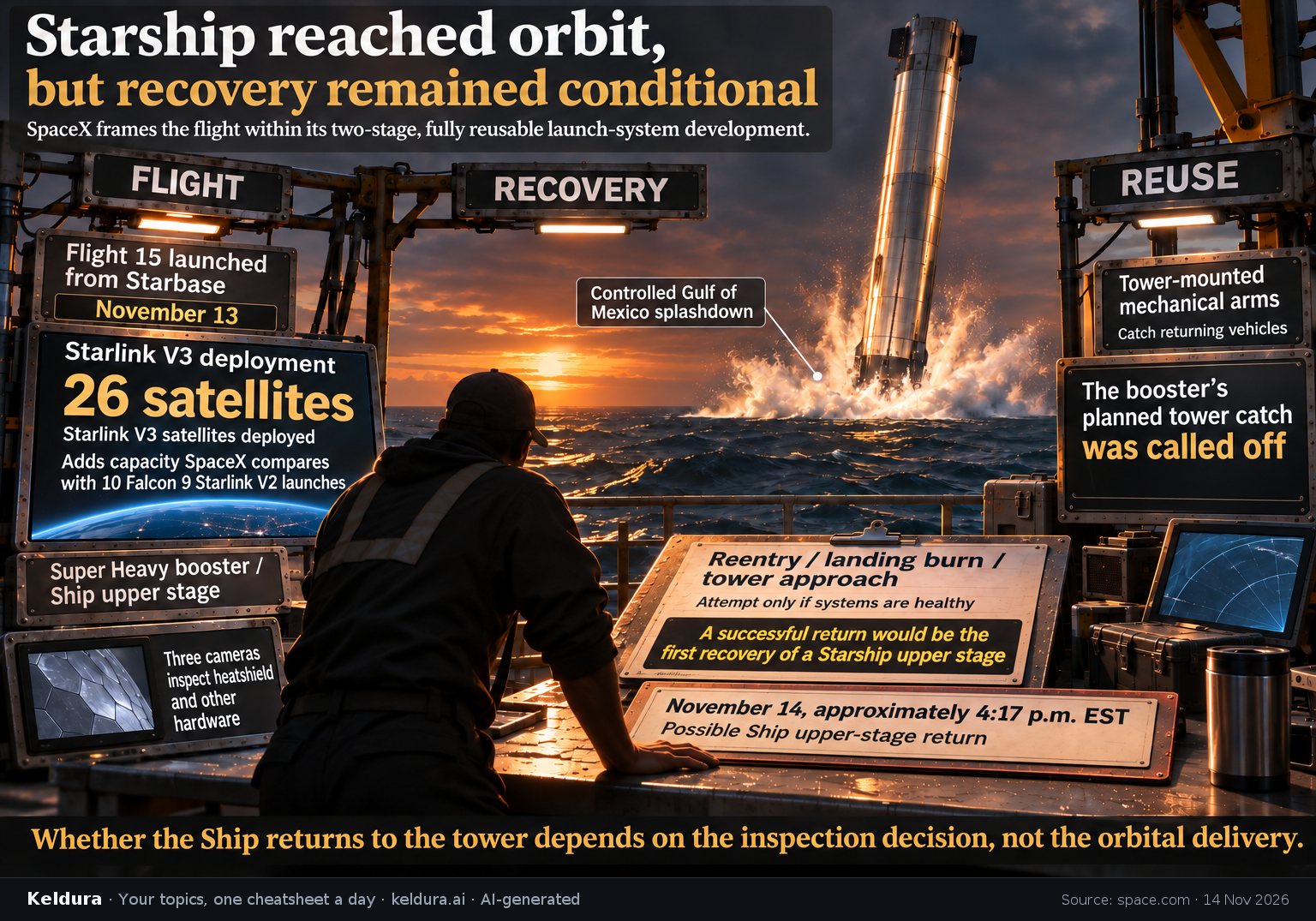
SpaceX's 15th Starship flight reached orbit and deployed 26 Starlink V3 satellites, but the Super Heavy booster made a controlled Gulf of Mexico splashdown instead of returning to its launch tower. [3][4] The upper stage remained scheduled for a possible November 14 tower catch after roughly 22.5 hours, contingent on checks of its heatshield and other critical systems. [2][3]
Why it matters: Recovering the upper stage would give SpaceX its first recovered Starship spacecraft, a concrete step toward its goal of a fully reusable launch system. The flight also delivered satellites that SpaceX says add one terabit of network capacity—equivalent to the contribution of 10 Falcon 9 launches carrying Starlink V2 satellites. [3]
Key insights: Reaching orbit and recovering the spacecraft are separate tests: this was Starship's second orbital flight, following Flight 14 on September 28, but no upper stage had yet been recovered. [3] | Three deployed satellites carried cameras to inspect Starship's heatshield and other hardware; those observations would help SpaceX decide whether to attempt the return. [3] | The booster splashdown ended the prospect of recovering both stages on this flight, but it did not automatically rule out the upper-stage catch. [3][4]
Cheatsheet facts: What happened: Flight 15 launched from Starbase on November 13, reached orbit and deployed 26 satellites; its booster splashed down about 6.5 minutes after liftoff. [3] | Background: Starship has two stages: the Super Heavy booster and the Ship upper stage. SpaceX is developing tower-mounted mechanical arms to catch returning vehicles as part of a fully reusable system. [3] | The catch: SpaceX said it would attempt the upper-stage return only if systems needed for reentry, the landing burn and tower approach were healthy; ocean-return options remained available. [3] | What's next: The planned upper-stage return was November 14 at approximately 4:17 p.m. EST, potentially producing the first recovery of a Starship upper stage. [3]
X copy pack
Edition complete
You've reached the end of this edition.