SpaceX schedules Starship's first spacecraft catch attempt
SpaceX has caught its booster before, but can it also recover the spacecraft after a full day in orbit?
SpaceX scheduled Starship's 15th flight for November 13, 2026, from South Texas, with its first spacecraft catch attempt planned after roughly 22 hours in orbit.
SpaceX plans to launch Starship on November 13 and attempt to catch both its Super Heavy booster and its spacecraft at the launch site, rather than discard the spacecraft in the ocean. [2][6][7] The mission is intended to deploy 26 Starlink V3 satellites and complete approximately 14 Earth orbits b…
Open original (5 sources):
- [2] SpaceX attempting first Starship rocket catch — axios.com
- [6] Reuters Science News Summary | International — devdiscourse.com
- [7] Double-catch drama: Why Starship's Flight 15 is so important to SpaceX | Space — Space.com
- [8] Rocket Report: Starship set for historic test flight; a century of Electron - Ars Technica — arstechnica.com
- [10] SpaceX’s Starship rocket may leave NASA in the dust : NPR — npr.org
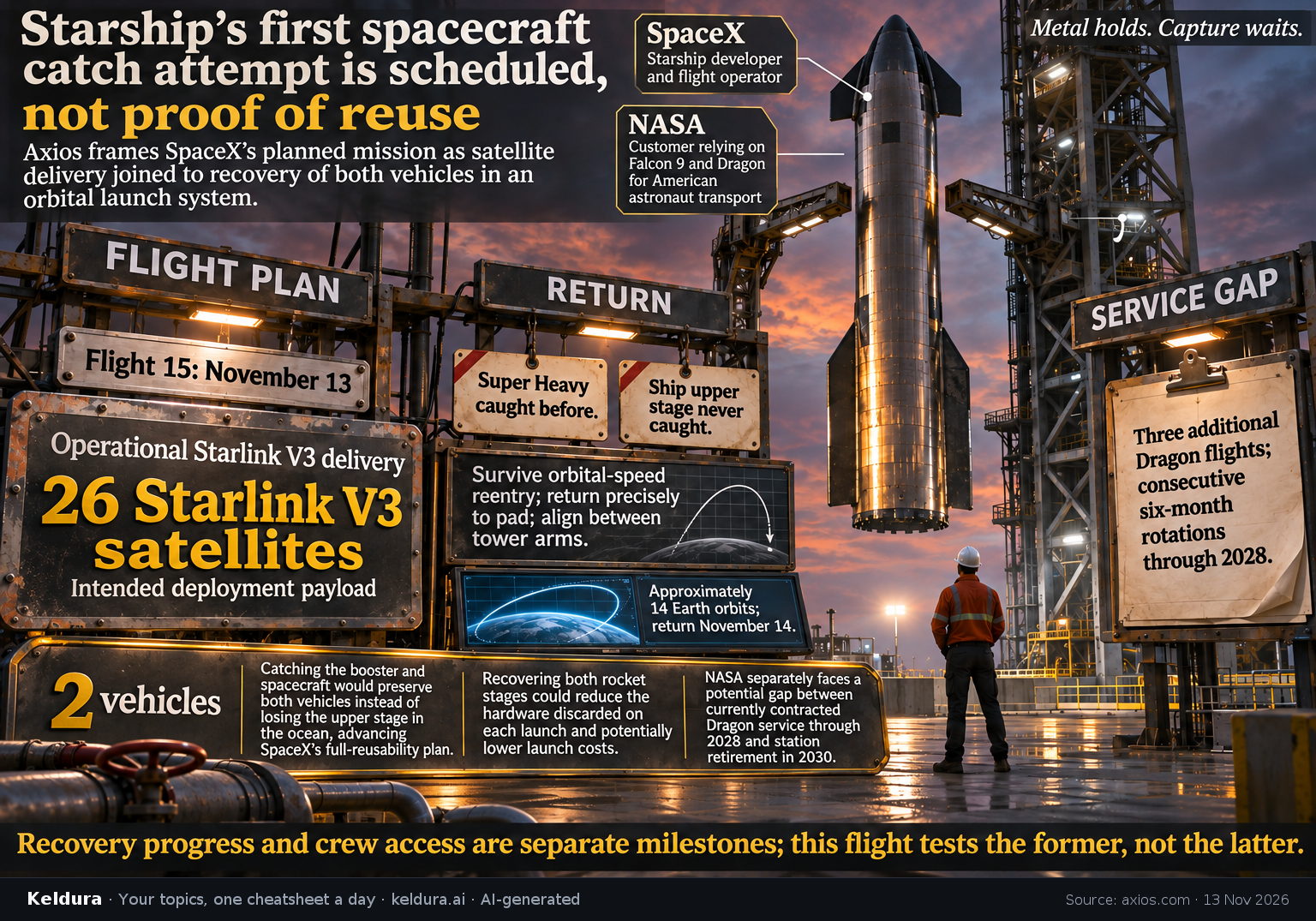
SpaceX plans to launch Starship on November 13 and attempt to catch both its Super Heavy booster and its spacecraft at the launch site, rather than discard the spacecraft in the ocean. [2][6][7] The mission is intended to deploy 26 Starlink V3 satellites and complete approximately 14 Earth orbits before the spacecraft returns on November 14. [8] A successful double recovery would be a first for an orbital launch system, although recovery alone would not demonstrate that both vehicles can fly again. [8]
Why it matters: Recovering both rocket stages could reduce the hardware discarded on each launch and potentially lower launch costs. [2][8] NASA also has a transition problem to watch: SpaceX intends to retire Falcon 9, which launches Dragon, currently the only American spacecraft carrying astronauts to the International Space Station; Starship cannot yet carry astronauts. [10]
Key insights: The new test is the spacecraft's return: SpaceX has caught Super Heavy before, but has never caught Starship's upper stage. [2] | The spacecraft must survive reentry from orbital speed, return precisely to the pad and position itself between the tower's mechanical catching arms. [7] | This is also a working satellite-delivery mission: Flight 15 is the second Starship flight intended to carry operational Starlink satellites. [6] | NASA's three additional contracted Dragon flights would extend service only through 2028 under consecutive six-month rotations, while the space station is scheduled to retire in 2030. [10]
Cheatsheet facts: Background: Starship has two main vehicles: the Super Heavy booster and the Ship upper stage. The booster has already been caught; the spacecraft has not. [2][7] | What happened: SpaceX scheduled Flight 15 for November 13, with a 75-minute launch window opening at 4:45 p.m. CT, pending regulatory approval. [8] | Why: The mission combines delivery of 26 Starlink V3 satellites with a test of recovering both parts of an orbital launch system. [8] | The catch: The spacecraft must withstand orbital reentry and reach the launch tower accurately enough for its arms to catch it. [7] | What's next: Watch for the booster catch shortly after launch, then the spacecraft's catch attempt on November 14 after approximately 14 orbits. [2][8]