Euclid releases observations of more than 900 million galaxies
Euclid has released observations of more than 900 million galaxies, but what can this first slice reveal about the unseen universe?
On November 12, 2026, the European Space Agency released Euclid observations of more than 900 million galaxies across a sky area equivalent to about 9,500 full moons.
The European Space Agency released Euclid's first large collection of mission data on November 12, including observations of more than 900 million galaxies. [6] Called DR1-Foundation, the release contains light from more than 1 billion objects across 1,900 square degrees, gathered over about 13 mon…
Open original (2 sources):
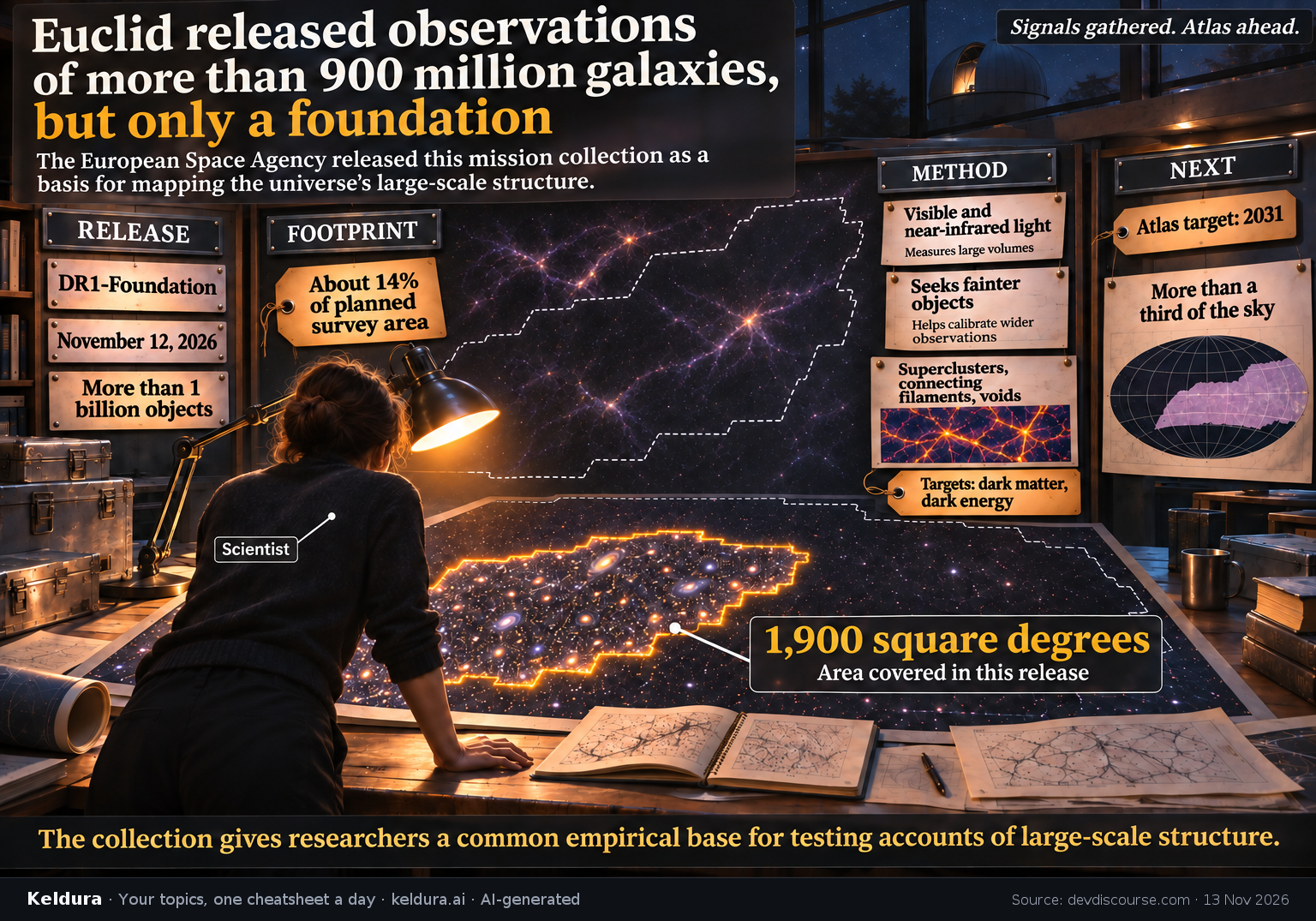
The European Space Agency released Euclid's first large collection of mission data on November 12, including observations of more than 900 million galaxies. [6] Called DR1-Foundation, the release contains light from more than 1 billion objects across 1,900 square degrees, gathered over about 13 months. [4] Scientists will use the observations to investigate dark matter and dark energy while building a three-dimensional cosmic atlas targeted for completion in 2031. [4][6]
Why it matters: Researchers now have a common dataset covering more than 900 million galaxies for testing explanations of the universe's large-scale structure. [6] It also supports work beyond cosmology: Euclid's deeper observations can reveal faint dwarf galaxies, distant galaxies and quasars. [4]
Key insights: The billion-object count and the 900-million-galaxy count describe different totals: the release includes more objects than galaxies alone. [4][6] | The 1,900-square-degree release represents about 14% of the sky area Euclid plans to survey, so the current dataset is a foundation rather than the completed atlas. [4] | The Wide Survey measures large volumes in visible and near-infrared light, while the Deep Survey seeks fainter objects and helps calibrate the wider observations. [4] | Euclid studies galaxy superclusters, connecting filaments and the voids between them because dark matter and dark energy affect structure on these large scales. [4]
Cheatsheet facts: What happened: ESA released Euclid observations of more than 900 million galaxies on November 12. [6] | Background: Euclid is an orbiting telescope mapping the universe's large-scale structure to investigate dark matter and dark energy. [4][6] | Why: Mapping galaxy concentrations, filaments and empty regions gives researchers evidence about how dark matter and dark energy shape the universe. [4] | The catch: The release covers 1,900 square degrees—about 14% of Euclid's planned survey area—not the finished three-dimensional atlas. [4] | What's next: The mission targets completion of its cosmic atlas in 2031, covering more than a third of the sky. [6]
X copy pack
Edition complete
You've reached the end of this edition.