Dragon returns space station research samples to Earth
Dragon has brought back experiments from orbit, but what can researchers learn from them on Earth?
On November 21, 2026, an unpiloted SpaceX Dragon splashed down near Los Angeles with space station research samples, completing NASA’s 35th SpaceX resupply mission.
SpaceX’s unpiloted Dragon splashed down in the Pacific Ocean near Los Angeles a day after leaving the International Space Station. [7] Its return cargo included a 3D-bioprinted blood vessel construct, frozen tumor organoids treated aboard the station, and a lighting system tested there for more tha…
Open original · [7] Dragon Returns to Earth Packed With Science and Cargo - NASA — NASA News
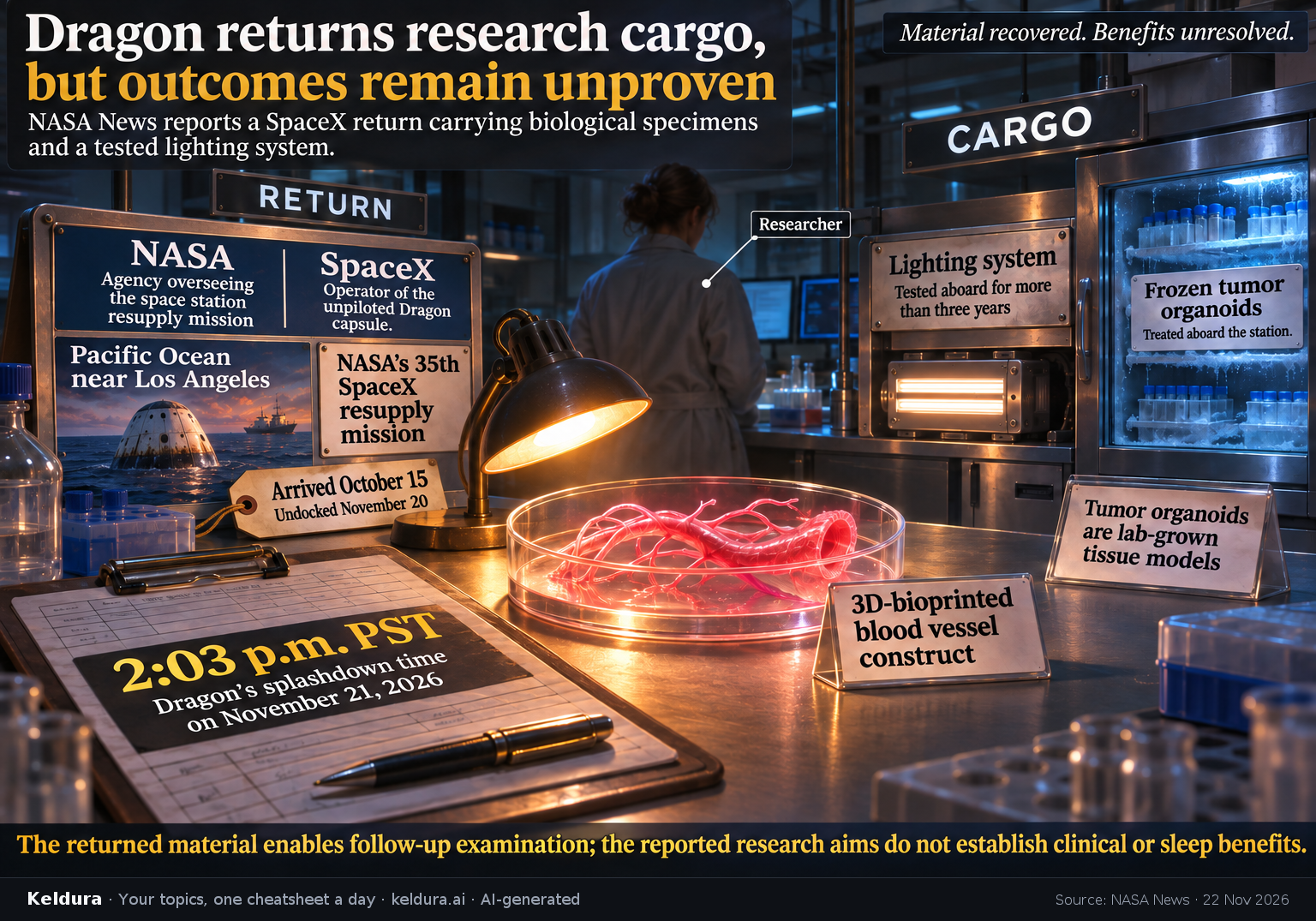
SpaceX’s unpiloted Dragon splashed down in the Pacific Ocean near Los Angeles a day after leaving the International Space Station. [7] Its return cargo included a 3D-bioprinted blood vessel construct, frozen tumor organoids treated aboard the station, and a lighting system tested there for more than three years. [7]
Why it matters: The return gives researchers physical samples to examine for studies of blood vessel aging and cancer treatment, plus hardware from a test of lighting intended to support astronauts’ sleep on long missions. [7]
Key insights: Researchers used the printed blood vessel construct to study vascular aging and cardiovascular disease in space and on Earth. [7] | The frozen tumor organoids are lab-grown tissue models; researchers can study them after their treatment aboard the station. [7] | Dragon arrived at the station on October 15 and undocked on November 20; the lighting system it brought back had spent more than three years aboard. [7]
Cheatsheet facts: What happened: Dragon splashed down at 2:03 p.m. PST on November 21, completing NASA’s 35th SpaceX resupply mission. [7] | Why: The return brought physical research materials back from orbit, including a printed vessel model and frozen tumor organoids. [7] | The catch: NASA described potential uses for the returned samples, not a demonstrated improvement in cancer treatment or cardiovascular care. [7]
X copy pack
Edition complete
You've reached the end of this edition.