Astronomers catch a nearby type Ia supernova before peak brightness
Astronomers caught SN 2026ahvu before it reached peak brightness, a rare early look at a type Ia supernova this close to Earth.
On November 2, astronomers spotted SN 2026ahvu before peak brightness and identified it within a day as a type Ia supernova, perhaps 50 million light-years away or less.
Astronomers caught SN 2026ahvu before it reached peak brightness, a rare early look at a type Ia supernova this close to Earth. Preliminary findings submitted on November 6 suggest the white dwarf that exploded was less than 100 million years old, unusually young for this kind of event. [10]
Open original · [10] A cosmically close supernova may spill the stellar explosion’s secrets — sciencenews.org
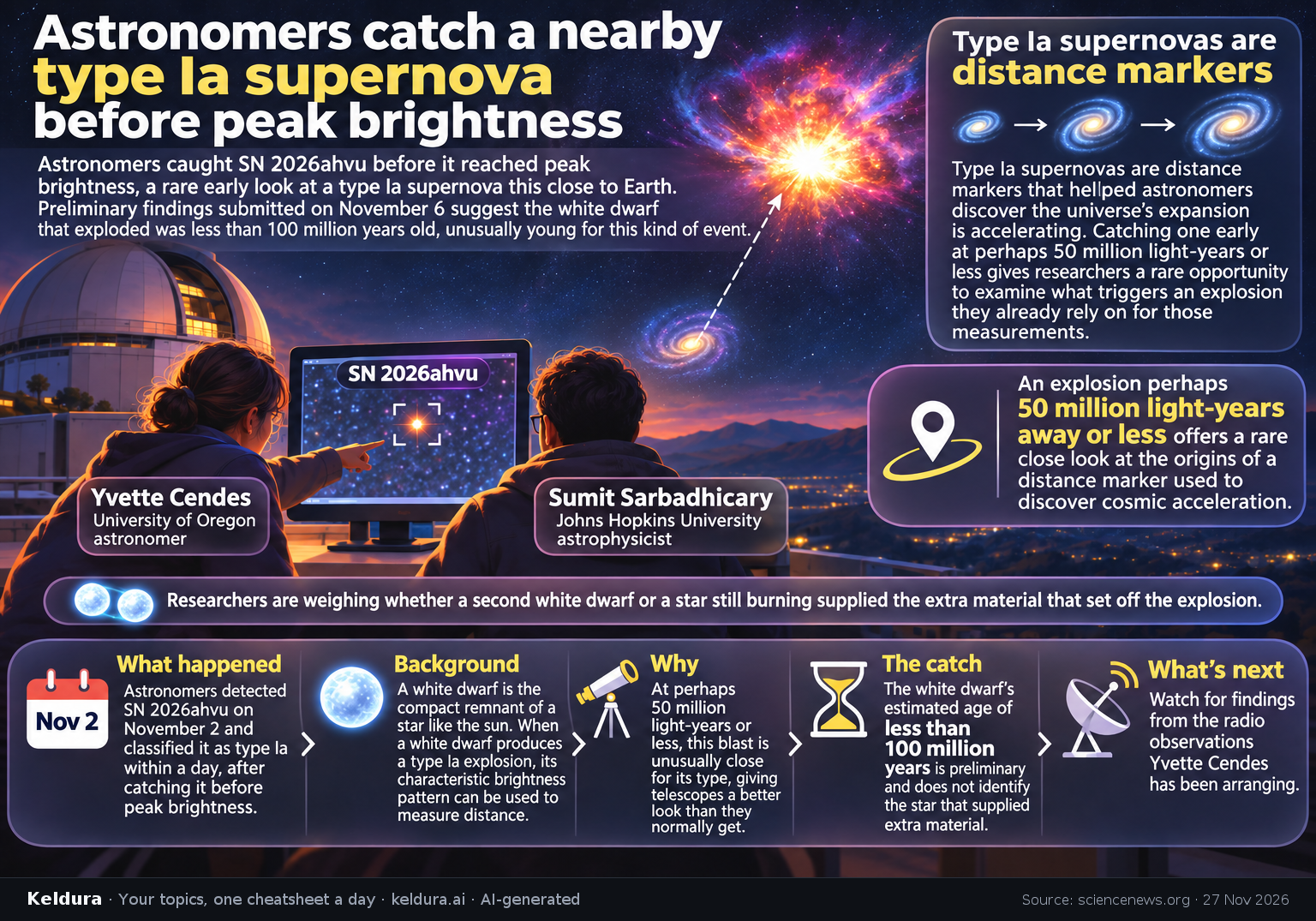
Astronomers caught SN 2026ahvu before it reached peak brightness, a rare early look at a type Ia supernova this close to Earth. Preliminary findings submitted on November 6 suggest the white dwarf that exploded was less than 100 million years old, unusually young for this kind of event. [10]
Why it matters: Type Ia supernovas are distance markers that helped astronomers discover the universe's expansion is accelerating. Catching one early at perhaps 50 million light-years or less gives researchers a rare opportunity to examine what triggers an explosion they already rely on for those measurements. [10]
Key insights: Researchers are weighing whether a second white dwarf or a star still burning supplied the extra material that set off the explosion. [10] | University of Oregon astronomer Yvette Cendes has been arranging radio observations to investigate why the white dwarf exploded. [10]
Cheatsheet facts: What happened: Astronomers detected SN 2026ahvu on November 2 and classified it as type Ia within a day, after catching it before peak brightness. [10] | Background: A white dwarf is the compact remnant of a star like the sun. When a white dwarf produces a type Ia explosion, its characteristic brightness pattern can be used to measure distance. [10] | Why: At perhaps 50 million light-years or less, this blast is unusually close for its type, giving telescopes a better look than they normally get. [10] | The catch: The white dwarf's estimated age of less than 100 million years is preliminary and does not identify the star that supplied extra material. [10] | What's next: Watch for findings from the radio observations Yvette Cendes has been arranging. [10]