Astronomers find the earliest known quasar
A black hole already weighed as much as 360 million suns, but how did it get so big so early?
On November 24, astronomers reported finding the quasar Dún Aonghasa as it was 630 million years after the Big Bang, 40 million years earlier than the previous record.
Astronomers combined data from NASA's James Webb Space Telescope and the European Space Agency's Euclid Wide Survey to identify Dún Aonghasa, the earliest quasar yet observed. Its central black hole had an estimated mass of 360 million suns just 630 million years after the Big Bang. [8]
Open original · [8] Earliest monster black hole found at the universe's edge by JWST and Euclid — pushing theories to their limits | Live Science — livescience.com
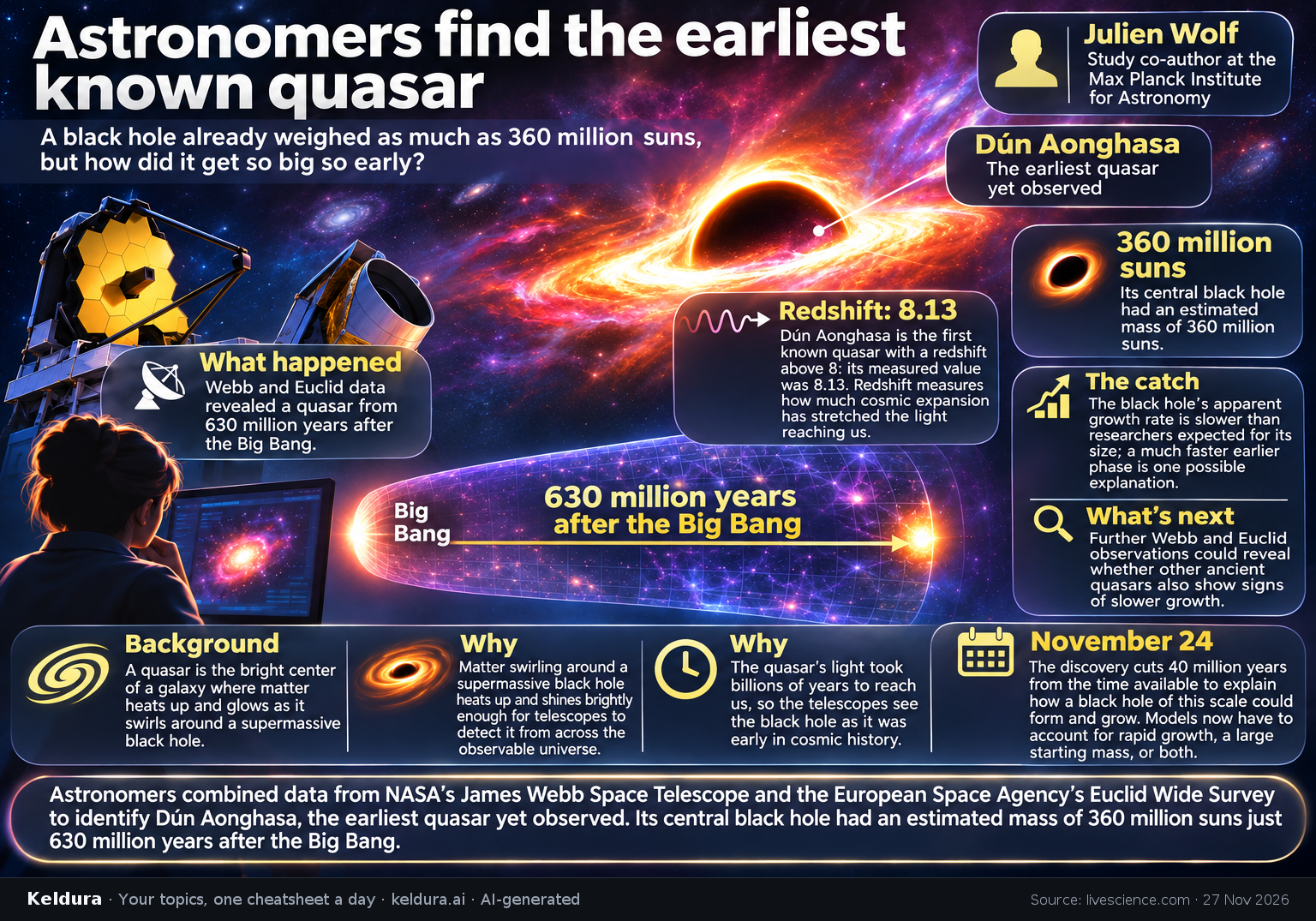
Astronomers combined data from NASA's James Webb Space Telescope and the European Space Agency's Euclid Wide Survey to identify Dún Aonghasa, the earliest quasar yet observed. Its central black hole had an estimated mass of 360 million suns just 630 million years after the Big Bang. [8]
Why it matters: The discovery cuts 40 million years from the time available to explain how a black hole of this scale could form and grow. Models now have to account for rapid growth, a large starting mass, or both. [8]
Key insights: Dún Aonghasa is the first known quasar with a redshift above 8: its measured value was 8.13. Redshift measures how much cosmic expansion has stretched the light reaching us. [8] | The researchers found that the black hole appears to be growing more slowly than expected for its size, so its growth at the time we see it may not tell us how fast it grew earlier. [8]
Cheatsheet facts: What happened: Webb and Euclid data revealed a quasar from 630 million years after the Big Bang. [8] | Background: A quasar is the bright center of a galaxy where matter heats up and glows as it swirls around a supermassive black hole. [8] | Why: The quasar's light took billions of years to reach us, so the telescopes see the black hole as it was early in cosmic history. [8] | The catch: The black hole's apparent growth rate is slower than researchers expected for its size; a much faster earlier phase is one possible explanation. [8] | What's next: Further Webb and Euclid observations could reveal whether other ancient quasars also show signs of slower growth. [8]