Why is English football’s money advantage also a financial risk?
Uefa estimates that Premier League clubs spent €4.6bn (£4bn) in the summer transfer market—more than the next eight largest European.
Uefa estimates that Premier League clubs spent €4.6bn (£4bn) in the summer transfer market—more than the next eight largest European countries combined—and that the outlay equalled 56% of their annual revenue.[8] Separately, the Premier League said it wanted to resolve its funding stalemate with th…
Uefa estimates that Premier League clubs spent €4.6bn (£4bn) in the summer transfer market—more than the next eight largest European countries combined—and that the outlay equalled 56% of their annual revenue.[8] Separately, the Premier League said it wanted to resolve its funding stalemate with the EFL so additional money could flow to lower-league clubs.[7] Manchester United disclosed £90m in further borrowing, taking overall debt to £1.15bn after spending £191.7m on players during the summer.[11]
Why it matters: Together, the developments expose English football’s central financial contradiction: Premier League clubs dominate European purchasing, but the wider pyramid is still waiting for a distribution agreement and even a globally prominent club can combine heavy transfer spending with rising debt.[7][8][11]
Key insights: Premier League transfer spending was larger than the combined total of Europe’s next eight biggest national markets.[8] | The league’s estimated transfer bill equalled 56% of annual revenue, compared with a 33% pre-Covid-decade average.[8] | Manchester United’s £1.15bn overall debt included £578m of historic debt, £200m on its revolving credit facility and £375m in outstanding transfer fees.[11] | The Premier League and EFL had not yet concluded the strategic partnership needed for additional funding to flow to EFL clubs.[7]
Cheatsheet facts: What changed: Uefa quantified a €4.6bn Premier League transfer surge, Manchester United added £90m of borrowing, and talks over additional EFL funding continued.[7][8][11] | Why now: English clubs accelerated transfer spending to 56% of annual revenue while internal funding and club-level leverage remained unresolved.[7][8][11] | Watch next: The observable tests are whether the Premier League and EFL conclude a funding agreement and whether Manchester United’s future filings show debt or outstanding transfer fees declining.[7][11]
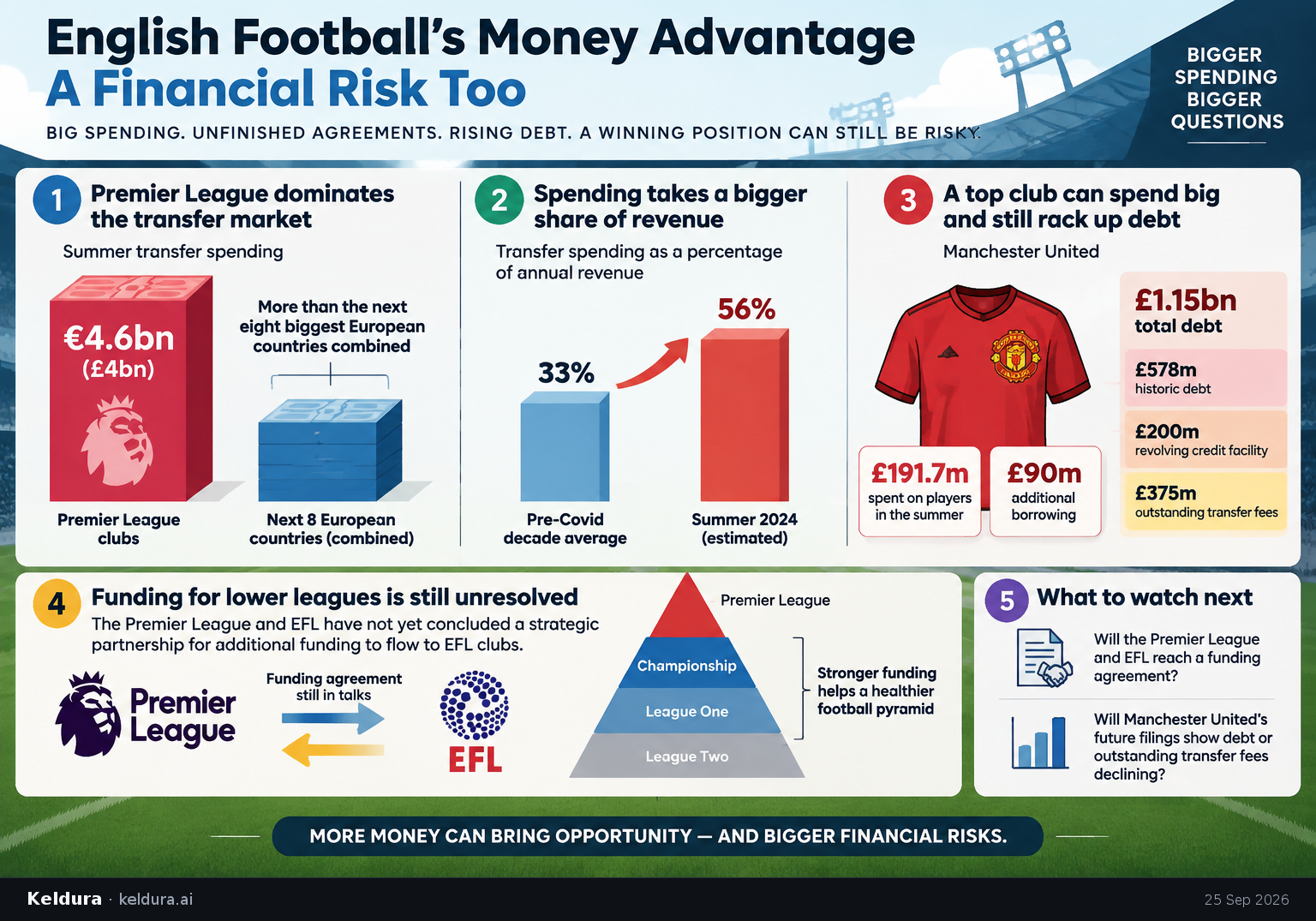
Uefa estimates that Premier League clubs spent €4.6bn (£4bn) in the summer transfer market—more than the next eight largest European countries combined—and that the outlay equalled 56% of their annual revenue.[8] Separately, the Premier League said it wanted to resolve its funding stalemate with the EFL so additional money could flow to lower-league clubs.[7] Manchester United disclosed £90m in further borrowing, taking overall debt to £1.15bn after spending £191.7m on players during the summer.[11]
Why it matters: Together, the developments expose English football’s central financial contradiction: Premier League clubs dominate European purchasing, but the wider pyramid is still waiting for a distribution agreement and even a globally prominent club can combine heavy transfer spending with rising debt.[7][8][11]
Key insights: Premier League transfer spending was larger than the combined total of Europe’s next eight biggest national markets.[8] | The league’s estimated transfer bill equalled 56% of annual revenue, compared with a 33% pre-Covid-decade average.[8] | Manchester United’s £1.15bn overall debt included £578m of historic debt, £200m on its revolving credit facility and £375m in outstanding transfer fees.[11] | The Premier League and EFL had not yet concluded the strategic partnership needed for additional funding to flow to EFL clubs.[7]
Cheatsheet facts: What changed: Uefa quantified a €4.6bn Premier League transfer surge, Manchester United added £90m of borrowing, and talks over additional EFL funding continued.[7][8][11] | Why now: English clubs accelerated transfer spending to 56% of annual revenue while internal funding and club-level leverage remained unresolved.[7][8][11] | Watch next: The observable tests are whether the Premier League and EFL conclude a funding agreement and whether Manchester United’s future filings show debt or outstanding transfer fees declining.[7][11]
X copy pack
[8] Uefa fears impact of Premier League spending in transfer market - BBC Sport — BBC Sport[7] Premier League hopeful of reaching agreement with EFL over funding offer - BBC Sport — BBC Sport[11] Man Utd borrow another £90m to take debt to more than £1.1bn - BBC Sport — BBC SportRead in BriefingsPost to X