How expensive oil and resilient growth triggered a global bond selloff
The US 30-year Treasury yield climbed to 5.48%, its highest since 2004, while the benchmark 10-year yield reached 5.20% as investors.
The US 30-year Treasury yield climbed to 5.48%, its highest since 2004, while the benchmark 10-year yield reached 5.20% as investors confronted elevated energy costs, resilient growth and increased government spending.[2] Interest-rate futures assigned about a 70% probability to another Federal Res…
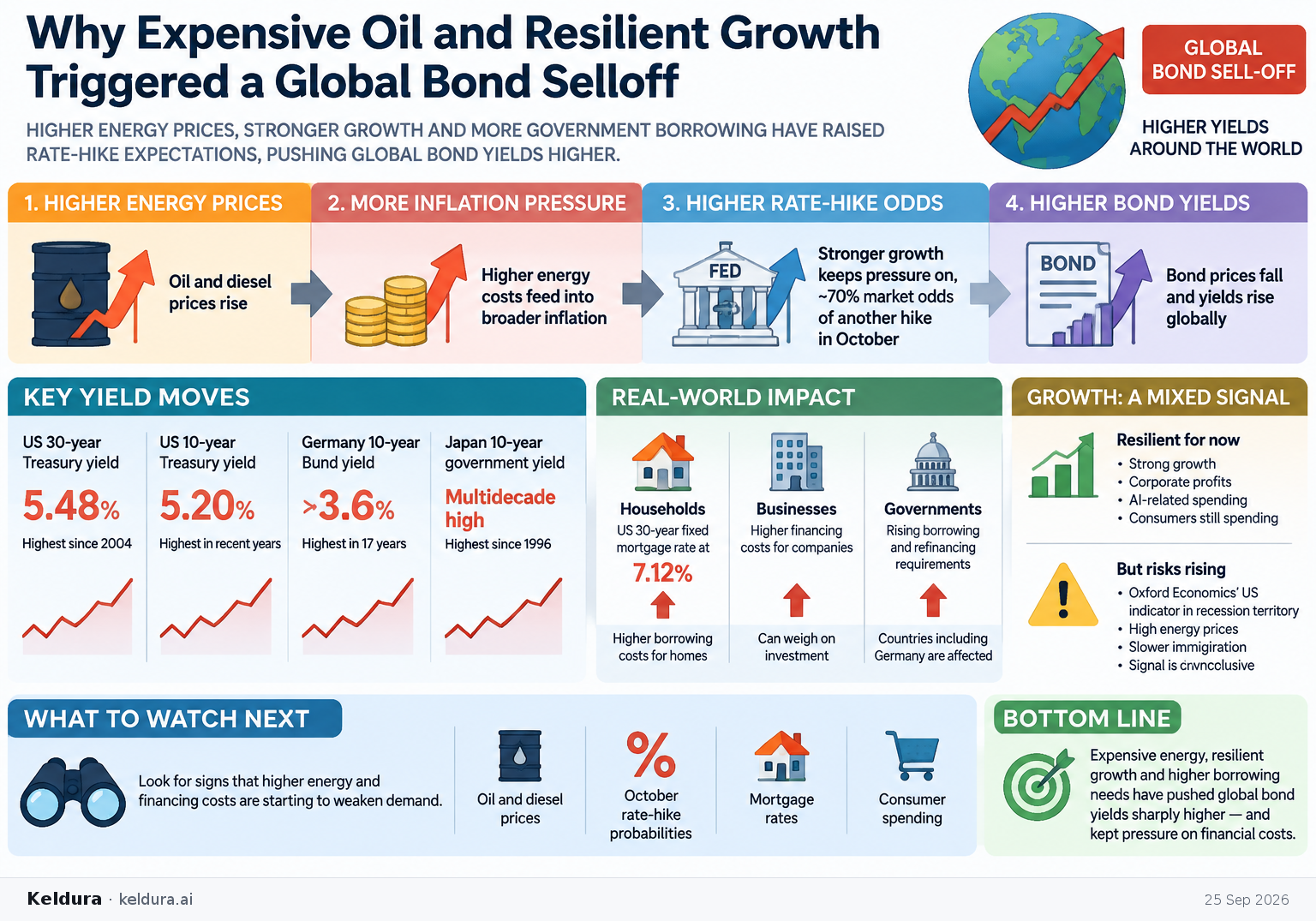
The US 30-year Treasury yield climbed to 5.48%, its highest since 2004, while the benchmark 10-year yield reached 5.20% as investors confronted elevated energy costs, resilient growth and increased government spending.[2] Interest-rate futures assigned about a 70% probability to another Federal Reserve increase in October after strong business-activity data and the central bank’s latest rate rise.[3][4]
Why it matters: Higher sovereign yields feed into household, corporate and government financing costs: the average US 30-year fixed mortgage reached 7.12%, while governments including Germany face rising borrowing and refinancing requirements.[2][3]
Key insights: The market’s causal chain runs from disrupted energy supplies to higher oil and diesel prices, broader inflation pressure, greater odds of Federal Reserve tightening and higher Treasury yields.[3][5] | The adjustment is global: Germany’s 10-year Bund recently exceeded 3.6%, its highest level in 17 years, while Japan’s 10-year yield reached its highest since 1996.[2] | Strong growth, corporate profits and AI-related spending have so far helped markets absorb higher yields, but those same supports reinforce expectations that monetary policy may remain tight.[2][6] | Oxford Economics' US business-cycle indicator has entered recession territory because of high energy prices and slower immigration, although resilient spending, productivity and AI investment make the signal inconclusive.[6]
Cheatsheet facts: What changed: The US 30-year Treasury yield reached 5.48%, the 10-year yield reached 5.20%, and comparable long-term yields in Germany and Japan climbed to multiyear or multidecade highs.[2] | Why now: High energy prices, resilient economic activity, expanding government borrowing and roughly 70% market odds of an October Federal Reserve increase are pressuring bond prices and lifting yields.[2][3][4] | Watch next: Track oil and diesel prices, October rate-hike probabilities, mortgage rates and consumer spending for evidence that higher financing and energy costs are beginning to weaken demand.[3][6]
The US 30-year Treasury yield climbed to 5.48%, its highest since 2004, while the benchmark 10-year yield reached 5.20% as investors confronted elevated energy costs, resilient growth and increased government spending.[2] Interest-rate futures assigned about a 70% probability to another Federal Reserve increase in October after strong business-activity data and the central bank’s latest rate rise.[3][4]
Why it matters: Higher sovereign yields feed into household, corporate and government financing costs: the average US 30-year fixed mortgage reached 7.12%, while governments including Germany face rising borrowing and refinancing requirements.[2][3]
Key insights: The market’s causal chain runs from disrupted energy supplies to higher oil and diesel prices, broader inflation pressure, greater odds of Federal Reserve tightening and higher Treasury yields.[3][5] | The adjustment is global: Germany’s 10-year Bund recently exceeded 3.6%, its highest level in 17 years, while Japan’s 10-year yield reached its highest since 1996.[2] | Strong growth, corporate profits and AI-related spending have so far helped markets absorb higher yields, but those same supports reinforce expectations that monetary policy may remain tight.[2][6] | Oxford Economics' US business-cycle indicator has entered recession territory because of high energy prices and slower immigration, although resilient spending, productivity and AI investment make the signal inconclusive.[6]
Cheatsheet facts: What changed: The US 30-year Treasury yield reached 5.48%, the 10-year yield reached 5.20%, and comparable long-term yields in Germany and Japan climbed to multiyear or multidecade highs.[2] | Why now: High energy prices, resilient economic activity, expanding government borrowing and roughly 70% market odds of an October Federal Reserve increase are pressuring bond prices and lifting yields.[2][3][4] | Watch next: Track oil and diesel prices, October rate-hike probabilities, mortgage rates and consumer spending for evidence that higher financing and energy costs are beginning to weaken demand.[3][6]
X copy pack
[2] Global bond selloff rolls on, US 30-year yield at highest since 2004 | The Straits Times — straitstimes.com[3] US markets raise bets on another rate hike | The Star — thestar.com.my[4] Stocks mostly fall as oil prices and bond yields rise - RTHK — news.rthk.hk[5] US STOCKS-S&P 500 ends marginally lower as investors focus on US-Iran war | International — devdiscourse.com[6] Recession signal flashes on Oxford Economics' US indicator, but spending shows no sign of cracking — investinglive.comRead in BriefingsPost to X