How Washington Is Combining Strikes, Force Buildup and Pressure on Iran
US Central Command said it struck dozens of IRGC-linked command, missile, drone, surveillance, defense and maritime targets after attempted.
US Central Command said it struck dozens of IRGC-linked command, missile, drone, surveillance, defense and maritime targets after attempted Iranian attacks on US forces and shipping; Iranian state media reported three civilian deaths on Qeshm island.[6] Separately, the USS Theodore Roosevelt carrie…
US Central Command said it struck dozens of IRGC-linked command, missile, drone, surveillance, defense and maritime targets after attempted Iranian attacks on US forces and shipping; Iranian state media reported three civilian deaths on Qeshm island.[6] Separately, the USS Theodore Roosevelt carrier strike group and USS Makin Island Amphibious Ready Group are being deployed in a movement that could add 9,000 to 10,000 US personnel to the region.[5] Trump has said Washington will decide the Iran confrontation “the easy way or the hard way” but has not disclosed his next action or its timing.[3]
Why it matters: The buildup gives Washington both offensive capacity and protection against Iranian retaliation while talks mediated by Qatar remain stalled.[5] Continued exchanges also threaten the Strait of Hormuz, where attacks on commercial vessels and Iran’s effective closure have placed regional security and energy shipments at risk.[3][5][6]
Key insights: If deployments overlap, the US could have three carrier strike groups and two amphibious groups in the Middle East, substantially expanding available offensive and defensive options.[5] | Qatar has tried to bridge US-Iran differences, but Trump rejected an Iranian proposal linking reopening the Strait of Hormuz to sanctions relief and changes to the US blockade.[5] | Iran says it retains missiles and drones for retaliation, while Washington has added Patriot air-defense systems and naval forces to the region.[5] | Iraq transported 2 million barrels of crude through the Strait of Hormuz in its first such operation in decades, demonstrating that some traffic is continuing with Iranian permission.[3]
Cheatsheet facts: What changed: The US combined a fresh strike wave with deployments that could add 9,000 to 10,000 personnel and potentially bring three carrier groups into the region.[5][6] | Why now: Iranian attacks on US forces and shipping have resumed while Qatar-mediated diplomacy remains deadlocked and Washington is intensifying economic pressure.[5][6] | Watch next: Watch for an announced US decision, arrival or overlap of the planned naval groups, renewed Qatar-mediated talks, and observable commercial traffic through the Strait of Hormuz.[3][5]
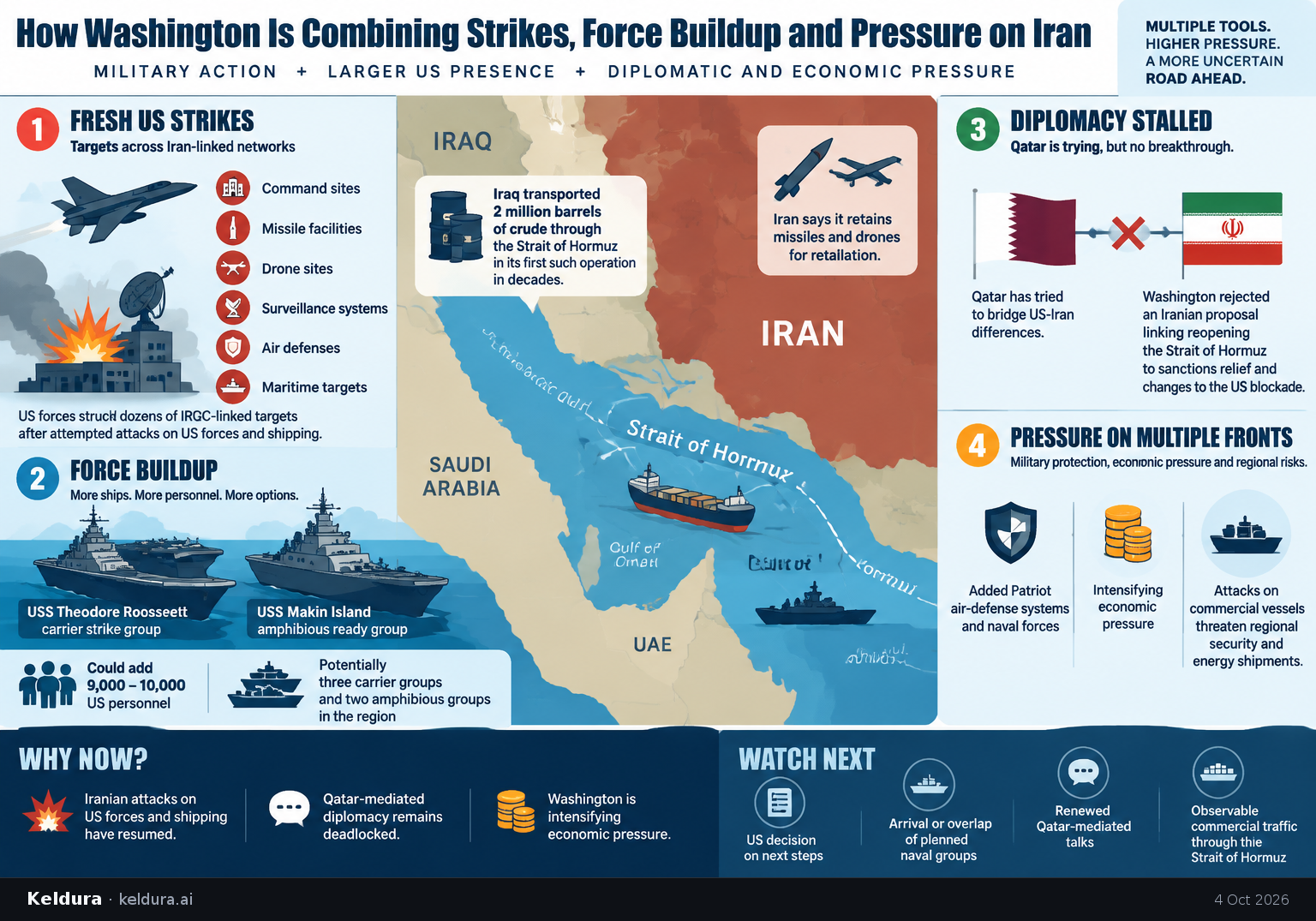
US Central Command said it struck dozens of IRGC-linked command, missile, drone, surveillance, defense and maritime targets after attempted Iranian attacks on US forces and shipping; Iranian state media reported three civilian deaths on Qeshm island.[6] Separately, the USS Theodore Roosevelt carrier strike group and USS Makin Island Amphibious Ready Group are being deployed in a movement that could add 9,000 to 10,000 US personnel to the region.[5] Trump has said Washington will decide the Iran confrontation “the easy way or the hard way” but has not disclosed his next action or its timing.[3]
Why it matters: The buildup gives Washington both offensive capacity and protection against Iranian retaliation while talks mediated by Qatar remain stalled.[5] Continued exchanges also threaten the Strait of Hormuz, where attacks on commercial vessels and Iran’s effective closure have placed regional security and energy shipments at risk.[3][5][6]
Key insights: If deployments overlap, the US could have three carrier strike groups and two amphibious groups in the Middle East, substantially expanding available offensive and defensive options.[5] | Qatar has tried to bridge US-Iran differences, but Trump rejected an Iranian proposal linking reopening the Strait of Hormuz to sanctions relief and changes to the US blockade.[5] | Iran says it retains missiles and drones for retaliation, while Washington has added Patriot air-defense systems and naval forces to the region.[5] | Iraq transported 2 million barrels of crude through the Strait of Hormuz in its first such operation in decades, demonstrating that some traffic is continuing with Iranian permission.[3]
Cheatsheet facts: What changed: The US combined a fresh strike wave with deployments that could add 9,000 to 10,000 personnel and potentially bring three carrier groups into the region.[5][6] | Why now: Iranian attacks on US forces and shipping have resumed while Qatar-mediated diplomacy remains deadlocked and Washington is intensifying economic pressure.[5][6] | Watch next: Watch for an announced US decision, arrival or overlap of the planned naval groups, renewed Qatar-mediated talks, and observable commercial traffic through the Strait of Hormuz.[3][5]
X copy pack
[6] US Says It Has Carried Out Heavy Strikes on Iran After Attempted Attacks on Its Forces - Brussels Post — brusselspost.com[5] Trump's Secret Camp David Talks and Military Buildup: What's Next for Iran? — gulfnews.com[3] Trump Considers Next Steps on Iran as Iraq Boosts Oil Exports Through Hormuz — gulfnews.comRead in BriefingsPost to X