India pairs a 900-gigawatt clean-power goal with grid upgrades
India wants to triple clean-power capacity, but can its grid carry the additional electricity to consumers?
By November 14, India had set a 900-gigawatt clean-power goal for 2035 and approved nearly $20 billion in grid upgrades to ease delivery bottlenecks.
India has set a goal of tripling clean-energy capacity to 900 gigawatts by 2035, enough installed power to supply more than 1 billion homes, according to AP. It has also approved nearly $20 billion in grid upgrades to address bottlenecks that prevent some solar and wind electricity from reaching co…
Open original · [7] India seeks to triple clean energy capacity to 900 gigawatts by 2035, but major hurdles remain — apnews.com
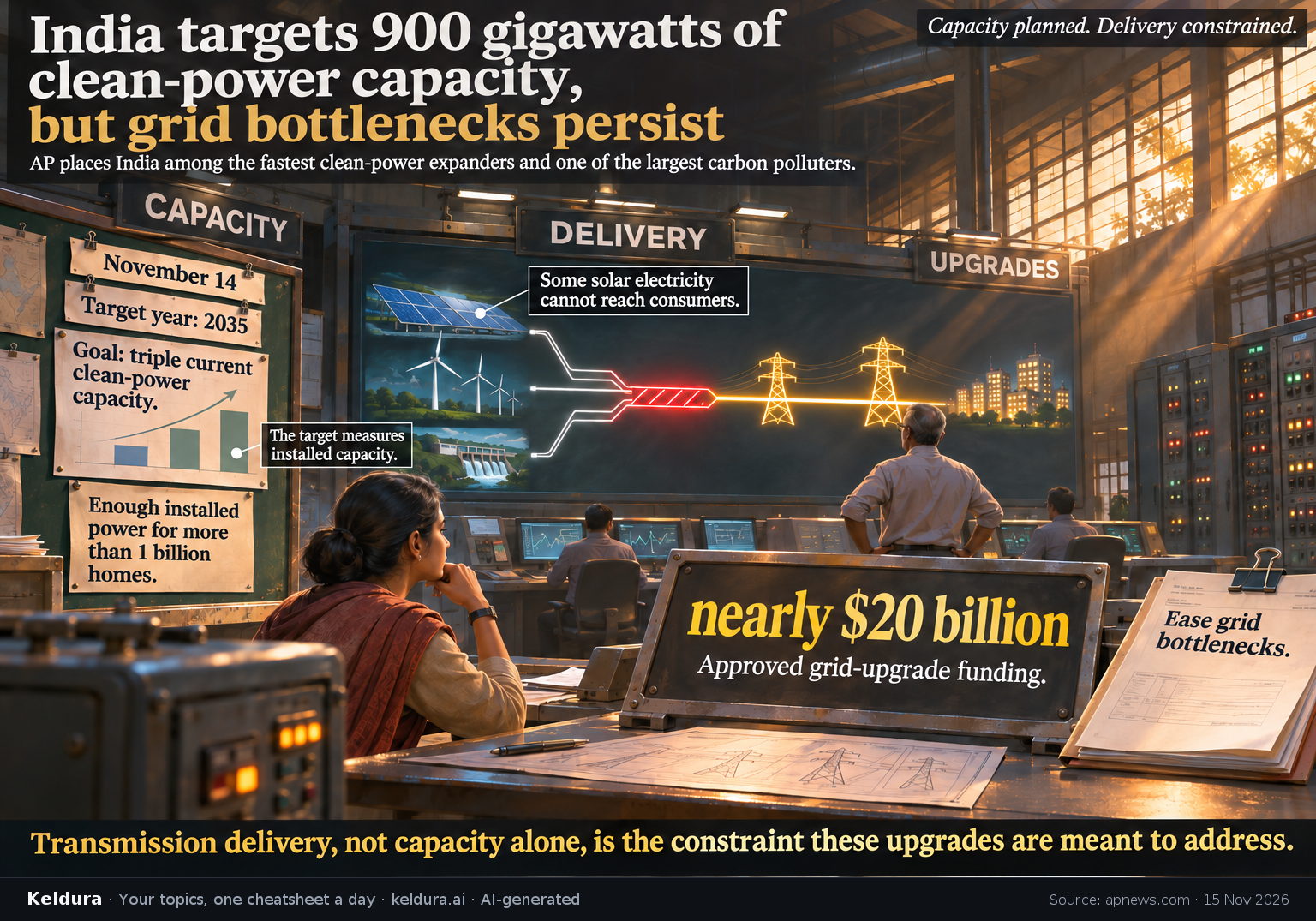
India has set a goal of tripling clean-energy capacity to 900 gigawatts by 2035, enough installed power to supply more than 1 billion homes, according to AP. It has also approved nearly $20 billion in grid upgrades to address bottlenecks that prevent some solar and wind electricity from reaching consumers. [7]
Why it matters: For electricity consumers, building solar and wind capacity is useful only if the power can reach them. India's nearly $20 billion grid approval addresses that delivery problem in the world's most populous country and one of its biggest carbon polluters. [7]
Key insights: The 900-gigawatt target concerns installed capacity; the grid investment addresses the separate task of delivering electricity to consumers. [7] | India is both one of the largest carbon polluters and among the fastest countries to expand clean power, making its build-out consequential for the transition away from fossil fuels. [7]
Cheatsheet facts: What happened: India set a 2035 goal of 900 gigawatts of clean-power capacity, triple its current capacity. [7] | Why: Grid bottlenecks already prevent some solar and wind electricity from reaching consumers. [7] | Who pays: India has approved nearly $20 billion in power-grid upgrades to ease those bottlenecks. [7] | The catch: The 900-gigawatt figure is a capacity goal for 2035, while some existing solar and wind output already faces delivery constraints. [7]
X copy pack
Edition complete
You've reached the end of this edition.