Every Climate & Environment cheatsheet Keldura Daily has published, newest first. Each cheatsheet is compiled by Keldura's AI from the sources it cites.
Young Canadians want courts to require climate protection, but can constitutional rights compel government action?
On October 26, a Vancouver trial opened in which 15 young Canadians are seeking binding climate protections from the federal government.
Why it matters: The case tests a question Canadian federal courts have not previously tried: whether climate protections are a constitutional issue. It also puts legal accountability alongside Canada's 2030 emission…
Storms have brought rain back to Sussex, but how much water is needed to rebuild its depleted supplies?
On October 25, reporting showed parts of Sussex remained in severe drought after two named storms, with South East Water restricting reservoir releases.
Why it matters: A wet weekend does not necessarily restore drinking-water security: South East Water has reduced daily releases from Ardingly into the River Ouse to protect supplies, linking the reservoir shortage d…
Sri Lanka needs renewable electricity, but can Mannar's wind expansion proceed without resolving residents' complaints?
On October 25, AFP reported that Sri Lanka had frozen new wind projects in Mannar while allowing already approved projects to proceed.
Why it matters: Sri Lanka aims to obtain 70 percent of its electricity from renewable sources by 2030, making local acceptance consequential for its energy transition as fuel and electricity costs rise. Mannar shows…
The government froze new Mannar wind projects but pledged to carry out those already approved. [1]
Why
Residents oppose further construction, blaming existing infrastructure for smaller catches and monsoon flooding. [1]
Who pays
Fishing households report reduced catches, while residents describe floodwater entering homes and overflowing toilets. [1]
The catch
Sri Lanka still targets 70 percent renewable electricity by 2030, and the supplied evidence does not establish that turbines caused the reported fishing losses. [1]
Countries have promised emissions cuts, but what happens when those promises still leave warming above the agreed limit?
On October 21, 2026, the United Nations Environment Programme raised its projected warming under national climate pledges and identified US policy and emissions as contributors.
Why it matters: The difference between promised action and a pathway back toward 1.5°C is substantial: UNEP's overshoot-limiting scenario requires greenhouse gas emissions to fall 70% by 2040 and 320 gigatonnes of c…
Full delivery of national pledges now implies 2.6°C warming by 2100, compared with a projection 0.1°C lower last year. [6]
Why
The report cites US withdrawal from the Paris Agreement and revised historical emissions; rising electricity demand and renewed coal generation also increased US emissions. [6]
The catch
The pathway back toward 1.5°C requires both a 70% emissions reduction by 2040 and removal of 320 gigatonnes of carbon dioxide by century's end. [4]
What's next
A measurable benchmark in UNEP's scenario is a 75% reduction in coal use for electricity generation by 2035. [4]
Governments have promised emissions cuts, but how much warming would delivering those promises still leave?
On October 21, the UN's latest Emissions Gap Report said current national policies put the world on course for 2.8°C of warming this century.
Why it matters: The gap is between two different futures, not simply between promises and compliance: even full delivery of current pledges would leave warming above 1.5°C. Bringing temperatures back down would also…
The UN assessment puts warming under current policies at 2.8°C this century, or 2.1°C if all climate promises are delivered. [6]
Why
Global fossil-fuel emissions rose again last year, and pledged reductions remain below the pace needed to limit the size and duration of a 1.5°C overshoot. [8]
The catch
Returning to 1.5°C would require both deeper emissions cuts and vast carbon removal; the assessment says socioeconomic and technological challenges make success uncertain. [6][8]
What's next
Watch emissions against the 2030 benchmark: an 18% reduction from 2025 levels, rather than the 5–8% implied by current pledges. [6][8]
Indonesia has accepted help against fires spreading regional haze, but how much land has actually burned?
On October 19, 2026, Indonesian officials said they had accepted firefighting assistance from Malaysia and Singapore.
Why it matters: The consequences extend beyond burned land: hundreds of thousands of people have become ill, schools have closed in Malaysia and East Timor, and Singapore's run of days reaching unhealthy air quality…
Green ammonia can fuel ships without direct CO2 emissions, but can a toxic fuel be handled safely at scale?
On October 13, Energy China Hydrogen Energy Co., Ltd., CMB.TECH and Jiangsu Andefu Energy Technology Co., Ltd. completed a ship-to-ship ammonia fueling operation in Zhoushan.
Why it matters: The operation links renewable fuel production with storage, transport, port handling and an ocean-going ship, providing a concrete example of the supply chain needed for ammonia-powered shipping. The…
Shenghang Yongle transferred 1,000 tonnes of green ammonia to Mineral Europa at Zhoushan anchorage. [9]
Why
Ammonia can be made with renewable energy and produces no direct CO2 emissions during combustion, making it a potential shipping fuel. [9]
The catch
Ammonia is toxic, requiring specialized equipment and stringent safety procedures for storage, transport and ship fueling. [9]
What's next
The release says Mineral Europa is due to cross the Pacific to Australia for commercial service, while 7,000 tonnes at Nanjing are intended for fueling in batches. [9]
Brazil has cut Amazon forest clearance to a record low, but how far is that from ending illegal deforestation?
On October 16, Brazil released satellite figures showing Amazon deforestation fell to 3,335 square kilometres in the year through July 2026.
Why it matters: The figures show a substantial reduction in annual forest loss rather than simply a new pledge: deforestation has fallen every year since 2022 and is down 71.2 percent over four years. The distinctio…
Amazon forest clearance fell to 3,335 square kilometres in August 2025–July 2026, the lowest annual figure since records began in 1988. [4][5]
Why
AFP attributes the decline to greater monitoring and tougher penalties for illegal logging. [4]
The catch
A record low still means 3,335 square kilometres were cleared; Lula's stated goal is zero illegal deforestation by 2030, not zero total clearance. [4]
What's next
The stated policy benchmark is zero illegal deforestation by 2030; the current annual clearance figure is about 42 percent below the previous year's. [4]
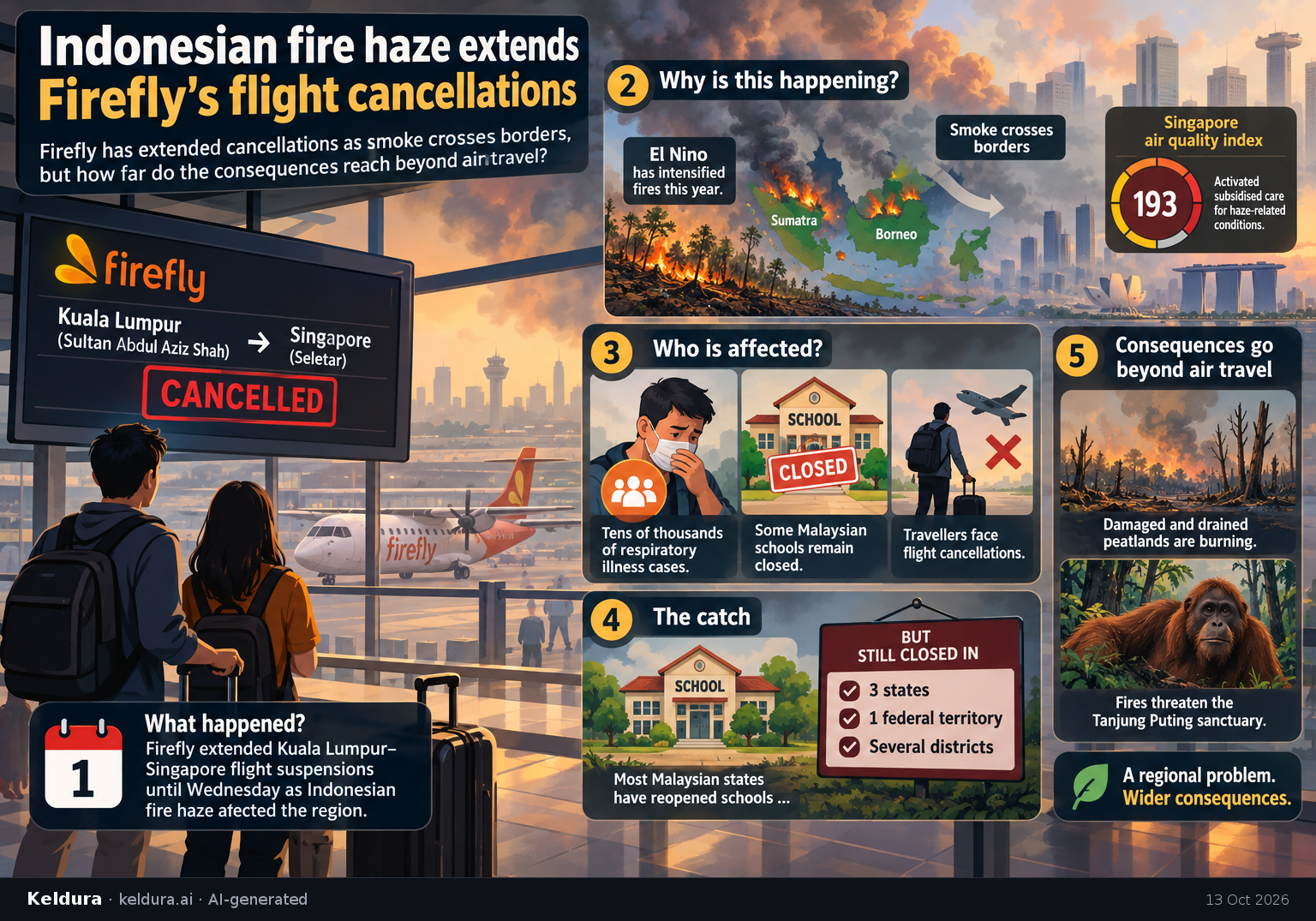
Firefly has extended cancellations as smoke crosses borders, but how far do the consequences reach beyond air travel?
On October 13, 2026, AFP reported that Firefly had extended Kuala Lumpur–Singapore flight cancellations until Wednesday because of Indonesian fire haze.
Why it matters: This is an environmental disruption with several routes into daily life: cancelled flights, respiratory illness and interrupted schooling. The haze has caused tens of thousands of respiratory illness…
Firefly extended Kuala Lumpur–Singapore flight suspensions until Wednesday as Indonesian fire haze affected the region. [5]
Why
The airline described the suspension as a proactive safety measure; El Nino has intensified fires on Borneo and Sumatra. [5]
Who pays
Travellers face cancellations, communities have recorded tens of thousands of respiratory illness cases, and some Malaysian schools remain closed. [5]
The catch
Air quality improved enough for most Malaysian states to reopen schools, but closures continued in three states, one federal territory and several districts. [5]
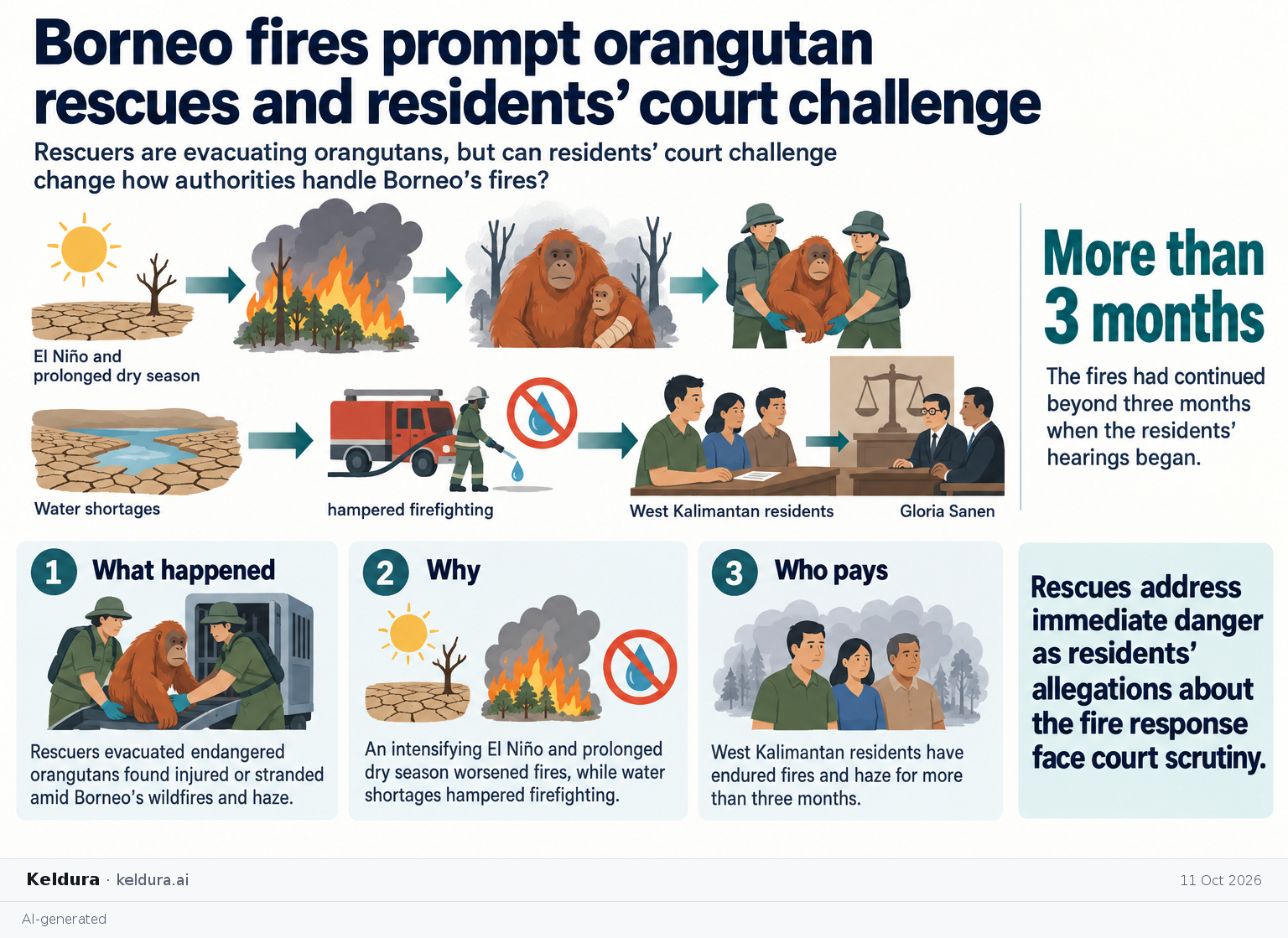
Rescuers are evacuating orangutans, but can residents’ court challenge change how authorities handle Borneo’s fires?
On October 10, 2026, rescuers were evacuating endangered orangutans in Borneo, after residents’ hearings over authorities’ handling of the fires began that week.
Why it matters: The fires are affecting both endangered wildlife and residents, while water shortages are hampering firefighting. The court case puts authorities’ handling and supervision of the response under scrut…
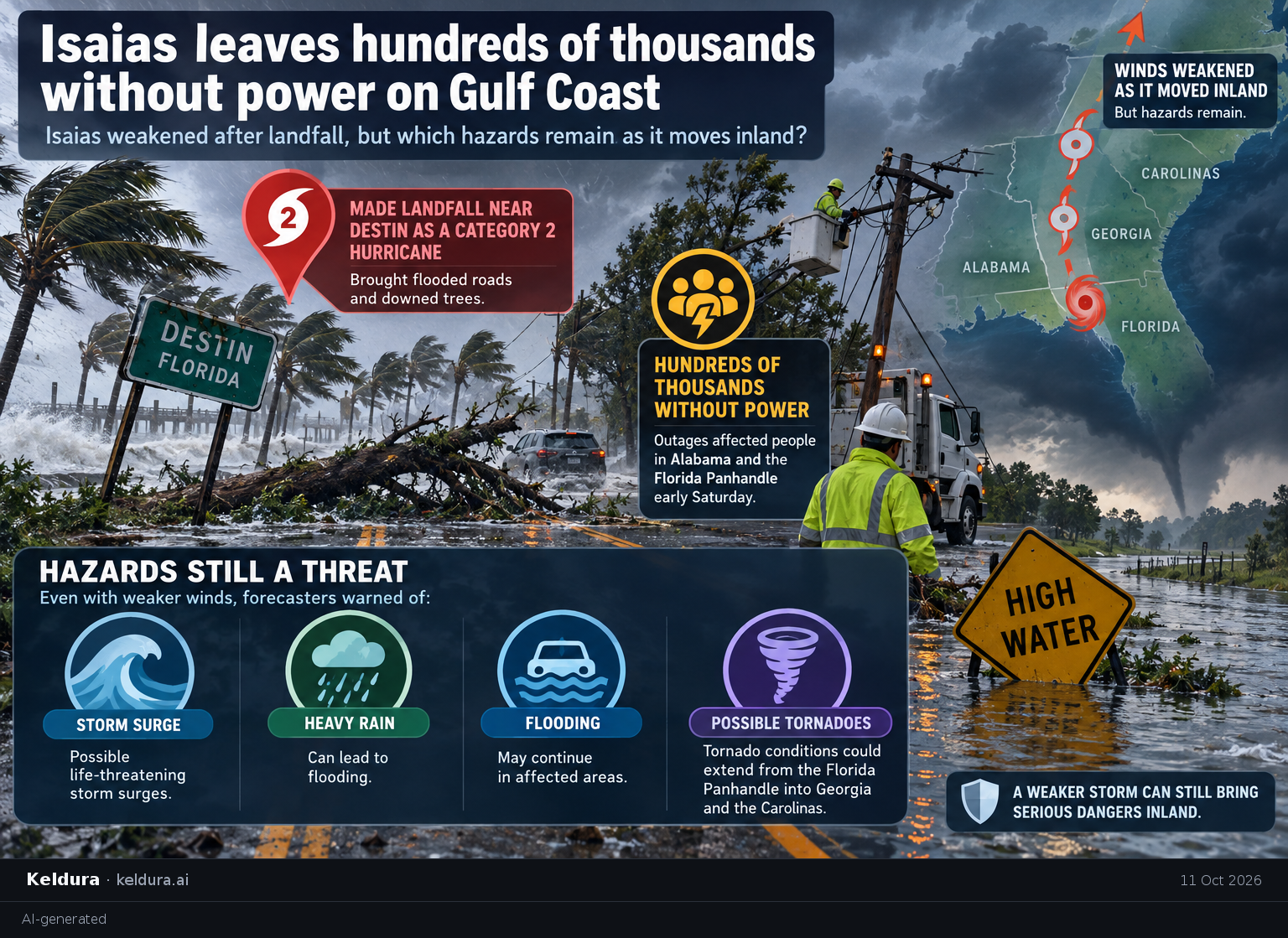
Isaias weakened after landfall, but which hazards remain as it moves inland?
On October 10, 2026, hundreds of thousands in Alabama and the Florida Panhandle were without power after Isaias made landfall near Destin on Friday as a Category 2 hurricane.
Why it matters: Falling wind speeds do not mean all danger has passed: coastal storm-surge risks and inland rain and tornado risks can persist as the storm moves away from its landfall location. Widespread outages a…
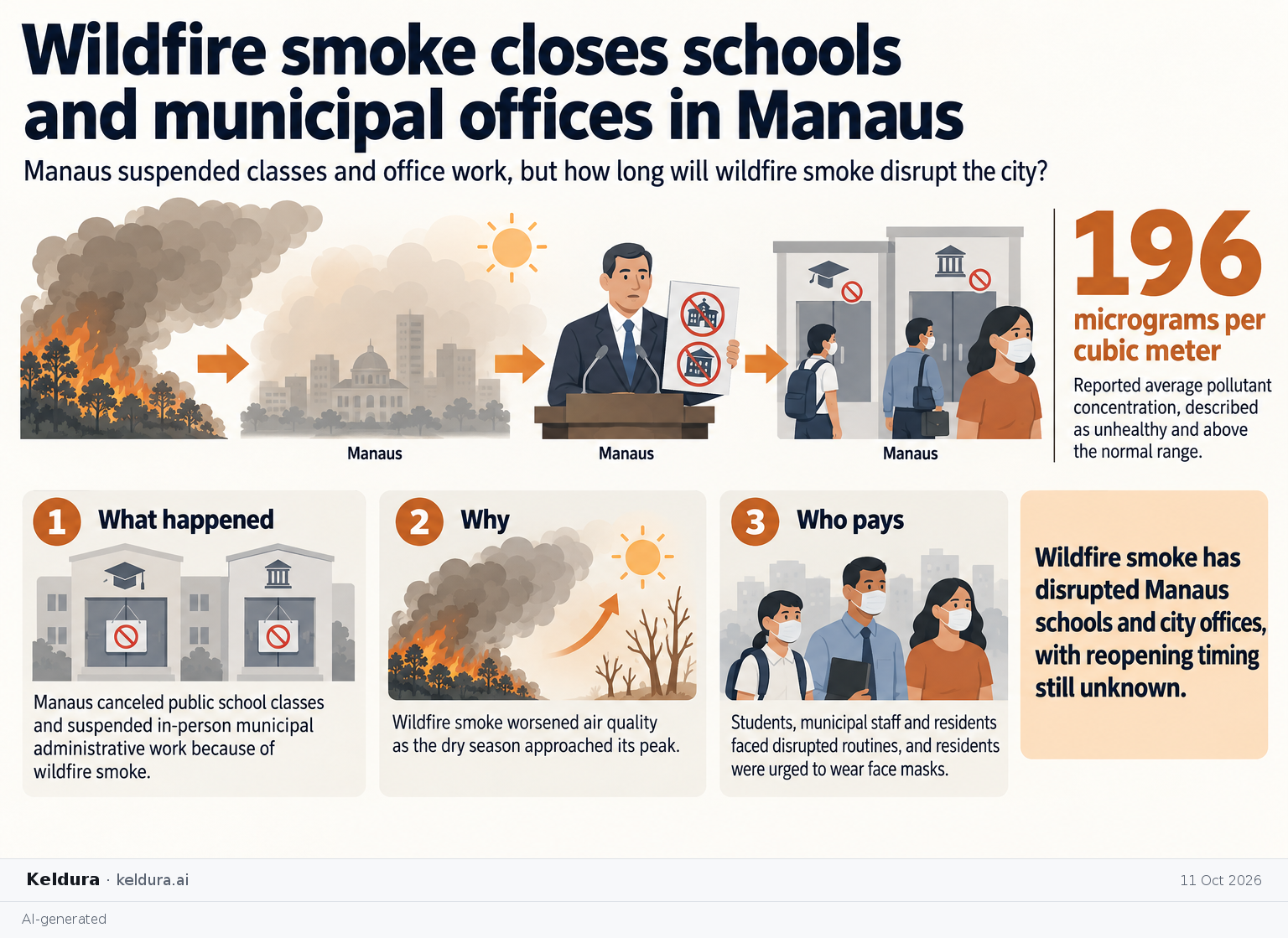
Manaus suspended classes and office work, but how long will wildfire smoke disrupt the city?
On October 9, 2026, Manaus suspended in-person municipal administrative work and canceled public school classes as wildfire smoke worsened air quality.
Why it matters: Wildfire impacts reached schools and city services, not just areas directly affected by flames. The closures show how degraded air quality can interrupt daily routines across an urban population.