Every Climate & Environment cheatsheet Keldura Daily has published, newest first. Each cheatsheet is compiled by Keldura's AI from the sources it cites.
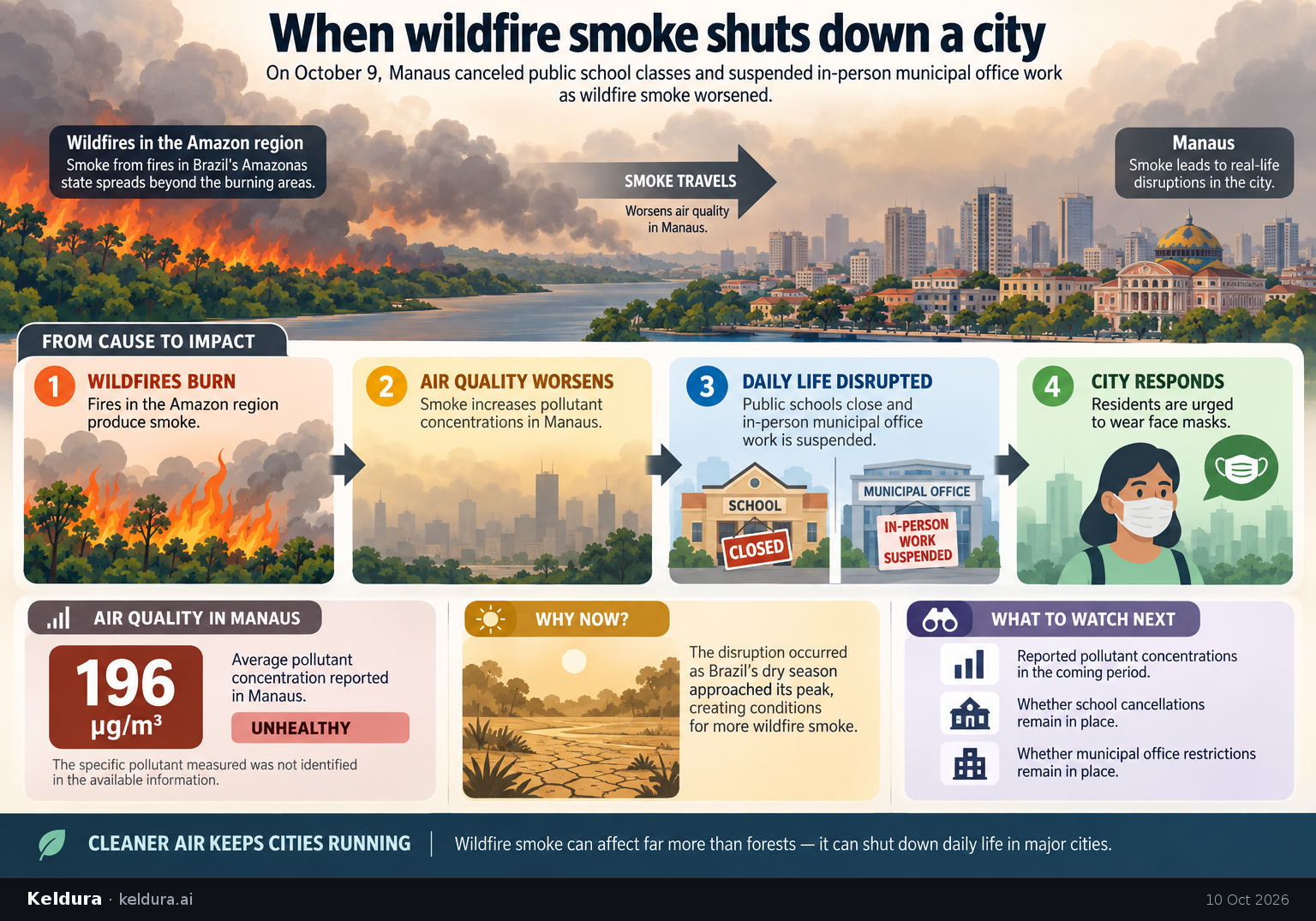
On October 9, Manaus canceled public school classes and suspended in-person municipal office work as wildfire smoke worsened.
Why it matters: The disruption extends beyond the burning areas: smoke has made air quality a reason to interrupt education and municipal office operations in Brazil’s largest Amazon region city.
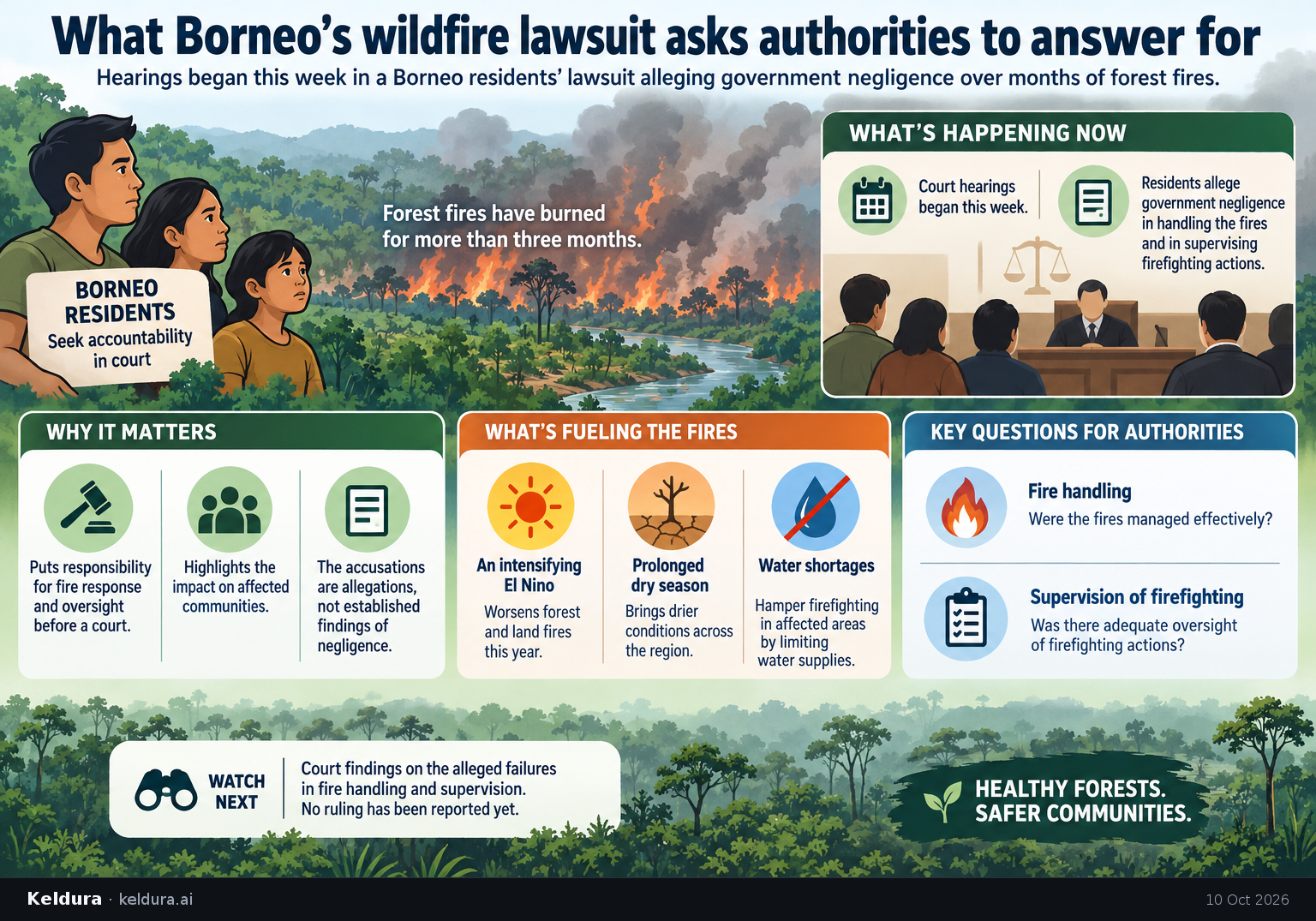
Hearings began this week in a Borneo residents’ lawsuit alleging government negligence over months of forest fires.
Why it matters: The case puts responsibility for fire response and oversight before a court, while prolonged dry conditions and water shortages are hampering firefighting. The residents’ accusations remain allegatio…
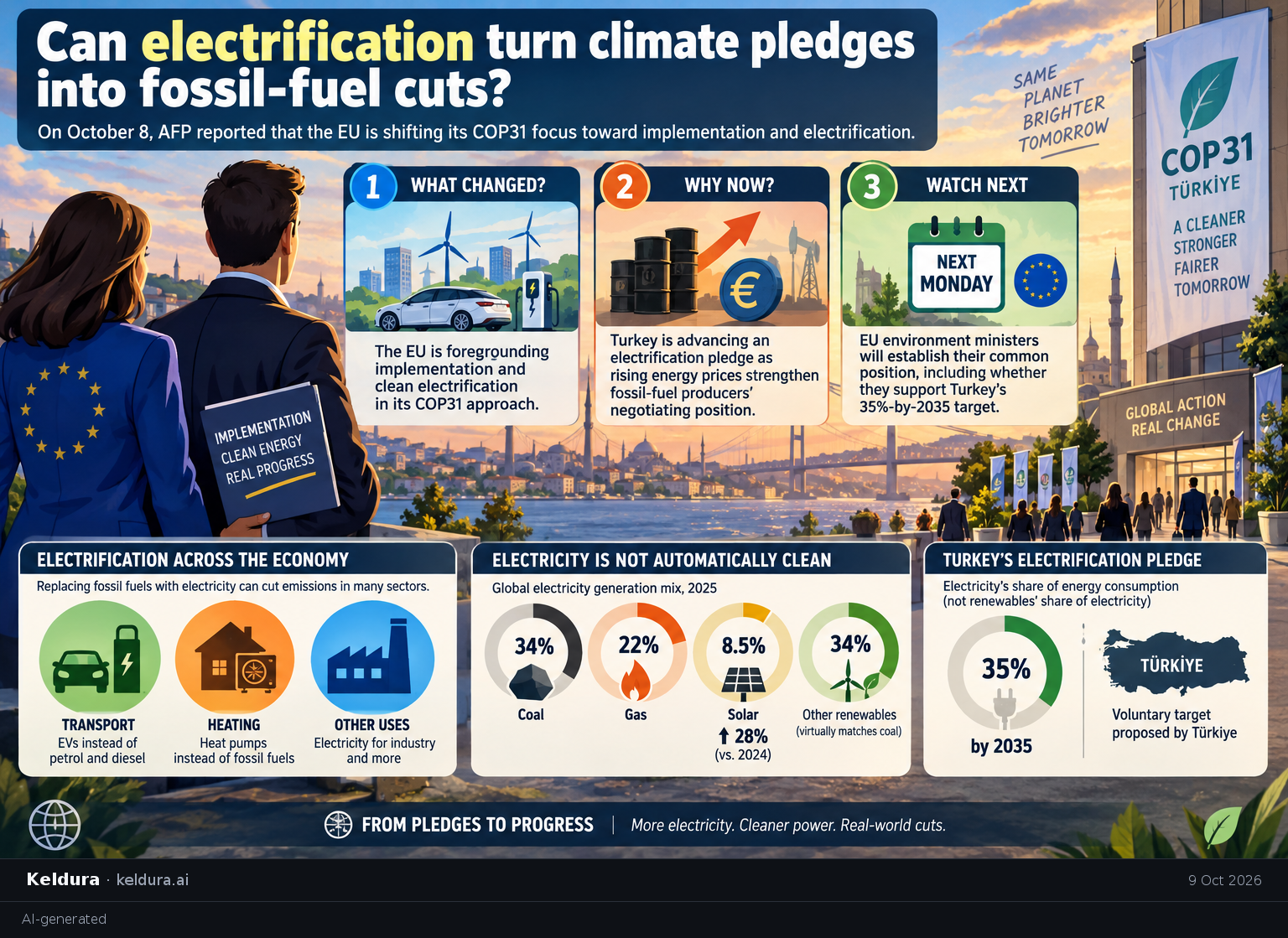
On October 8, AFP reported that the EU is shifting its COP31 focus toward implementation and electrification.
Why it matters: Electrification links climate diplomacy to practical changes in transport, heating and other energy uses, but electricity is not automatically clean: coal and gas still supplied 34 percent and 22 per…
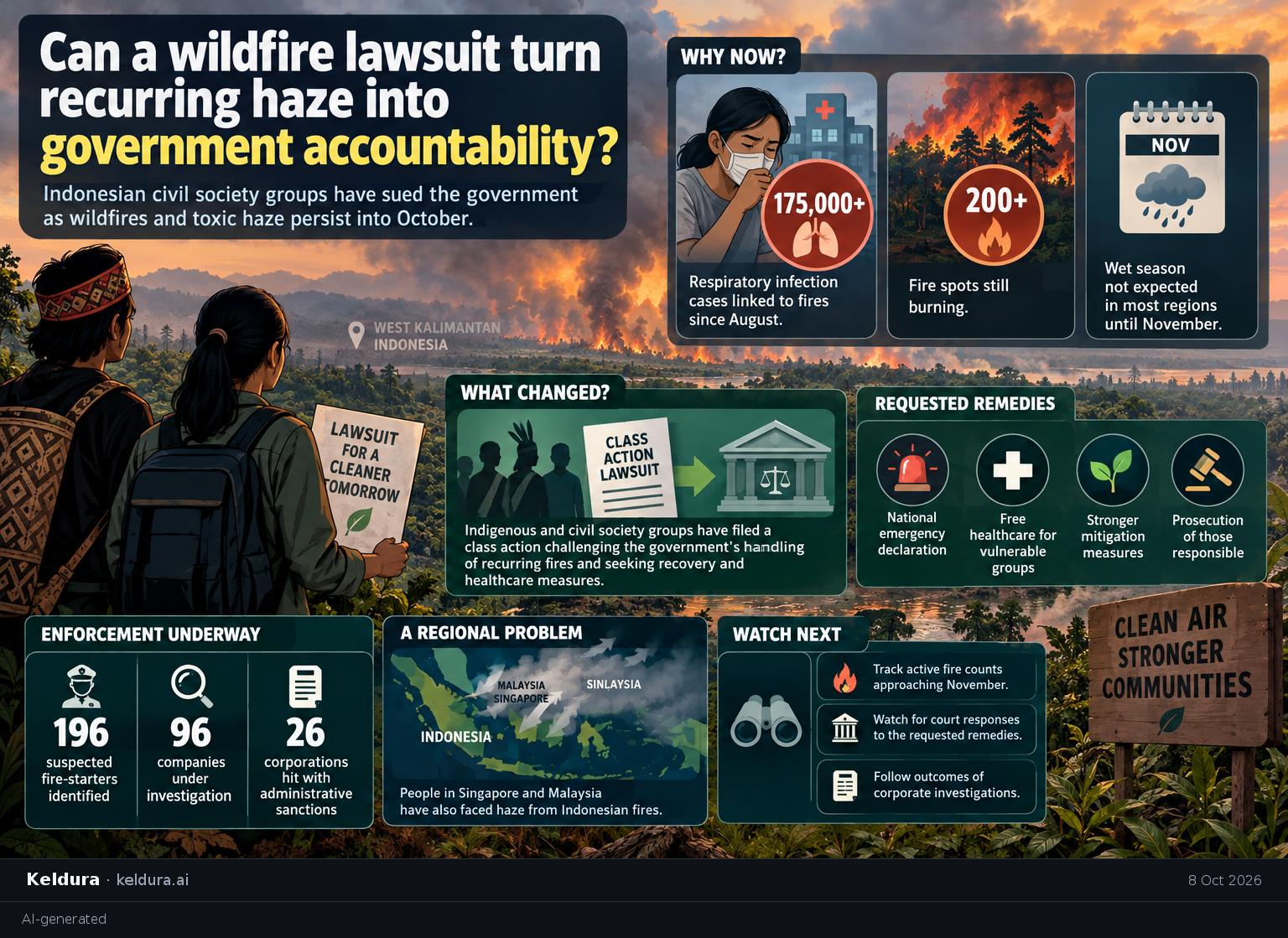
Indonesian civil society groups have sued the government as wildfires and toxic haze persist into October.
Why it matters: The case seeks to connect fire prevention with recovery obligations, including healthcare costs, rather than treating firefighting as the entire response. Its outcome is uncertain: an earlier lawsuit…
A new class action challenges government handling of recurring fires and seeks recovery and healthcare measures. [2][4]
Why now
Fires remain active, with at least 175,000 linked respiratory infections recorded since August and more than 200 fire spots still burning. [2]
Watch next
Track active fire counts approaching the expected November wet season, court responses to the requested remedies and outcomes of corporate investigations. [2]
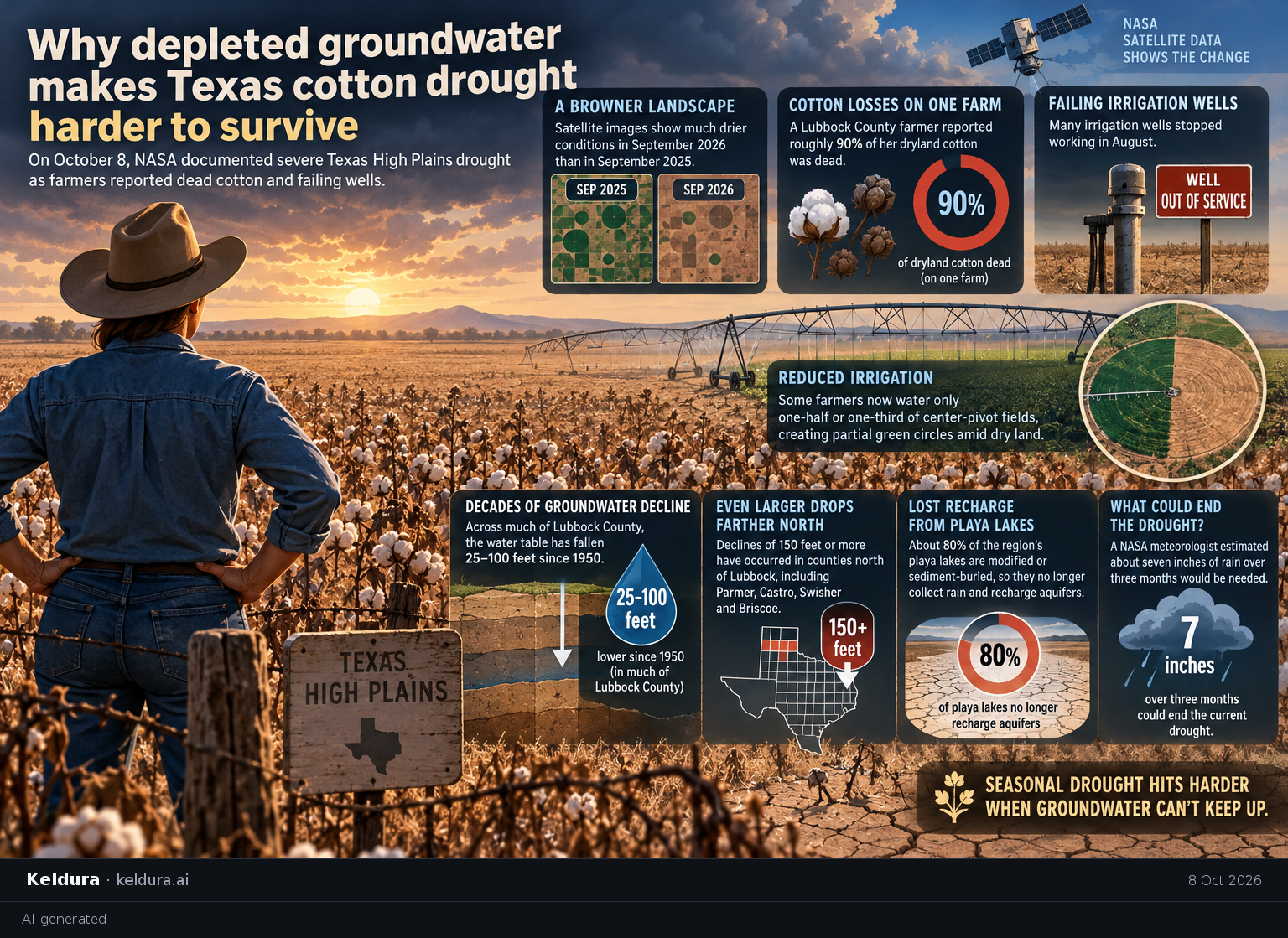
On October 8, NASA documented severe Texas High Plains drought as farmers reported dead cotton and failing wells.
Why it matters: Groundwater is becoming a less reliable fallback when rain fails, leaving farmers exposed to both seasonal drought and long-term aquifer depletion. Recharge is also constrained: NASA reports that abo…
The 2026 drought coincided with failing irrigation wells and severe cotton losses; satellite images show a browner landscape than in September 2025. [5]
Why now
Seasonal dryness is hitting an already depleted aquifer, while many playa lakes no longer provide their natural recharge function. [5]
Watch next
Track three-month rainfall totals and U.S. Drought Monitor conditions against the cited estimate of roughly seven inches needed to end the current drought. [5]
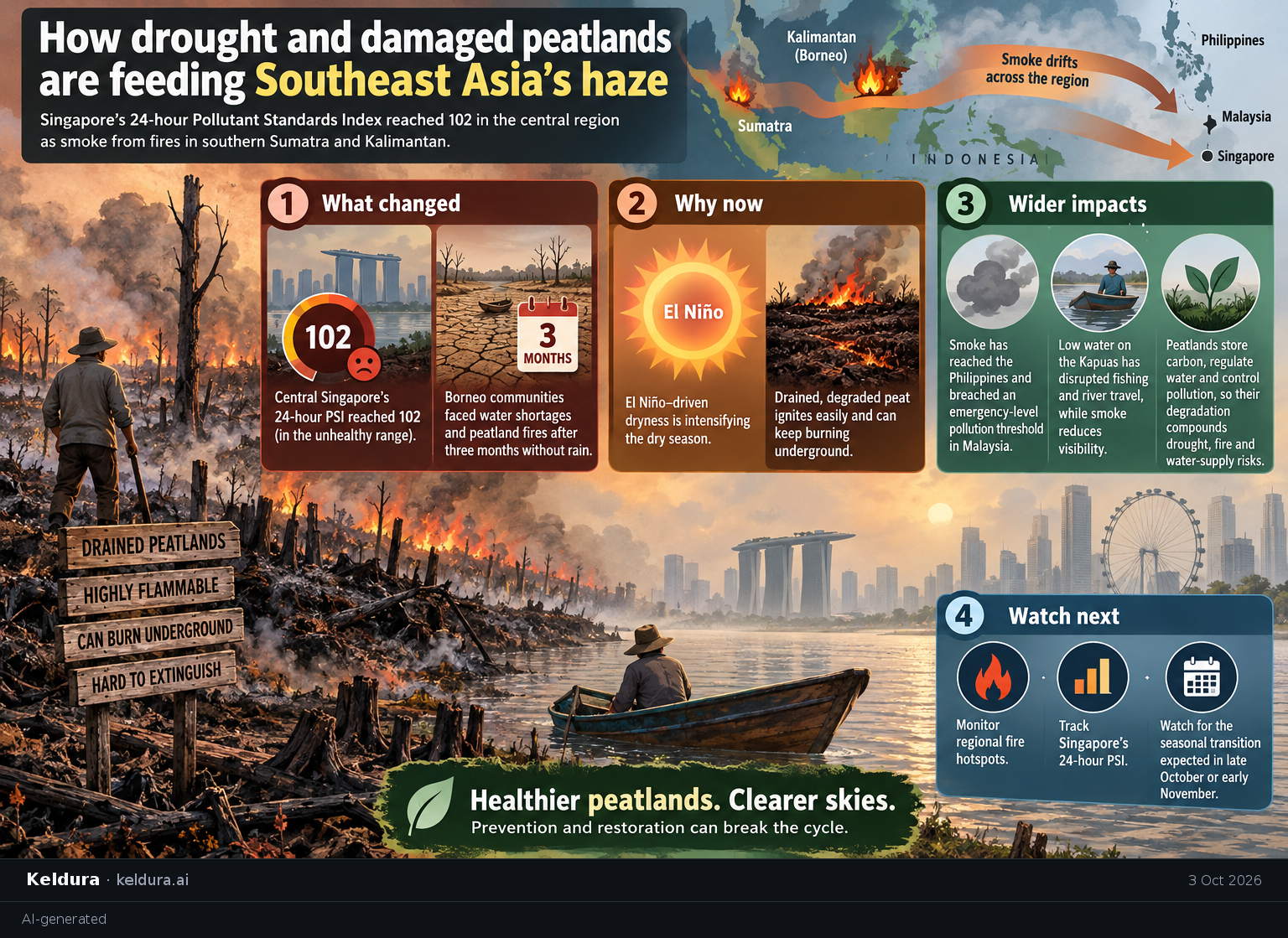
Singapore’s 24-hour Pollutant Standards Index reached 102 in the central region as smoke from fires in southern Sumatra and Kalimantan.
Why it matters: Drained peat is highly flammable, can burn underground and is difficult to extinguish, allowing local land degradation to become a prolonged regional air-pollution problem. Strong El Niño conditions…
Central Singapore’s 24-hour PSI reached 102, while Borneo communities experienced water shortages and peatland fires after three months without rain.[3][5]
Why now
El Niño-driven dryness is interacting with drained, degraded peat that ignites easily and can keep burning underground.[3][5]
Watch next
Monitor regional fire hotspots, Singapore’s 24-hour PSI and the timing of the seasonal transition expected in late October or early November.[3]
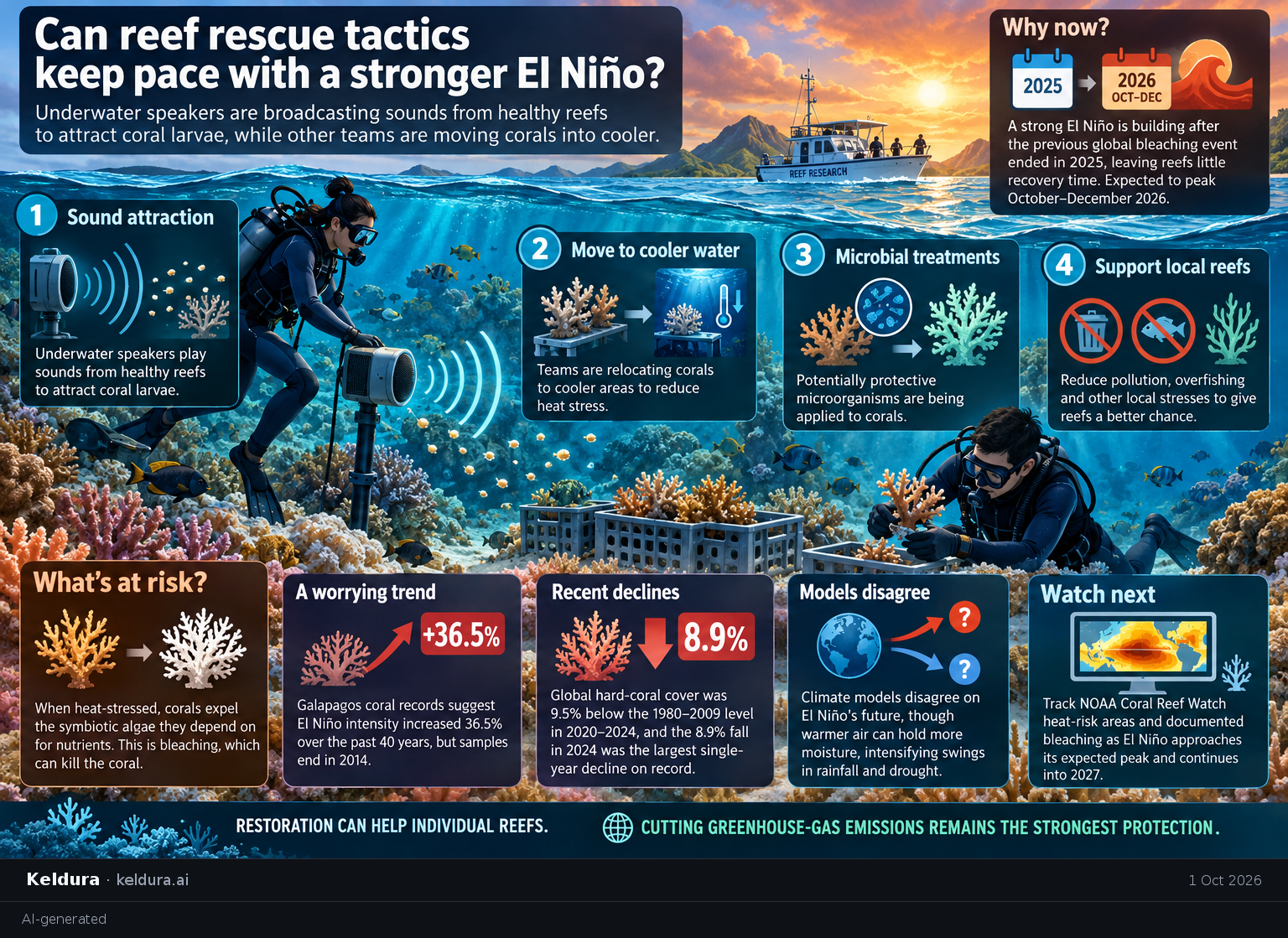
Underwater speakers are broadcasting sounds from healthy reefs to attract coral larvae, while other teams are moving corals into cooler.
Why it matters: Global hard-coral cover in 2020–2024 was 9.5% below the 1980–2009 level, and the 8.9% fall in 2024 was the largest recorded single-year decline. Restoration can support individual reefs, but scientis…
Researchers are pairing acoustic attraction, coral relocation and microbial treatments with efforts to reduce local reef stresses.[2]
Why now
A strong El Niño is building after the previous global bleaching event ended in 2025, leaving reefs little recovery time.[2][6]
Watch next
Track NOAA Coral Reef Watch heat-risk areas and documented bleaching as El Niño approaches its expected October–December 2026 peak and continues into 2027.[2][6]
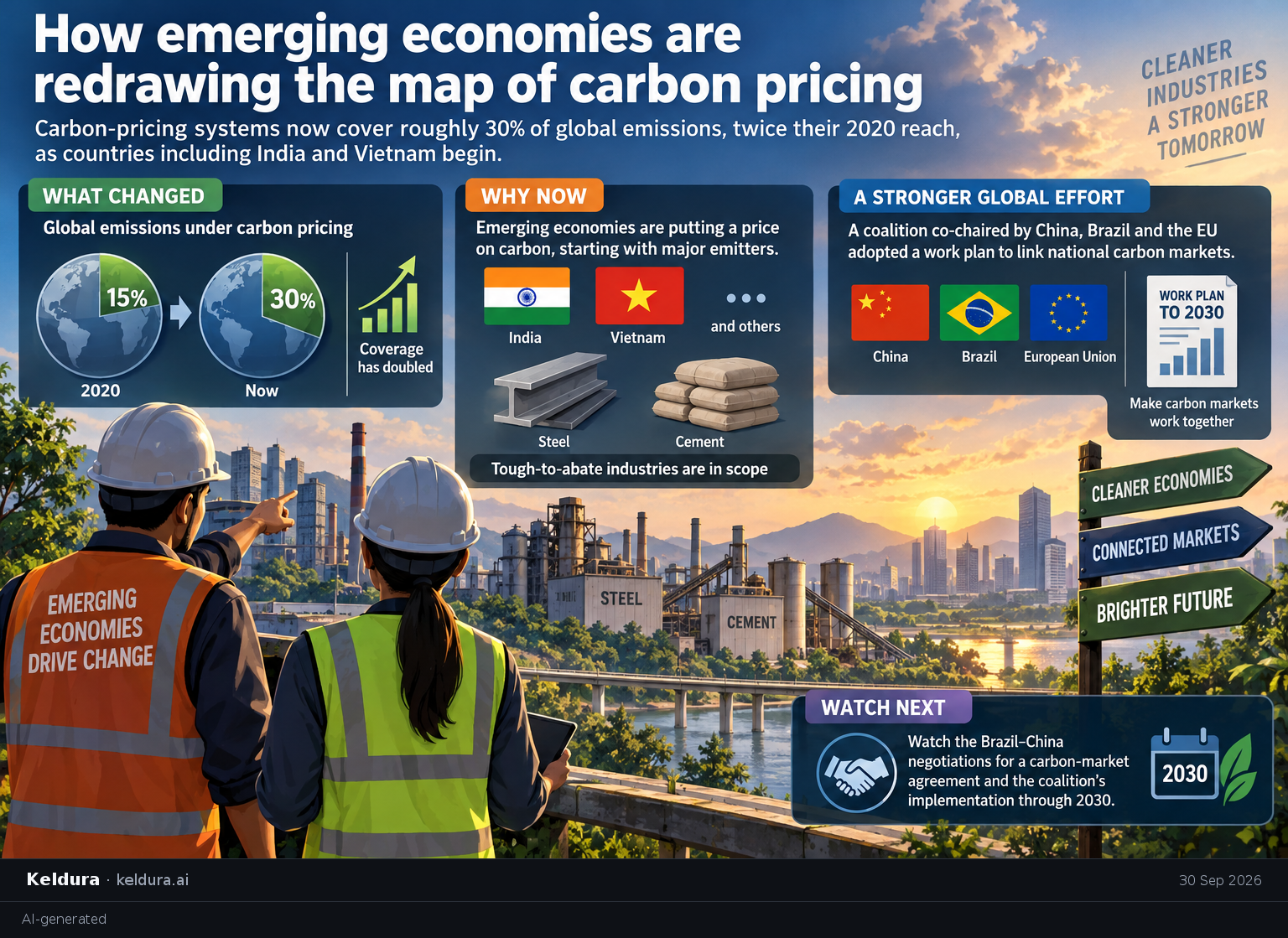
Carbon-pricing systems now cover roughly 30% of global emissions, twice their 2020 reach, as countries including India and Vietnam begin.
Why it matters: Broader coverage puts more industrial emissions under an explicit cost or cap, while cooperation between markets could determine whether national systems can interact rather than remain isolated.
Carbon-pricing coverage reached roughly 30% of global emissions, while the China-Brazil-EU coalition adopted a work plan for linking national markets.[2][3]
Why now
India, Vietnam and other emerging economies are extending carbon constraints to major industrial polluters.[2]
Watch next
Watch the Brazil-China negotiations for a carbon-market agreement and the coalition’s implementation of its work plan through 2030.[3]
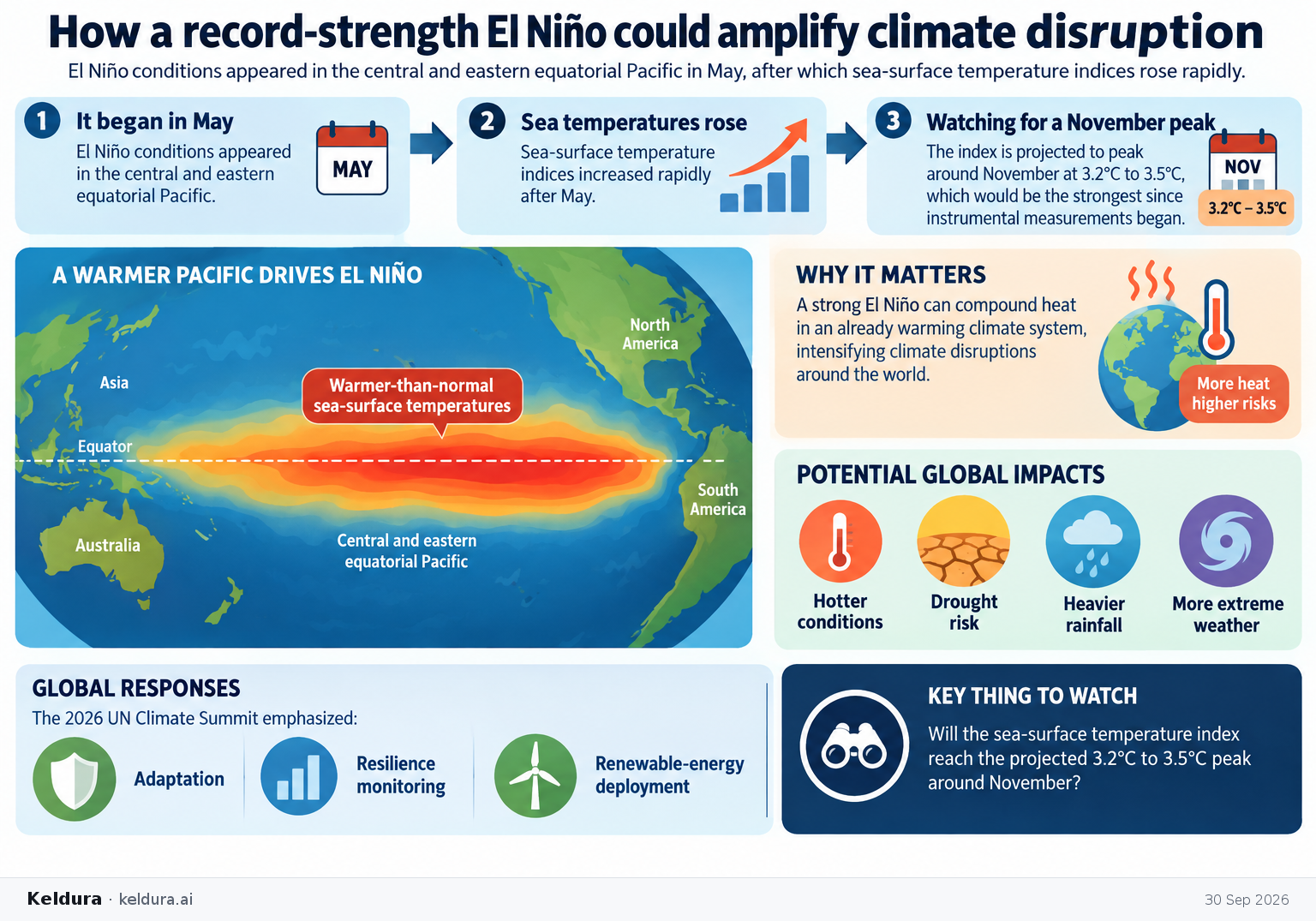
El Niño conditions appeared in the central and eastern equatorial Pacific in May, after which sea-surface temperature indices rose rapidly.
Why it matters: The projected peak provides a measurable near-term indicator of an extreme Pacific warming event that can compound heat in an already warming climate system.
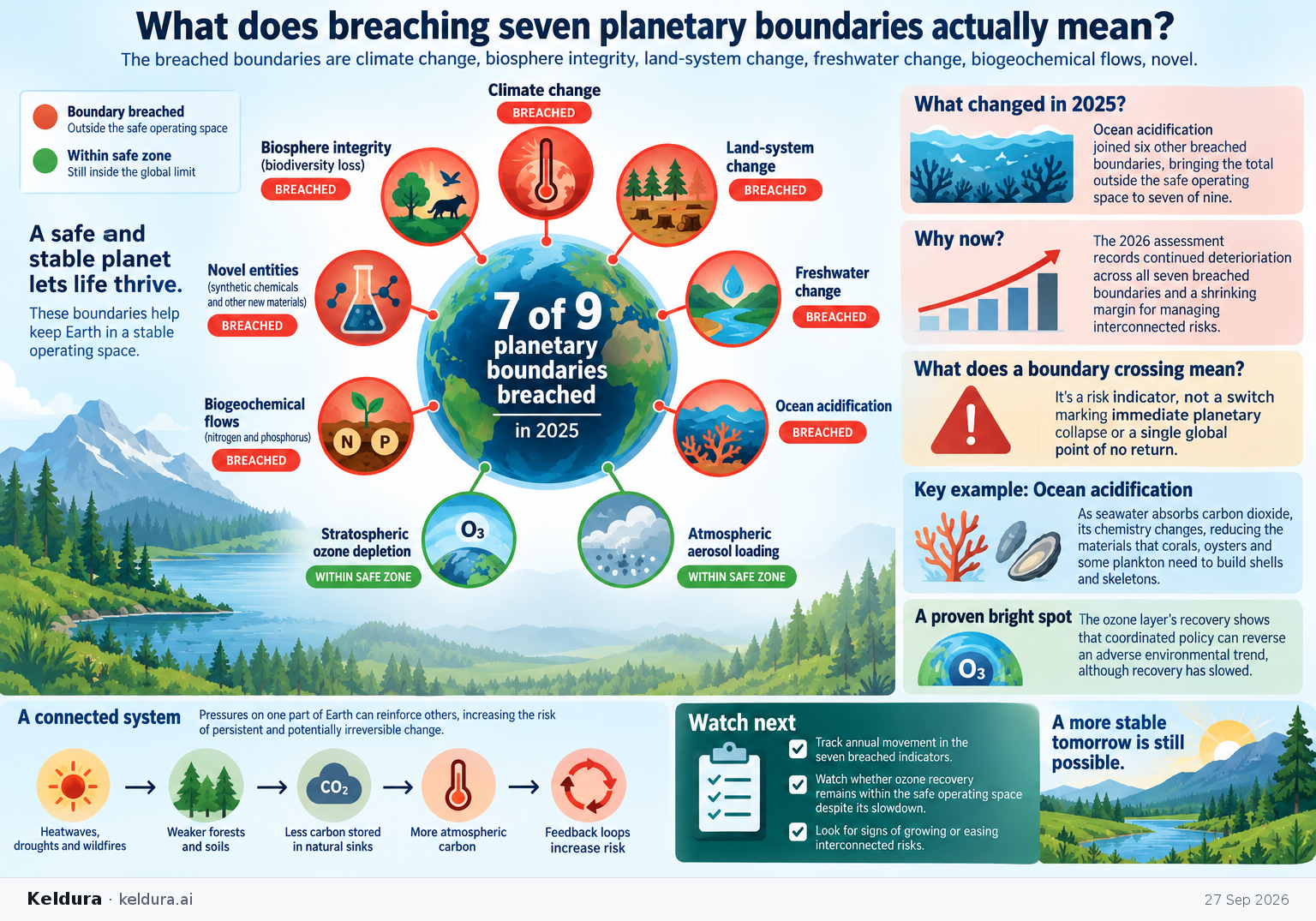
The breached boundaries are climate change, biosphere integrity, land-system change, freshwater change, biogeochemical flows, novel.
Why it matters: The framework tracks interacting pressures rather than isolated environmental problems: damage to climate, oceans, ecosystems, freshwater and soils can reinforce other stresses, increasing the risk o…
Ocean acidification joined six other breached boundaries in 2025, bringing the total outside the safe operating space to seven of nine.[1]
Why now
The 2026 assessment records continued deterioration across all seven breached boundaries and a shrinking margin for managing interconnected risks.[1][5]
Watch next
Track annual movement in the seven breached indicators and whether ozone recovery remains within the safe operating space despite its slowdown.[1]
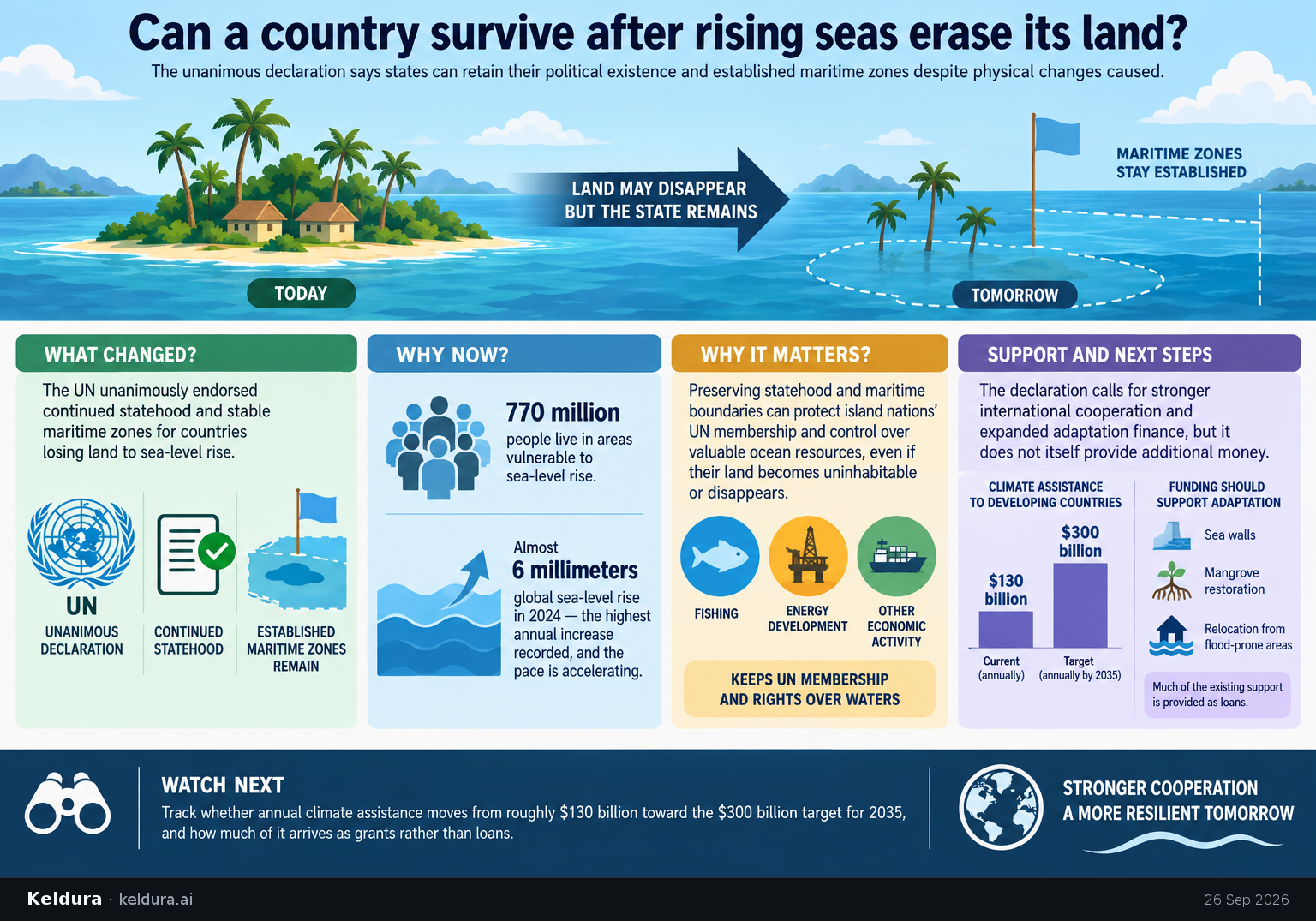
The unanimous declaration says states can retain their political existence and established maritime zones despite physical changes caused.
Why it matters: Preserving statehood and maritime boundaries could protect island nations’ UN membership and control over waters used for fishing, energy development and other economic activity, even if their land b…
The UN unanimously endorsed continued statehood and stable maritime zones for countries losing land to sea-level rise.[6]
Why now
About 770 million people live in vulnerable areas, while the recorded annual sea-level increase reached almost 6 millimeters in 2024.[2]
Watch next
Track whether annual climate assistance moves from roughly $130 billion toward the agreed $300 billion target for 2035, and how much arrives as grants rather than loans.[6]
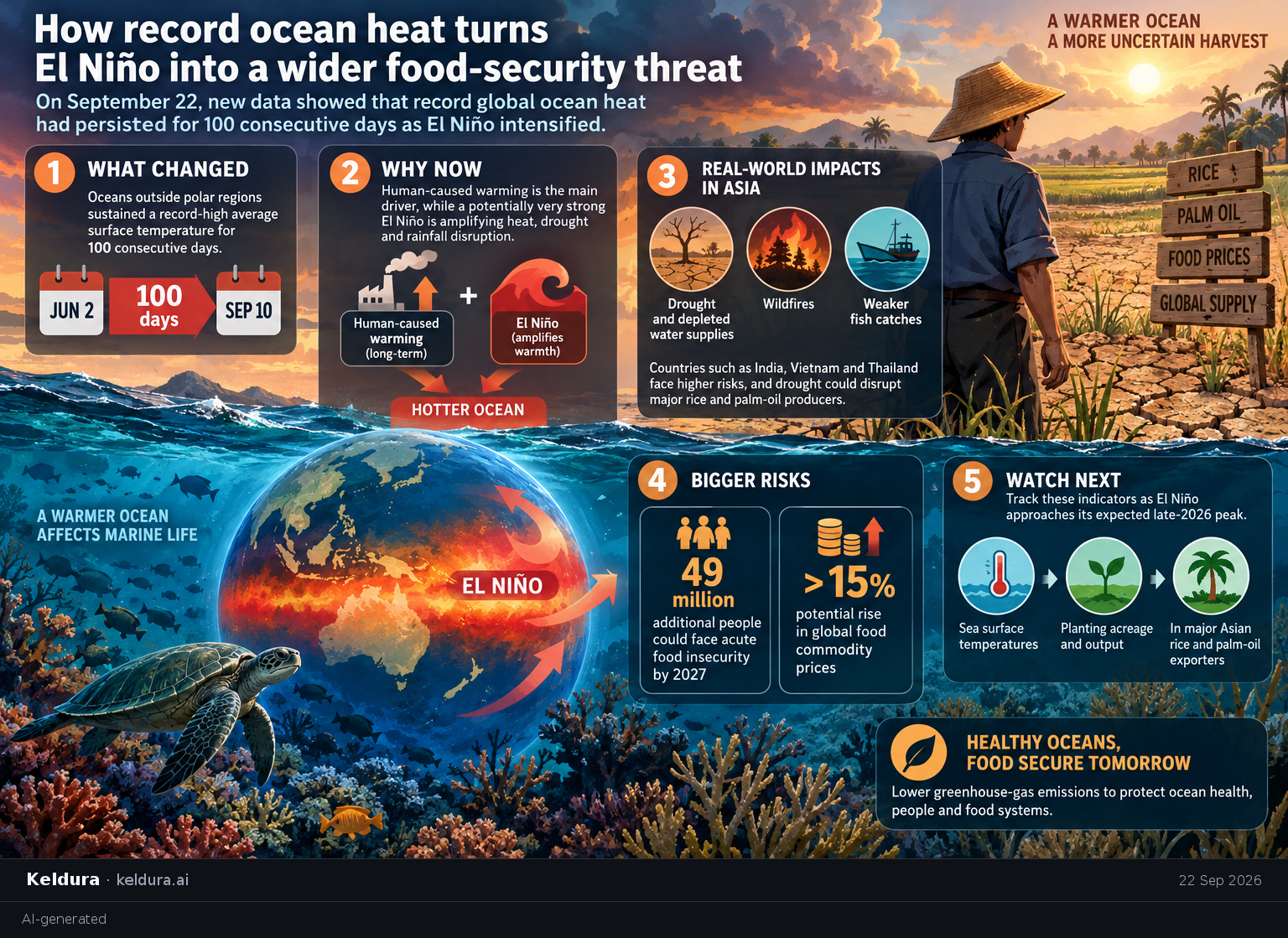
On September 22, new data showed that record global ocean heat had persisted for 100 consecutive days as El Niño intensified.
Why it matters: More than 90 per cent of the excess heat associated with fossil-fuel emissions enters the ocean, affecting marine ecosystems, weather patterns and economies dependent on fisheries and coastal protect…
Oceans outside polar regions sustained a record-high average surface temperature for 100 consecutive days from June 2 through September 10 [2].
Why now
Human-caused warming remains the main driver, while a potentially very strong El Niño is amplifying heat, drought and rainfall disruption [2][3].
Watch next
Track sea surface temperatures as El Niño approaches its expected late-2026 peak, alongside planting acreage and output in major Asian rice and palm-oil exporters [2][3].
That's the desk. Every cheatsheet here started as a link. Yours can too.