Every Climate & Environment cheatsheet Keldura Daily has published, newest first. Each cheatsheet is compiled by Keldura's AI from the sources it cites.
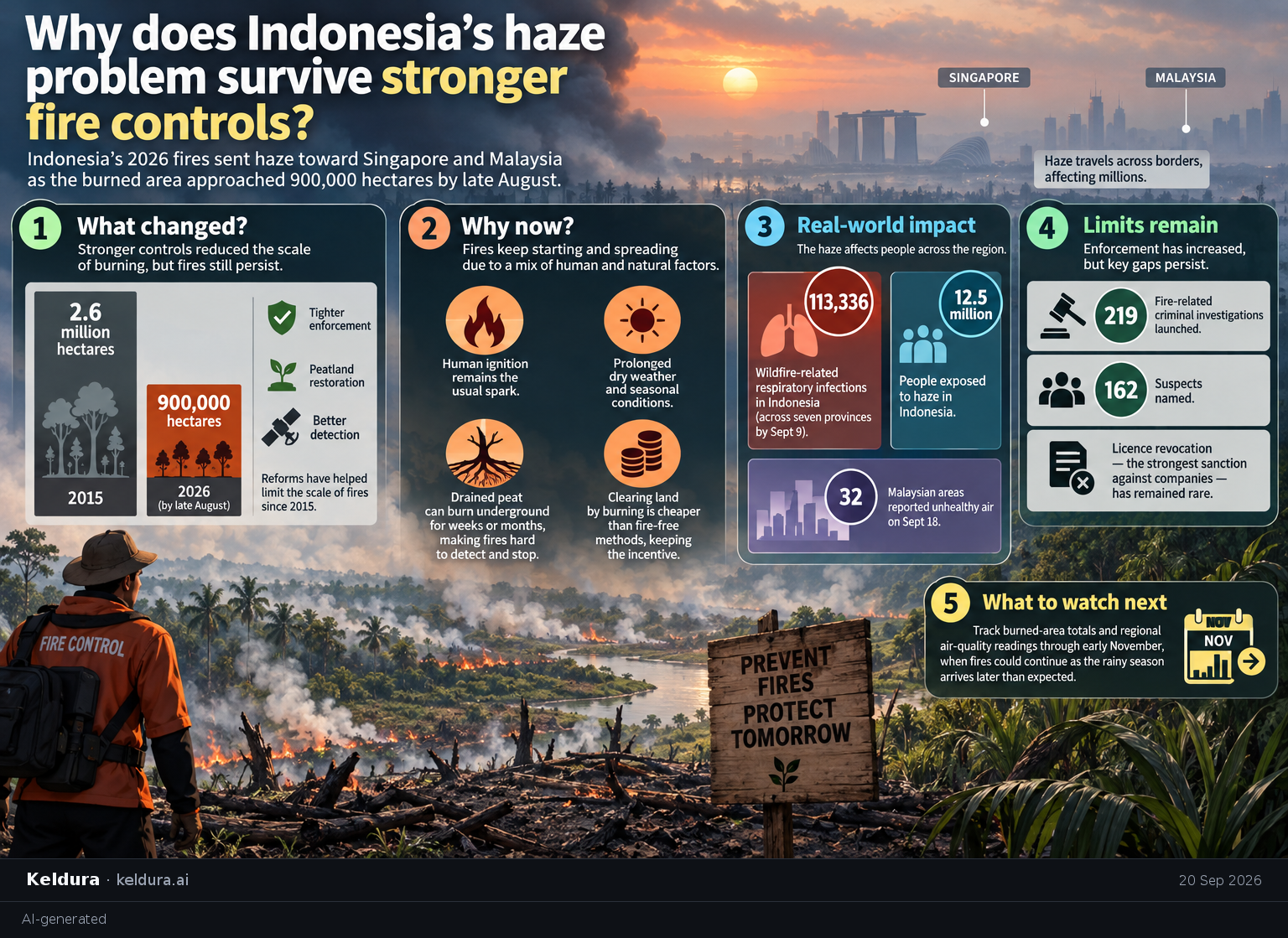
Indonesia’s 2026 fires sent haze toward Singapore and Malaysia as the burned area approached 900,000 hectares by late August.
Why it matters: The consequences extend beyond burned land: Indonesia recorded 113,336 wildfire-related respiratory infections across seven provinces by Sept 9, with 12.5 million people exposed to haze, while 32 Mal…
Post-2015 reforms reduced the scale of burning, but nearly 900,000 hectares had still burned by late August 2026.[1]
Why now
Human ignition remains the usual spark, while prolonged dry weather, drained peat and seasonal conditions allow fires to spread and persist.[1][4]
Watch next
Track burned-area totals and regional air-quality readings through early November, when Indonesia’s forestry minister said fires could continue as the rainy season arrives later than expected.[1][4]
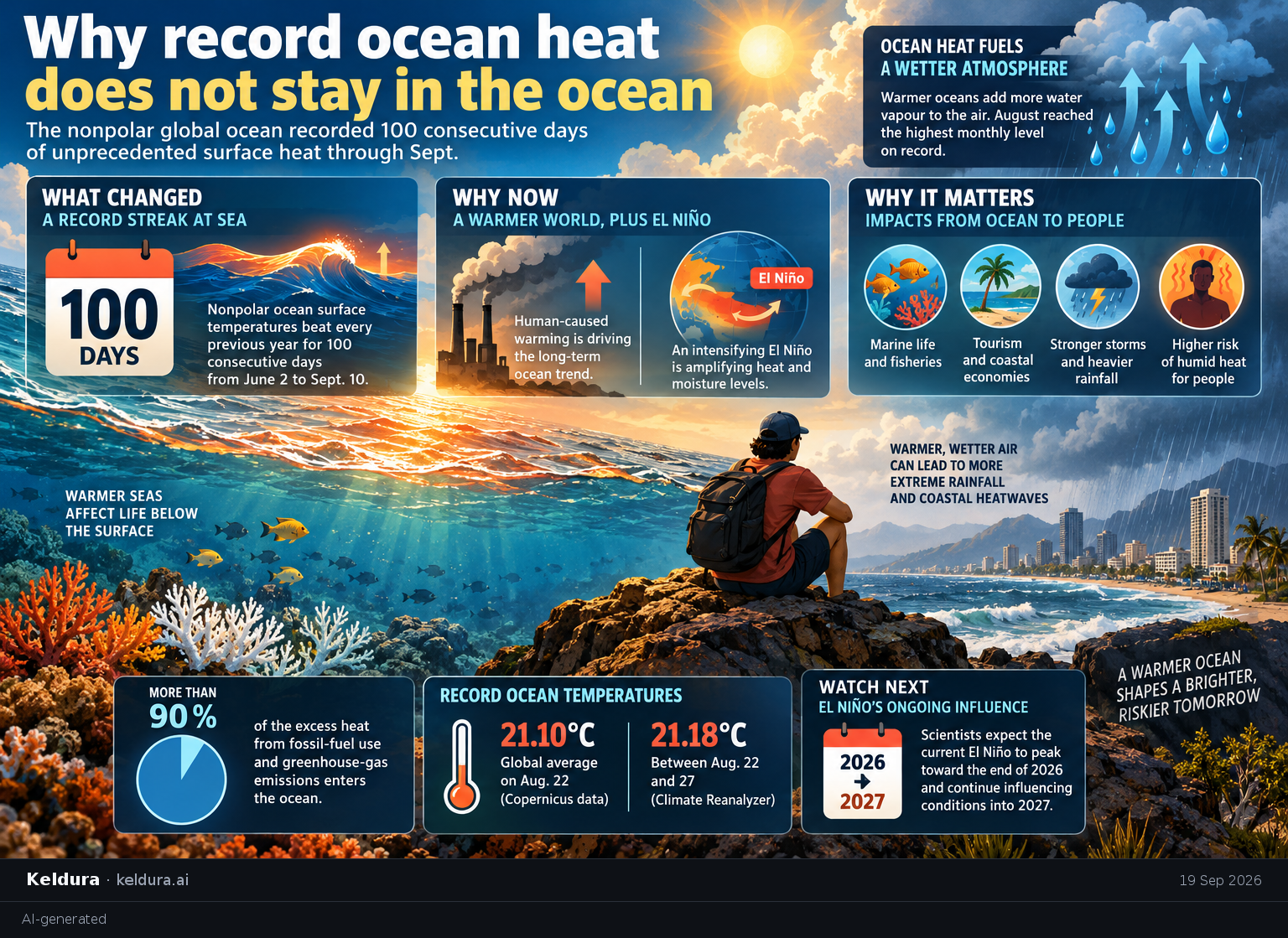
The nonpolar global ocean recorded 100 consecutive days of unprecedented surface heat through Sept.
Why it matters: Hotter seas can disrupt marine food chains, fisheries, tourism, coral and weather, while warmer, wetter air increases the risks of extreme rainfall, humid heat and intensified coastal heatwaves.
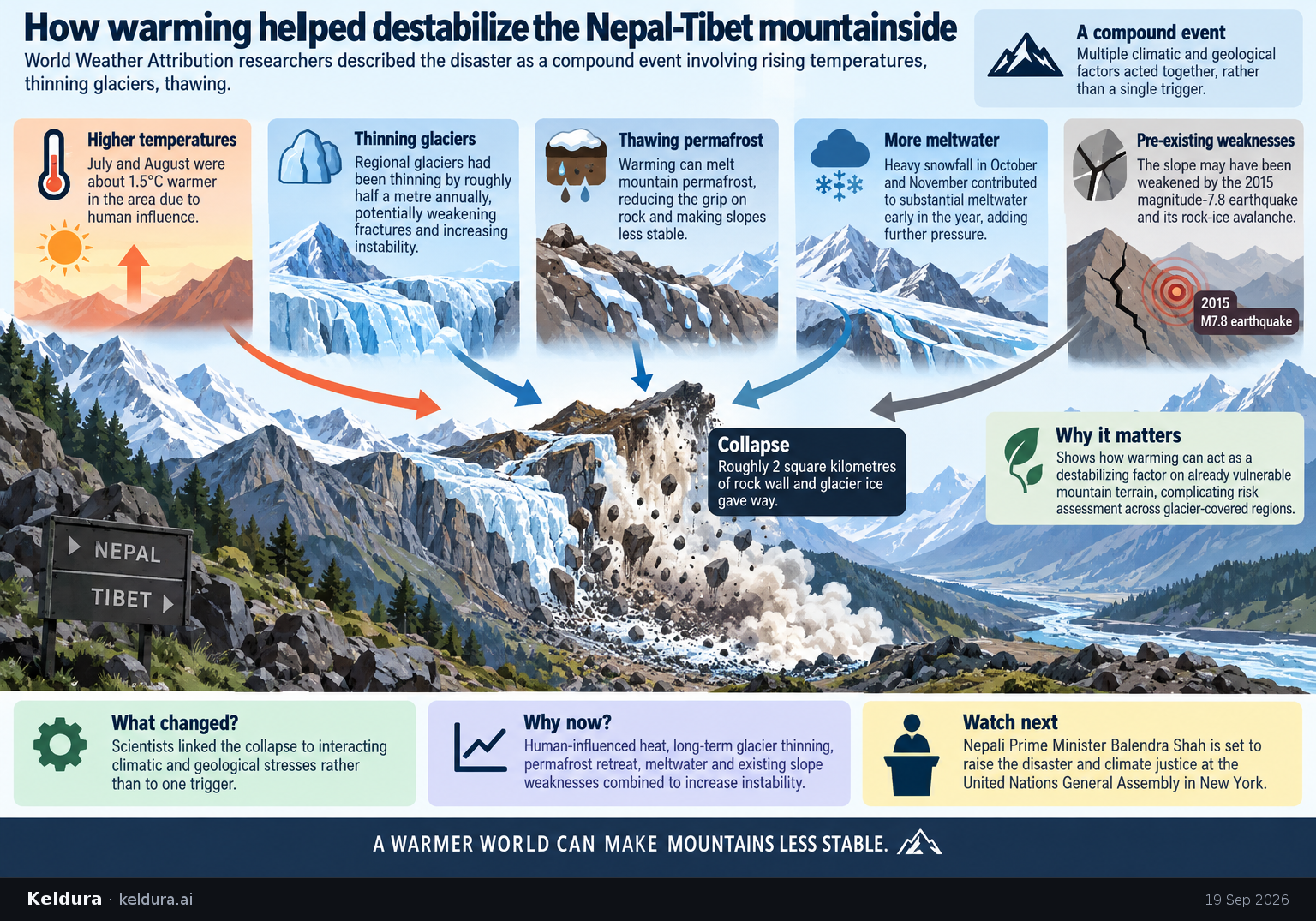
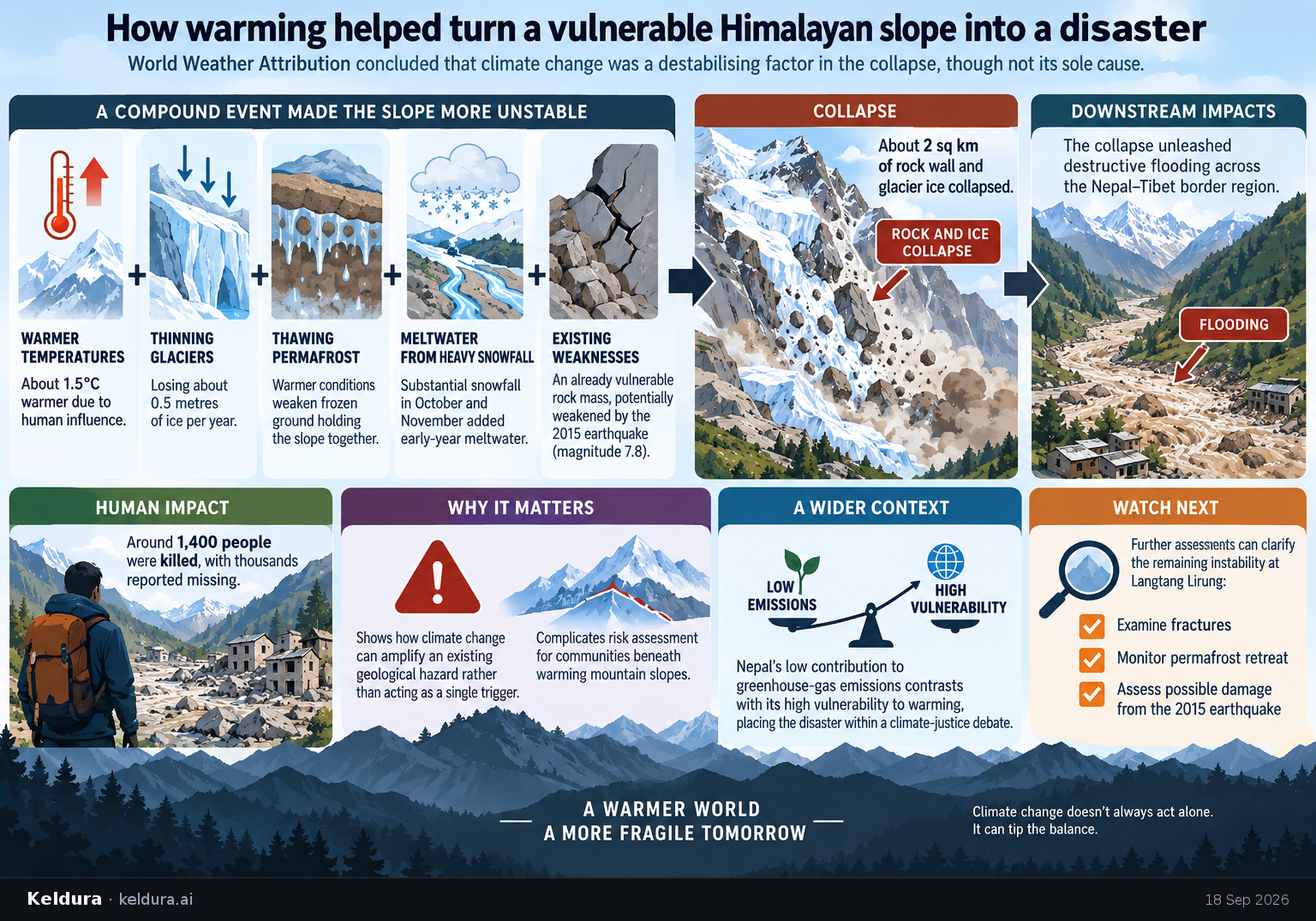
World Weather Attribution researchers described the disaster as a compound event involving rising temperatures, thinning glaciers, thawing.
Why it matters: The findings show how warming can act as a destabilizing factor on already vulnerable mountain terrain rather than serving as a single, isolated trigger, complicating risk assessment across glacier-c…
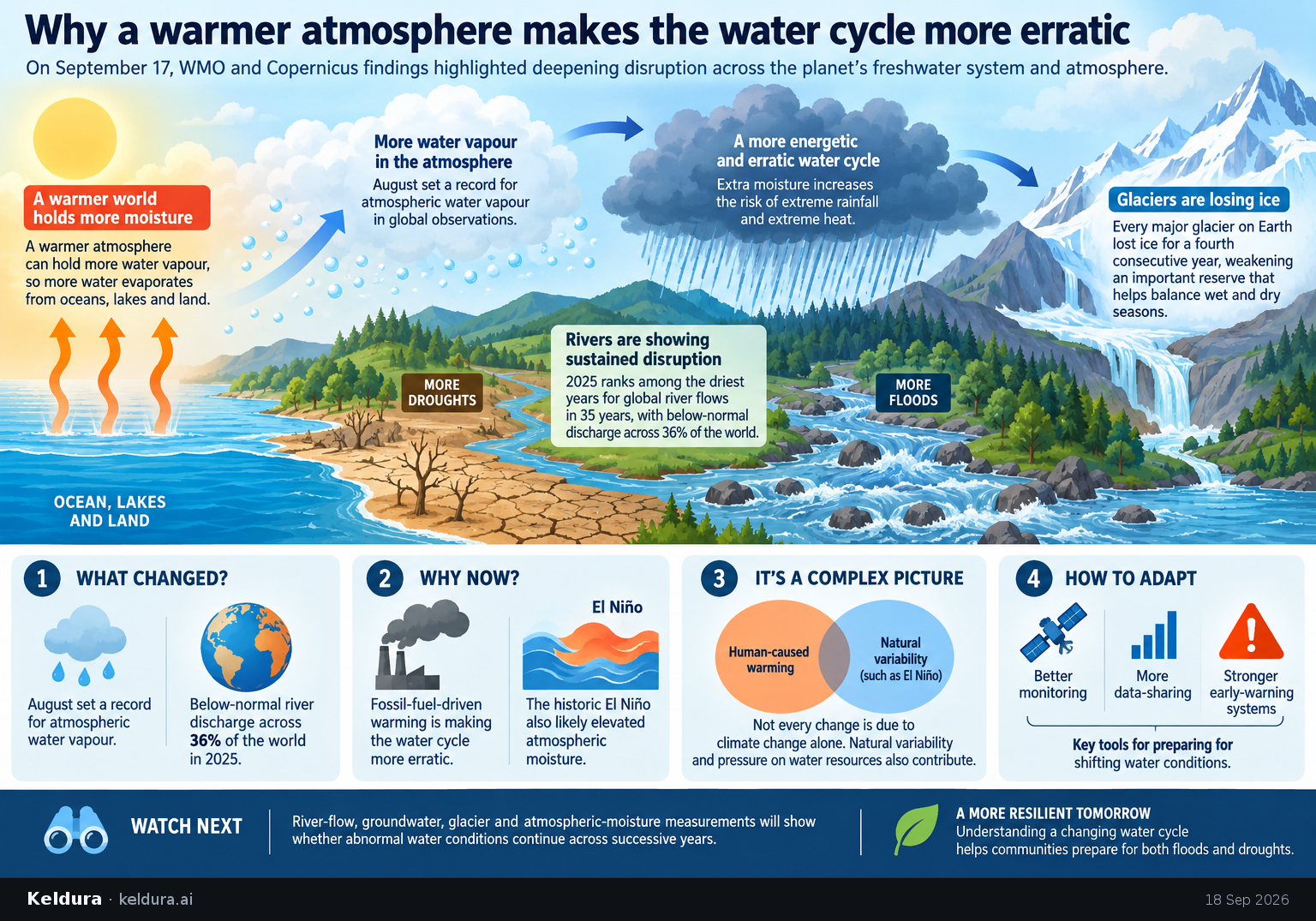
On September 17, WMO and Copernicus findings highlighted deepening disruption across the planet’s freshwater system and atmosphere.
Why it matters: A warmer atmosphere can hold more moisture, while disrupted rivers, glaciers and groundwater leave communities facing sharper swings between floods and droughts; WMO says historical water patterns ar…
August set a record for atmospheric water vapour, while 2025 brought below-normal river discharge across 36 per cent of the world.[4][7]
Why now
Fossil-fuel-driven warming is making the water cycle more erratic, and the historic El Niño also likely elevated atmospheric moisture.[3][4]
Watch next
River-flow, groundwater, glacier and atmospheric-moisture measurements will show whether abnormal water conditions continue across successive years.[4][7]
World Weather Attribution concluded that climate change was a destabilising factor in the collapse, though not its sole cause.
Why it matters: The finding shows how climate change can amplify an existing geological hazard rather than acting as a single trigger, complicating risk assessment for communities beneath warming mountain slopes.
About 2 sq km of rock wall and glacier ice collapsed, unleashing destructive flooding across the Nepal-Tibet border region.[2]
Why now
Human-driven warming, glacier thinning, permafrost thaw, meltwater and an already vulnerable rock mass interacted to destabilise the slope.[2][5]
Watch next
Further assessments of fractures, permafrost retreat and possible damage from the 2015 earthquake can clarify the remaining instability at Langtang Lirung.[5]
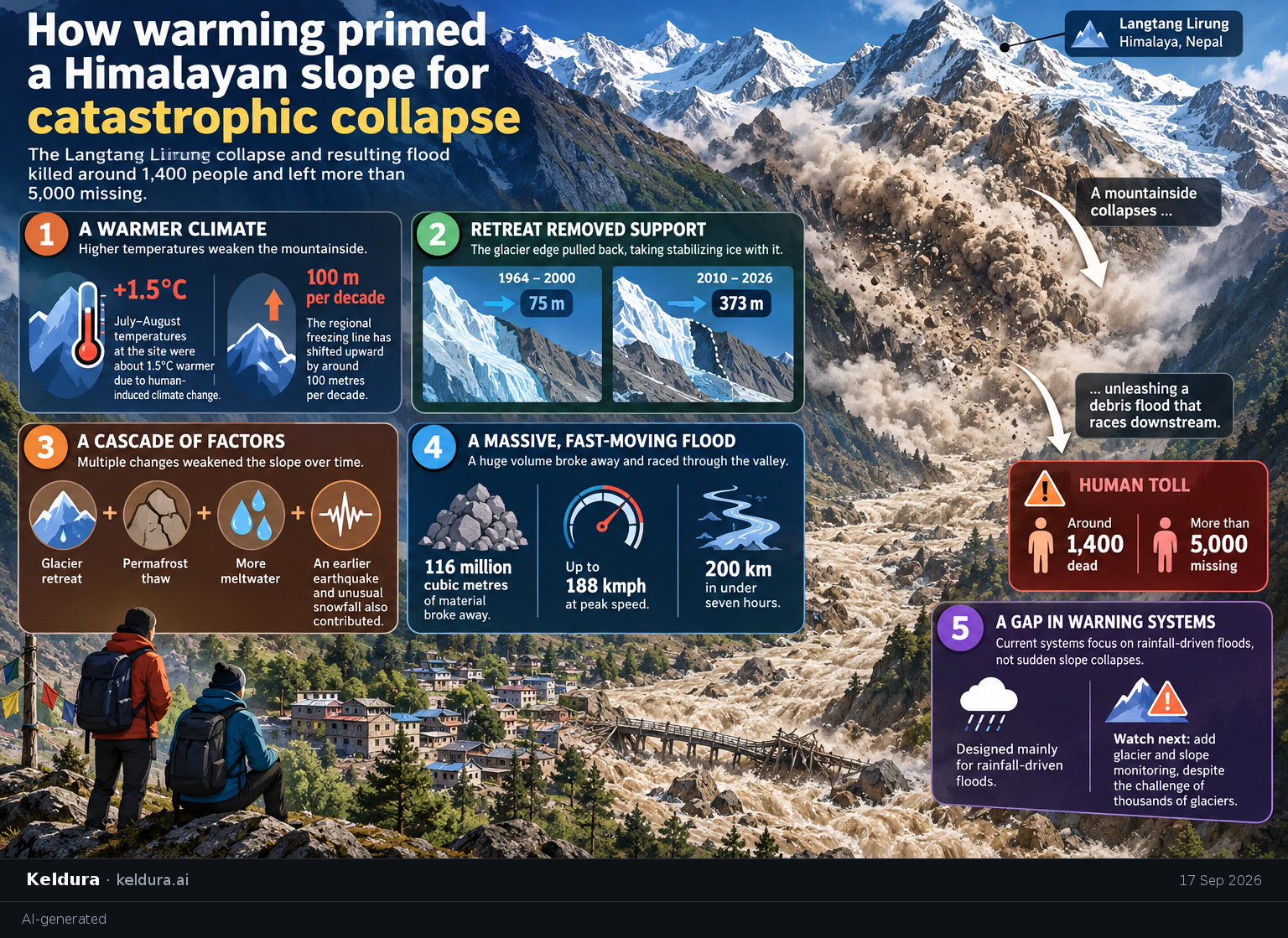
The Langtang Lirung collapse and resulting flood killed around 1,400 people and left more than 5,000 missing.
Why it matters: The disaster exposed a gap in mountain-risk planning: Nepal’s warning systems are designed mainly for forecastable, rainfall-driven floods, while this fast cascade began with an abrupt slope collapse…
Scientists linked the disaster to a cascade in which glacier retreat, permafrost thaw and meltwater progressively weakened the mountainside, rather than identifying one simple trigger.[5][7]
Why now
July and August were the warmest on record at the site, with extreme heat immediately before the collapse adding to long-term destabilization.[5][7]
Watch next
Watch whether Himalayan authorities add glacier and slope monitoring to flood-warning systems that currently focus on rainfall, despite the challenge of covering thousands of glaciers.[5][7]
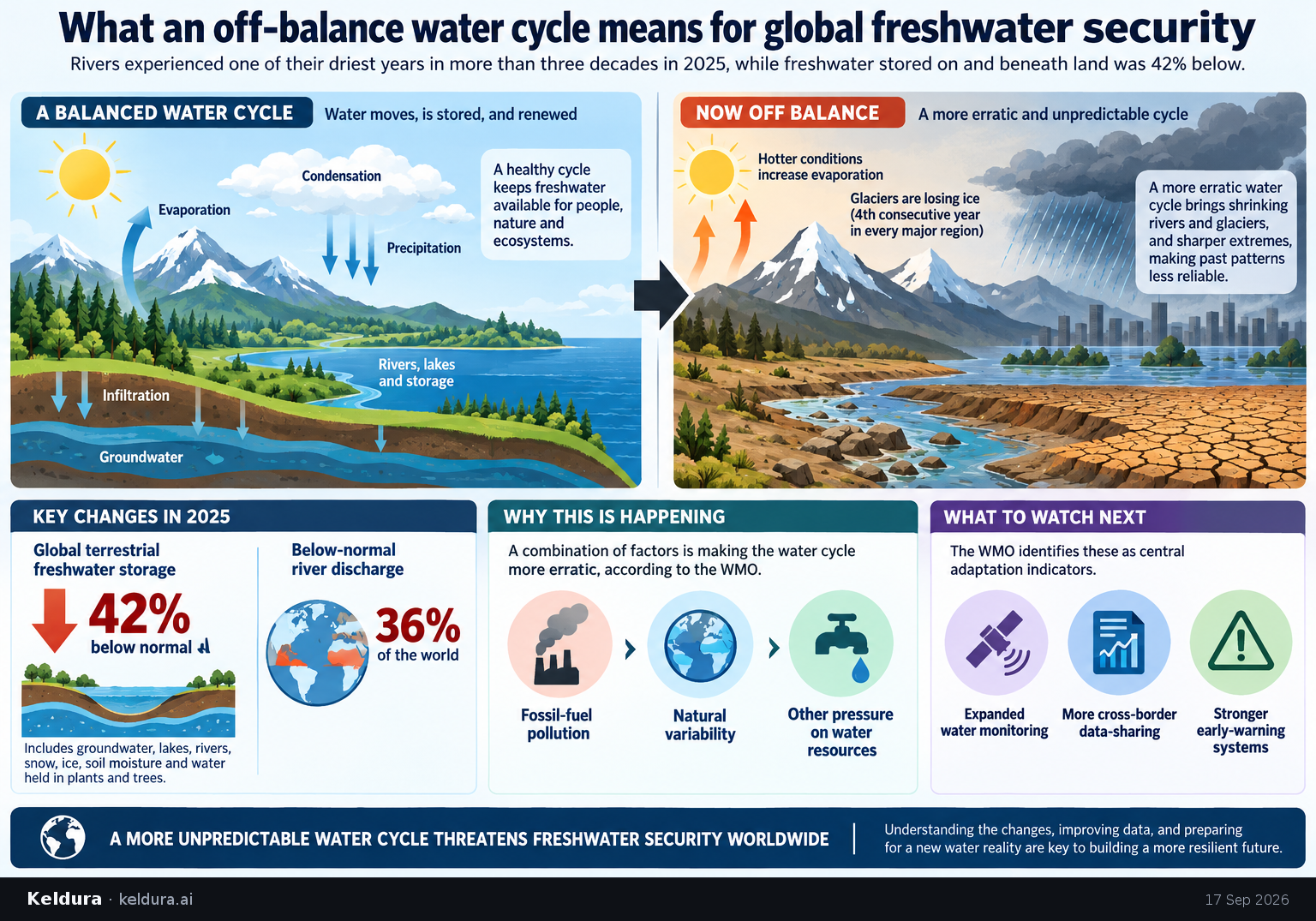
Rivers experienced one of their driest years in more than three decades in 2025, while freshwater stored on and beneath land was 42% below.
Why it matters: As fossil-fuel pollution makes the water cycle more erratic, societies face shrinking rivers and glaciers alongside sharper swings between drought and flooding, making historical water patterns less…
Global terrestrial freshwater storage fell 42% below normal in 2025, while below-normal river discharge covered 36% of the world.[2][4]
Why now
The WMO says the water cycle is becoming more erratic and unpredictable as fossil-fuel pollution combines with natural variability and other pressures on water resources.[3][4]
Watch next
Watch the expansion of water monitoring, cross-border data-sharing and early-warning systems, which the WMO identifies as central adaptation indicators.[4]
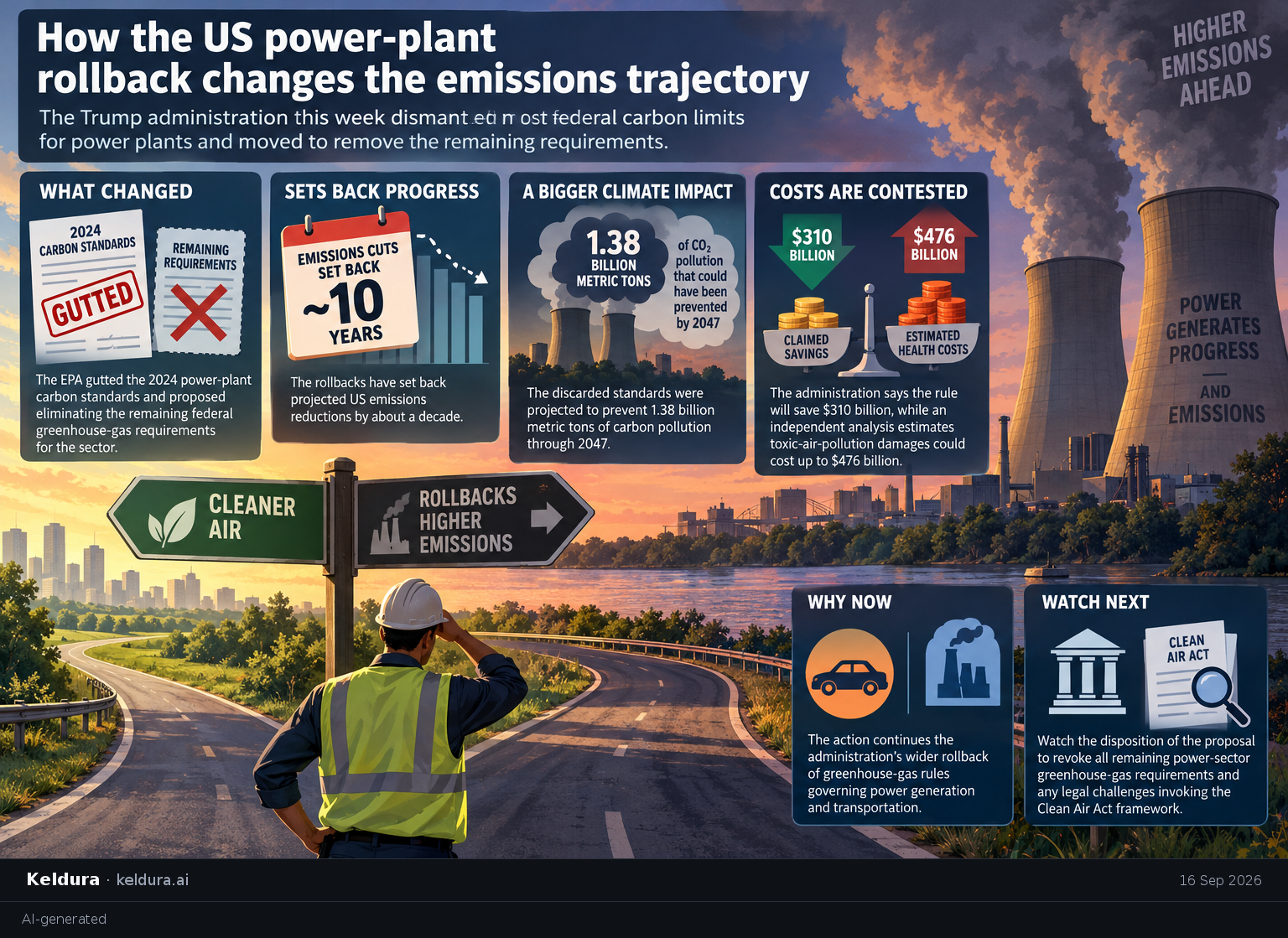
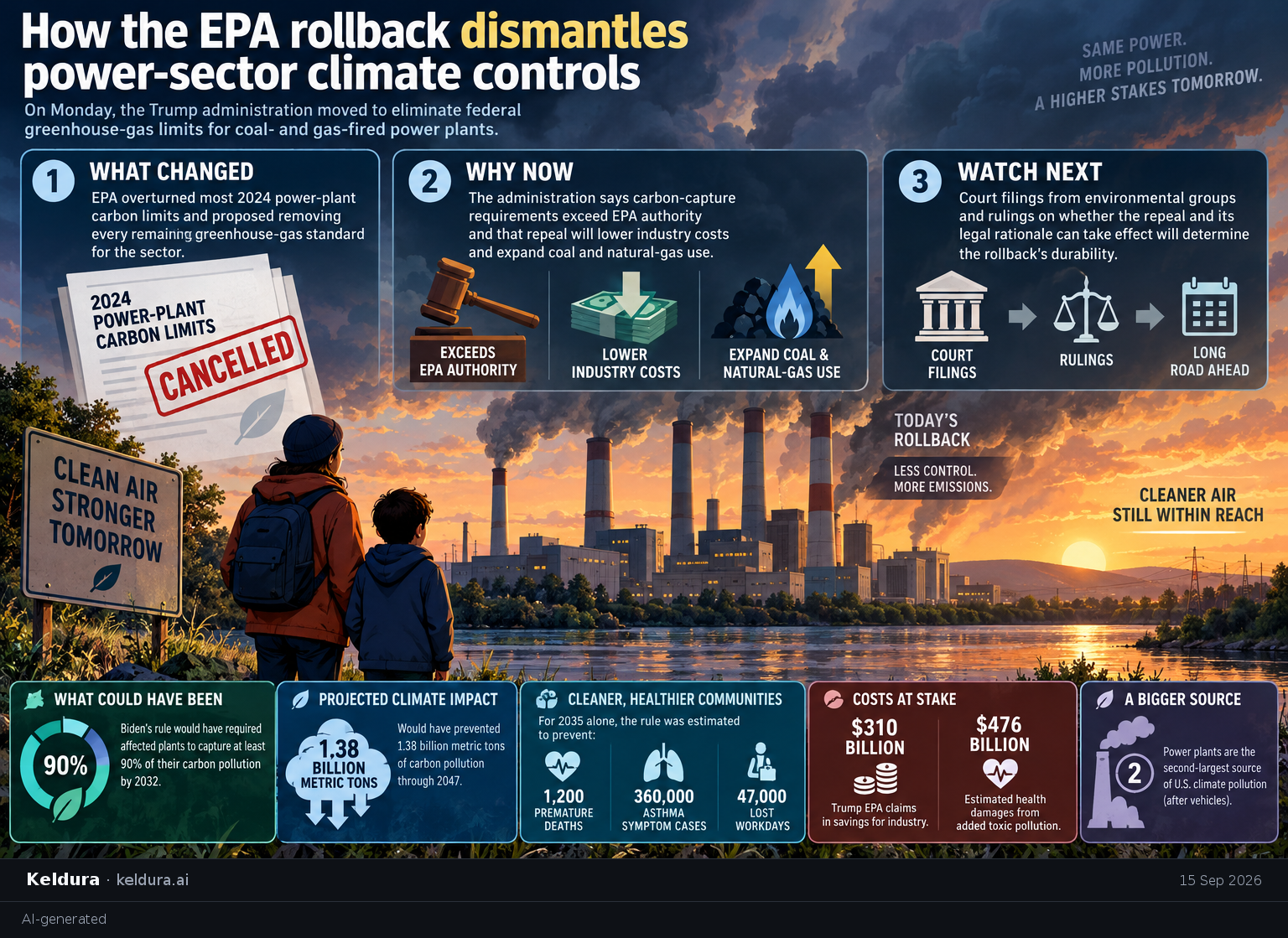
The Trump administration this week dismantled most federal carbon limits for power plants and moved to remove the remaining requirements.
Why it matters: Power generation is the United States’ second-largest source of greenhouse gases, and the discarded standards were projected to prevent 1.38 billion metric tons of carbon pollution through 2047. The…
The EPA gutted the 2024 power-plant carbon standards and proposed eliminating the remaining federal greenhouse-gas requirements for the sector.[6]
Why now
The action continues the administration’s wider rollback of greenhouse-gas rules governing power generation and transportation.[6][7]
Watch next
Watch the disposition of the proposal to revoke all remaining power-sector greenhouse-gas requirements and any legal challenges invoking the Clean Air Act framework.[6]
On Monday, the Trump administration moved to eliminate federal greenhouse-gas limits for coal- and gas-fired power plants.
Why it matters: Power plants are the second-largest source of U.S. climate pollution, so the action follows the administration's repeal of rules covering vehicles, the largest source. If the rollback survives expect…
The EPA overturned most 2024 power-plant carbon limits and proposed removing every remaining greenhouse-gas standard for the sector.[1]
Why now
The administration says carbon-capture requirements exceed EPA authority and that repeal will lower industry costs and expand coal and natural-gas use.[1][3]
Watch next
Court filings from environmental groups and rulings on whether the repeal and its legal rationale can take effect will determine the rollback's durability.[3]
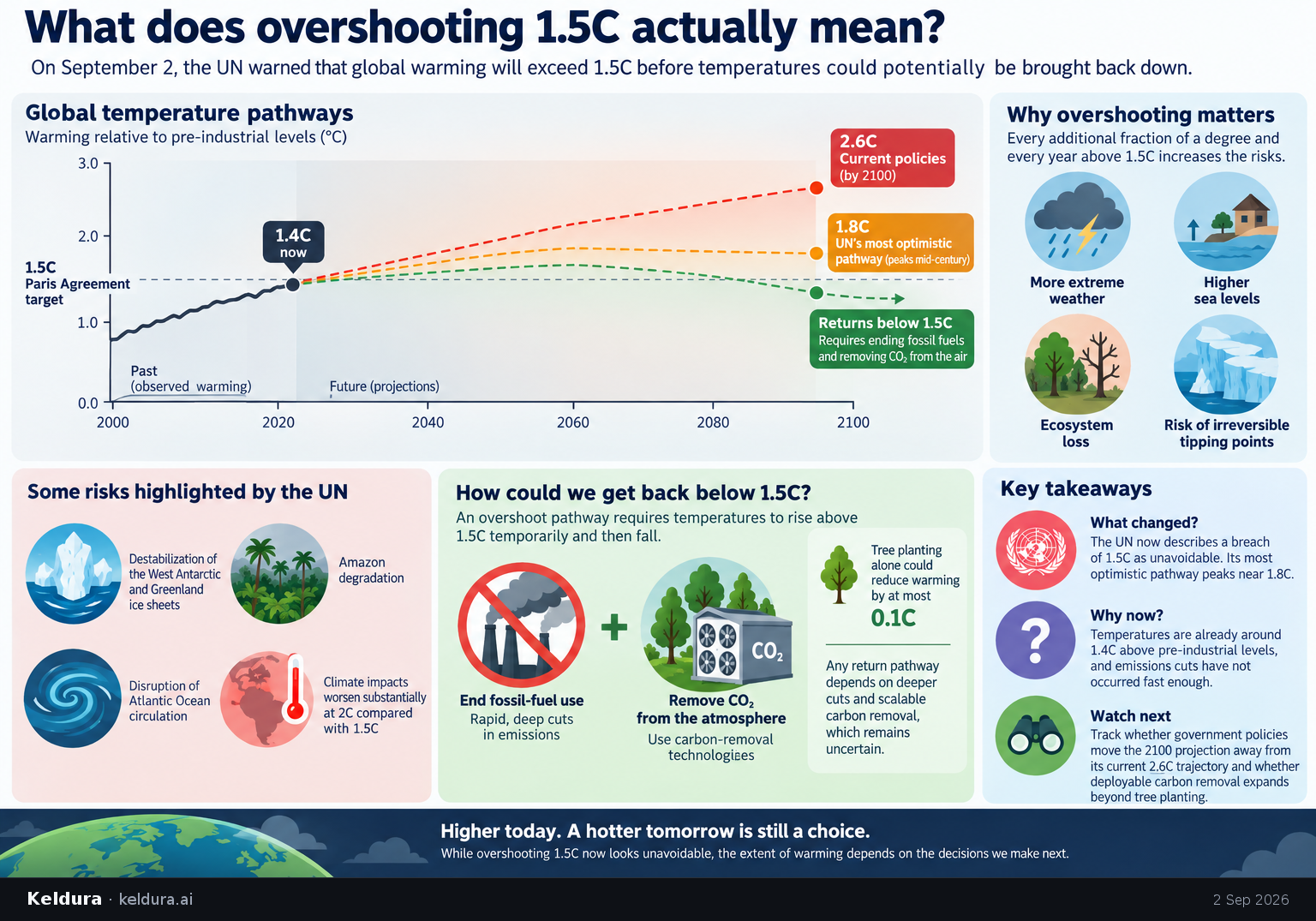
On September 2, the UN warned that global warming will exceed 1.5C before temperatures could potentially be brought back down.
Why it matters: Overshoot is not a harmless delay: every additional fraction of warming and every year above 1.5C increases exposure to extreme weather, sea-level rise, ecosystem loss and potentially irreversible ti…
The UN now describes a breach of 1.5C as unavoidable; its most optimistic pathway peaks near 1.8C [2][3].
Why now
Temperatures are already around 1.4C above pre-industrial levels, while emissions cuts have not occurred fast enough to prevent an overshoot [3].
Watch next
Track whether government policies move the 2100 projection away from its current 2.6C trajectory and whether deployable carbon removal expands beyond tree planting [3].
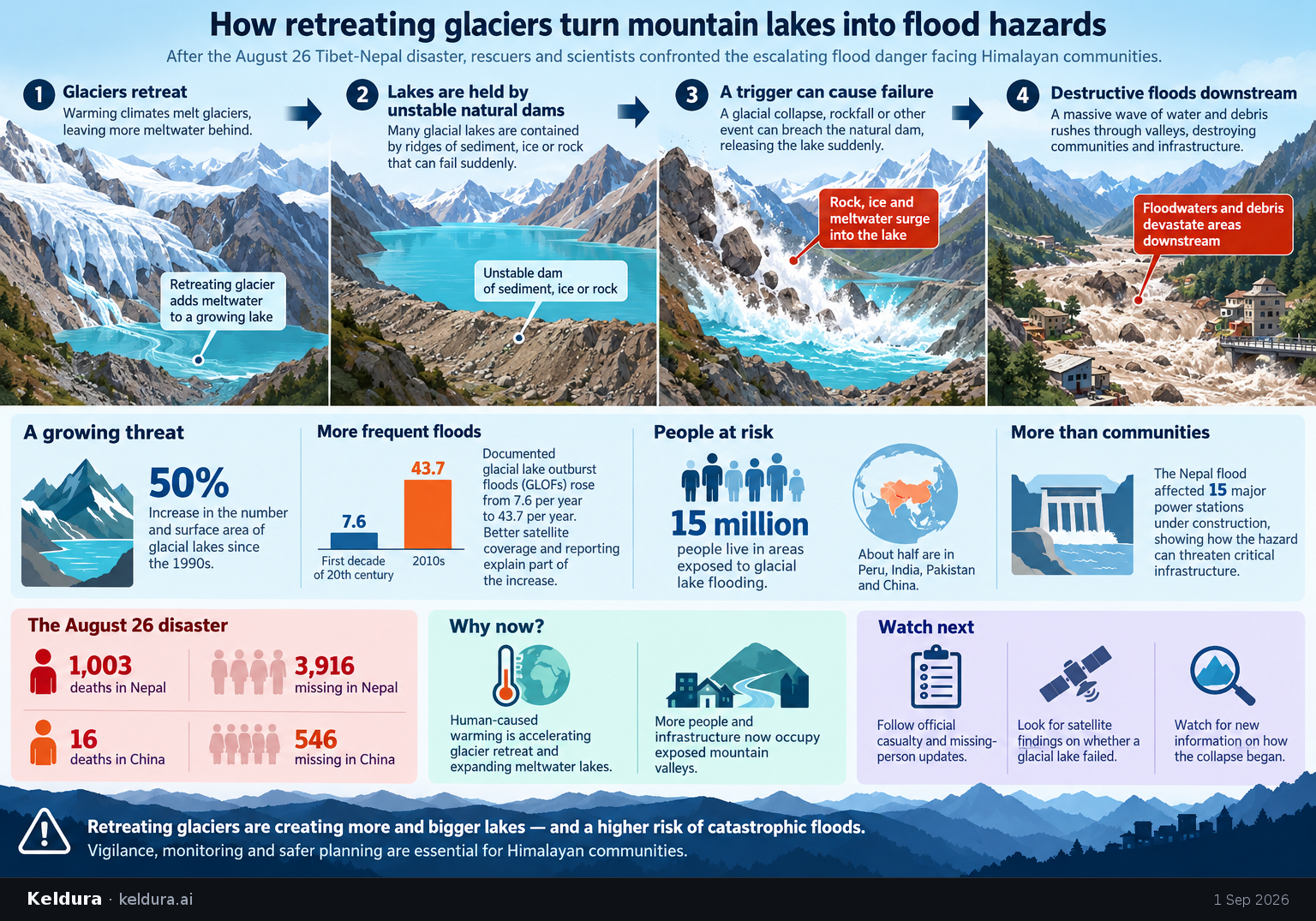
After the August 26 Tibet-Nepal disaster, rescuers and scientists confronted the escalating flood danger facing Himalayan communities.
Why it matters: An estimated 15 million people live in areas exposed to glacial lake flooding, with half concentrated in Peru, India, Pakistan and China. The Nepal flood also affected 15 major power stations under c…
The August 26 collapse generated a destructive cross-border flood, leaving more than 1,000 dead in Nepal and thousands missing across Nepal and China.[7]
Why now
Human-caused warming is accelerating glacier retreat and expanding meltwater lakes, while more people and infrastructure occupy exposed mountain valleys.[2][3]
Watch next
Watch official casualty and missing-person updates, along with satellite findings on whether a particular glacial lake failed and how the collapse began.[3][7]
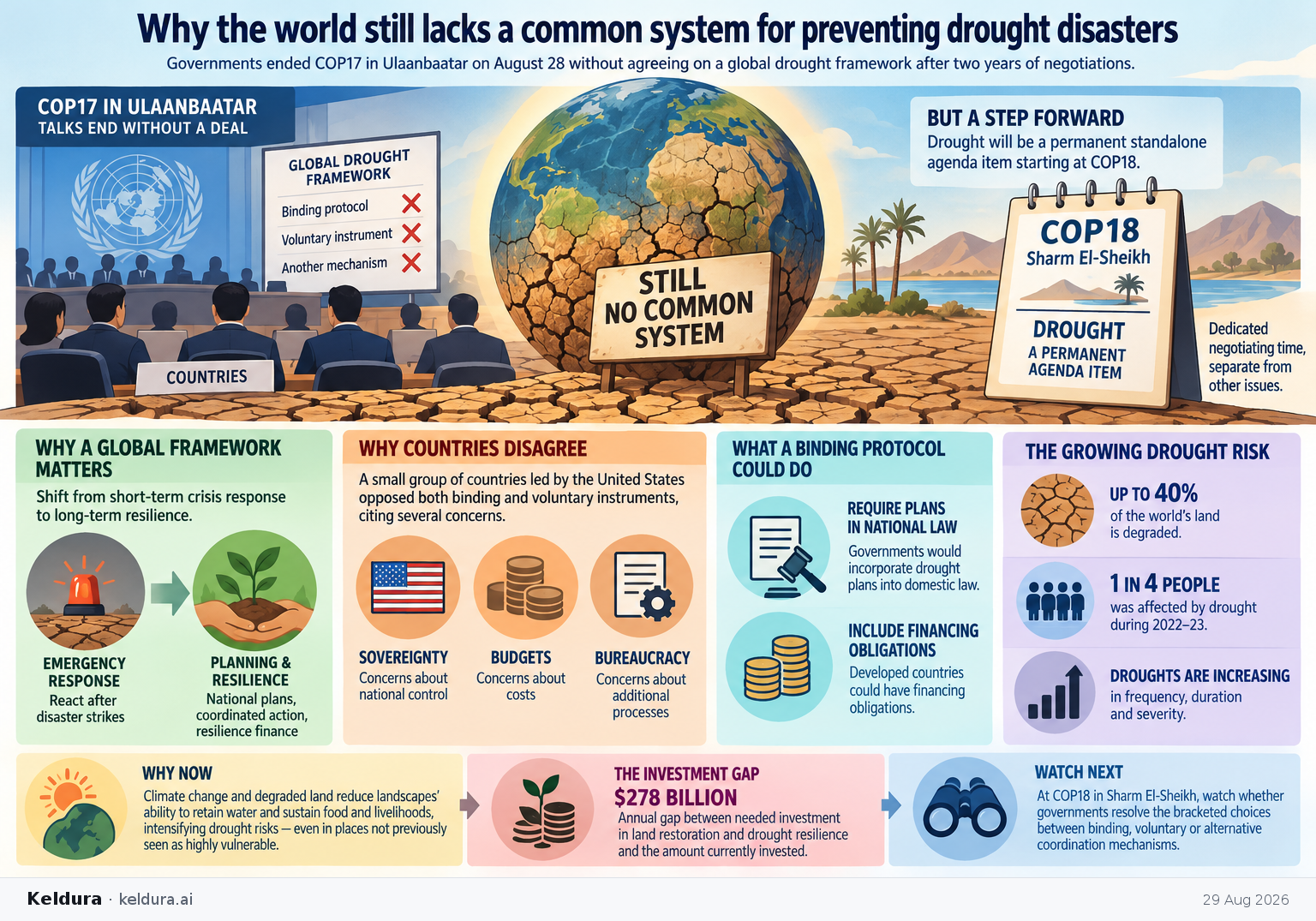
Governments ended COP17 in Ulaanbaatar on August 28 without agreeing on a global drought framework after two years of negotiations.
Why it matters: Up to 40 per cent of the world’s land is degraded, and drought is emerging in places not considered highly vulnerable a decade ago. Yet the UNCCD estimates an annual gap of $278 billion between neede…
The framework remained blocked, but drought gained a permanent standalone place on the agenda at COP18 and subsequent ordinary sessions.[4]
Why now
Drought risks are intensifying as climate change and degraded land reduce landscapes’ ability to retain water and sustain food and livelihoods.[5]
Watch next
At COP18 in Sharm El-Sheikh, watch whether governments resolve the bracketed choices between binding, voluntary or alternative coordination mechanisms.[4]
That's the desk. Every cheatsheet here started as a link. Yours can too.