How could soaring Treasury yields threaten the AI investment boom?
The 10-year Treasury yield closed at 5.20%, its highest since 2007, while the 30-year yield reached a post-2004 high of 5.48%.
The 10-year Treasury yield closed at 5.20%, its highest since 2007, while the 30-year yield reached a post-2004 high of 5.48%.[5] Analysts attributed the sell-off mainly to higher real yields, soft Treasury-auction demand and evidence of an accelerating US economy rather than a sharp rise in market…
The 10-year Treasury yield closed at 5.20%, its highest since 2007, while the 30-year yield reached a post-2004 high of 5.48%.[5] Analysts attributed the sell-off mainly to higher real yields, soft Treasury-auction demand and evidence of an accelerating US economy rather than a sharp rise in market inflation expectations.[5] That repricing raises financing and valuation pressure on an AI build-out exceeding $US700 billion in the US this year and potentially reaching $US1 trillion next year.[2]
Why it matters: Higher risk-free yields make bonds more competitive with equities, increase corporate borrowing costs and reduce the present value of distant earnings—an especially important combination for AI-related companies and hyperscalers that account for about 35% of the US sharemarket’s value.[2] With US stocks also trading at CAPE valuations last seen in 1999, sustained high rates could transmit the Treasury sell-off into growth stocks, consumer finances and the broader economy.[2]
Key insights: The two-year Treasury yield rose 55 basis points during September as markets anticipated Fed increases, while the 30-year yield moved near its highest level since 2004.[1] | Pricing implied a 70% probability of an October Fed increase and a 57% probability of consecutive increases in October and December.[5] | Even cash-rich companies such as Amazon and Alphabet have turned to debt as escalating AI expenditure absorbs legacy cash flows and stretches the equity market’s funding capacity.[2] | The MOVE index of bond-market volatility jumped from 78.56 to 96 in one week, indicating increased investor anxiety about the speed of the yield rise.[2]
Cheatsheet facts: What changed: The 10-year Treasury yield reached 5.20%, its highest since 2007, and the 30-year yield reached a post-2004 high of 5.48%.[5] | Why now: Strong US indicators, weak demand at Treasury auctions and expectations of a tighter Fed path pushed real yields higher.[5] | Watch next: Monitor the upcoming US inflation, GDP, manufacturing and employment releases, including Friday’s payroll report, alongside market pricing for October and December Fed increases.[1][5]
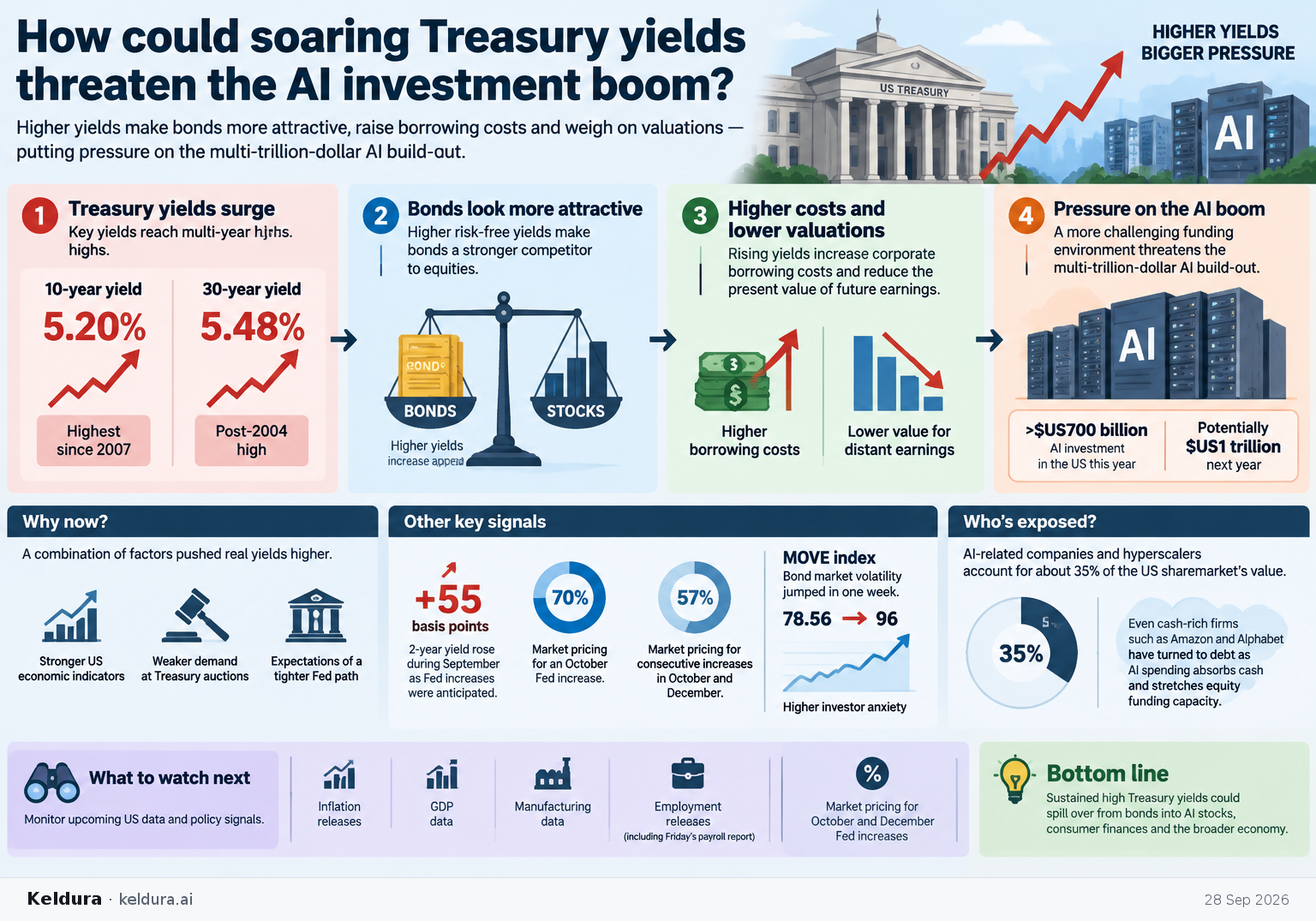
The 10-year Treasury yield closed at 5.20%, its highest since 2007, while the 30-year yield reached a post-2004 high of 5.48%.[5] Analysts attributed the sell-off mainly to higher real yields, soft Treasury-auction demand and evidence of an accelerating US economy rather than a sharp rise in market inflation expectations.[5] That repricing raises financing and valuation pressure on an AI build-out exceeding $US700 billion in the US this year and potentially reaching $US1 trillion next year.[2]
Why it matters: Higher risk-free yields make bonds more competitive with equities, increase corporate borrowing costs and reduce the present value of distant earnings—an especially important combination for AI-related companies and hyperscalers that account for about 35% of the US sharemarket’s value.[2] With US stocks also trading at CAPE valuations last seen in 1999, sustained high rates could transmit the Treasury sell-off into growth stocks, consumer finances and the broader economy.[2]
Key insights: The two-year Treasury yield rose 55 basis points during September as markets anticipated Fed increases, while the 30-year yield moved near its highest level since 2004.[1] | Pricing implied a 70% probability of an October Fed increase and a 57% probability of consecutive increases in October and December.[5] | Even cash-rich companies such as Amazon and Alphabet have turned to debt as escalating AI expenditure absorbs legacy cash flows and stretches the equity market’s funding capacity.[2] | The MOVE index of bond-market volatility jumped from 78.56 to 96 in one week, indicating increased investor anxiety about the speed of the yield rise.[2]
Cheatsheet facts: What changed: The 10-year Treasury yield reached 5.20%, its highest since 2007, and the 30-year yield reached a post-2004 high of 5.48%.[5] | Why now: Strong US indicators, weak demand at Treasury auctions and expectations of a tighter Fed path pushed real yields higher.[5] | Watch next: Monitor the upcoming US inflation, GDP, manufacturing and employment releases, including Friday’s payroll report, alongside market pricing for October and December Fed increases.[1][5]