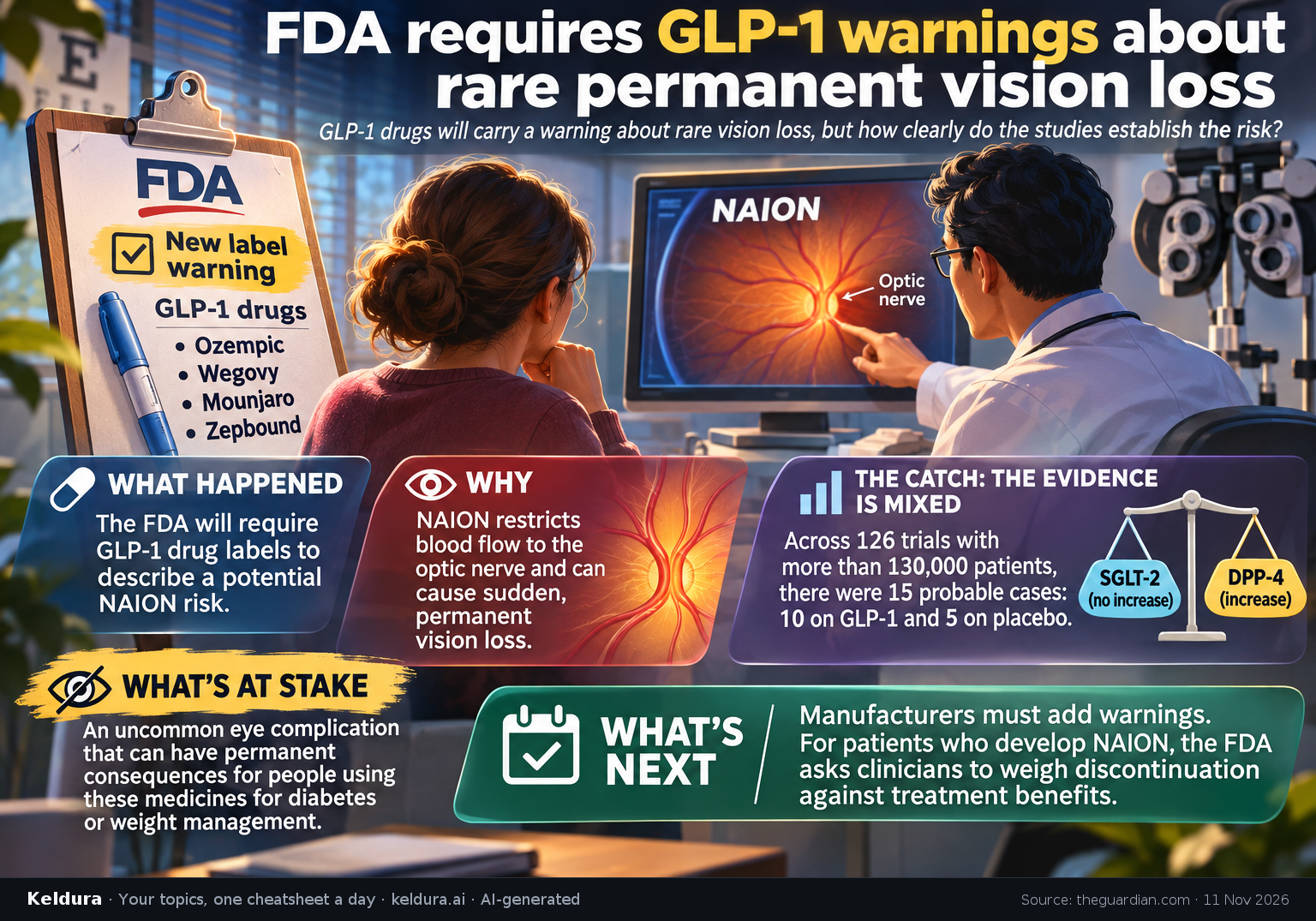
GLP-1 drugs will carry a warning about rare vision loss, but how clearly do the studies establish the risk?
On November 9, the FDA announced that GLP-1 drug labels must warn about a potential risk of a rare eye condition that can cause permanent vision loss.
Why it matters: People taking these medicines for diabetes or weight management face a new treatment consideration: an uncommon eye complication can have permanent consequences. The FDA advises clinicians to conside…
Pimicotinib offers some adults a daily pill instead of damaging tumor surgery, but how much benefit has the trial shown?
On November 10, Merck announced FDA approval of PIMJETMI for certain adults with tenosynovial giant cell tumor, citing a 56% tumor response rate versus 3% with placebo.
Why it matters: For eligible adults, approval creates a treatment option when removing the tumor could itself cause substantial disability. The 53-percentage-point response difference is accompanied by reported impr…
Merck announced FDA approval of once-daily PIMJETMI for a defined group of adults with symptomatic tenosynovial giant cell tumor. [7]
Background
For the approved patient group, surgically removing the tumor may worsen physical function or cause severe harm; pimicotinib provides an oral systemic treatment option. [7]
Why
At week 25, tumor response was 56% with pimicotinib versus 3% with placebo, alongside reported improvements in pain, movement and physical function. [7]
The catch
The 77% longer-term benefit figure applies only to patients who had responded at week 25, not to all trial participants. [7]
Yemen is sending vaccination teams into 100 districts, but will the campaign reach children missed by health services?
On November 8, Yemen's health ministry, supported by WHO and Gavi, launched a measles-rubella vaccination campaign targeting more than 957,196 children across 11 southern governorates.
Why it matters: The campaign aims to protect nearly one million young children from infections that cause preventable illness, disability and death. Its 1,648 mobile teams are intended to bring vaccination directly…
Removing scar-associated cells helped cancer immunotherapy work in mice, but can the treatment do the same in people?
In a study published September 24 in Science, researchers used targeted nanoparticles to reduce fibrosis and improve immunotherapy responses in mice with tumors in scarred tissue.
Why it matters: Scarring around tumors can suppress nearby immune cells and make cancer harder to treat with immunotherapy. This approach addresses that barrier while, in mice, avoiding the toxic effects seen when t…
Barbados has met WHO’s elimination targets, but what must its health system sustain to keep that status?
On October 30, 2026, WHO announced that Barbados had eliminated mother-to-child transmission of HIV as a public health problem.
Why it matters: Barbados demonstrates a prevention pathway built around free testing and treatment for every pregnant woman, regardless of nationality, alongside early testing and follow-up for exposed babies. WHO’s…
Sick Medicaid recipients won a challenge to tighter exemptions, but which work requirements remain in place?
On October 29, US District Judge Richard Stearns blocked a Trump administration rule restricting medical exemptions from Medicaid work requirements.
Why it matters: Beginning January 1, 2027, Medicaid expansion enrollees aged 19–64 must meet work, community-service or schooling conditions unless exempt; the ruling makes exemptions easier to obtain for some peopl…
An Ebola outbreak has passed 10,000 cases, but how can responders reach people who distrust the care being offered?
On October 27, NPR reported more than 10,000 Ebola infections; on October 29, AP described a village chief confronting mistrust in eastern Congo.
Why it matters: The response must address both disease transmission and the willingness to seek care: AP's account shows mistrust reaching inside families, while NPR reports that children account for about a third o…
US measles cases have more than doubled last year's tally, but what makes Pennsylvania's outbreak so difficult to contain?
On October 24, federal figures showed 4,588 US measles cases in 2026, while Pennsylvania reported 1,338 cases.
Why it matters: Pennsylvania illustrates the consequences behind the national count: at least 251 people have been hospitalized, roughly one in five reported cases. Officials identify low vaccination rates, particul…
The US reported 4,588 measles cases in 2026 as of Friday, including 178 newly reported cases that week. [4]
Why
Pennsylvania officials cite low vaccination rates as their biggest challenge; researchers also point to frequent close contact within affected Amish communities. [2]
Who pays
Pennsylvania has recorded at least six deaths and 251 hospitalizations; two of those who died were infants. [2]
The catch
Mitchell describes skepticism toward government intervention in affected Amish communities, complicating efforts to increase protection. [2]
Kenya and Nigeria have reported imported Ebola cases, but how far has transmission extended beyond the initial patients?
On October 23, 2026, WHO reported that the Bundibugyo virus outbreak had expanded within the Democratic Republic of the Congo and reached Kenya and Nigeria.
Why it matters: Of the 482 deaths reported since WHO's previous update, 307 occurred in communities rather than treatment centres, highlighting difficulties detecting patients early and getting them into care. Cross…
A new partnership will test ways to help older people live well, but can its approach work across different health systems?
On October 22, WHO and the Institute of Philanthropy announced a four-year healthy-ageing initiative involving The Chinese University of Hong Kong.
Why it matters: The Western Pacific has more than 245 million people aged 65 or older, a population projected to double by 2050. Meanwhile, the gap between life expectancy and healthy life expectancy widened from 9.…
Pennsylvania has requested federal measles help, but how will officials measure the outbreak while death reporting remains disputed?
On October 14, 2026, a federal health official said the CDC would send an outbreak investigator to Pennsylvania that week as the state reported 1,222 measles cases.
Why it matters: The assistance is intended to improve estimates of how many people measles is affecting and how vaccination efforts influence the outbreak analysis—not simply add another responder. Meanwhile, differ…
Pennsylvania reported 1,222 measles cases, and a federal official said the CDC would send an investigator that week. [6]
Why
The state requested help estimating the outbreak’s true burden, understanding its trajectory and assessing how vaccination efforts affect those analyses. [6]
Who pays
Federal health officials have provided nearly $4 million in one-time funding for measles response operations through most of 2027. [6]
The catch
The state formally requested Epi-Aid assistance on October 7 but said it was still seeking answers about CDC death reporting before finalizing acceptance. [6]
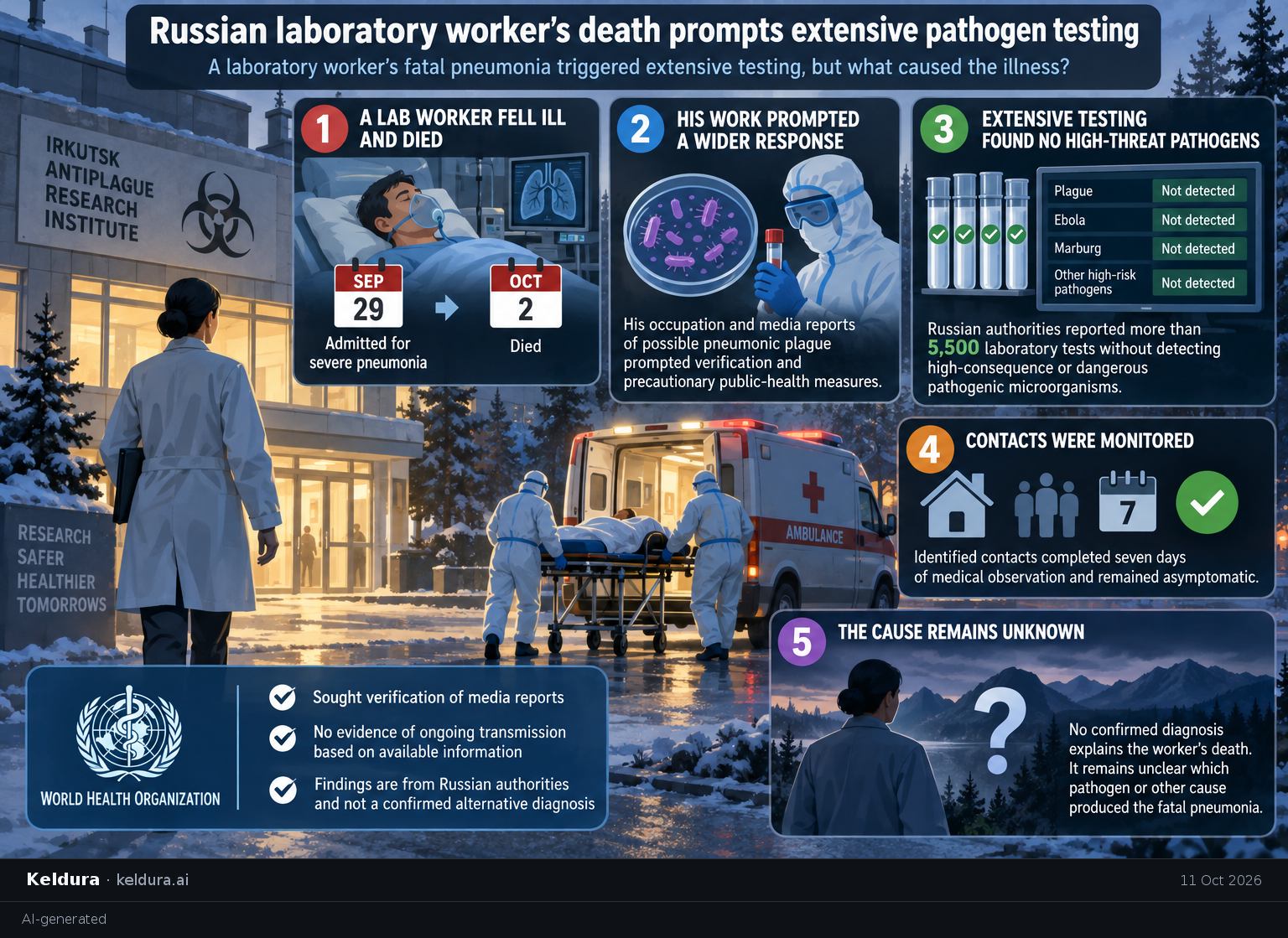
A laboratory worker’s fatal pneumonia triggered extensive testing, but what caused the illness?
On October 10, WHO detailed the investigation into an Irkutsk Antiplague Research Institute employee who died on October 2 after hospitalization for severe pneumonia.
Why it matters: The investigation separates a suspected laboratory-associated infection from established findings: WHO has not identified evidence of ongoing transmission based on the information supplied, while the…