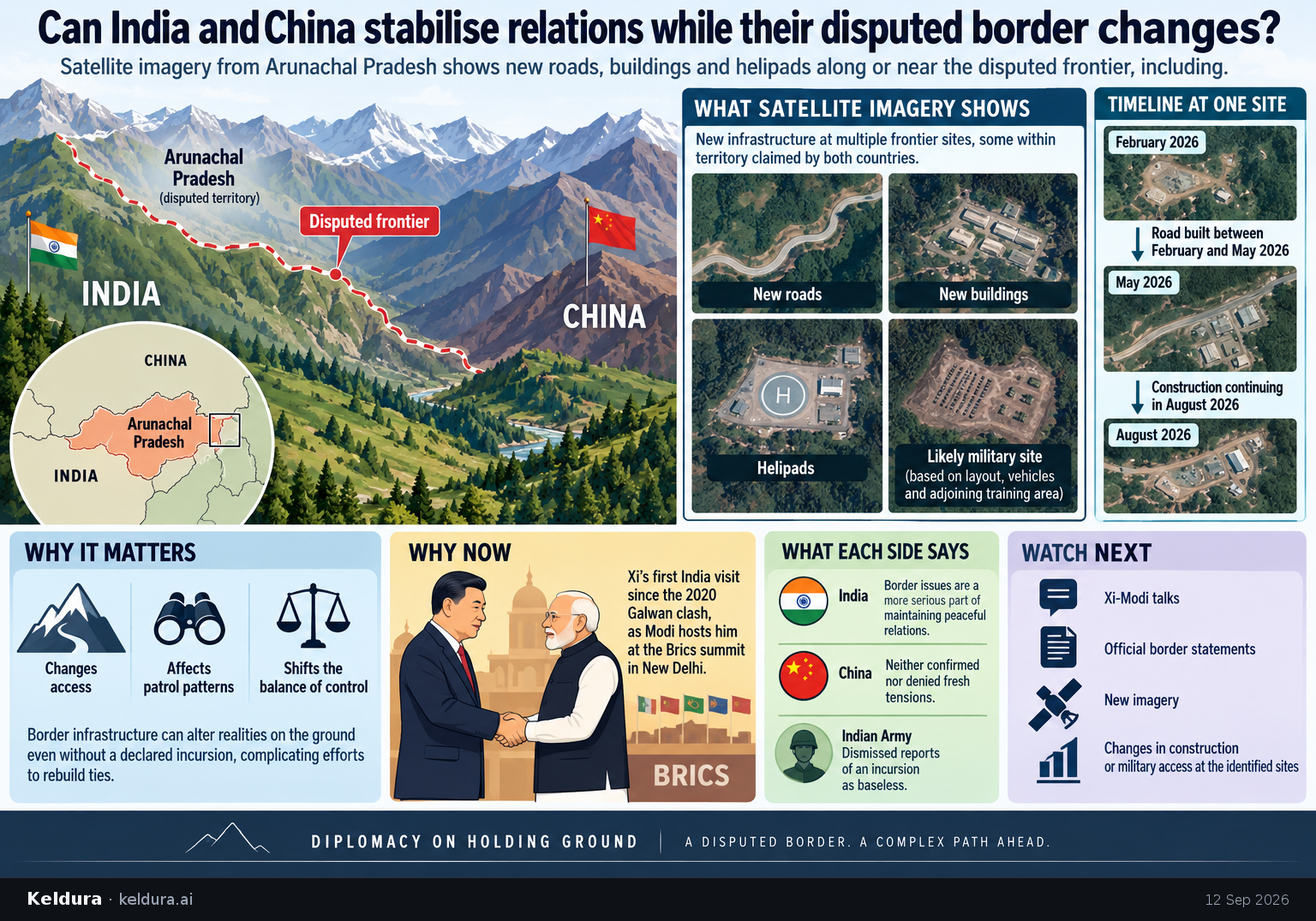
Why it matters: Border infrastructure can alter access, patrol patterns and the practical balance of control even without a declared incursion, complicating efforts by two nuclear-armed neighbours to rebuild ties. T…
New imagery documents ongoing roads and construction at multiple frontier sites, including infrastructure within territory claimed by both India and China [6].
Why now
The evidence surfaced as Xi arrived for the Delhi Brics summit and his first India visit since the 2020 Galwan clash [6][7].
Watch next
Watch the Xi-Modi talks, official border statements and subsequent imagery for changes in construction or military access around the identified sites [6][7].
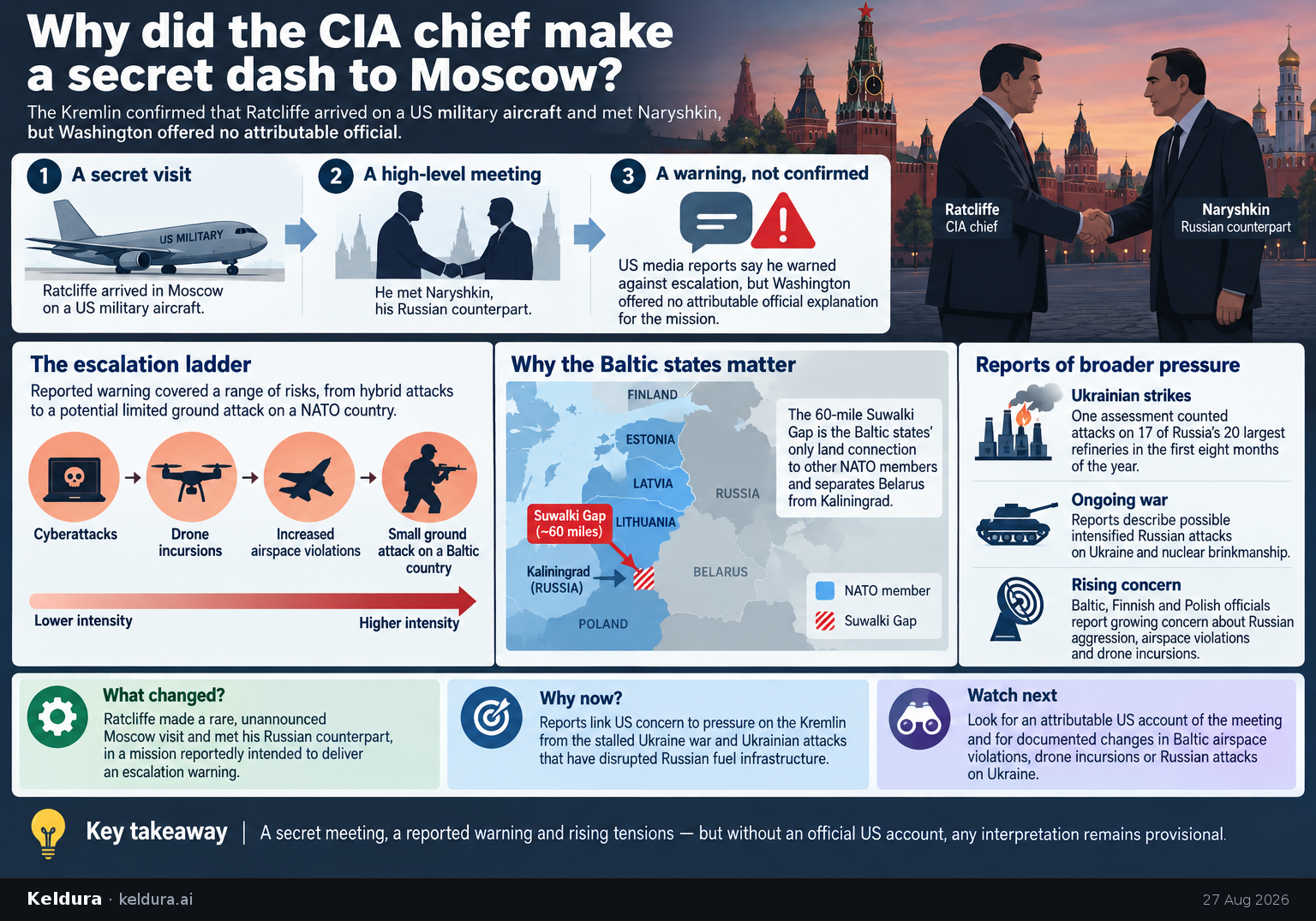
The Kremlin confirmed that Ratcliffe arrived on a US military aircraft and met Naryshkin, but Washington offered no attributable official.
Why it matters: A limited move against NATO territory could test whether the alliance invokes its Article 5 mutual-defence commitment, while the 60-mile Suwalki Gap is the Baltic states’ only land connection to othe…
Ratcliffe made a rare, unannounced Moscow visit and met his Russian counterpart aboard a mission reportedly intended to deliver an escalation warning.[1][4]
Why now
Reports link US concern to pressure on the Kremlin from the stalled Ukraine war and Ukrainian attacks that have disrupted Russian fuel infrastructure.[1][4]
Watch next
Watch for an attributable US account of the meeting and for documented changes in Baltic airspace violations, drone incursions or Russian attacks on Ukraine.[1][4]
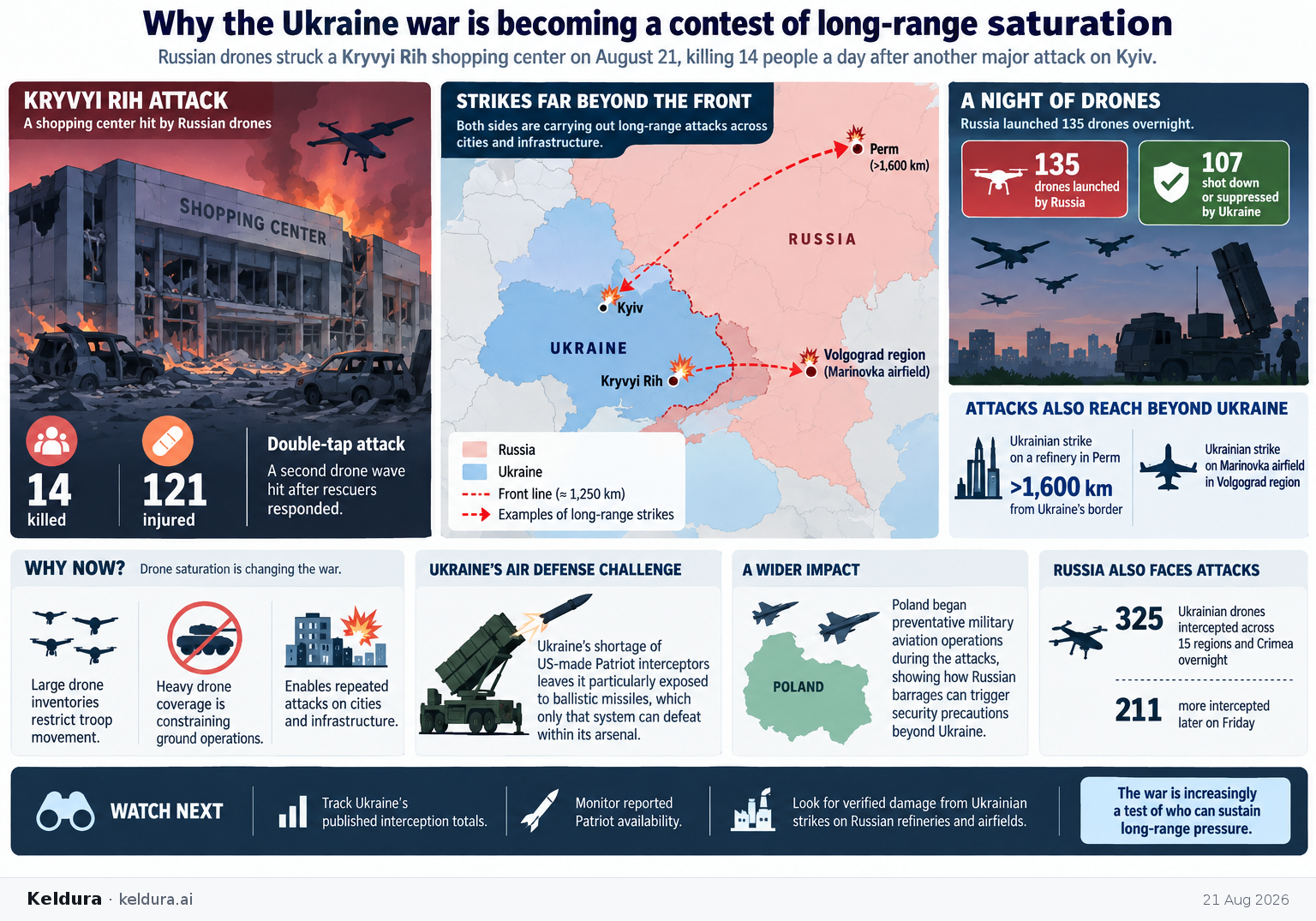
Russian drones struck a Kryvyi Rih shopping center on August 21, killing 14 people a day after another major attack on Kyiv.
Why it matters: Large drone inventories restrict troop movement while enabling repeated attacks on cities and infrastructure, shifting pressure toward air-defense capacity, civilian protection and each side’s abilit…
Russia’s Kryvyi Rih strike killed 14 and injured 121 after another major assault on Kyiv, while Ukraine continued deep attacks inside Russia.[3]
Why now
Heavy drone coverage is constraining ground operations, and Russia is exploiting Ukraine’s shortage of Patriot interceptors for ballistic-missile defense.[3]
Watch next
Track Ukraine’s published interception totals, reported Patriot availability and verified damage from Ukrainian strikes on Russian refineries and airfields.[3]
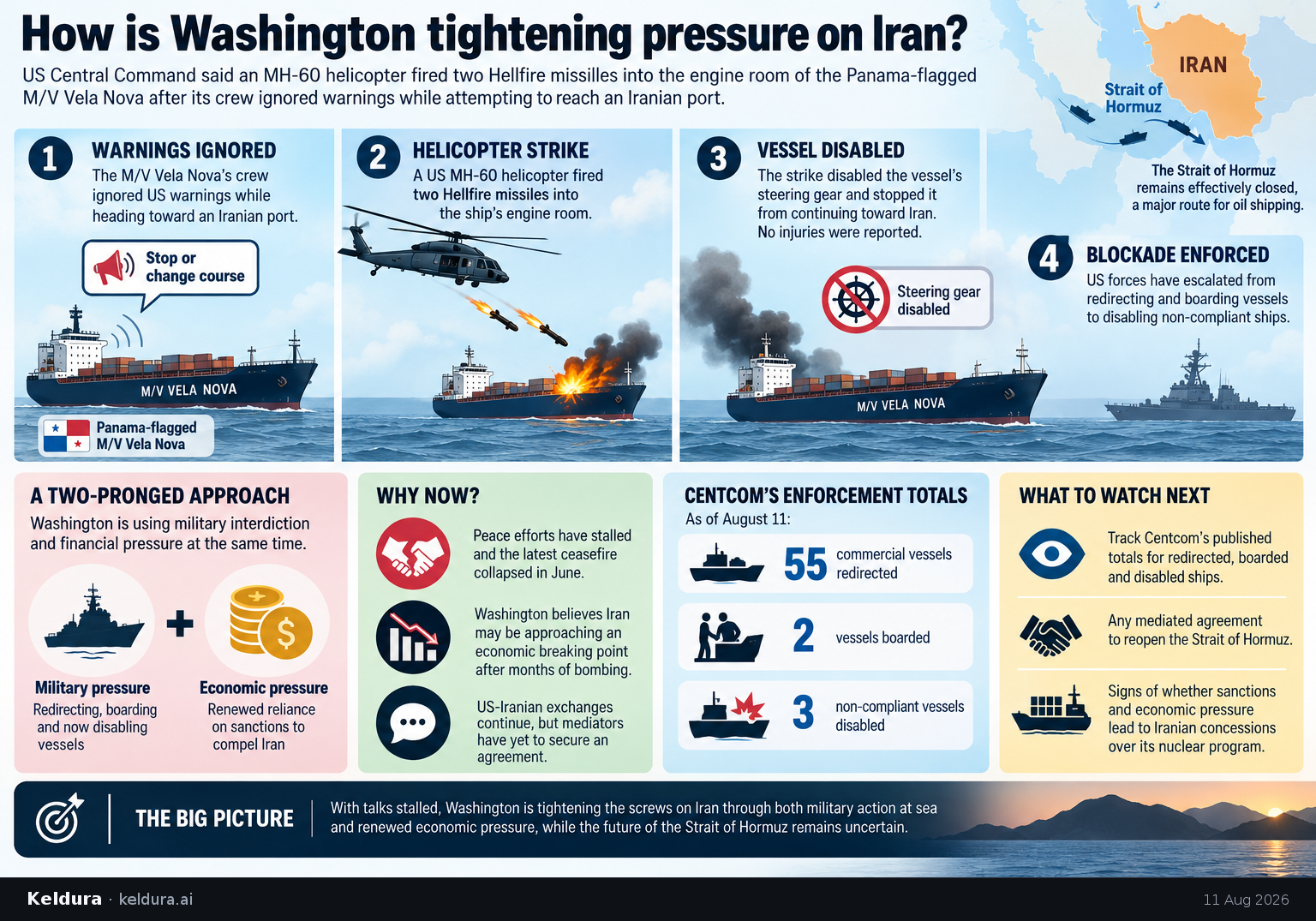
US Central Command said an MH-60 helicopter fired two Hellfire missiles into the engine room of the Panama-flagged M/V Vela Nova after its crew ignored warnings while attempting to reach an Iranian port.
Why it matters: Washington is now applying military interdiction and financial pressure simultaneously, while the Strait of Hormuz remains effectively closed and intermittent US-Iranian exchanges continue following…
US forces escalated from redirecting and boarding vessels to disabling M/V Vela Nova with two missiles, while the administration pivoted back toward sanctions.[1][9]
Why now
Peace efforts have stalled, the latest ceasefire collapsed in June, and Washington argues Iran may be approaching an economic breaking point after months of bombing.[1][9]
Watch next
Track Centcom’s published totals for redirected, boarded and disabled ships, along with any mediated agreement to reopen the Strait of Hormuz.[1]
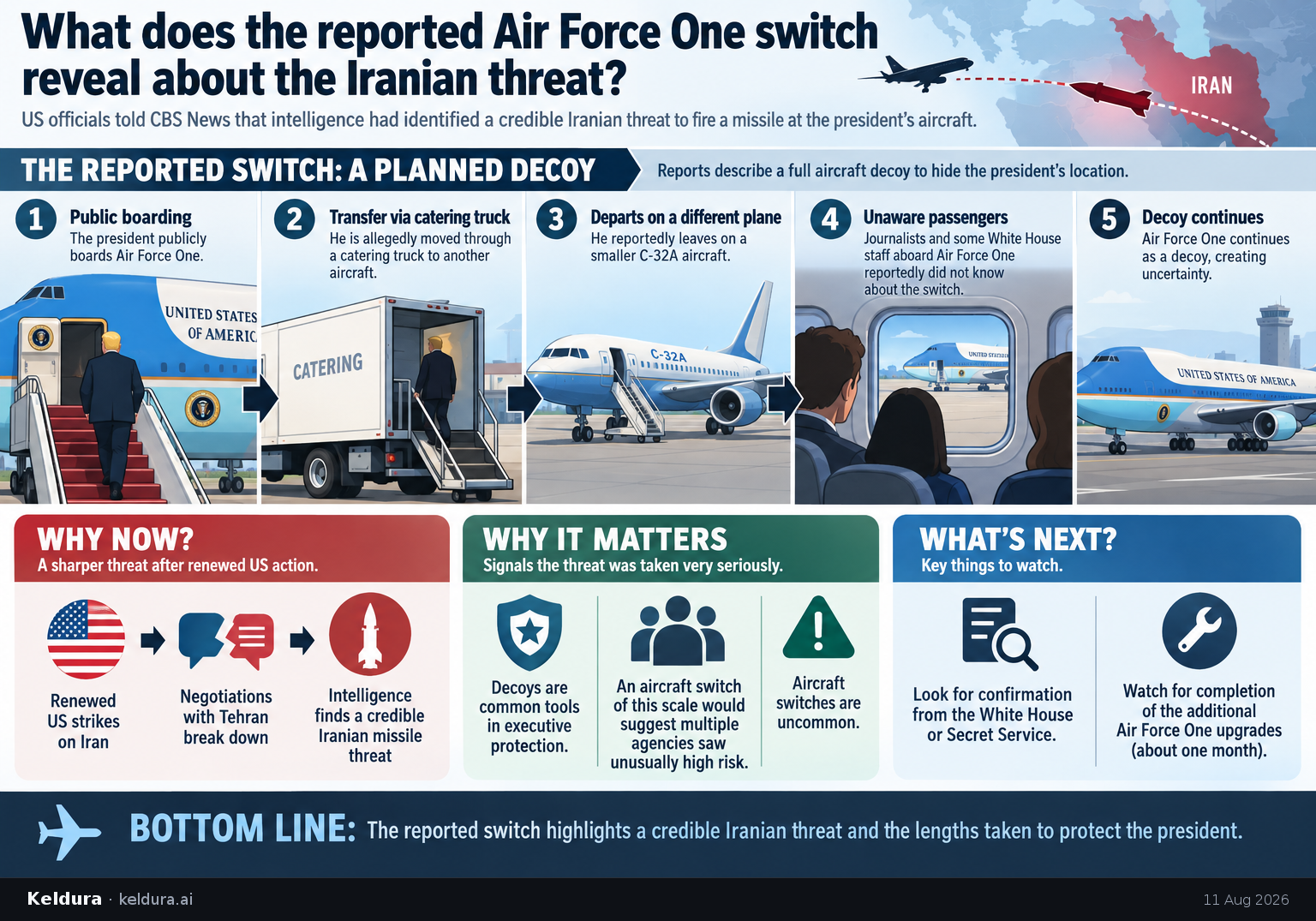
US officials told CBS News that intelligence had identified a credible Iranian threat to fire a missile at the president’s aircraft.
Why it matters: Former Secret Service officials said decoys are familiar tools in executive protection, but an aircraft substitution of this scale would indicate that multiple agencies considered the potential dange…
Reports described a full aircraft decoy: Trump publicly boarded Air Force One but was allegedly transferred by catering truck to a C-32A.[2]
Why now
Officials cited intelligence about a credible Iranian missile threat amid renewed US strikes and failed negotiations with Tehran.[2]
Watch next
Watch for confirmation from the White House or Secret Service and for completion of the additional Air Force One upgrades announced for the fall.[2][5]
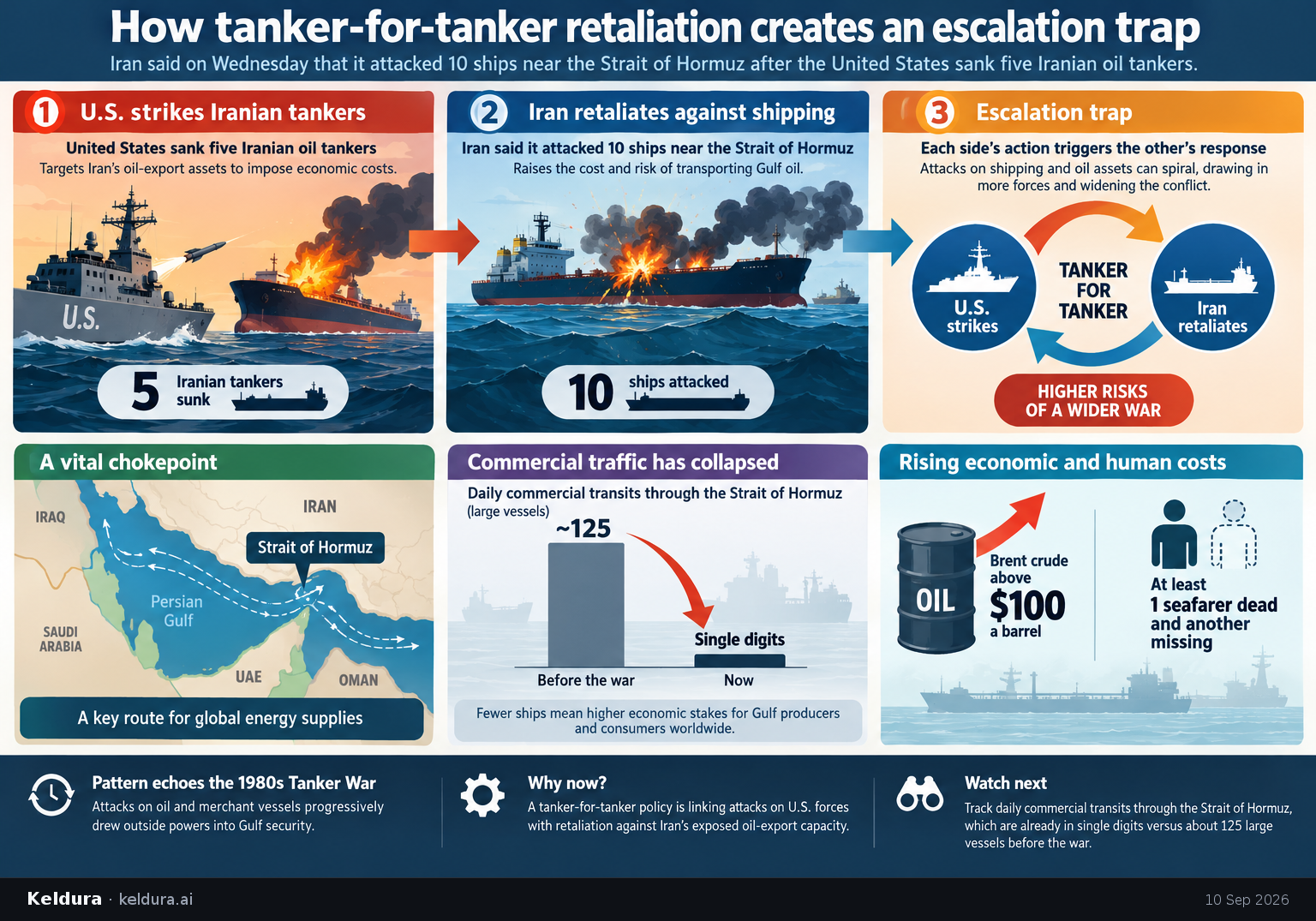
Iran said on Wednesday that it attacked 10 ships near the Strait of Hormuz after the United States sank five Iranian oil tankers.
Why it matters: Commercial traffic through the energy chokepoint has fallen to single digits per day, compared with roughly 125 large vessels before the war, raising the economic stakes for Gulf producers and oil co…
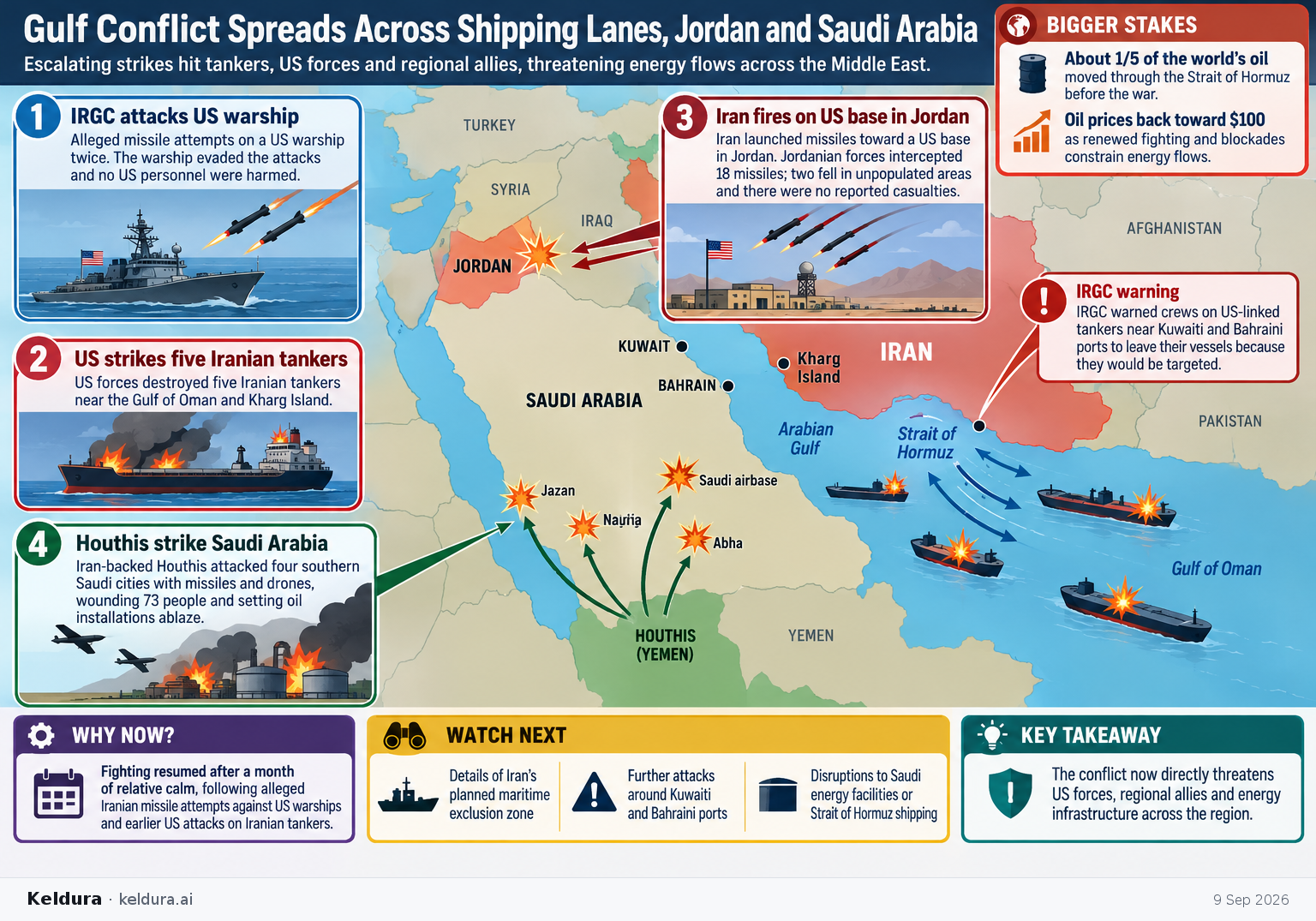
US forces struck five Iranian tankers near the Gulf of Oman and Kharg Island after the IRGC allegedly tried twice to hit a US warship with ballistic missiles.
Why it matters: The exchanges now directly threaten US forces, regional allies and energy infrastructure around the Strait of Hormuz, which carried about one-fifth of the world's oil before the war. Oil benchmarks h…
US attacks destroyed five Iranian tankers, Iran fired missiles toward a US base in Jordan, and the Houthis mounted major strikes on southern Saudi Arabia.[1][4][6]
Why now
Fighting resumed after a month of relative calm, following alleged Iranian missile attempts against US warships and earlier US attacks on Iranian tankers.[1][2][4]
Watch next
Track announced details of Iran's planned maritime exclusion zone, further attacks around Kuwaiti and Bahraini ports, and disruptions to Saudi energy facilities or Strait of Hormuz shipping.[1][4]
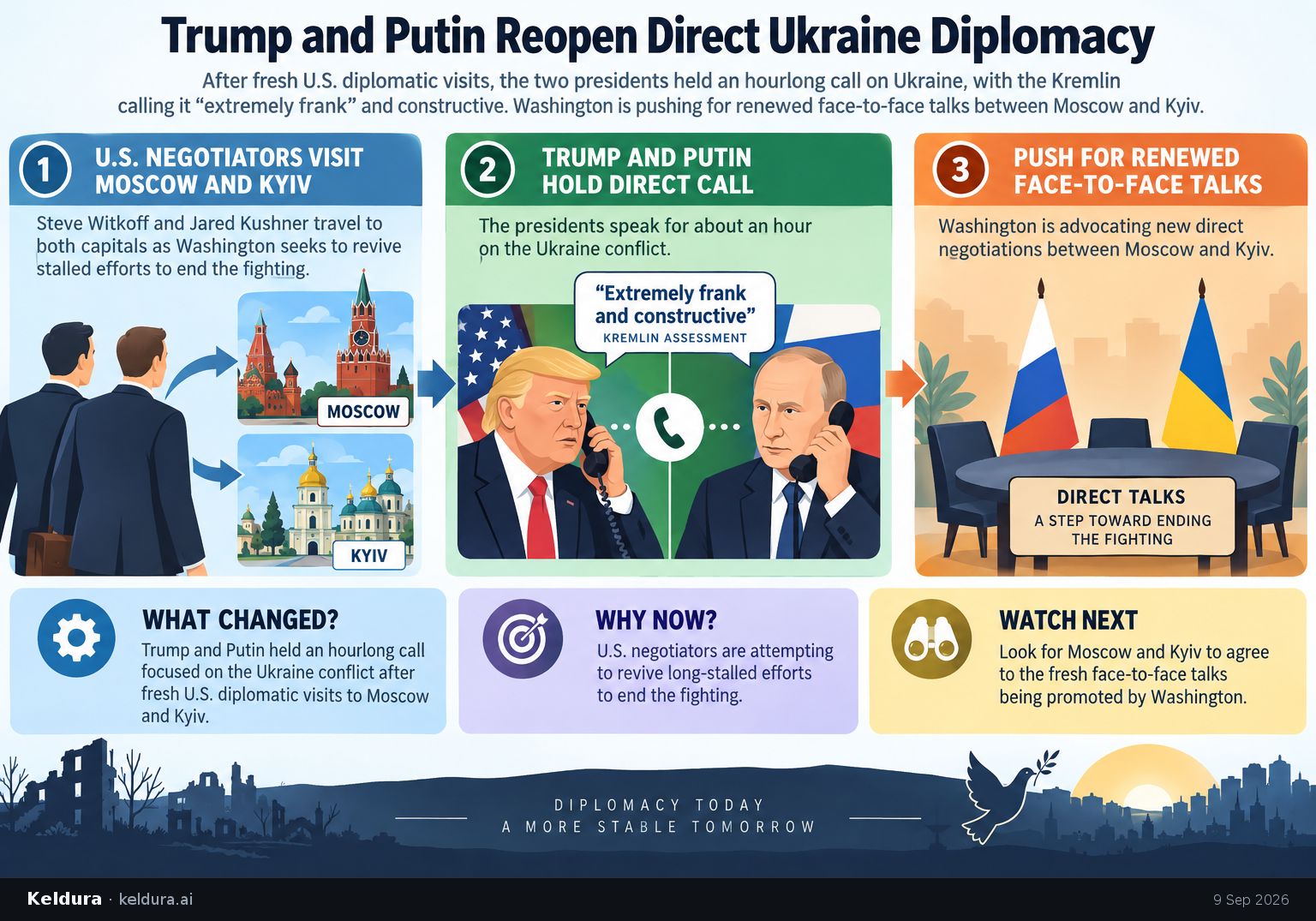
Donald Trump and Vladimir Putin discussed the Ukraine conflict in what the Kremlin called an extremely frank and constructive hourlong telephone call.
Why it matters: The call places the US and Russian presidents back into direct contact while Washington presses for renewed face-to-face negotiations between Moscow and Kyiv.
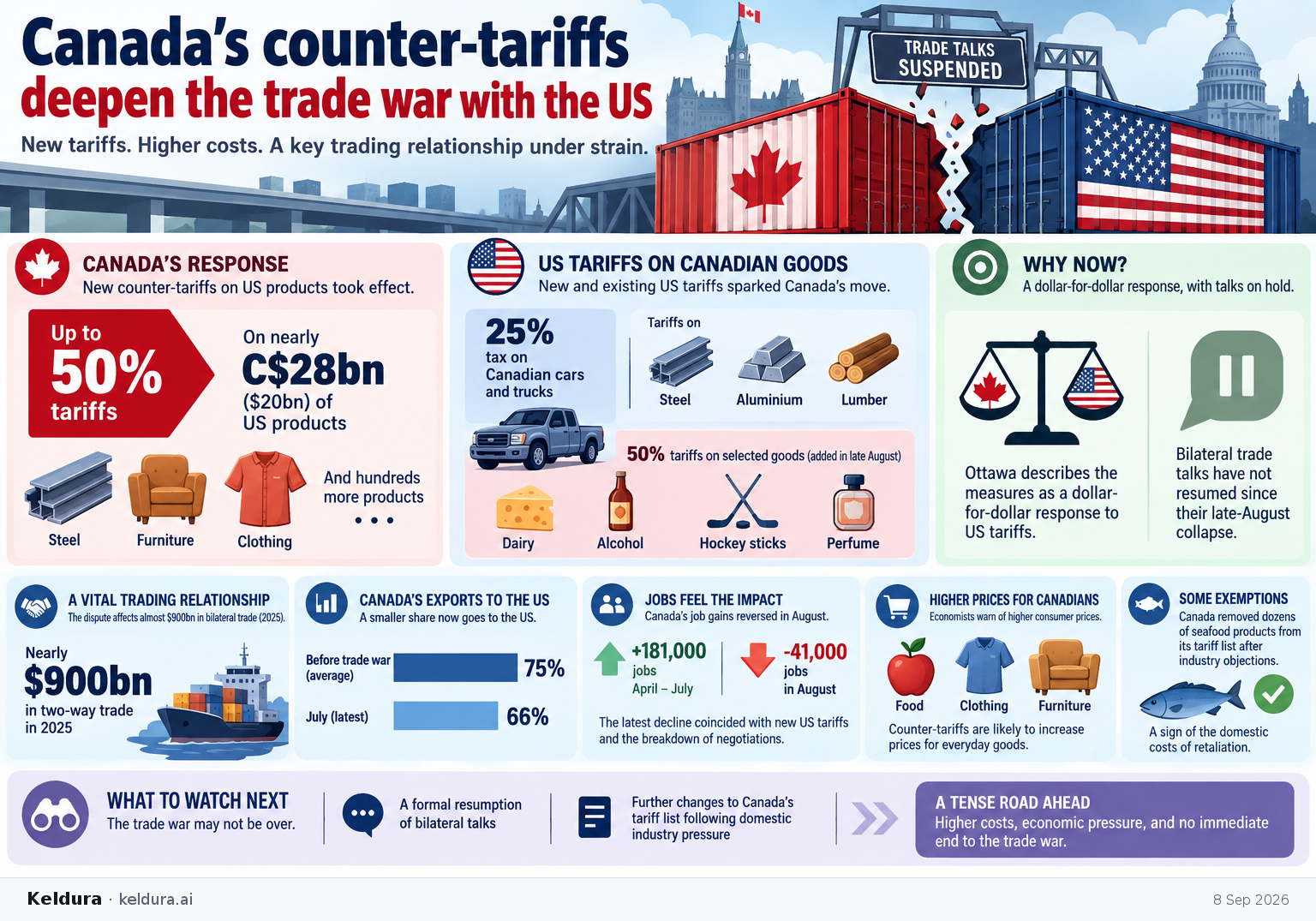
Canada has imposed retaliatory tariffs of up to 50% on nearly C$28bn ($20bn) of US products, including steel, furniture and clothing.
Why it matters: The dispute affects a bilateral trading relationship valued at nearly $900bn in 2025, and economists warn that Canada’s counter-tariffs will increase consumer prices for everyday goods such as food,…
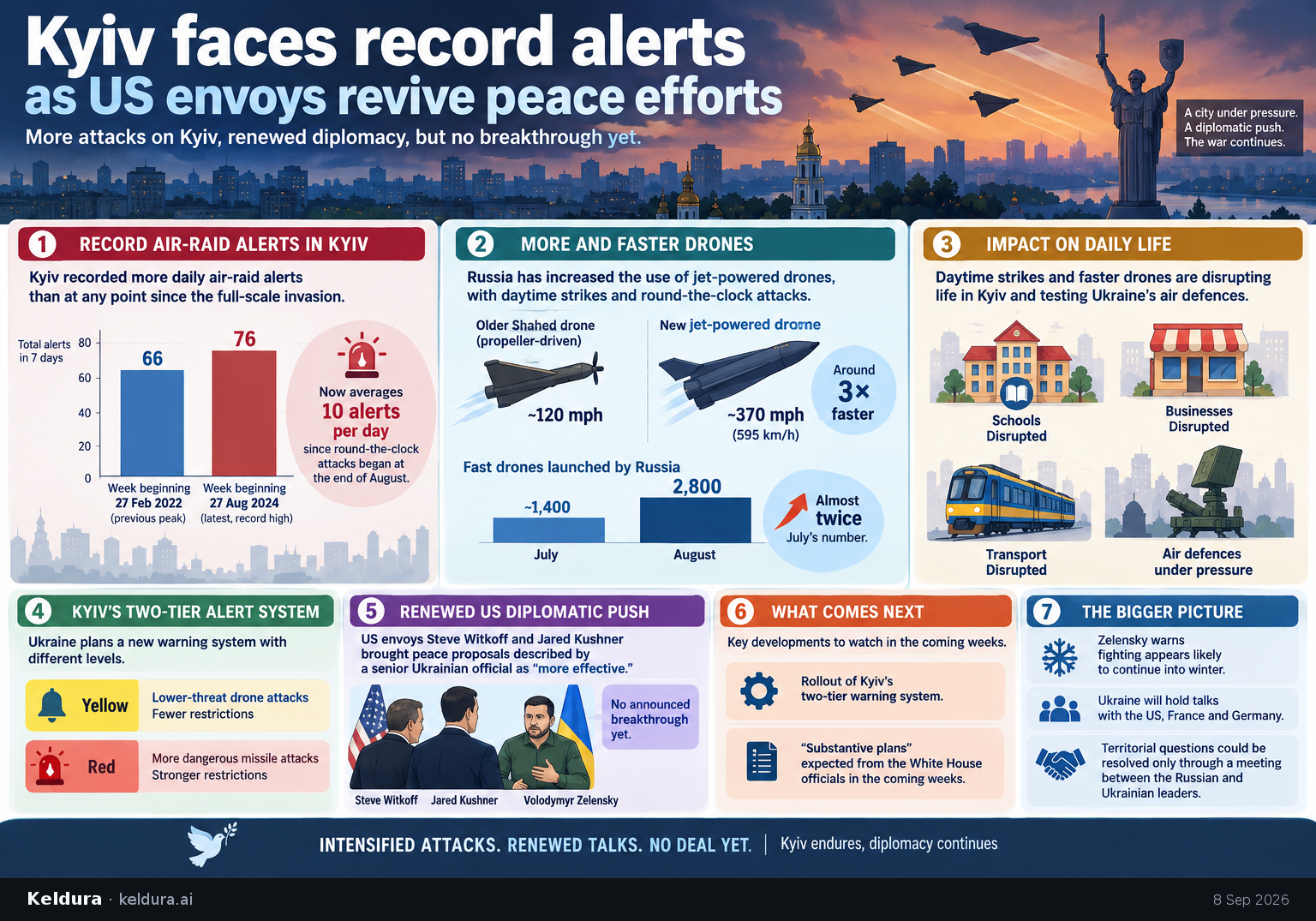
Kyiv is experiencing more daily air-raid alerts than at any point since Russia’s full-scale invasion, averaging 10 a day since round-the-clock attacks began at the end of August.
Why it matters: Russia’s daytime strikes and faster drones are disrupting schools, businesses and transport while testing Ukraine’s air defences; the simultaneous diplomatic activity has yet to produce an agreement…
Russia shifted toward round-the-clock attacks on Kyiv, including daytime strikes and increased use of faster jet-powered drones.[2]
Why now
The intensified campaign began at the end of August as US envoys pursued renewed settlement discussions after a summer of escalation.[2][8]
Watch next
Watch for the rollout of Kyiv’s two-tier warning system and the “substantive plans” that a White House official said would be announced in the coming weeks.[2][8]
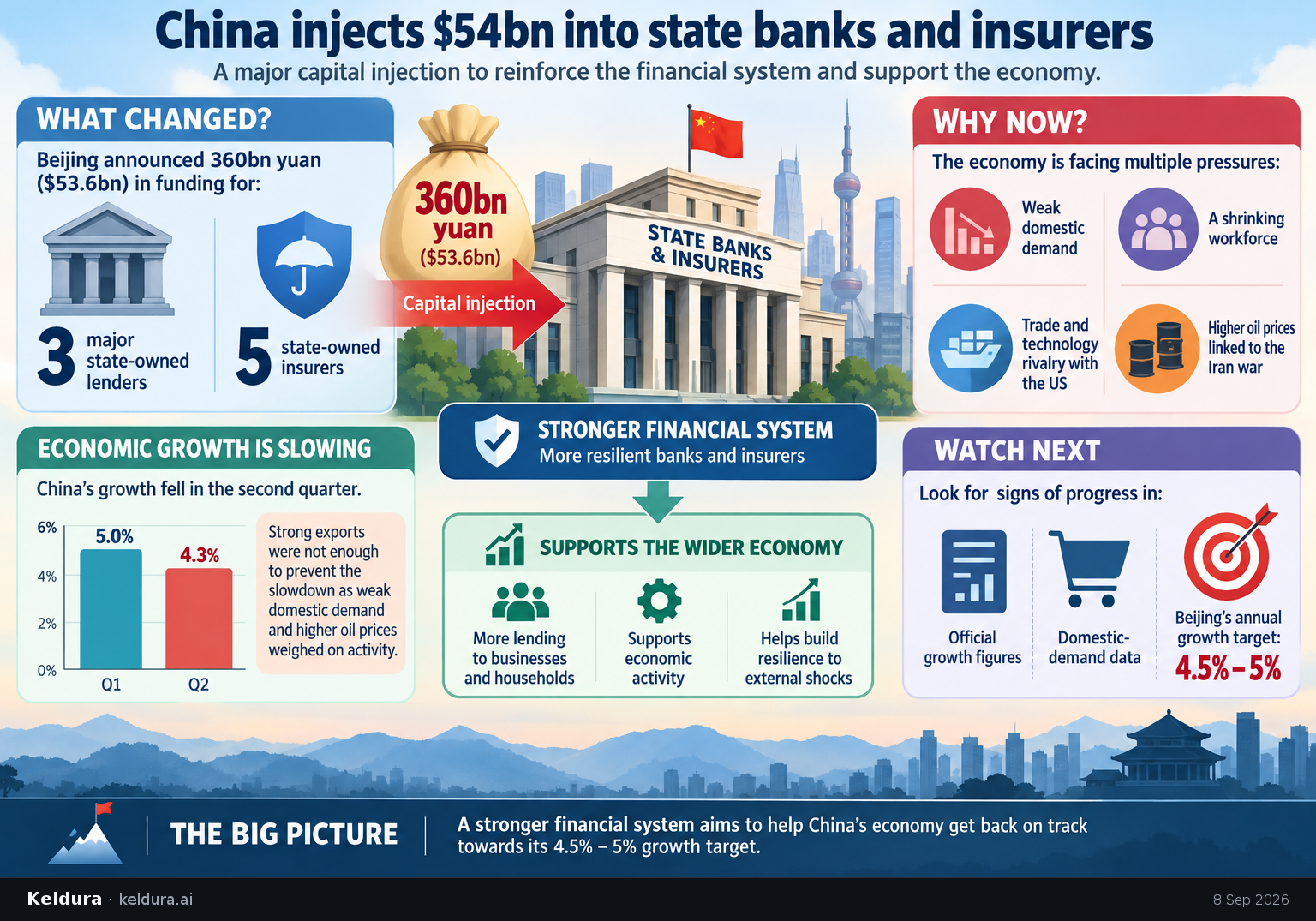
China’s finance ministry is leading a 360bn yuan ($53.6bn) capital injection into three major state-owned lenders and five insurers.
Why it matters: The intervention is intended to reinforce China’s financial system and support an economy confronting weak domestic demand, a shrinking workforce, trade and technology rivalry with the US, and higher…
Beijing announced 360bn yuan in funding for eight state-owned banks and insurance companies.[3]
Why now
Second-quarter growth fell below Beijing’s annual target as domestic demand weakened and external economic pressures mounted.[3]
Watch next
Watch official growth and domestic-demand figures for evidence of whether the capital injection helps activity return to Beijing’s 4.5%-5% target range.[3]
The Alternative for Germany won 43.8% of the vote in Saxony-Anhalt’s state election and finished three seats short of an outright majority, according to preliminary results.
Why it matters: The result puts unprecedented pressure on Germany’s political firewall against the AfD and could determine whether the party enters state-level power or whether Saxony-Anhalt faces political deadlock…
The AfD secured a historic state-election victory with 43.8% but lacks three seats for an outright majority.[4]
Why now
The result gives the AfD a claimed mandate to govern while leaving it dependent on support from political rivals or individual MPs.[4]
Watch next
Watch whether any parliamentary group or individual legislator agrees to support an AfD-led government during consultations expected to last days or weeks.[4]
That's the desk. Every cheatsheet here started as a link. Yours can too.