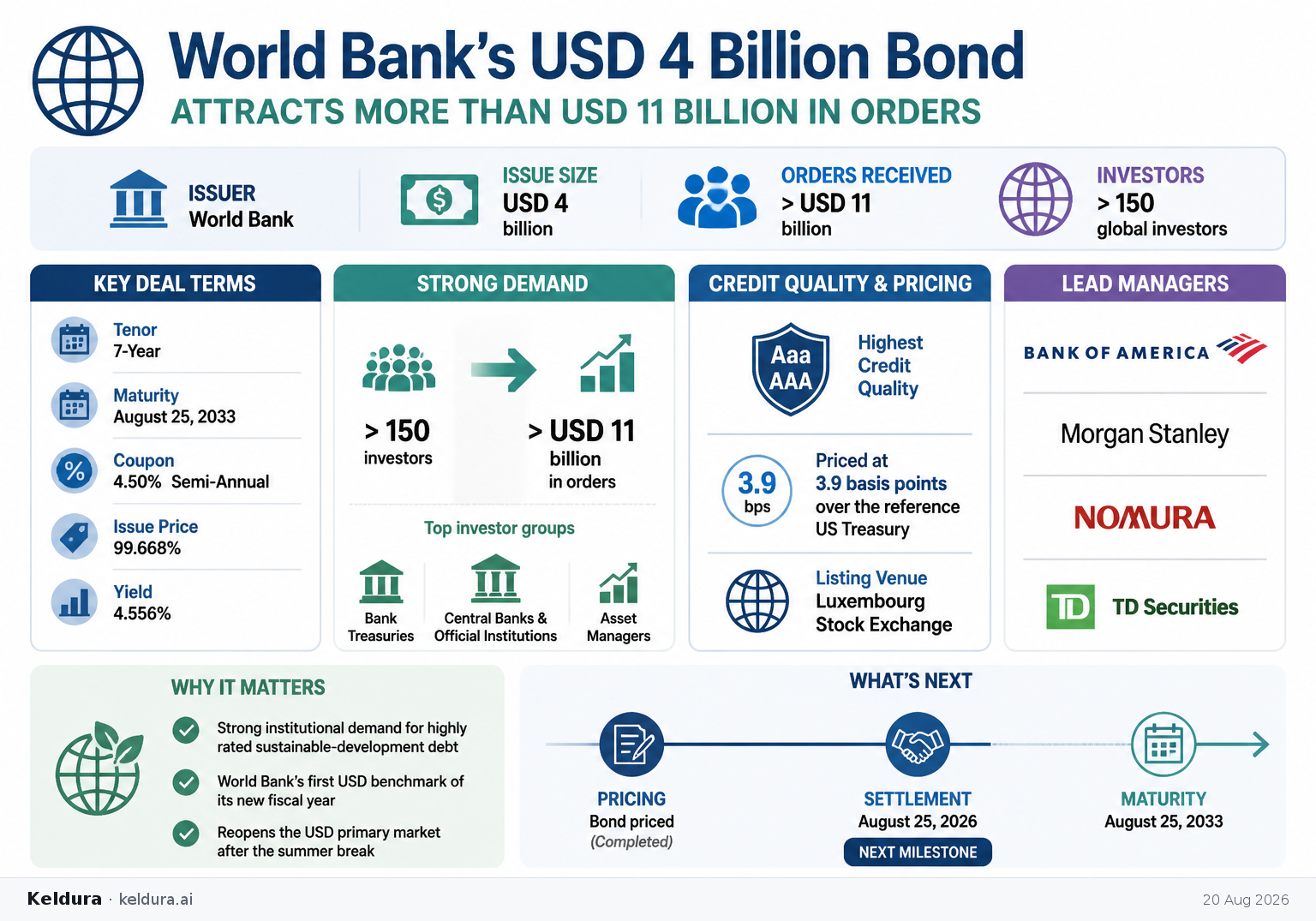
The World Bank priced a USD 4 billion, seven-year Sustainable Development Bond maturing on August 25, 2033, with settlement scheduled for August 25, 2026.
Why it matters: The heavily subscribed order book indicates strong institutional demand for highly rated sustainable-development debt as the World Bank returned to the USD benchmark market for its new fiscal year.
The World Bank priced a USD 4 billion benchmark Sustainable Development Bond after receiving more than USD 11 billion in orders from over 150 investors.[1]
Why now
The transaction marked the World Bank’s first USD benchmark of its new fiscal year and reopened the USD primary market after the summer break.[1]
Watch next
The observable next milestone is settlement on August 25, 2026; the bond is scheduled to mature on August 25, 2033.[1]
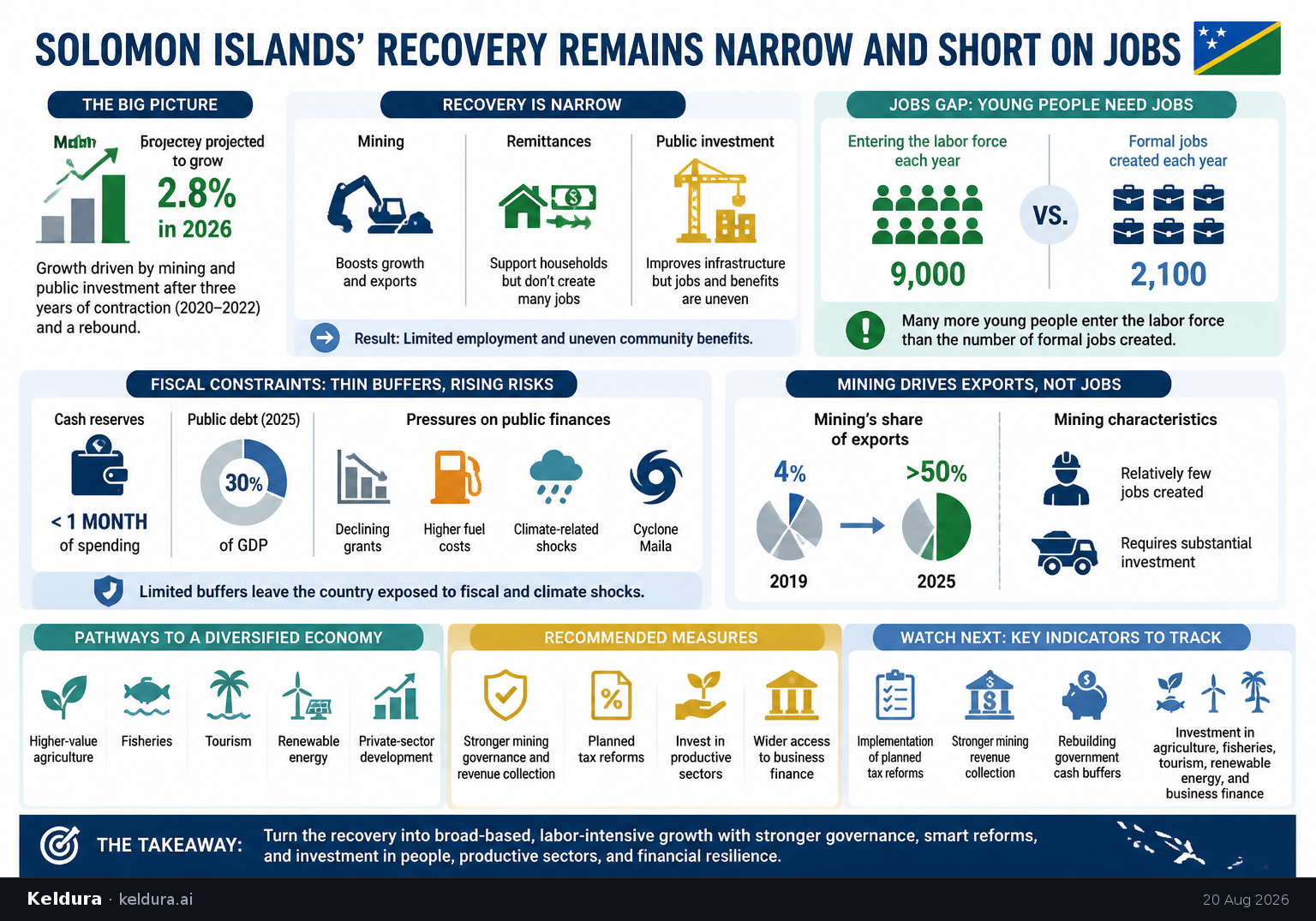
The World Bank projects Solomon Islands’ economy will grow 2.8% in 2026, mainly because of mining and public investment, after three consecutive years of contraction from 2020 through 2022 and a subsequent rebound.
Why it matters: About 9,000 young Solomon Islanders enter the labor force annually, but only around 2,100 formal jobs are created, making broader and more labor-intensive growth central to incomes and social resilie…
A new World Bank Economic Update put 2026 growth at 2.8% but found that the mining- and public-investment-led recovery is producing limited employment and uneven benefits.[2]
Why now
Mining’s export share has surged while labor-force entrants substantially outnumber new formal jobs, and thin cash reserves leave the country exposed to fiscal and climate shocks.[2]
Watch next
Observable indicators include implementation of planned tax reforms, stronger mining revenue collection, rebuilding of government cash buffers, and investment in agriculture, fisheries, tourism, renewable energy, and business finance.[2]
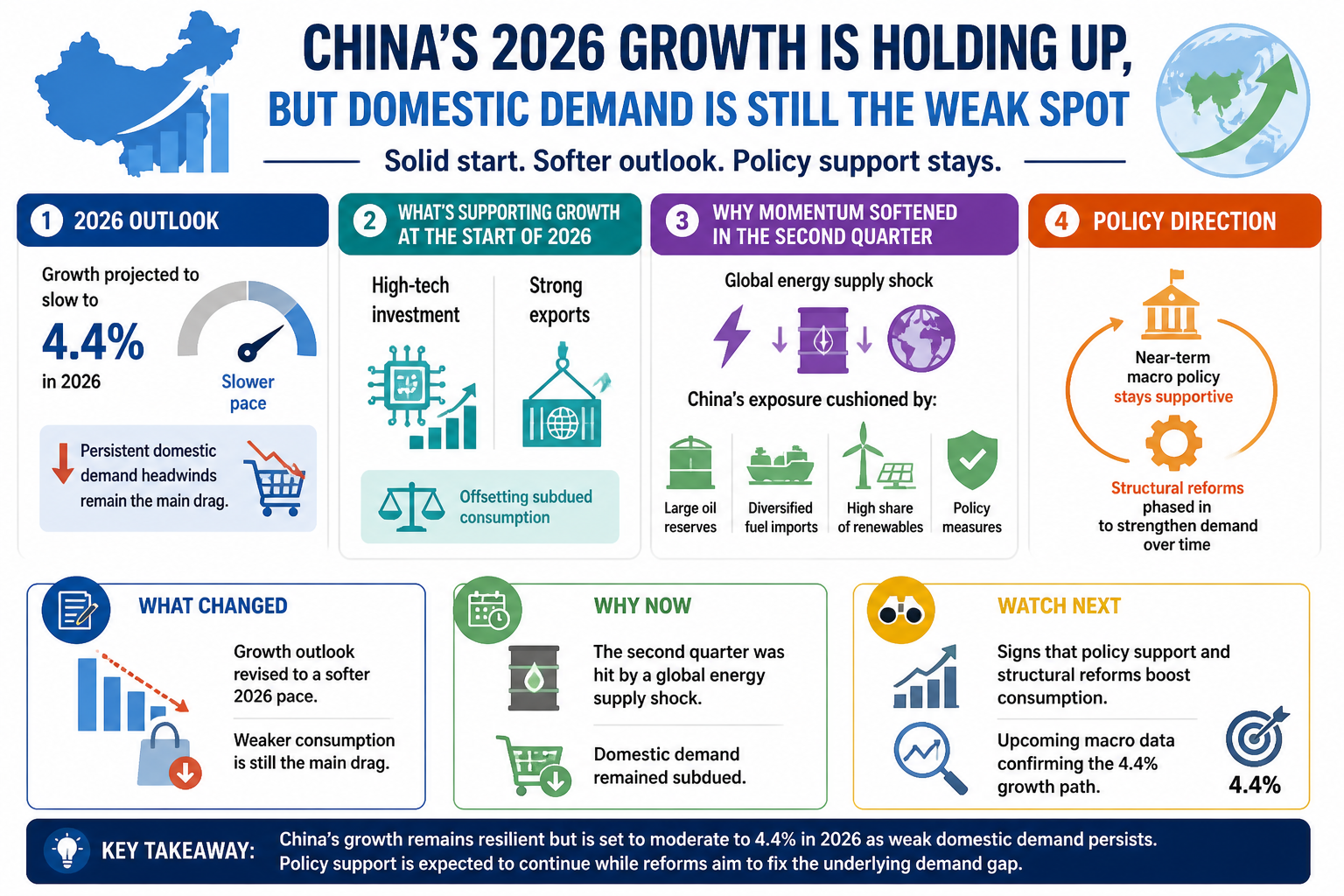
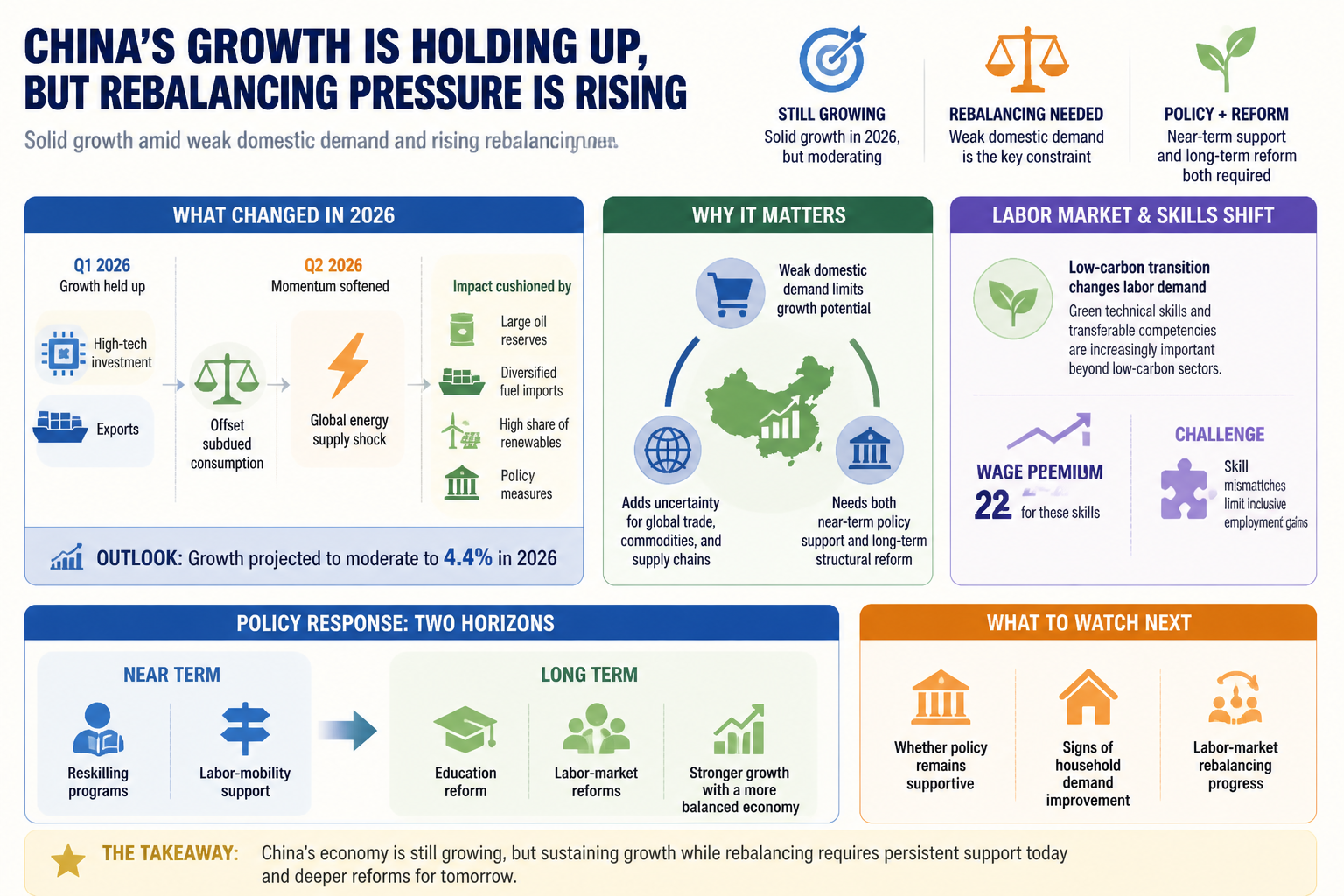
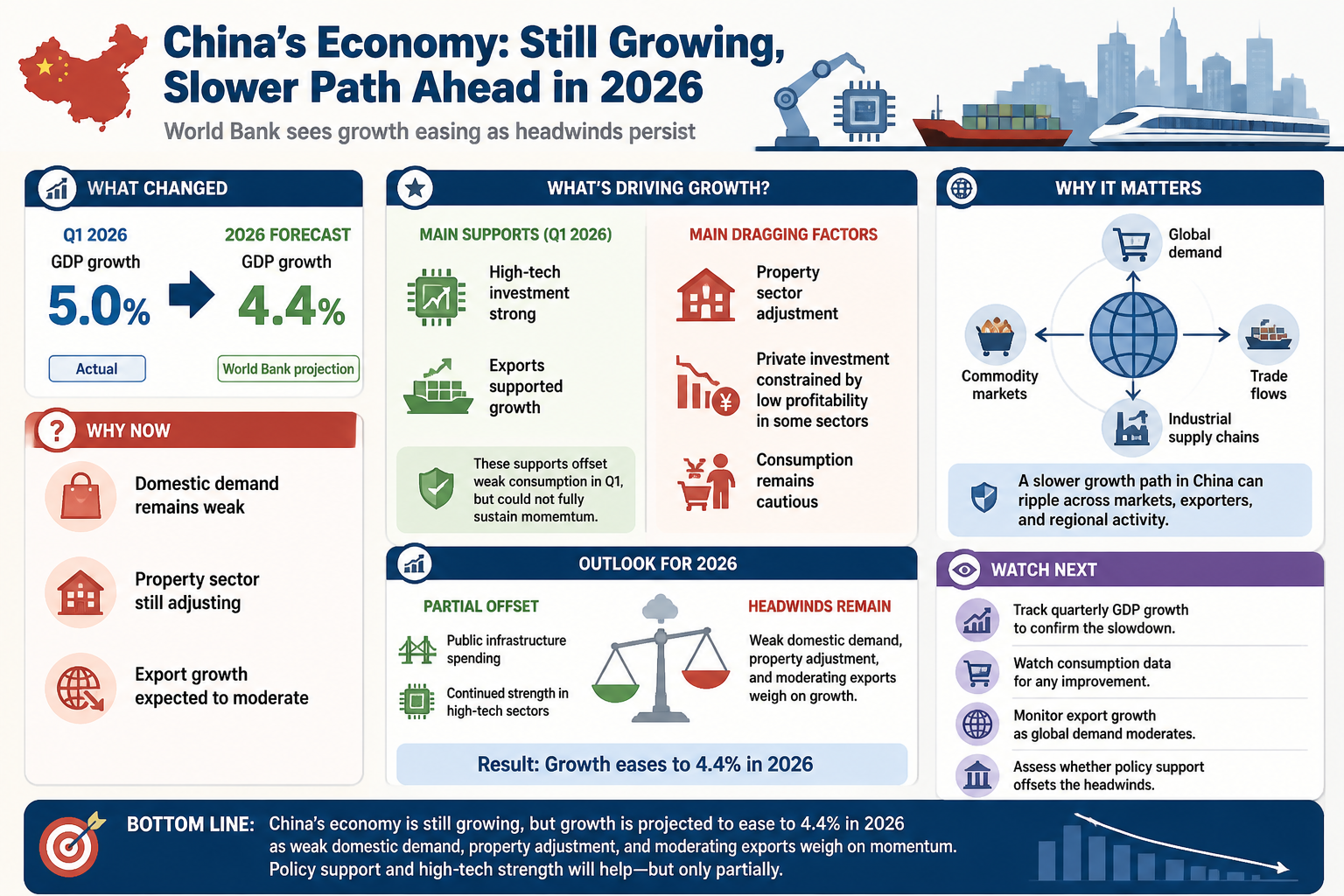
The World Bank’s China Economic Update says China maintained solid growth at the start of 2026, supported by high-tech investment and exports even as consumption stayed subdued.
Why it matters: This matters because China remains one of the world’s largest growth engines, so a moderation toward 4.4 percent in 2026 has implications for global trade, commodity demand, and investor expectations…
China’s growth outlook was revised to a softer 2026 pace, with weaker consumption still the main drag [2].
Why now
The second quarter was hit by a global energy supply shock, while domestic demand remained subdued [2].
Watch next
Look for signs of whether policy support and structural reforms improve consumption and whether the next macro data confirm the 4.4 percent growth path [2].
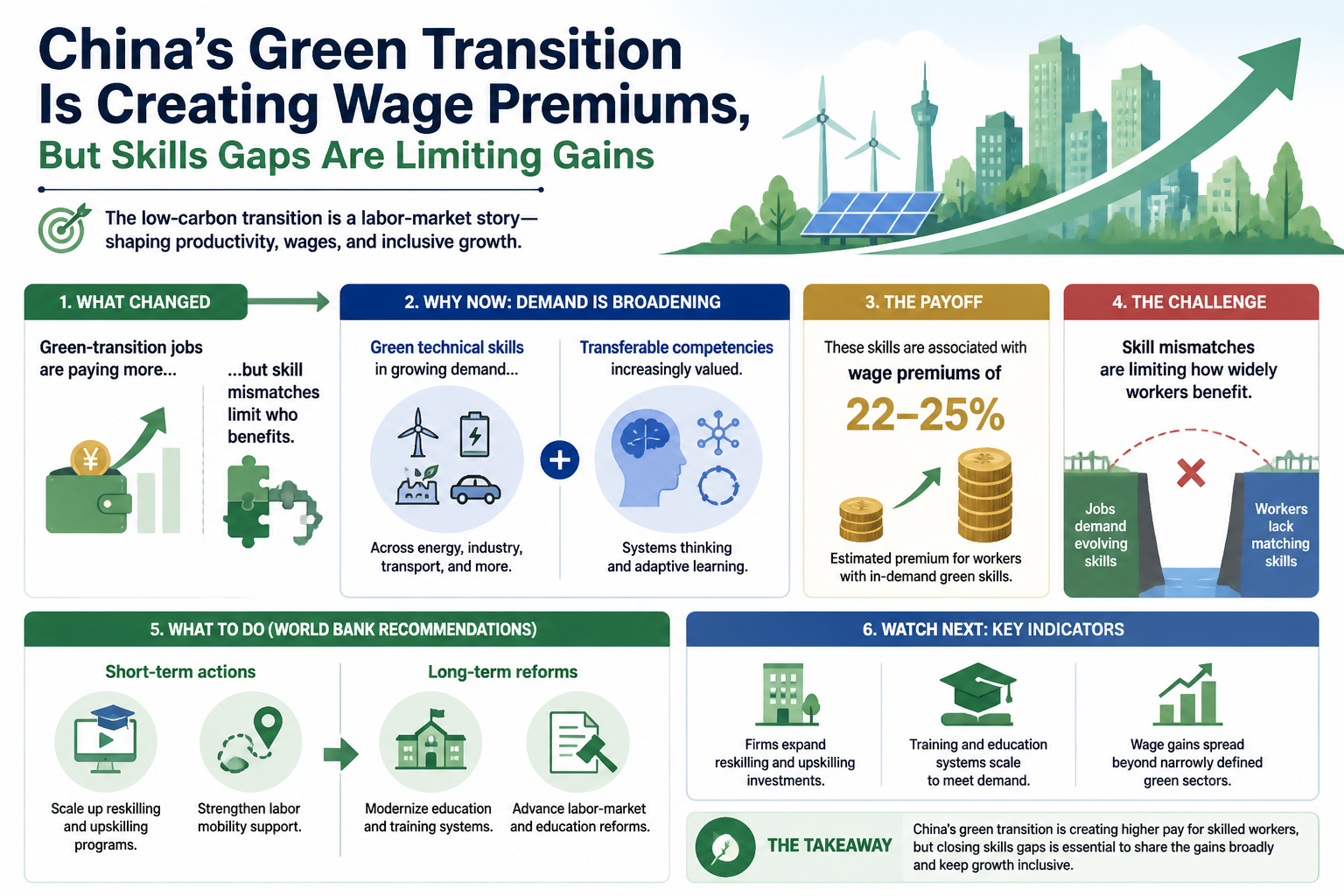
The same World Bank update says China’s low-carbon transition is reshaping its labor market, with demand rising for green technical skills and broader competencies such as systems thinking and adaptive learning.
Why it matters: This matters for markets and policymakers because the energy transition is not only an industrial story but also a labor-market story that affects productivity, wages, and the pace of inclusive growt…
Green-transition jobs are paying more, but skill mismatches are stopping workers from fully capturing the gains [2].
Why now
China’s low-carbon transition is broadening demand for both technical and transferable skills [2].
Watch next
Track whether firms and training systems expand reskilling programs and whether evidence of wage gains spreads beyond narrowly defined green sectors [2].
The World Bank’s July 2026 China Economic Update says China maintained solid growth early in the year, with high-tech investment and exports offsetting subdued consumption.
Why it matters: The report points to a Chinese economy that is still growing, but increasingly constrained by weak domestic demand, which makes the outlook for global trade, commodities, and emerging-market supply c…
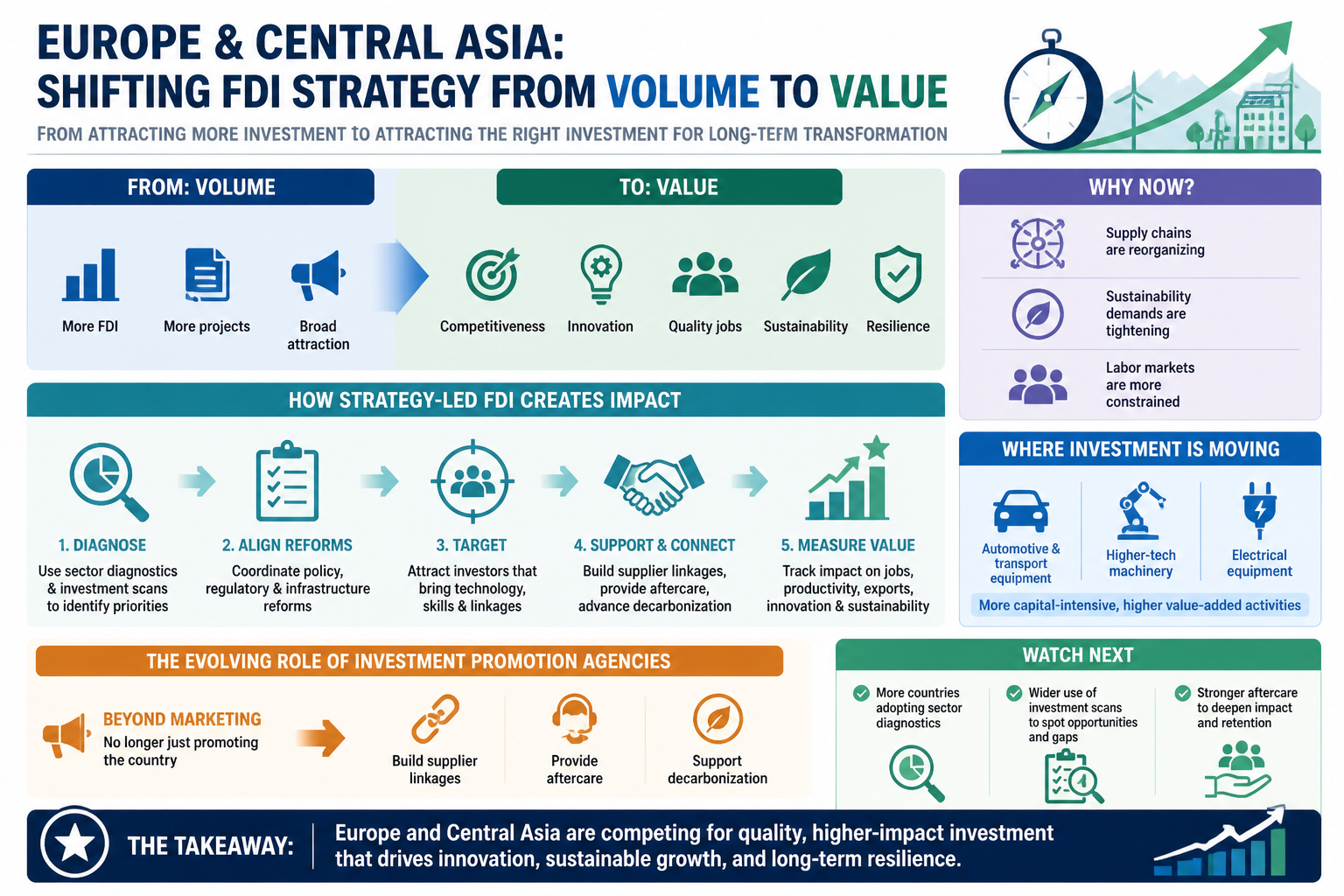
A World Bank brief says countries across Europe and Central Asia are moving away from judging foreign direct investment only by volume and project counts.
Why it matters: This matters because it changes how governments compete for capital: the goal is no longer simply to attract more FDI, but to attract investment that helps transform the economy. That could reshape p…
FDI policy is evolving from broad attraction campaigns toward strategy-led targeting of quality, higher-impact investment [3].
Why now
Governments are reacting to tighter sustainability demands, shifting supply chains, and more constrained labor markets [3].
Watch next
Monitor whether more countries adopt sector diagnostics, investment scans, and aftercare tools to target advanced manufacturing, renewables, and sustainable tourism [3].
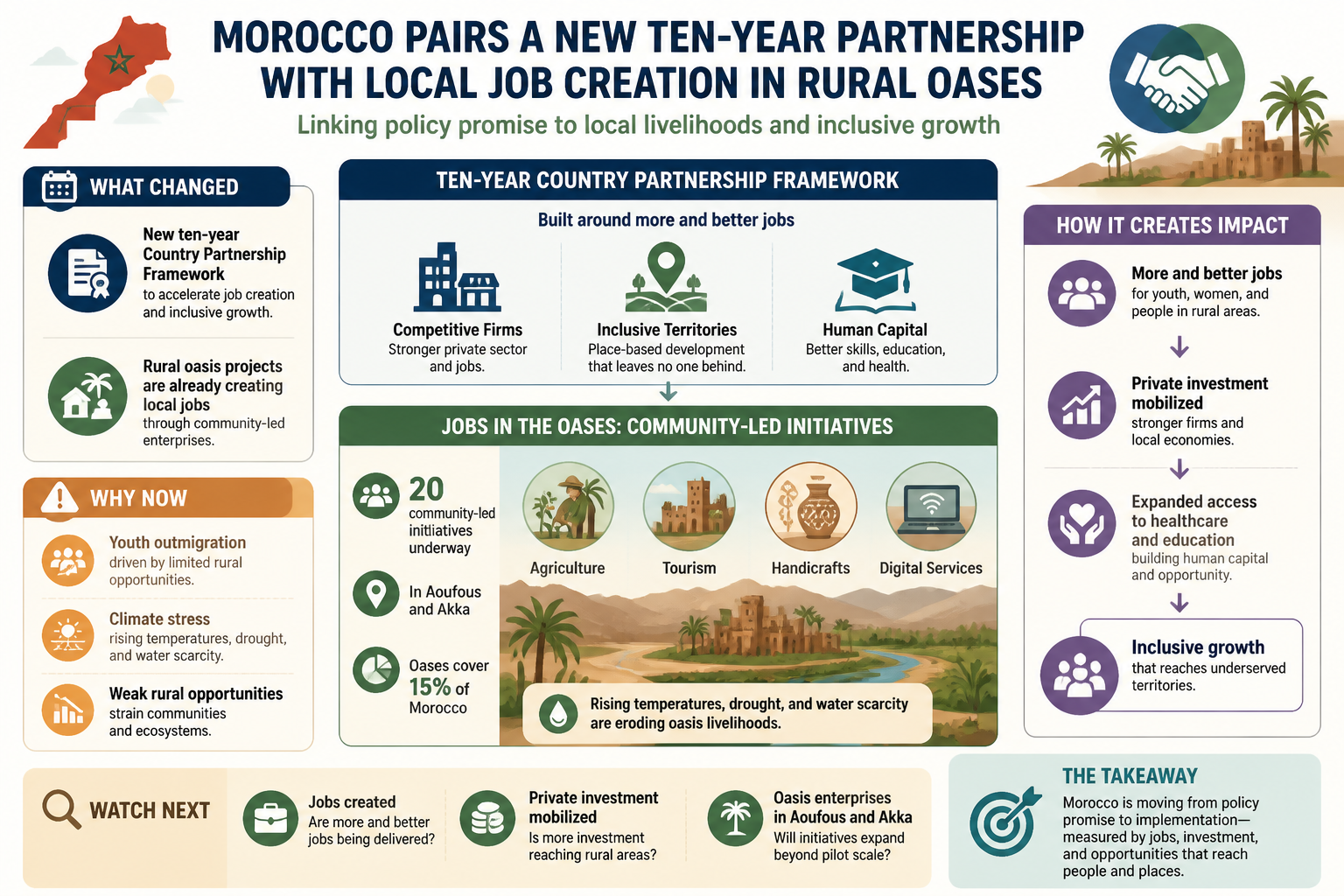
Why it matters: Together, the two Morocco stories suggest the country is moving from a policy promise to an implementation model that links private-sector-led growth with place-based development and social inclusion…
Morocco launched a new ten-year Country Partnership Framework, while rural oasis projects are already supporting local job creation.[4][1]
Why now
Job creation is being framed as urgent because youth outmigration, climate stress, and weak rural opportunities are straining communities and ecosystems.[1][4]
Watch next
Look for indicators on jobs created, private investment mobilized, and whether oasis enterprises in Aoufous and Akka expand beyond pilot-scale activity.[4][1]
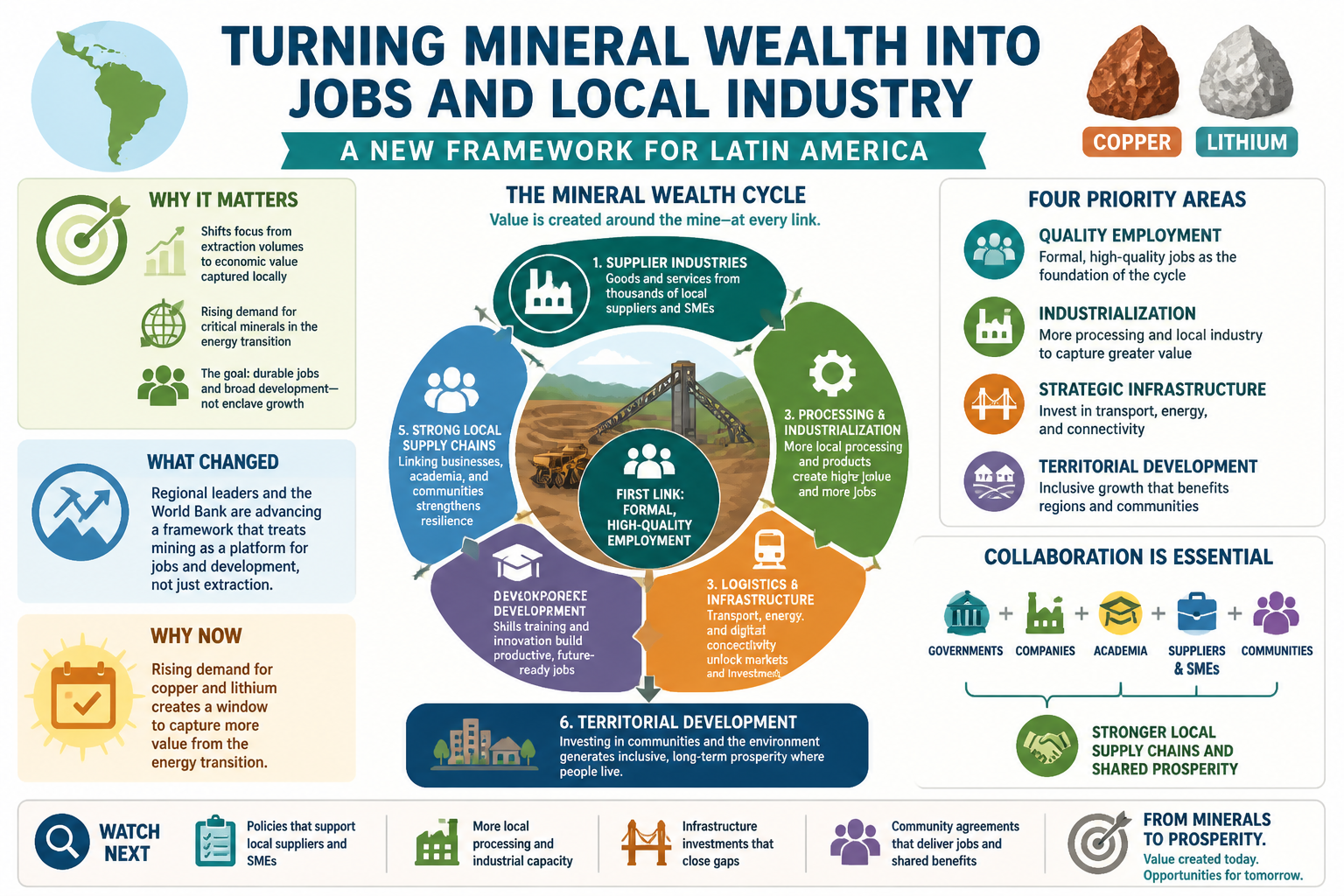
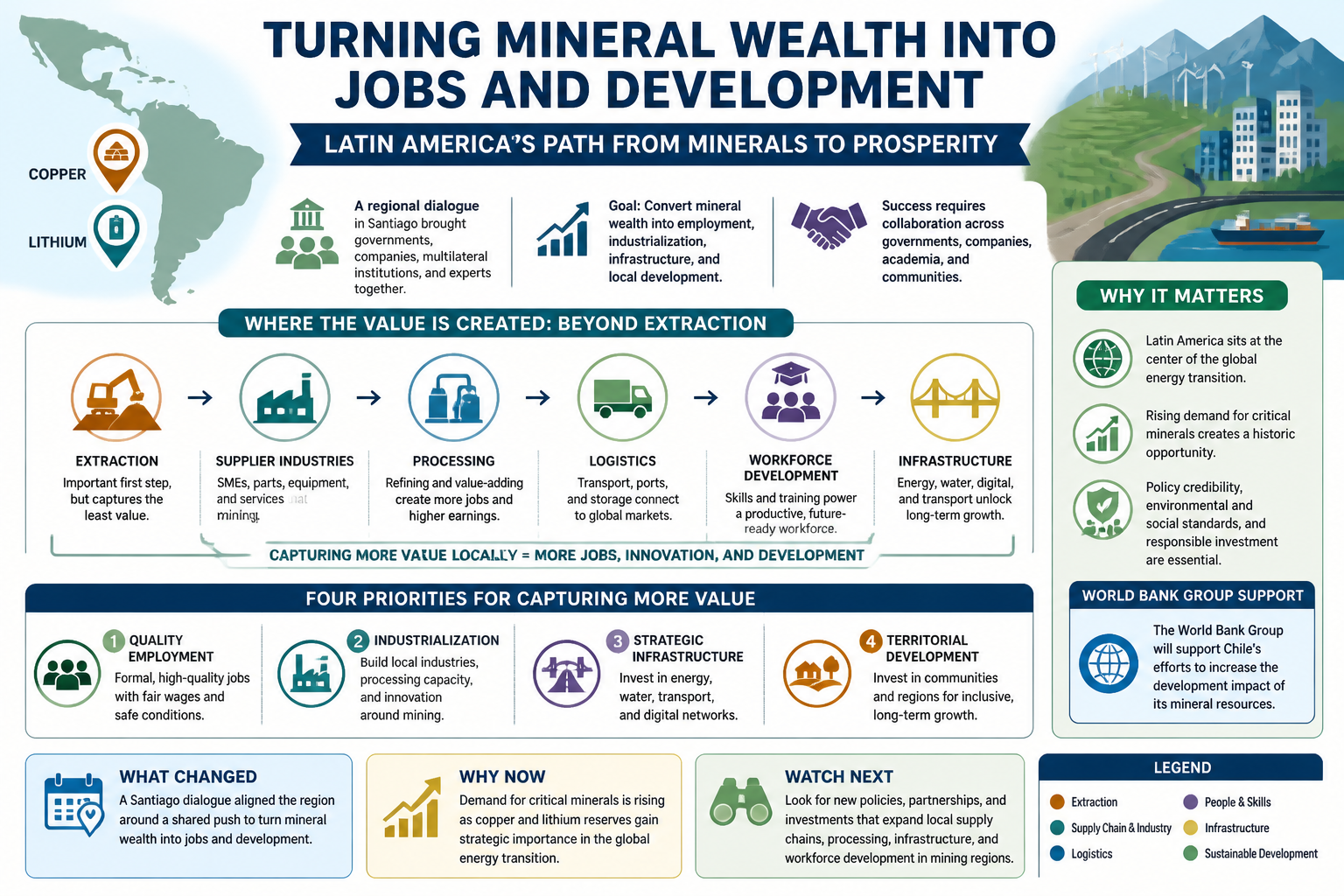
A World Bank-hosted regional dialogue in Santiago focused on how Latin America can convert copper and lithium wealth into jobs, innovation, infrastructure, and territorial development.
Why it matters: The discussion matters because it shifts the mineral conversation from output volumes to who captures the economic value, especially as global demand for critical minerals rises with the energy trans…
Regional leaders and the World Bank are advancing a framework that treats mining as a platform for jobs and development, not just extraction.[2]
Why now
Rising demand for copper and lithium is creating a window to capture more value from the energy transition.[2]
Watch next
Track whether countries adopt policies that strengthen local suppliers, processing, infrastructure, and community agreements around mining projects.[2]
A regional dialogue in Santiago focused on how Latin America can turn copper and lithium wealth into employment, industrialization, infrastructure, and local development.
Why it matters: This matters because Latin America sits at the center of the global energy transition, but the economic payoff from critical minerals will depend on whether countries can build local ecosystems that…
A Santiago dialogue brought governments, miners, multilateral institutions, and experts together around a regional push to convert mineral wealth into jobs and development.[1]
Why now
Demand for critical minerals is rising as Latin America’s copper and lithium reserves gain strategic importance in the global energy transition.[1]
Watch next
Evidence of new policies, partnerships, or investments that expand local supply chains, processing, infrastructure, or workforce development in mining regions.[1]
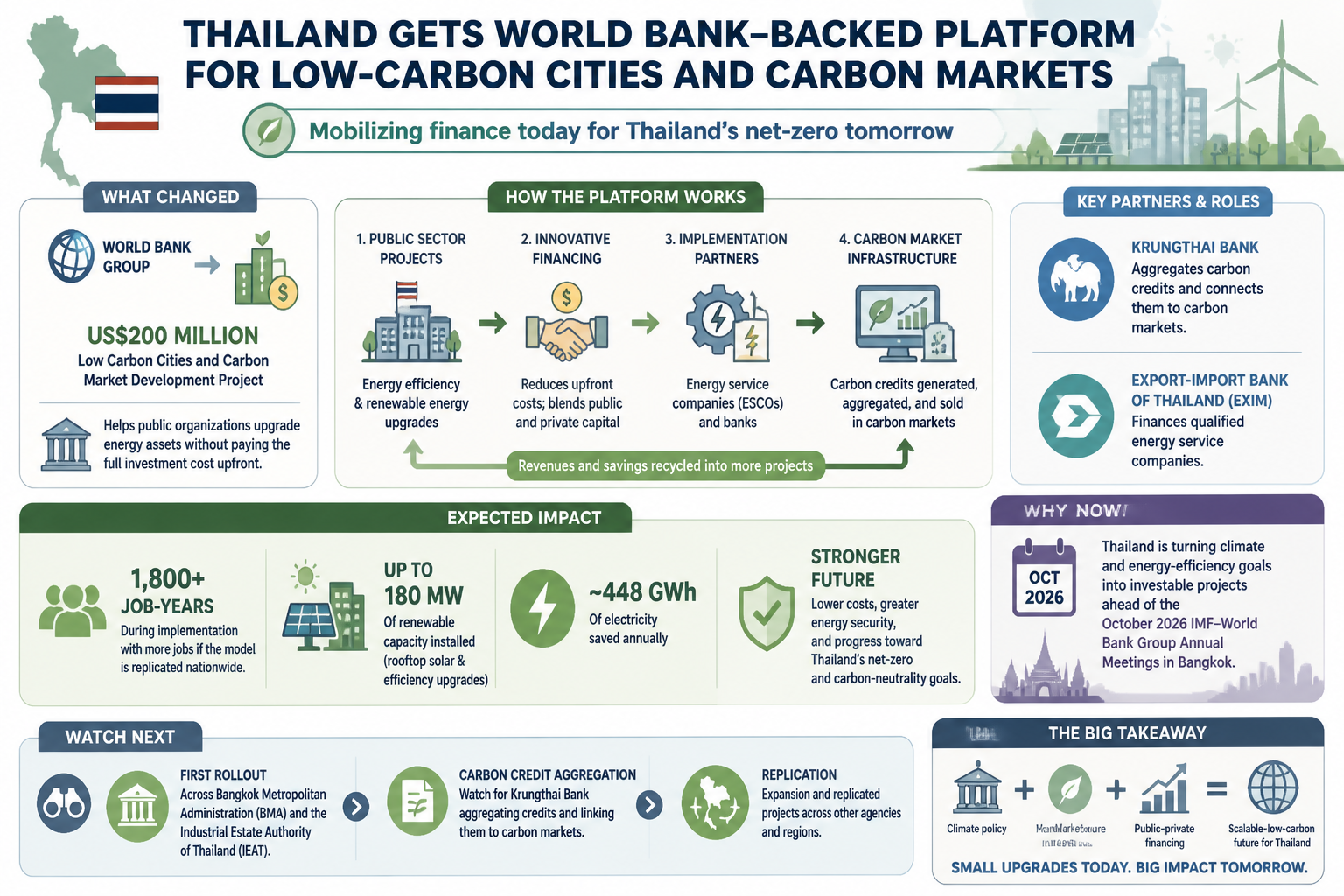
Why it matters: This matters because it links climate policy, market infrastructure, and public finance into a replicable model for turning smaller local upgrades into bankable investment pipelines. It also shows ho…
The World Bank Group approved a new financing-and-carbon-market platform for Thailand’s public sector energy upgrades.[2]
Why now
Thailand is trying to convert climate and energy-efficiency goals into investable projects ahead of the October 2026 IMF-World Bank Group Annual Meetings in Bangkok.[2]
Watch next
The first rollout across Bangkok Metropolitan Administration and the Industrial Estate Authority of Thailand, plus signs of carbon-credit aggregation and replicated projects across other agencies.[2]
China posted solid growth in early 2026, with GDP up 5.0 percent year on year in the first quarter as high-tech investment and exports offset weak consumption.
Why it matters: China is still one of the key anchors of global demand, trade, and industrial supply chains, so a slower growth path can ripple into commodity markets, exporters, and regional activity. The report al…
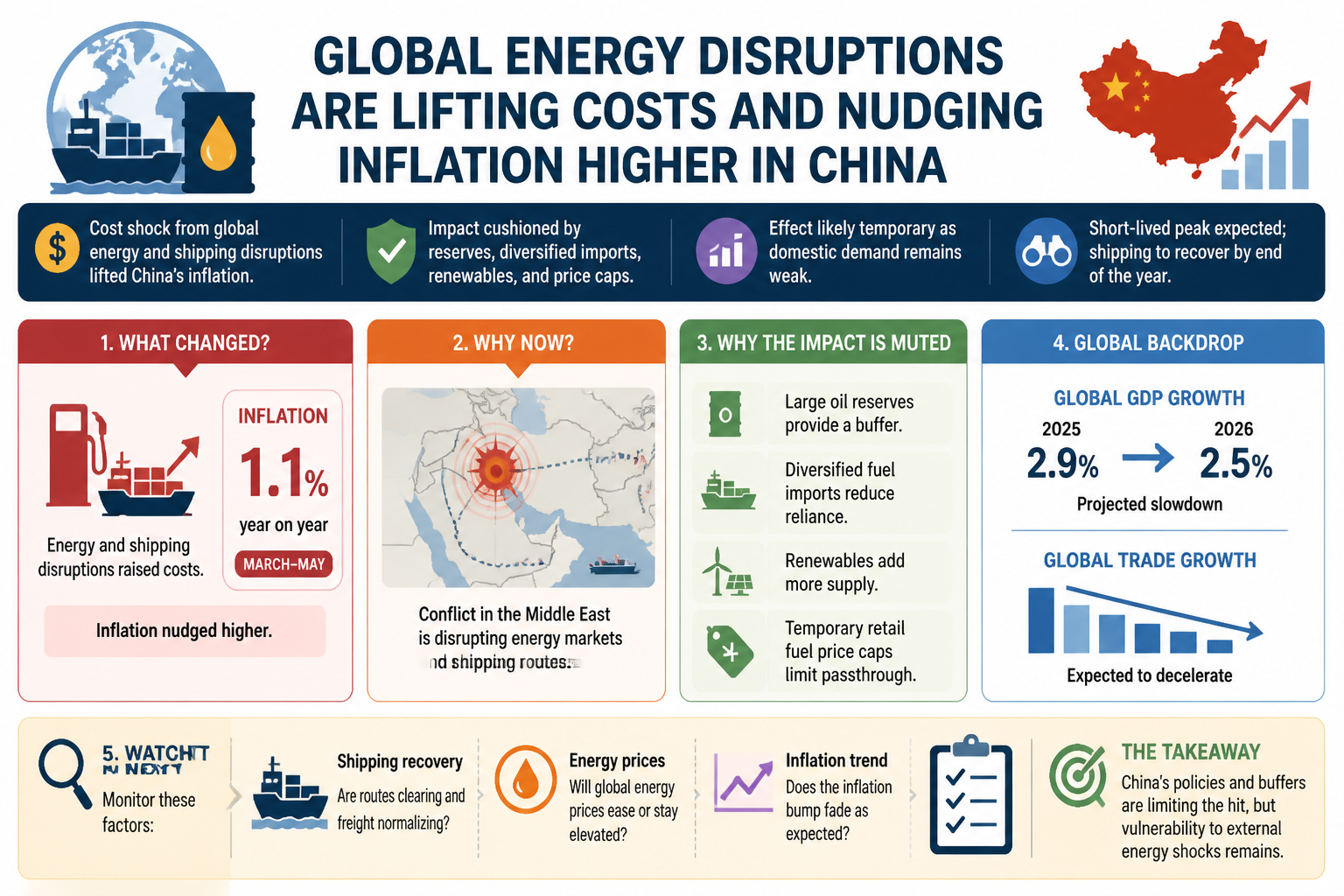
Why it matters: Energy shocks matter for markets because they can feed into inflation, logistics costs, and corporate margins even when the domestic economy is soft. In China’s case, the report suggests the macro im…