Keldura Daily Open Keldura

Keldura Daily · Cheatsheets

Climate & Environment cheatsheets.

Every Climate & Environment cheatsheet Keldura Daily has published, newest first.

Latest cheatsheets

Climate & Environment

Read in Briefings

Climate & Environment

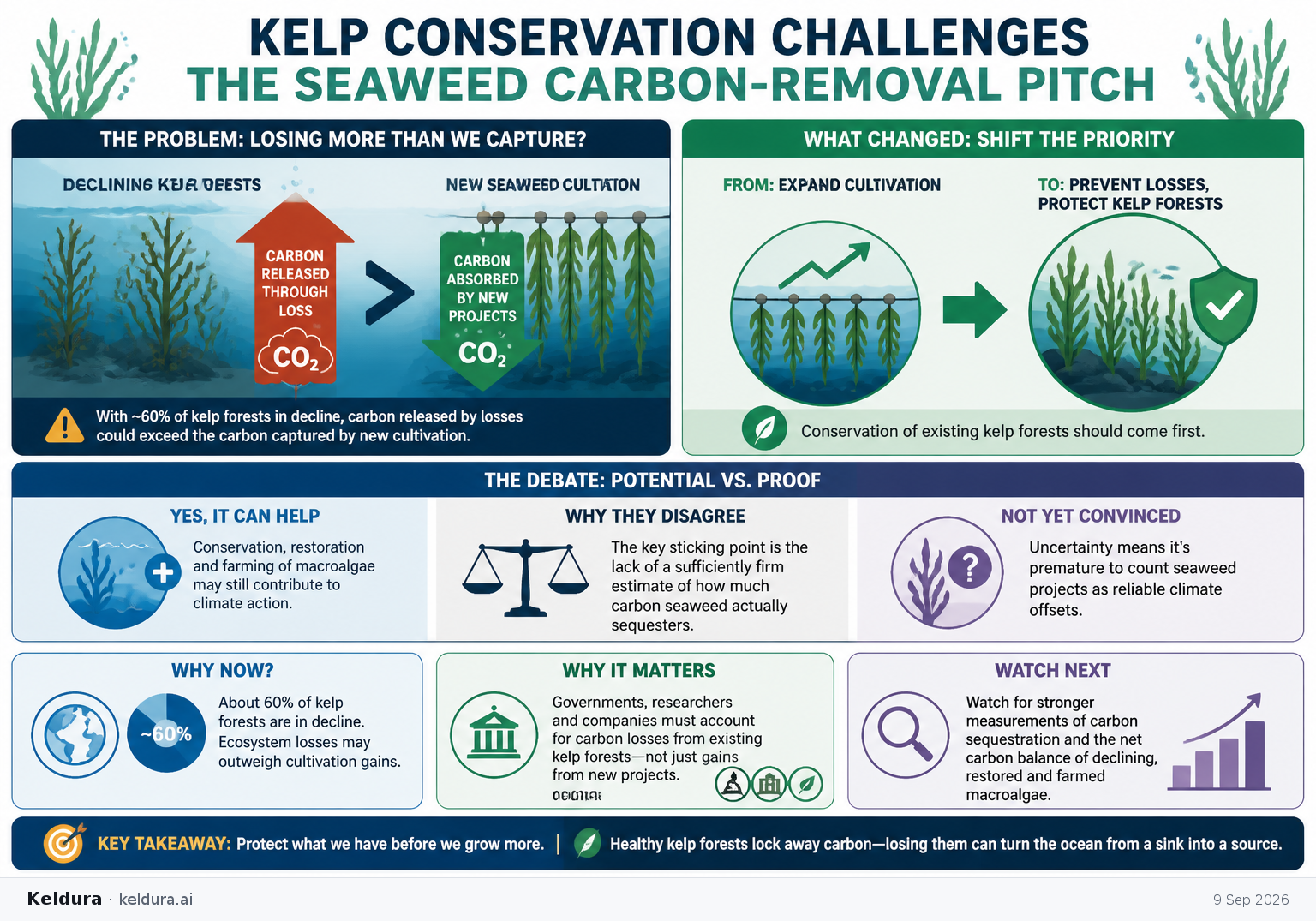
Kelp conservation challenges the seaweed carbon-removal pitch

A new study argues that cultivating seaweed is being overstated as a climate solution because carbon released through seaweed loss may exceed the amount absorbed by new cultivation.

Cheatsheet for Kelp conservation challenges the seaweed carbon-removal pitch. Text equivalent is attached.

Why it matters: Governments, researchers and companies considering seaweed for emissions offsets need to account for losses from existing kelp forests rather than counting only carbon captured by new projects.

Open cheatsheet → Post to X

What changed
The study shifts attention from expanding seaweed cultivation to preventing carbon losses from declining kelp forests.[3]
Why now
About 60 per cent of kelp forests are in decline, raising concern that ecosystem losses may outweigh cultivation gains.[3]
Watch next
Watch for stronger measurements of carbon sequestration by seaweed and the net carbon balance of declining, restored and farmed macroalgae.[3]

Climate & Environment

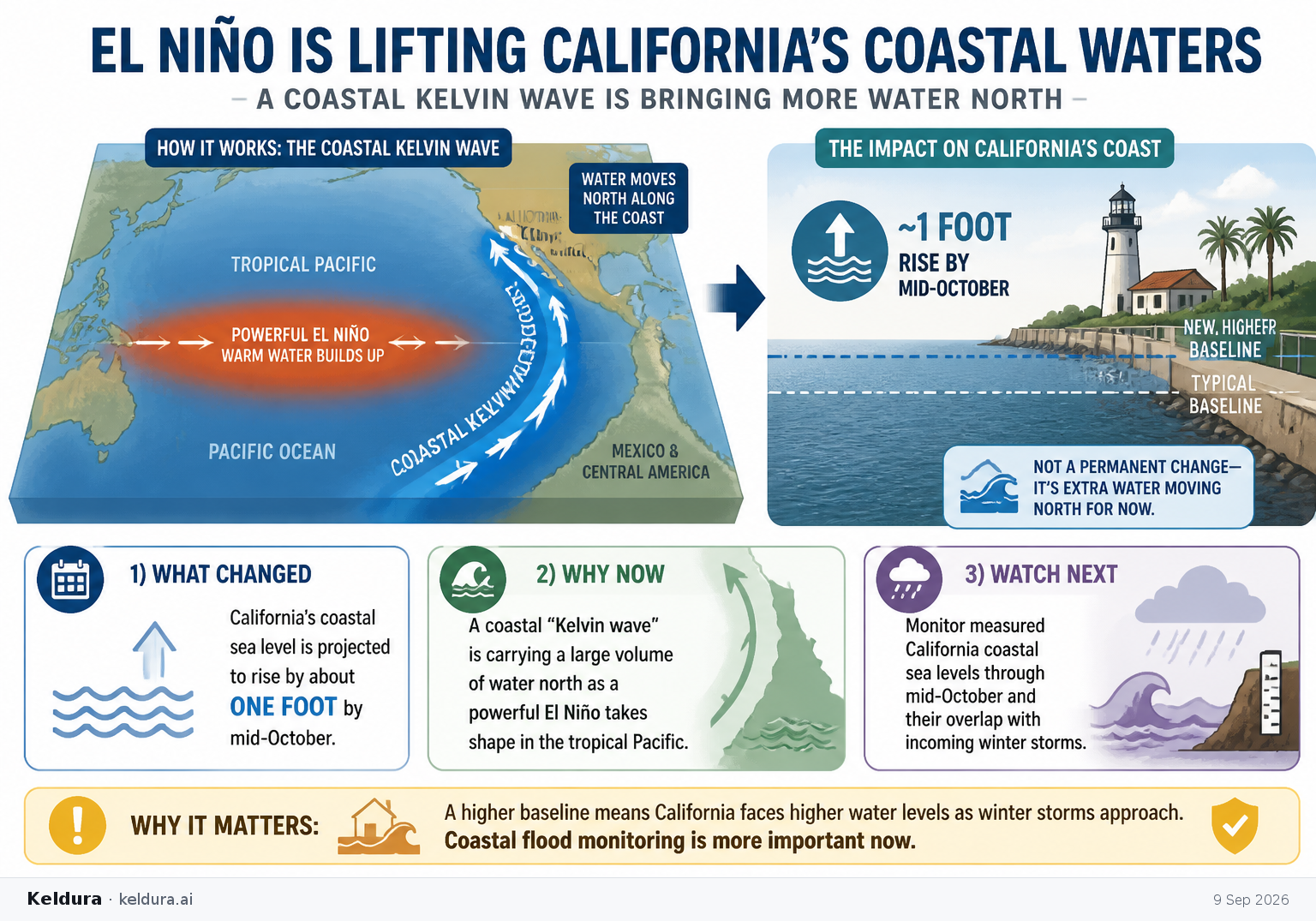
El Niño is lifting California’s coastal waters

El Niño is expected to raise sea level along California’s coast by about one foot by mid-October as water moves northward from waters off Mexico and Central America.

Cheatsheet for El Niño is lifting California’s coastal waters. Text equivalent is attached.

Why it matters: The elevated baseline would leave California’s coast facing higher water levels as winter storms approach, increasing the relevance of coastal flood monitoring.

Open cheatsheet → Post to X

What changed
California’s coastal sea level is projected to rise by about one foot by mid-October under El Niño’s influence.[4]
Why now
A coastal “Kelvin wave” is carrying water north as a powerful El Niño takes shape in the tropical Pacific.[4]
Watch next
Monitor measured California coastal sea levels through mid-October and their overlap with incoming winter storms.[4]

Climate & Environment

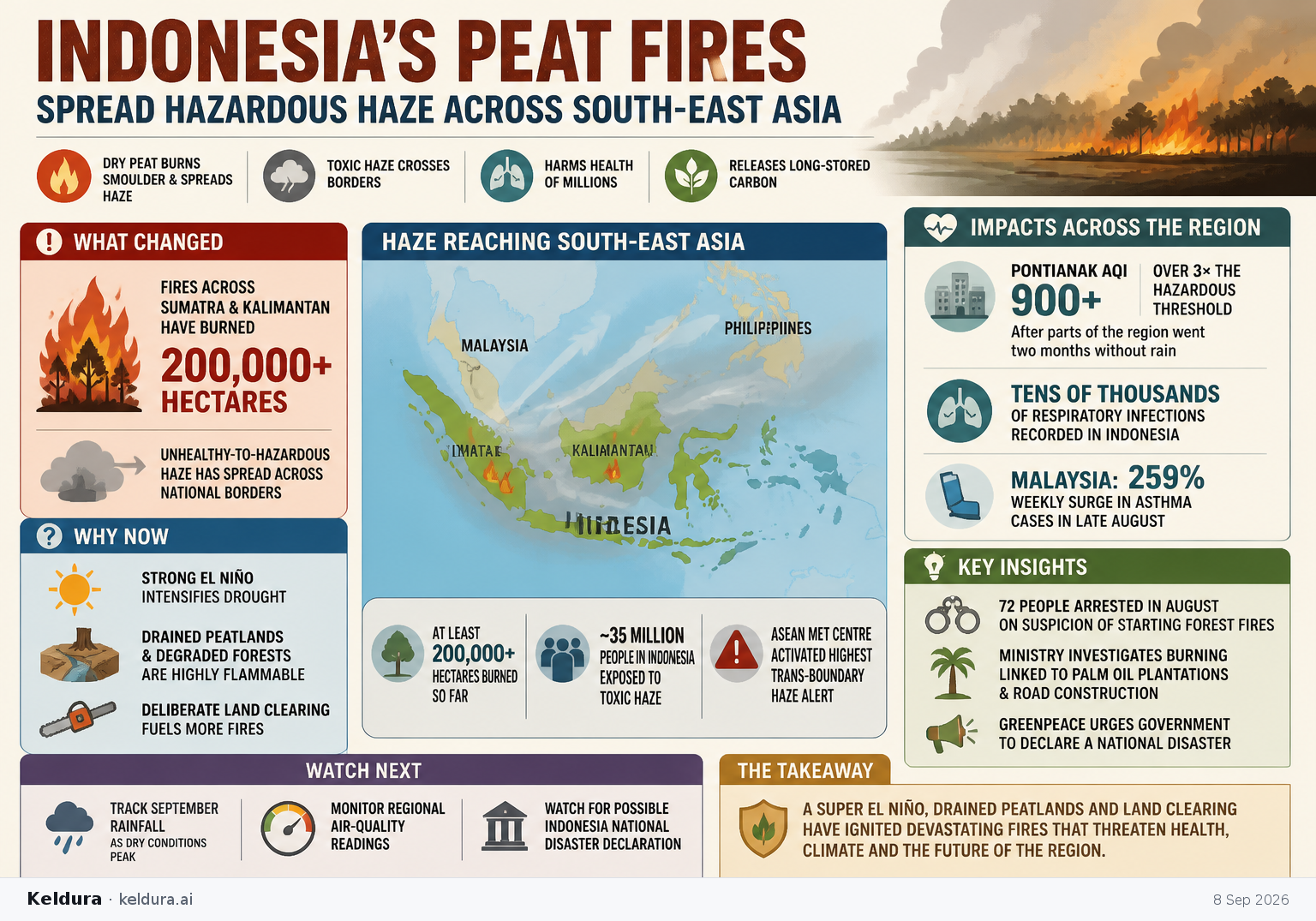
Indonesia’s peat fires spread hazardous haze across South-East Asia

Months of forest and land fires, intensified by a super El Niño and drought, have burned at least 200,000 hectares across Indonesia, with another tracker estimating more than 285,000 hectares so far this year.

Cheatsheet for Indonesia’s peat fires spread hazardous haze across South-East Asia. Text equivalent is attached.

Why it matters: The crisis combines an immediate regional health emergency with a climate feedback: dry peat can burn underground, spread persistent smoke and release carbon accumulated over thousands of years. With…

Open cheatsheet → Post to X

What changed
Fires across Sumatra and Kalimantan have burned at least 200,000 hectares and spread unhealthy-to-hazardous haze across national borders.[1][6]
Why now
A strong El Niño has intensified drought, while drained peatlands and degraded forests provide highly flammable fuel.[1][5]
Watch next
Track September rainfall, regional air-quality readings and whether Indonesia declares a national disaster as dry conditions reach their expected peak.[1][5]

Climate & Environment

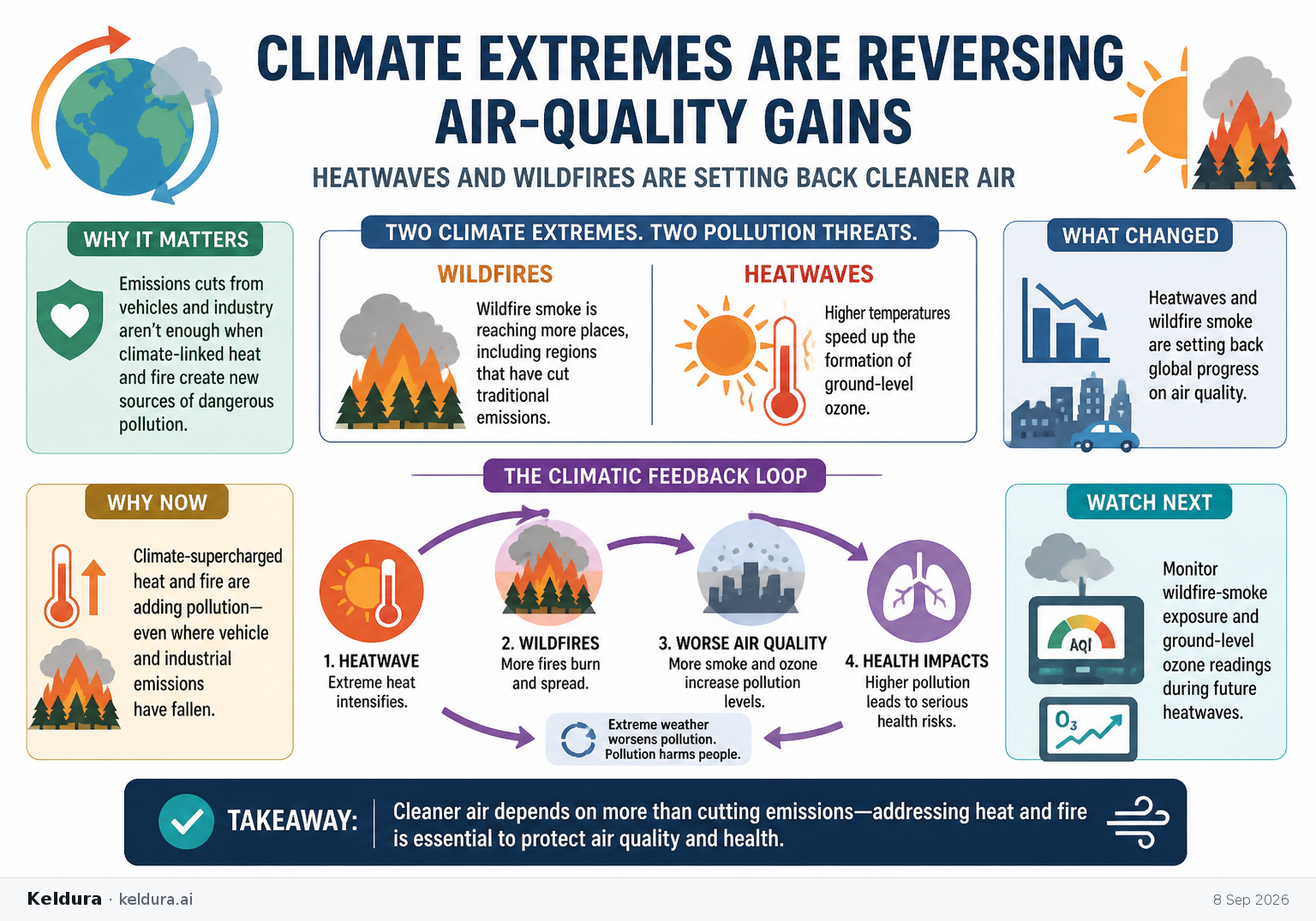
Climate extremes are reversing air-quality gains

A new WMO report finds that worsening wildfires and heatwaves are hindering improvements in air quality around the world.

Cheatsheet for Climate extremes are reversing air-quality gains. Text equivalent is attached.

Why it matters: The findings show that emissions controls on transport and industry may not deliver cleaner air on their own when climate-linked heat and fire introduce new sources of dangerous pollution.

Open cheatsheet → Post to X

What changed
The WMO says heatwaves and wildfire smoke are setting back global progress on air quality.[2]
Why now
Climate-supercharged heat and fire are adding pollution even where vehicle and industrial emissions have fallen.[2]
Watch next
Monitor wildfire-smoke exposure and ground-level ozone readings during future heatwaves.[2]

Climate & Environment

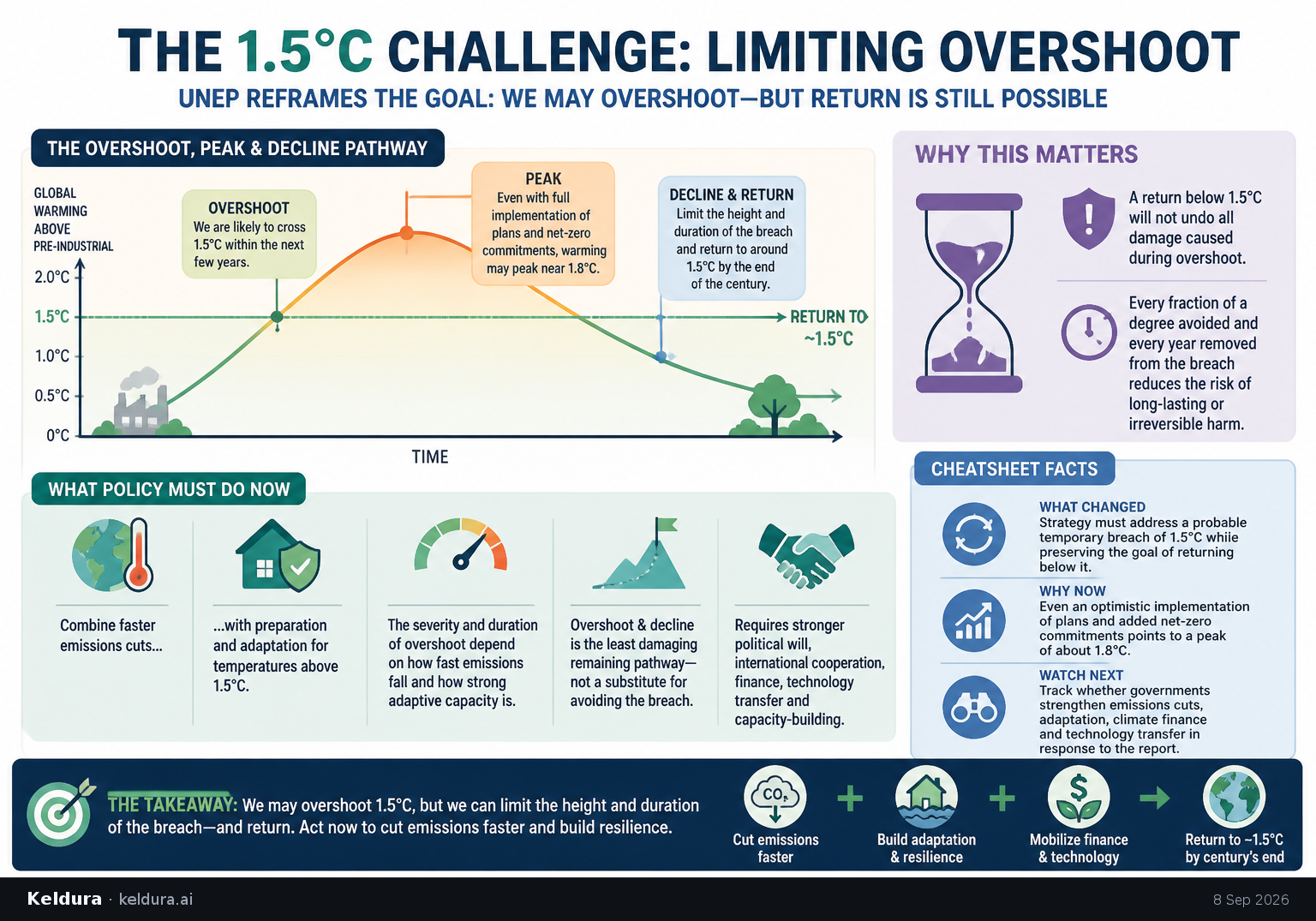
Unep reframes the 1.5°C challenge around limiting overshoot

Cheatsheet for Unep reframes the 1.5°C challenge around limiting overshoot. Text equivalent is attached.

Why it matters: A return below 1.5°C would not reverse all damage incurred during an overshoot, so every fraction of a degree avoided and every year removed from the breach would reduce exposure to long-lasting or i…

Open cheatsheet → Post to X

What changed
Unep says climate strategy must address a probable temporary breach of 1.5°C while preserving the goal of returning below it.[3]
Why now
Even an optimistic implementation of existing climate plans and added net-zero commitments points to a peak of about 1.8°C.[3]
Watch next
Track whether governments strengthen emissions cuts, adaptation, climate finance and technology transfer in response to the report.[3]

Climate & Environment

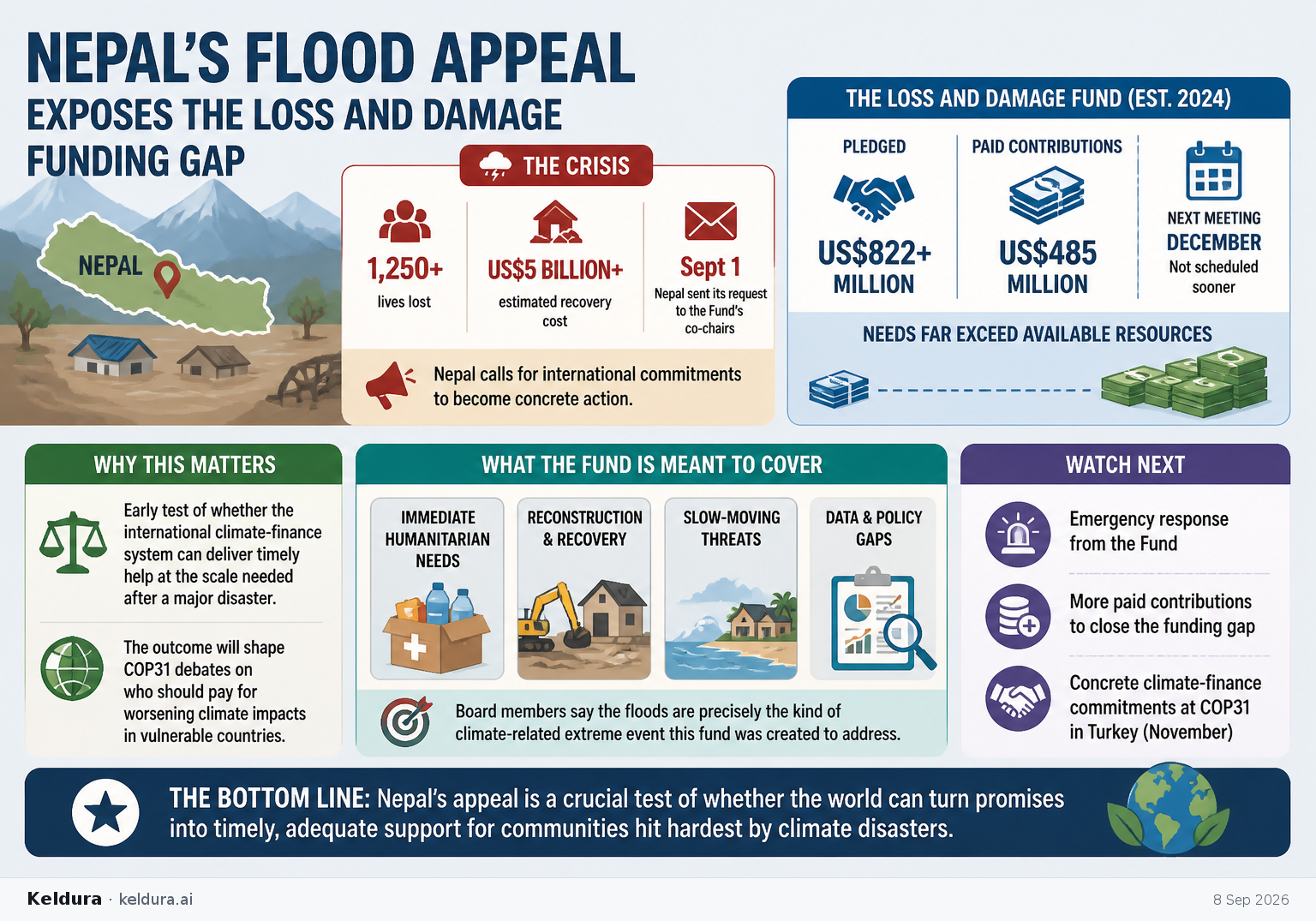
Nepal’s flood appeal exposes the loss and damage funding gap

Nepal has requested immediate support from the UN climate loss and damage fund after catastrophic floods killed 1,250 people and left an estimated recovery bill of at least US$5 billion.

Cheatsheet for Nepal’s flood appeal exposes the loss and damage funding gap. Text equivalent is attached.

Why it matters: Nepal’s needs dwarf the fund’s available resources, making the request an early test of whether the international climate-finance system can deliver timely assistance at the scale required after a ma…

Open cheatsheet → Post to X

What changed
Nepal formally sought urgent loss and damage support for a flood recovery effort expected to cost at least US$5 billion.[4]
Why now
The new fund is under-resourced and is not scheduled to meet again until December despite Nepal’s immediate reconstruction needs.[4]
Watch next
Watch for an emergency fund response, additional paid contributions and concrete climate-finance commitments at COP31.[4]

Climate & Environment

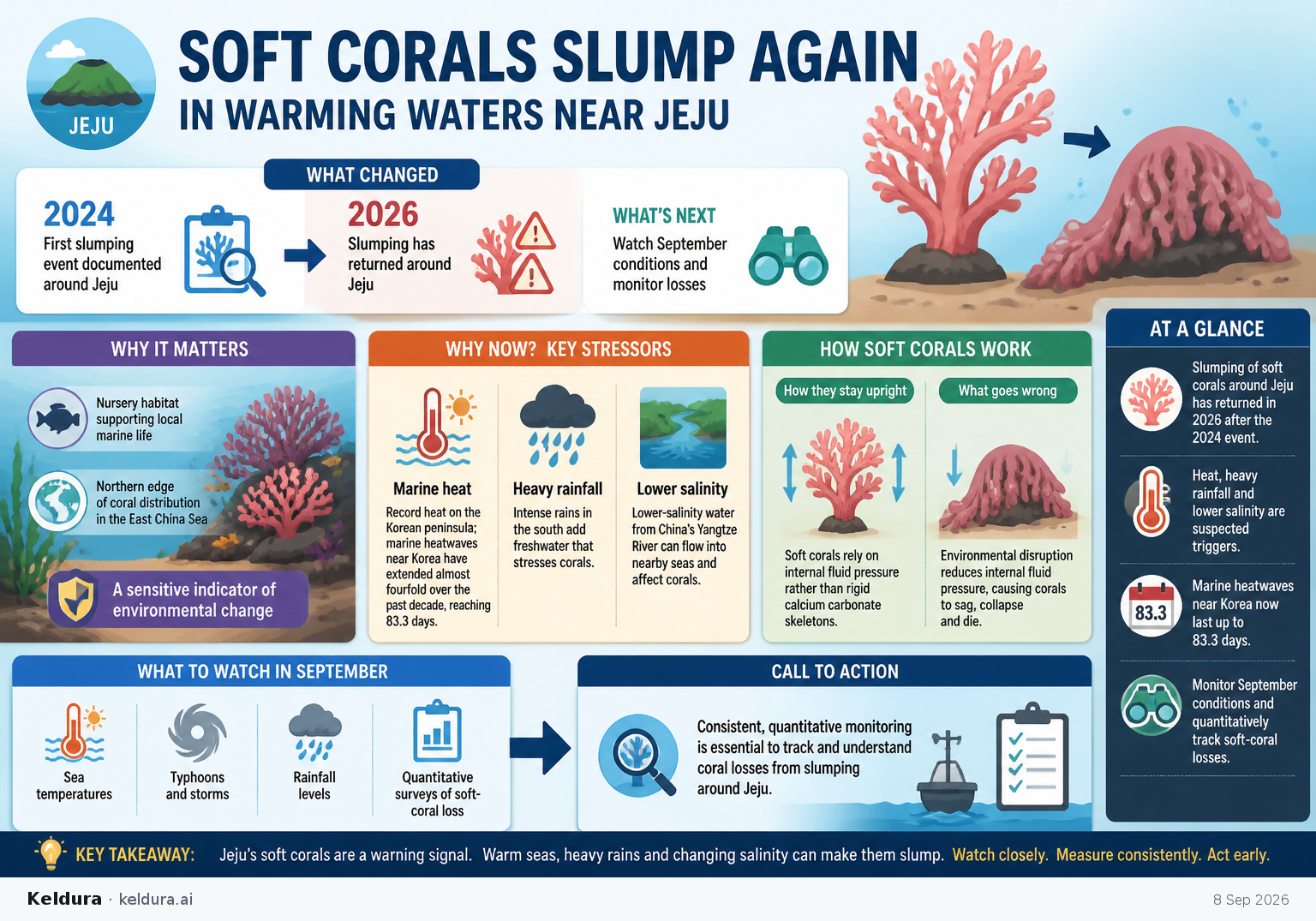
Soft corals slump again in warming waters near Jeju

Divers and scientists report that soft corals around Jeju are again sagging, collapsing and dying after two years of rising temperatures and harsher weather.

Cheatsheet for Soft corals slump again in warming waters near Jeju. Text equivalent is attached.

Why it matters: Jeju’s soft corals provide nursery habitat supporting the local marine ecosystem and occupy the northern edge of coral distribution in the East China Sea, making their condition a sensitive indicator…

Open cheatsheet → Post to X

What changed
The coral-slumping phenomenon documented in 2024 has returned around Jeju in 2026.[7]
Why now
Record heat on the Korean peninsula, heavy southern rains and changing salinity are among the suspected environmental stresses.[7]
Watch next
Monitor September sea temperatures, typhoons, rainfall and quantitative surveys of soft-coral loss around Jeju.[7]

Climate & Environment

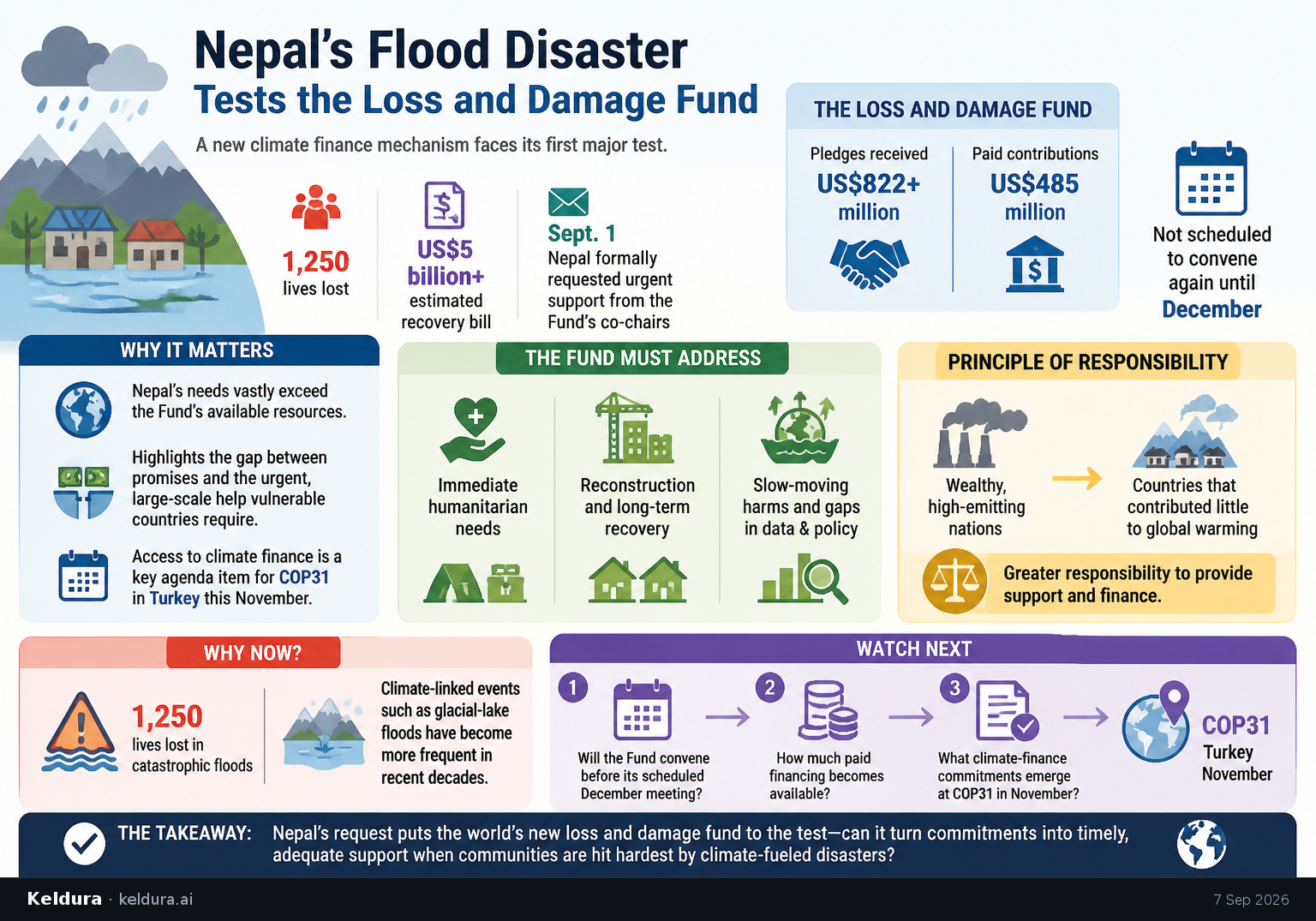
Nepal’s Flood Disaster Tests the Loss and Damage Fund

Nepal has requested immediate support from the UN climate loss and damage fund after floods killed 1,250 people and left an estimated recovery bill of at least US$5 billion.

Cheatsheet for Nepal’s Flood Disaster Tests the Loss and Damage Fund. Text equivalent is attached.

Why it matters: Nepal’s needs vastly exceed the fund’s available resources, exposing the gap between international climate-finance commitments and the rapid, large-scale assistance vulnerable countries require after…

Open cheatsheet → Post to X

What changed
Nepal sought an urgent payout from the UN loss and damage fund following catastrophic floods and an estimated US$5 billion recovery bill.[1]
Why now
The disaster killed 1,250 people, while climate-linked events such as glacial-lake floods have become more frequent in recent decades.[1]
Watch next
Watch whether the fund convenes before its scheduled December meeting, how much paid financing becomes available, and what climate-finance commitments emerge at COP31 in November.[1]

Climate & Environment

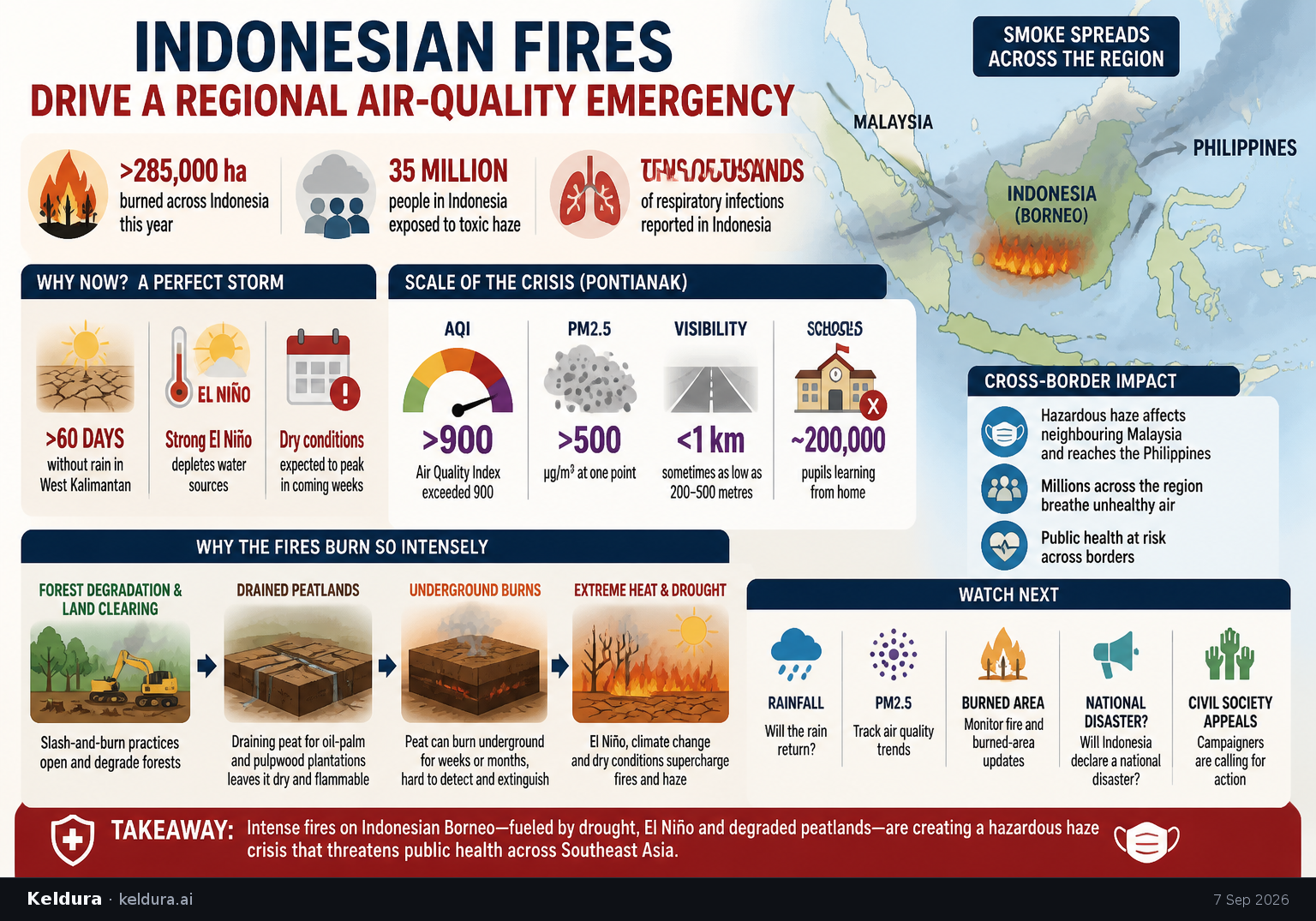
Indonesian Fires Drive a Regional Air-Quality Emergency

Forest and peatland fires across Indonesian Borneo have overwhelmed firefighters and generated hazardous haze, with West Kalimantan enduring more than two months without rain amid a powerful El Niño.

Cheatsheet for Indonesian Fires Drive a Regional Air-Quality Emergency. Text equivalent is attached.

Why it matters: The fires have become a cross-border public-health crisis: Indonesia has reported tens of thousands of associated respiratory infections, while Greenpeace estimates that 35 million people nationally…

Open cheatsheet → Post to X

What changed
Intense fires and haze have spread across Indonesian Borneo and beyond, closing schools and driving pollution to hazardous levels.[2][4]
Why now
More than 60 days without rain and a strong El Niño have depleted water sources, with dry conditions expected to peak in the coming weeks.[2]
Watch next
Track rainfall, PM2.5 readings, burned-area updates and whether Indonesia declares the fires a national disaster as campaigners have requested.[2][4]

Climate & Environment

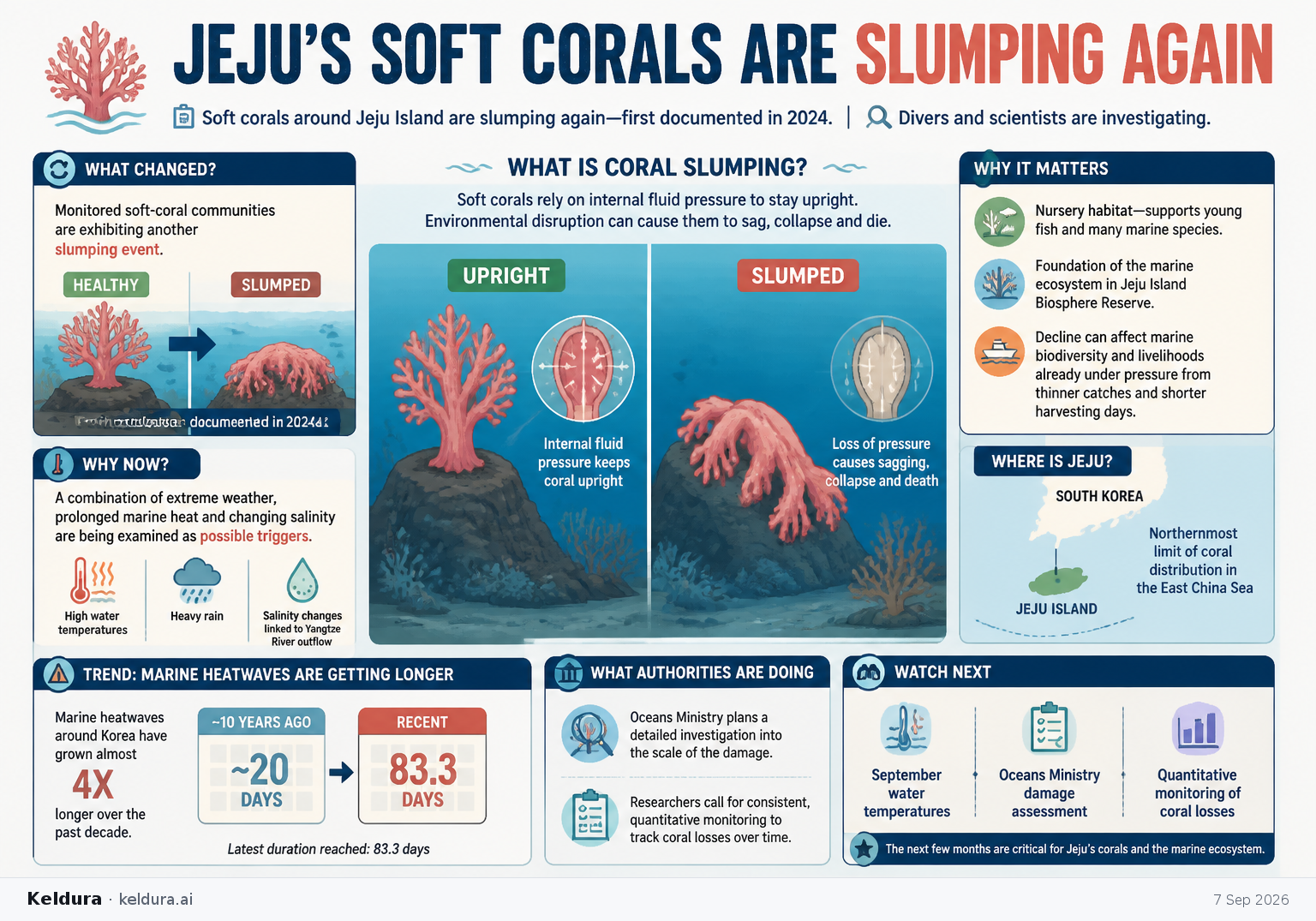
Jeju’s Soft Corals Are Slumping Again

Divers and scientists say the slumping of soft corals has returned around South Korea’s Jeju island after the phenomenon was first scientifically documented there in 2024.

Cheatsheet for Jeju’s Soft Corals Are Slumping Again. Text equivalent is attached.

Why it matters: Jeju’s soft corals serve as nursery habitat and form a foundational part of the marine ecosystem within the UNESCO-listed Jeju Island Biosphere Reserve. Their decline could therefore affect wider mar…

Open cheatsheet → Post to X

What changed
Jeju’s monitored soft-coral communities are exhibiting another slumping event similar to the collapse documented in 2024.[3][6]
Why now
South Korea has experienced a record heatwave and heavy southern rainfall, while prolonged marine heat and changing salinity are being examined as possible triggers.[3][6]
Watch next
Watch September water temperatures, the Oceans Ministry’s damage assessment and quantitative monitoring of coral losses.[3][6]

Climate & Environment

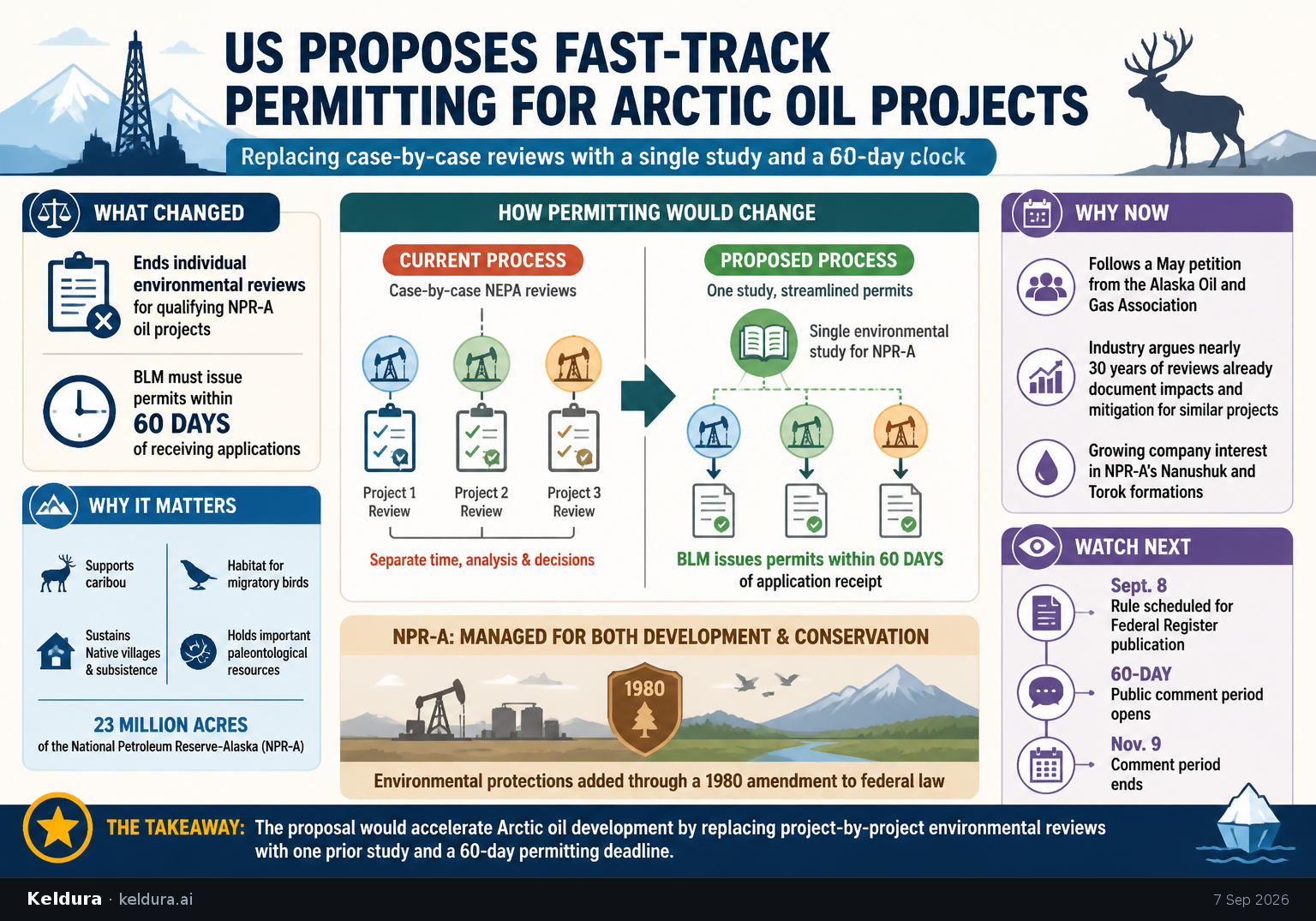
US Proposes Fast-Track Permitting for Arctic Oil Projects

Cheatsheet for US Proposes Fast-Track Permitting for Arctic Oil Projects. Text equivalent is attached.

Why it matters: The proposal could accelerate development across a 23-million-acre Arctic reserve that contains sought-after oil formations but also supports caribou, migratory birds, subsistence activities in Nativ…

Open cheatsheet → Post to X

What changed
BLM proposed ending individual environmental reviews for qualifying NPR-A oil projects and imposing a 60-day permitting timeline.[5]
Why now
The proposal follows an industry petition and growing company interest in the reserve’s Nanushuk and Torok geological formations.[5]
Watch next
The rule is scheduled for Federal Register publication on Sept. 8, opening a 60-day public-comment period ending Nov. 9.[5]

Climate & Environment

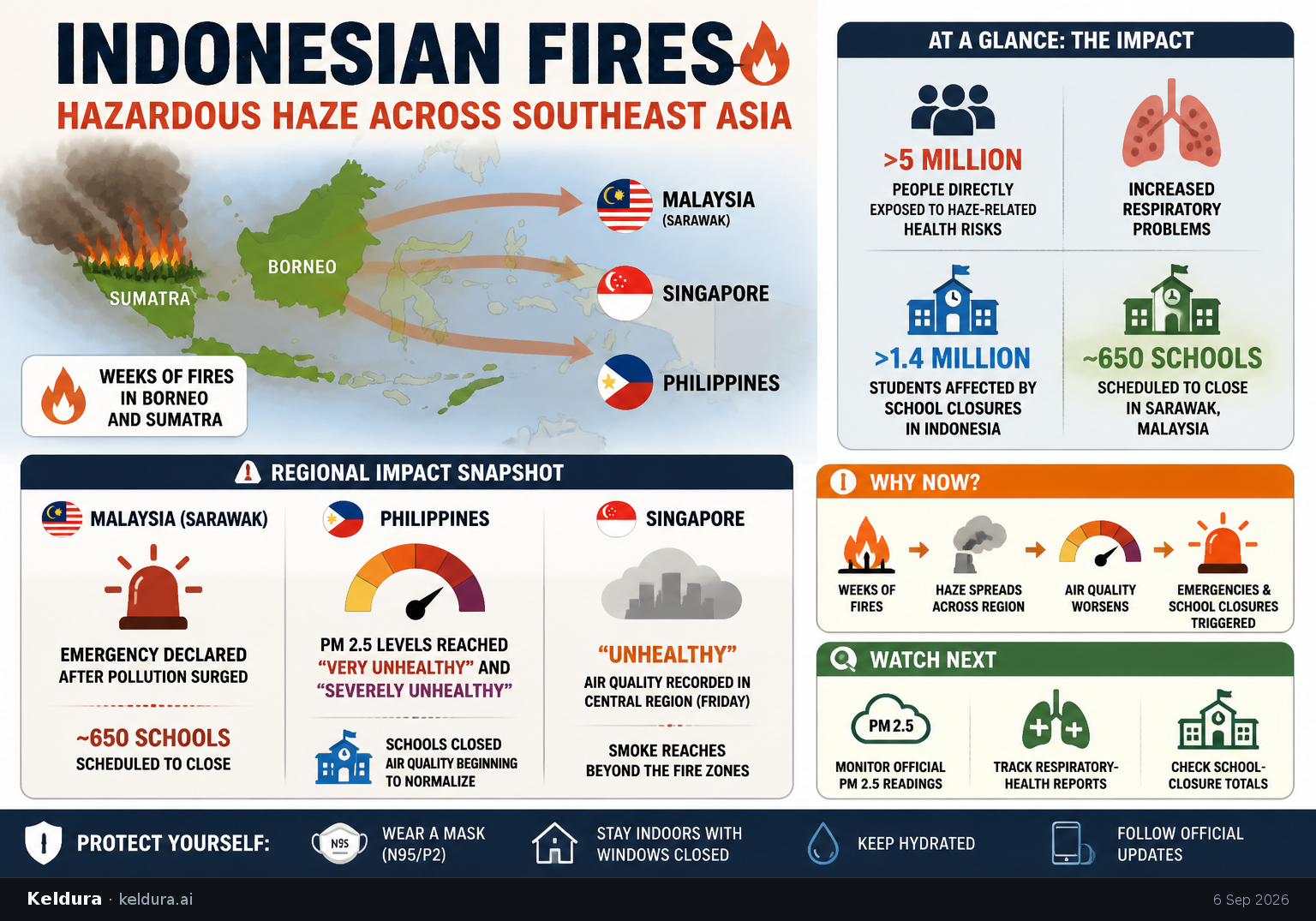
Indonesian fires spread hazardous haze across Southeast Asia

Fires burning across Borneo and Sumatra have blanketed parts of Indonesia in thick smog and sent hazardous smoke toward Malaysia, Singapore and the Philippines.

Cheatsheet for Indonesian fires spread hazardous haze across Southeast Asia. Text equivalent is attached.

Why it matters: The emergency has become a regional public-health and education crisis: respiratory problems have increased, air quality reached unhealthy or worse levels across multiple countries, and large numbers…
Open cheatsheet → Post to X

What changed
Weeks of fires in Borneo and Sumatra produced hazardous haze affecting Indonesia and neighboring Malaysia, Singapore and the Philippines [1].
Why now
Worsening air quality has triggered emergency measures and extensive school closures across the region [1].
Watch next
Monitor official PM 2.5 readings, respiratory-health reports and changes in school-closure totals across the affected countries [1].

That's the desk. Every cheatsheet here started as a link. Yours can too.

Cheatsheet your own link — free