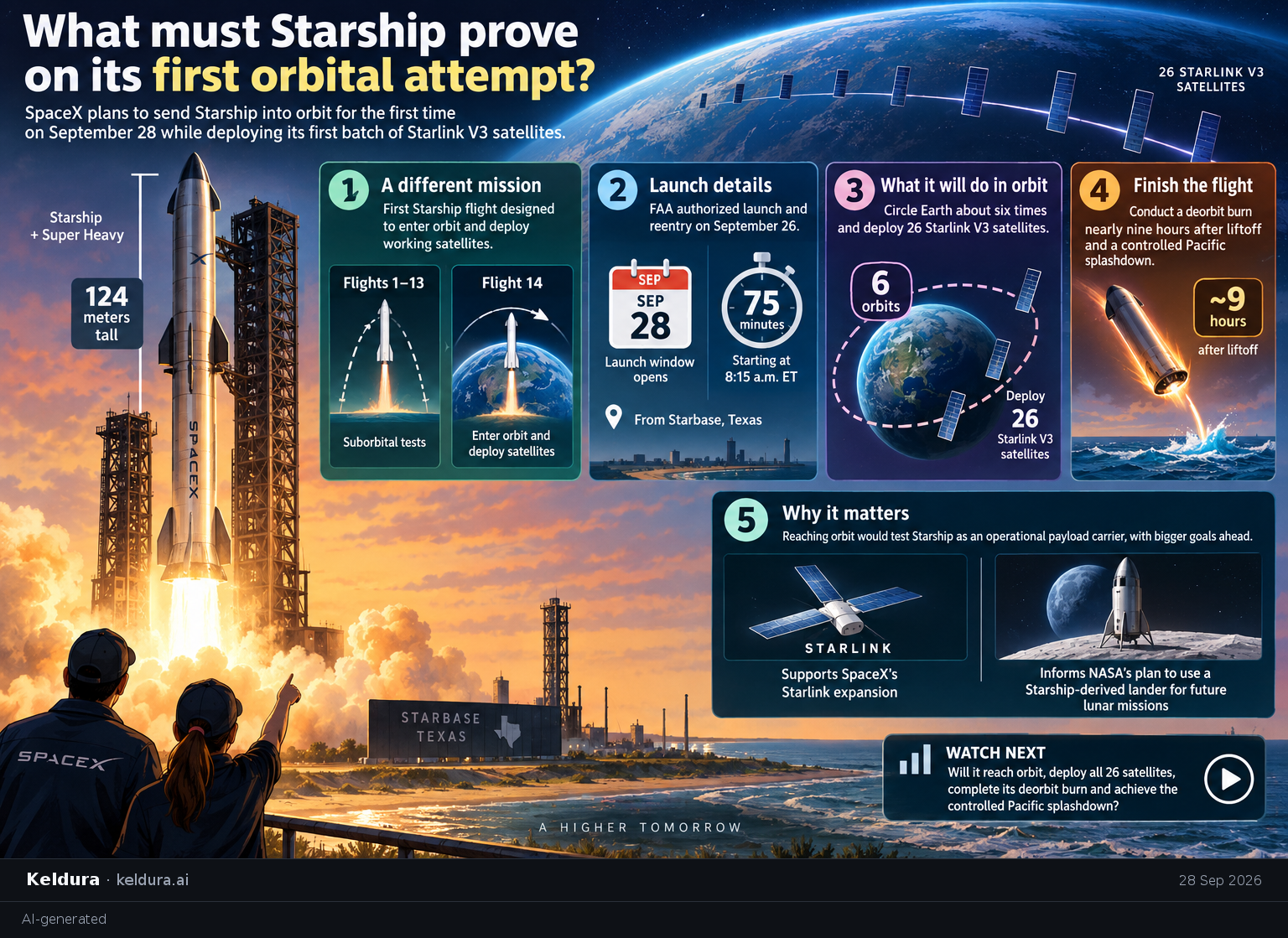
SpaceX plans to send Starship into orbit for the first time on September 28 while deploying its first batch of Starlink V3 satellites.
Why it matters: Reaching orbit would test Starship as an operational payload carrier rather than only an experimental vehicle, with implications for SpaceX’s Starlink expansion and NASA’s plan to use a Starship-deri…
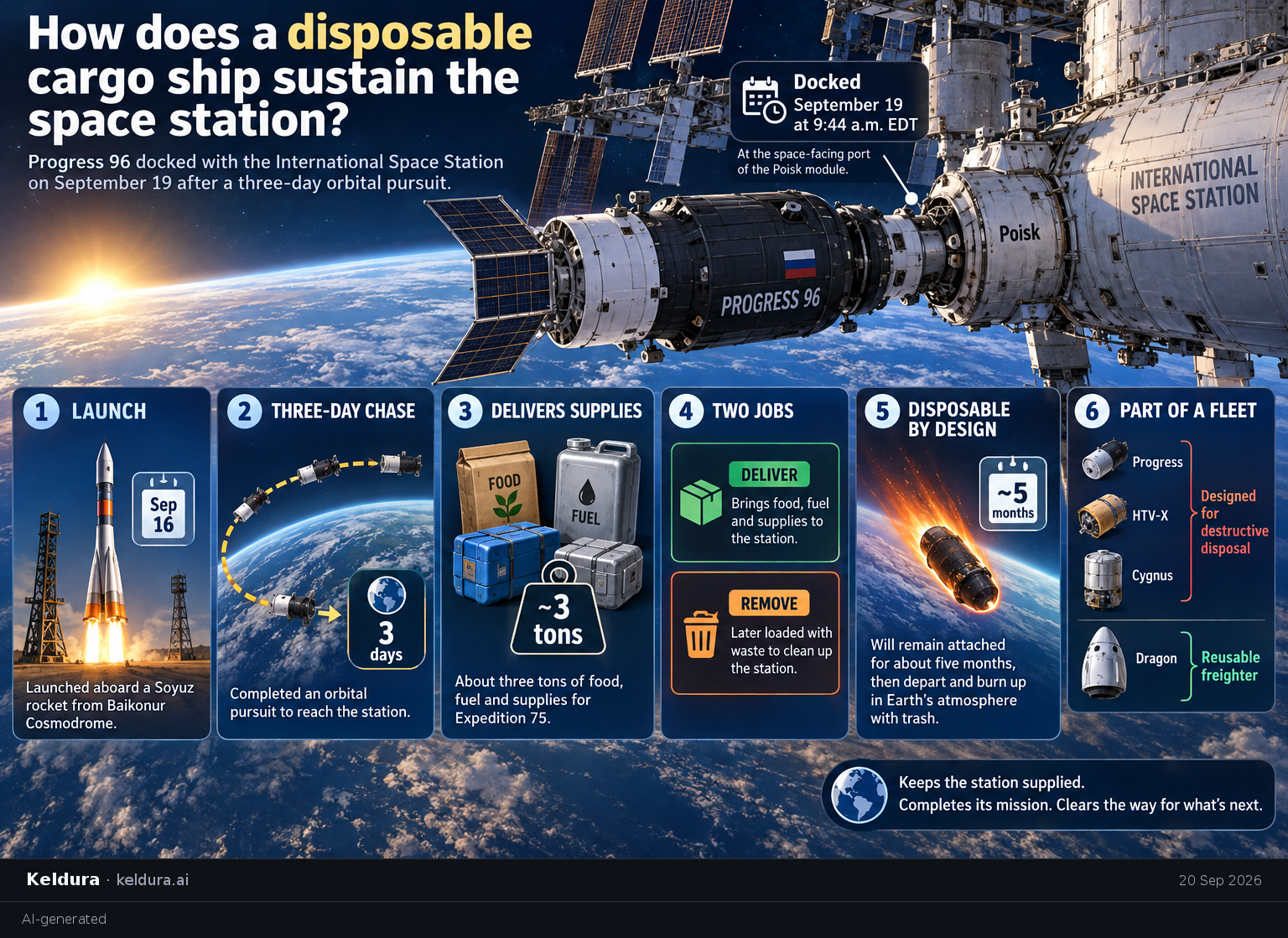
Progress 96 docked with the International Space Station on September 19 after a three-day orbital pursuit.
Why it matters: Progress vehicles serve two functions in the station’s logistics chain: they deliver consumables and later remove trash through planned destructive atmospheric re-entry, unlike SpaceX’s reusable Drag…
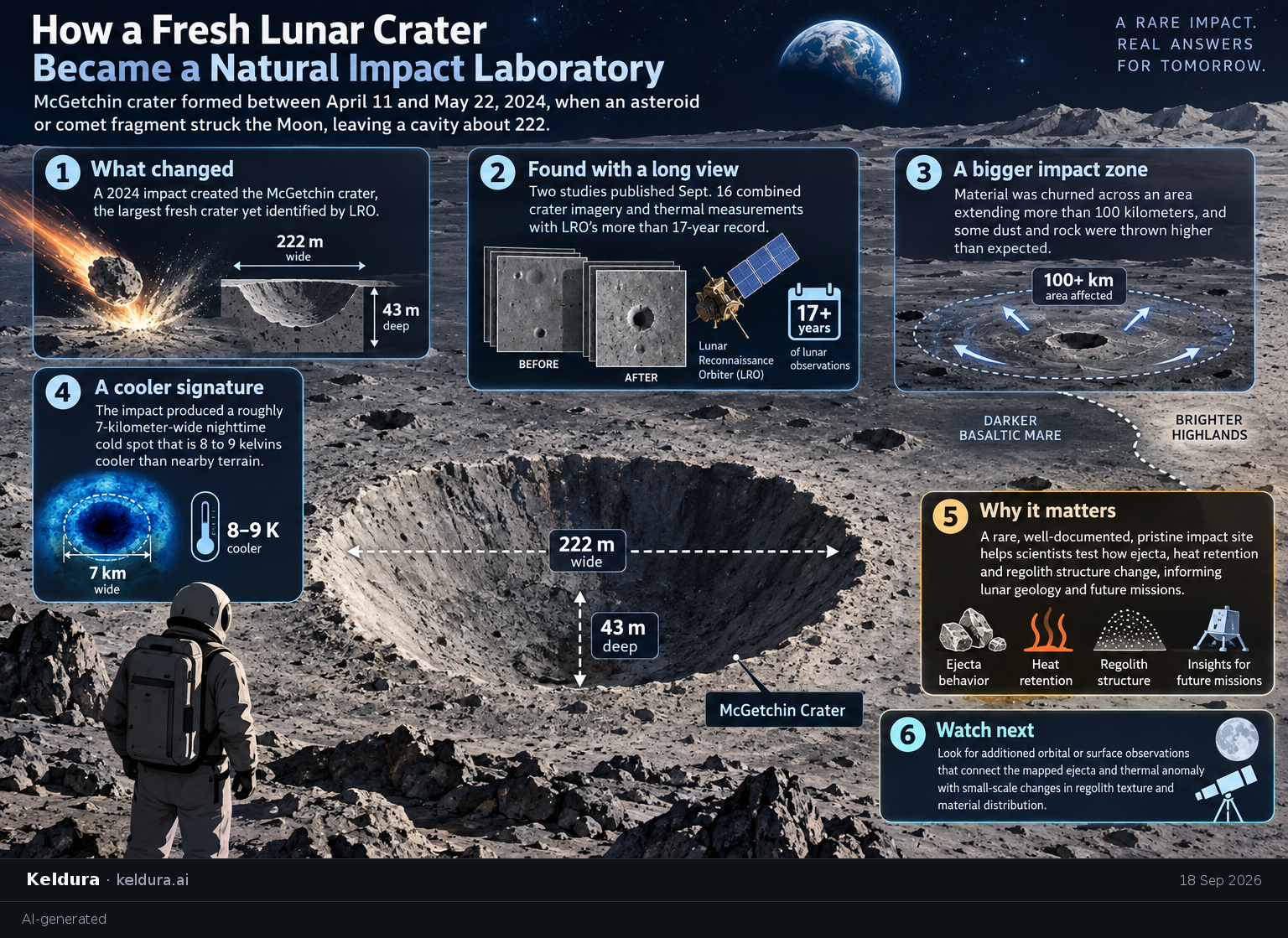
McGetchin crater formed between April 11 and May 22, 2024, when an asteroid or comet fragment struck the Moon, leaving a cavity about 222.
Why it matters: LRO's long observational record gives researchers rare before-and-after measurements of a large, pristine impact site, helping them test how ejecta, heat retention and regolith structure change after…
A 2024 impact created the 222-meter-wide, 43-meter-deep McGetchin crater, the largest fresh crater yet identified by LRO.[4]
Why now
Two studies published Sept. 16 combined crater imagery and thermal measurements with LRO's more than 17-year record of the lunar surface.[4]
Watch next
Watch for additional orbital or surface observations that connect the mapped ejecta and thermal anomaly with small-scale changes in regolith texture and material distribution.[4]
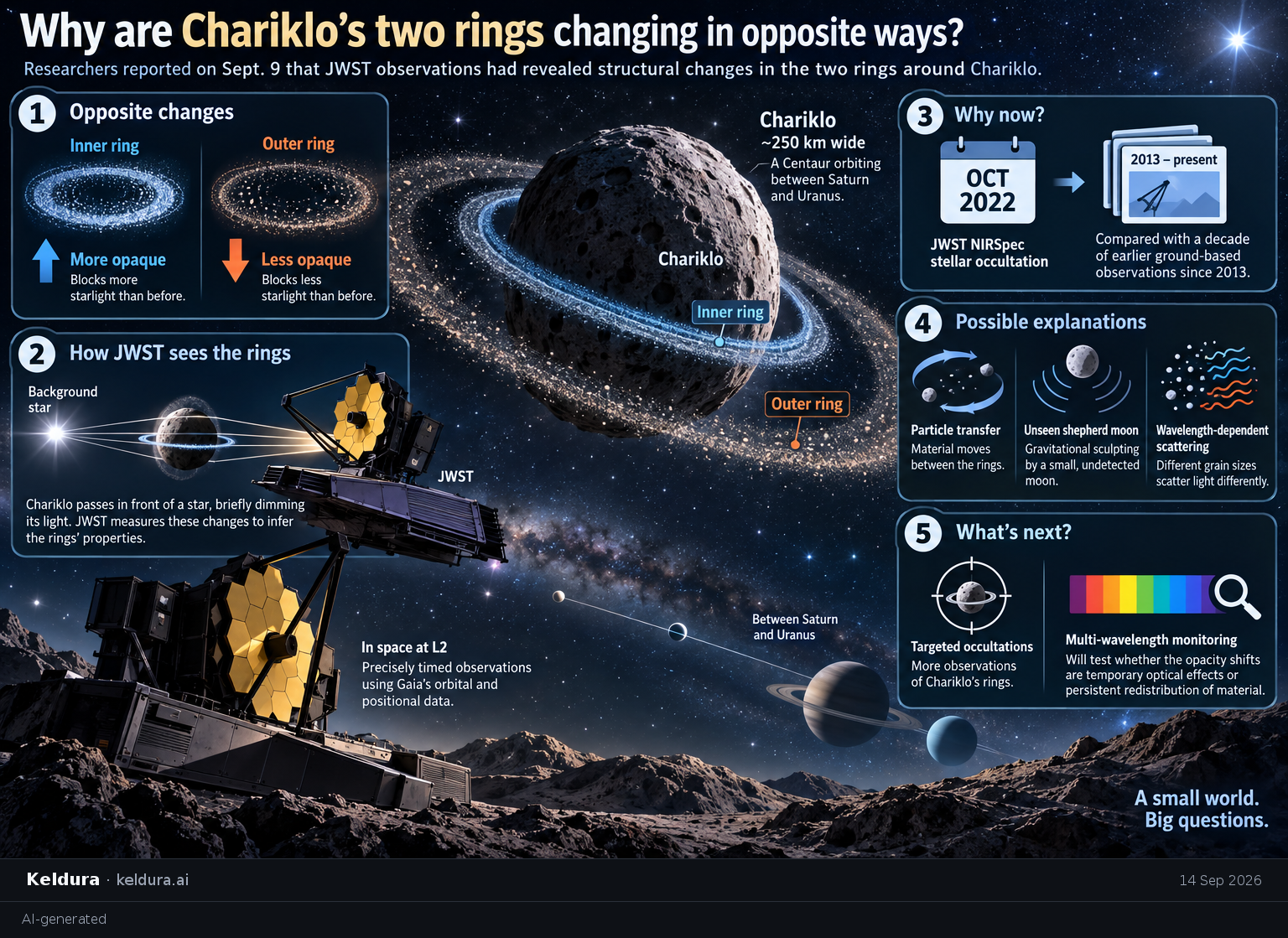
Researchers reported on Sept. 9 that JWST observations had revealed structural changes in the two rings around Chariklo.
Why it matters: The opposing changes challenge the assumption that rings around small bodies are relatively stable and could help researchers identify the processes that form, redistribute and preserve ring material…
Chariklo’s inner ring became significantly more opaque while its outer ring became less opaque relative to earlier occultation measurements.[1][2][3]
Why now
JWST’s October 2022 NIRSpec occultation was compared with ground-based observations collected since the rings’ 2013 discovery.[1][2][3]
Watch next
Targeted occultations and multi-wavelength monitoring will test whether the opacity shifts are temporary optical effects or persistent redistribution of ring material.[2]
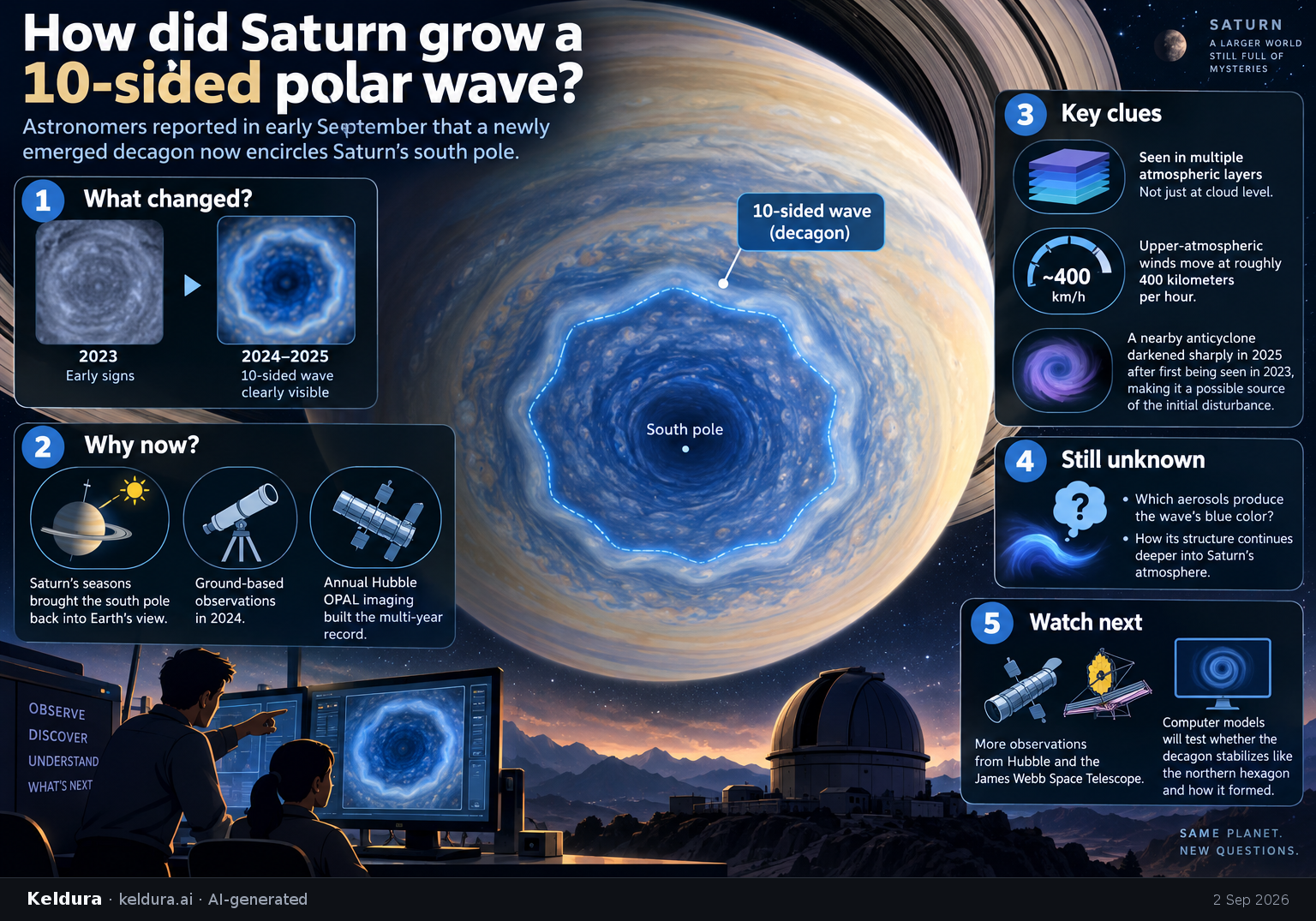
Astronomers reported in early September that a newly emerged decagon now encircles Saturn’s south pole.
Why it matters: Unlike Saturn’s northern hexagon, which has persisted through more than 40 years of observations, the southern decagon appears to have formed recently and is still strengthening, giving researchers a…
A 10-sided atmospheric wave became clearly visible around Saturn’s south pole after subtle signs appeared in observations dating to 2023.[1][6]
Why now
Saturn’s seasons brought the south pole back into Earth’s view, while annual OPAL imaging and ground-based observations supplied the multi-year record needed to identify the developing structure.[1][6]
Watch next
Continued Hubble and James Webb Space Telescope observations will test whether the decagon stabilizes like the northern hexagon, while computer models examine how it formed.[6]
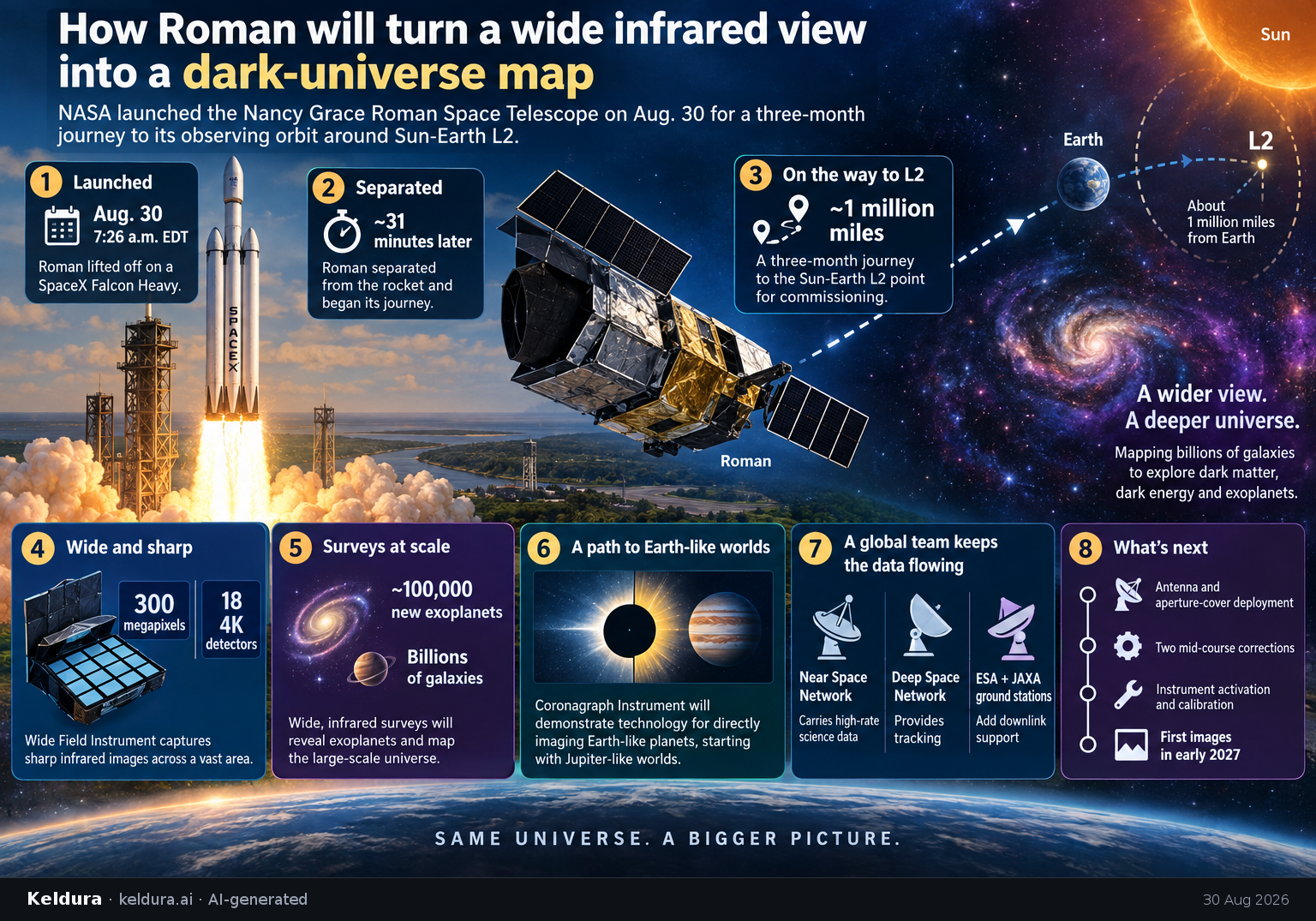
NASA launched the Nancy Grace Roman Space Telescope on Aug. 30 for a three-month journey to its observing orbit around Sun-Earth L2.
Why it matters: Roman is designed to survey the universe 1,000 times faster than Hubble and return 1.4 terabytes of data daily, making large public datasets—and the machine learning, citizen-science and follow-up sy…
Roman launched successfully, established communications, separated from Falcon Heavy and deployed its solar panels and lower instrument sun shade.[5][6]
Why now
The observatory has entered a three-month transit and commissioning phase on its way to L2, about one million miles from Earth.[5][6]
Watch next
Observable milestones include antenna and aperture-cover deployment, two mid-course corrections, instrument activation and calibration, followed by first images expected in early 2027.[5]
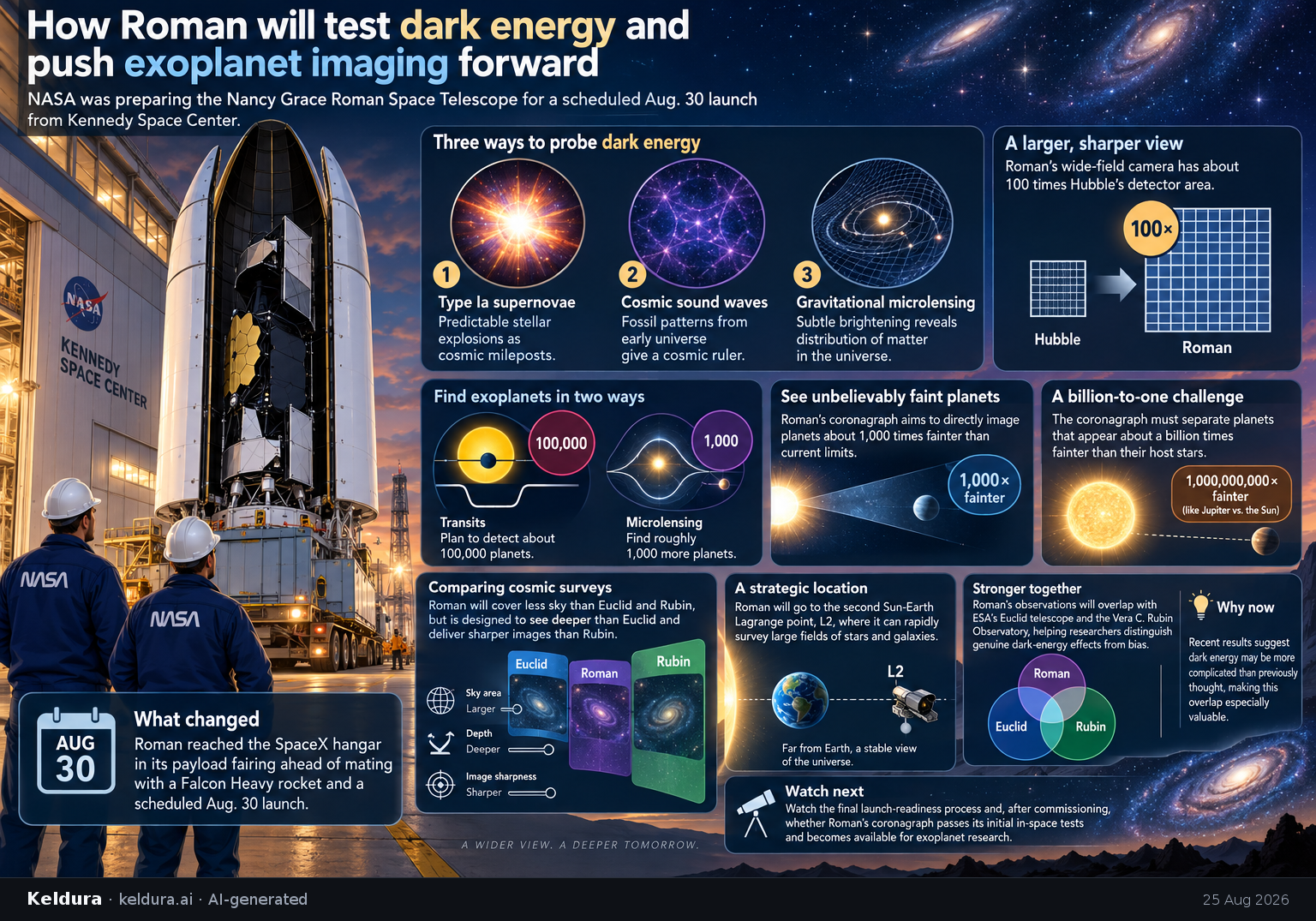
NASA was preparing the Nancy Grace Roman Space Telescope for a scheduled Aug. 30 launch from Kennedy Space Center.
Why it matters: Roman’s observations will overlap with surveys from ESA’s Euclid telescope and the Vera C. Rubin Observatory, helping researchers distinguish genuine dark-energy effects from observational bias. Its…
Roman reached the SpaceX hangar in its payload fairing ahead of mating with a Falcon Heavy rocket and a scheduled Aug. 30 launch.[4]
Why now
Recent results suggest dark energy may be more complicated than previously thought, making Roman’s overlap with Euclid and Rubin especially valuable.[1]
Watch next
Watch the final launch-readiness process and, after commissioning, whether Roman’s coronagraph passes its initial in-space tests and becomes available for exoplanet research.[2][4]
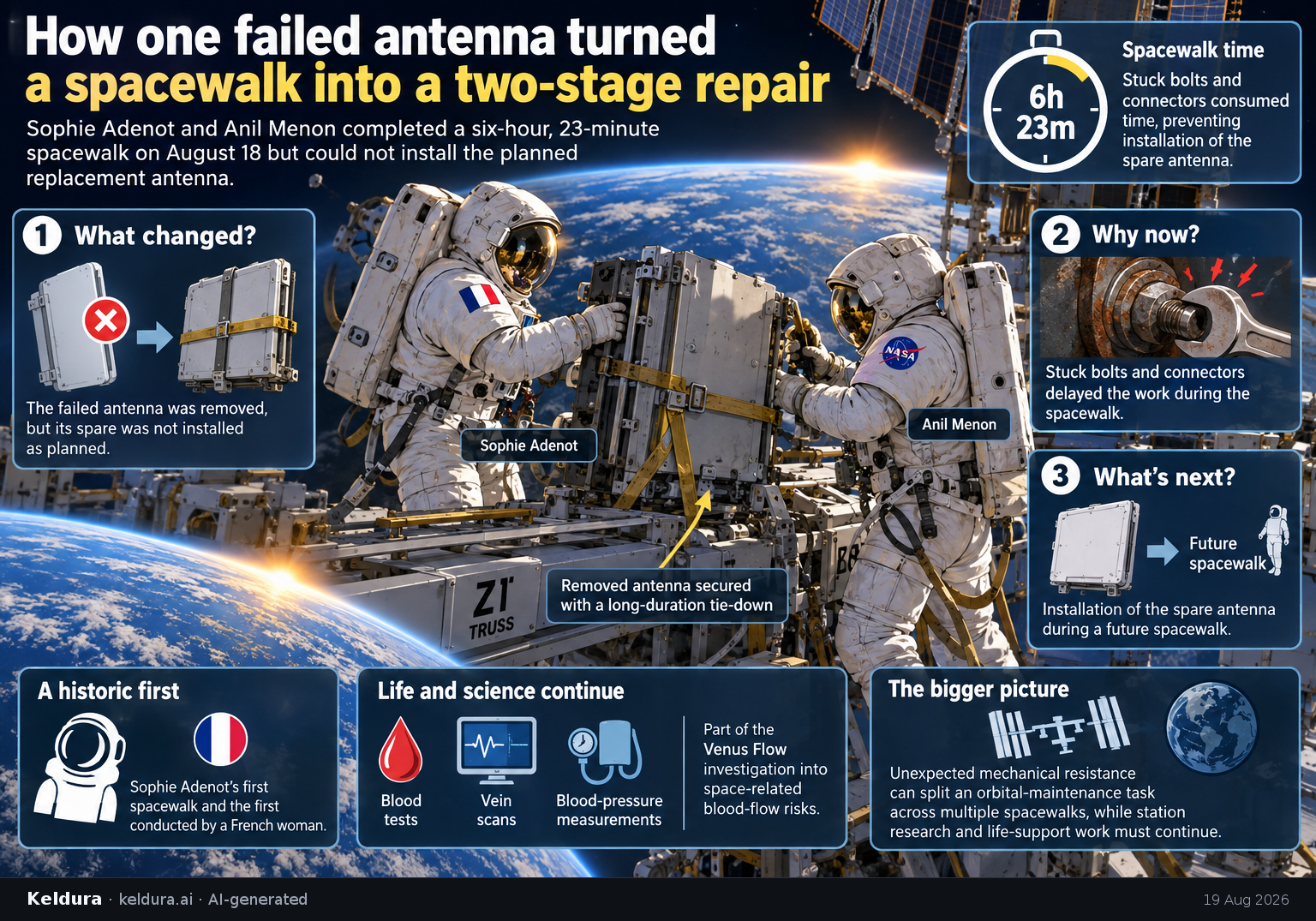
Sophie Adenot and Anil Menon completed a six-hour, 23-minute spacewalk on August 18 but could not install the planned replacement antenna.
Why it matters: The repair illustrates how unexpected mechanical resistance can split an orbital-maintenance task across multiple spacewalks, while station research and life-support work must continue around the int…
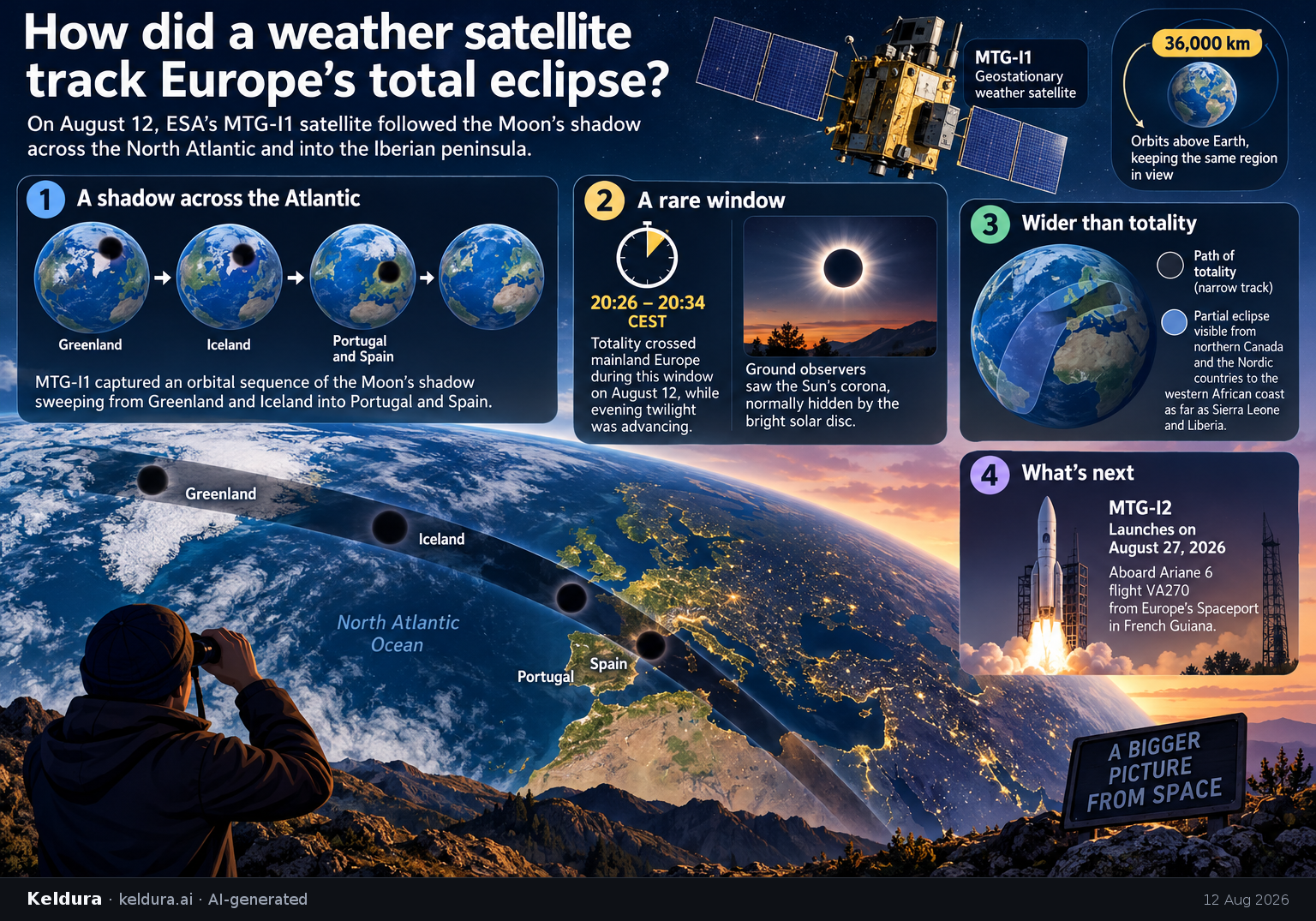
On August 12, ESA’s MTG-I1 satellite followed the Moon’s shadow across the North Atlantic and into the Iberian peninsula.
Why it matters: The event demonstrates how a geostationary weather satellite can provide a continuous, continent-scale view of an eclipse while observers inside the narrow path record details of the Sun’s atmosphere.
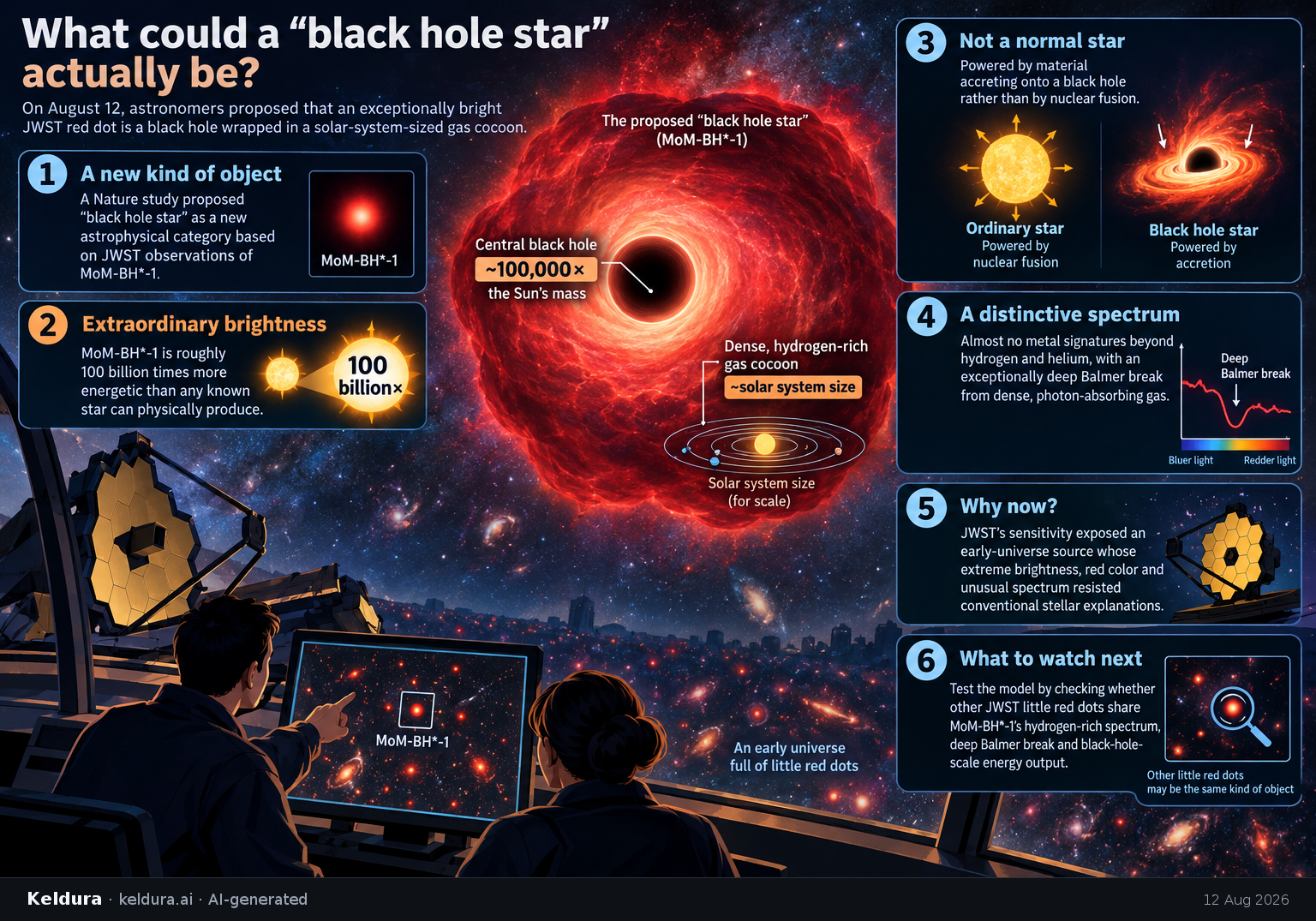
On August 12, astronomers proposed that an exceptionally bright JWST red dot is a black hole wrapped in a solar-system-sized gas cocoon.
Why it matters: If the interpretation holds, this previously unobserved configuration could help explain the numerous “little red dots” found in JWST imagery and clarify how massive black holes operated only a few h…
A Nature study proposed “black hole star” as a new astrophysical category based on JWST observations of MoM-BH*-1.[7][8]
Why now
JWST’s sensitivity exposed an early-universe source whose extreme brightness, red color and unusual spectrum resisted conventional stellar explanations.[7][8]
Watch next
Researchers can test the model by checking whether additional JWST little red dots share MoM-BH*-1’s hydrogen-rich spectrum, deep Balmer break and black-hole-scale energy output.[7][8]
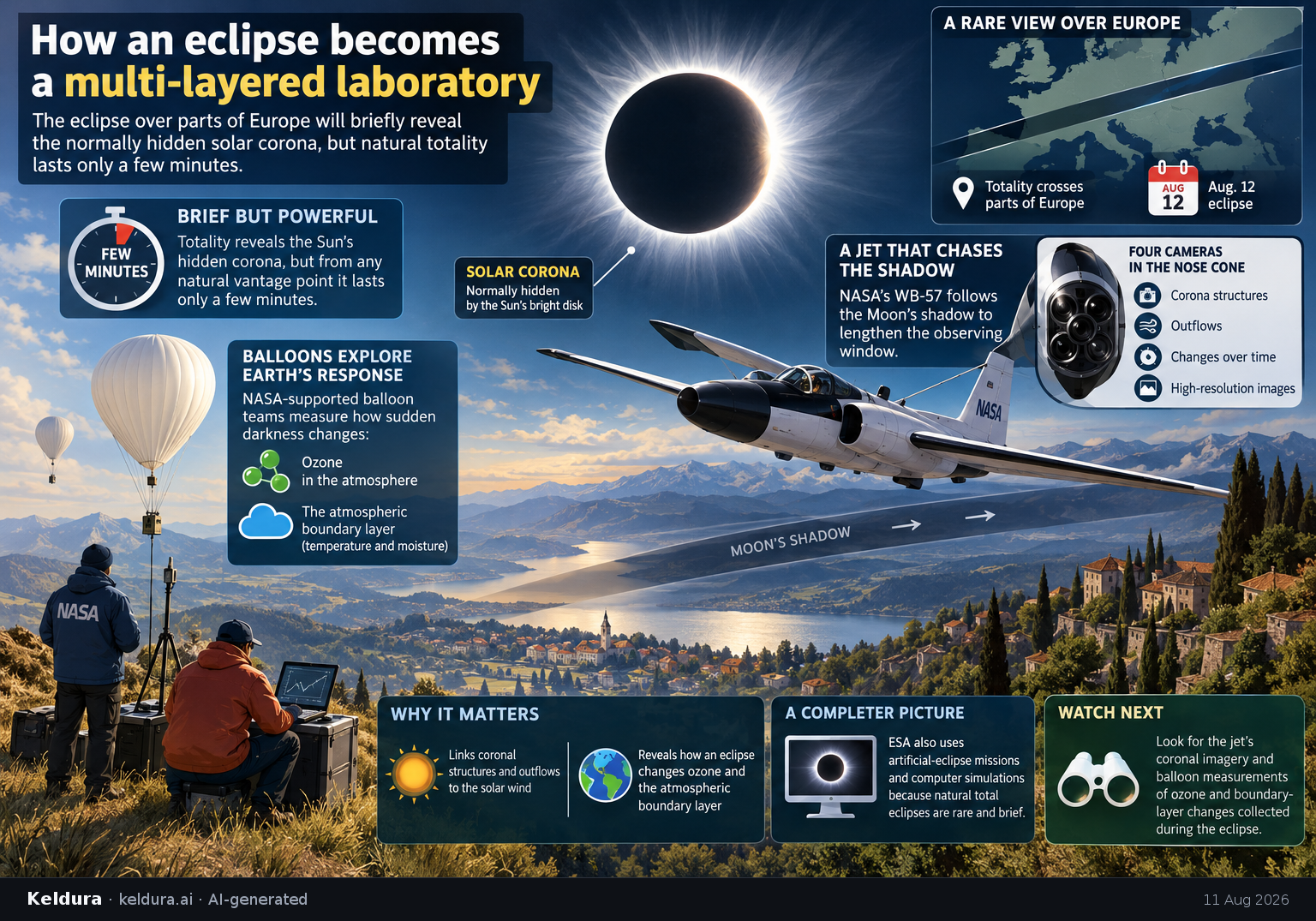
The eclipse over parts of Europe will briefly reveal the normally hidden solar corona, but natural totality lasts only a few minutes.
Why it matters: The combined campaign can connect coronal structures and outflows with the solar wind while examining how sudden darkness changes ozone and Earth’s temperature- and moisture-sensitive atmospheric bou…
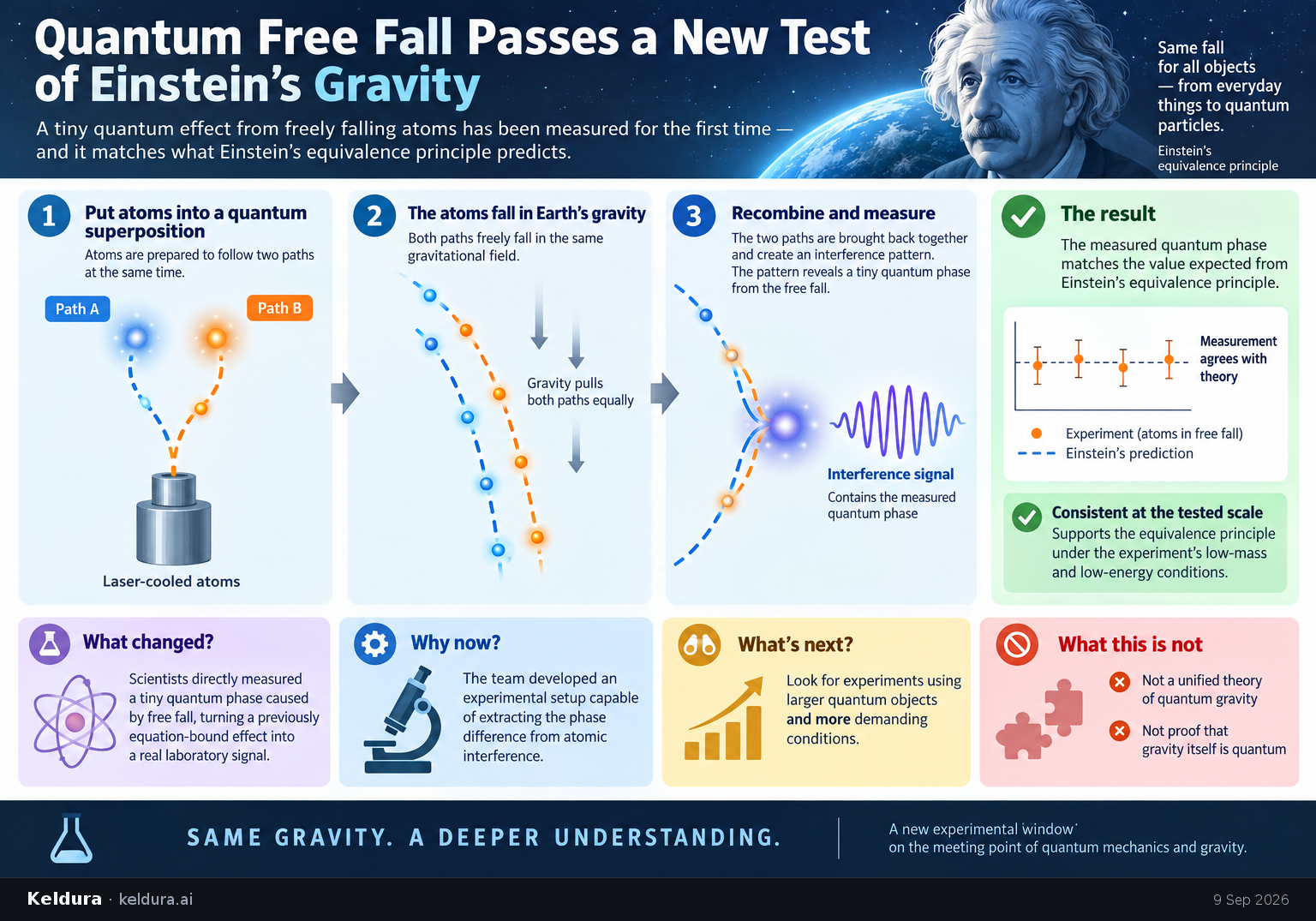
An international team measured a predicted quantum phase associated with freely falling atoms for the first time, and the result matched the value expected from Einstein’s equivalence principle.
Why it matters: The work turns a previously equation-bound effect into a measurable laboratory signal, creating a new experimental route for probing the boundary between quantum mechanics and gravity.