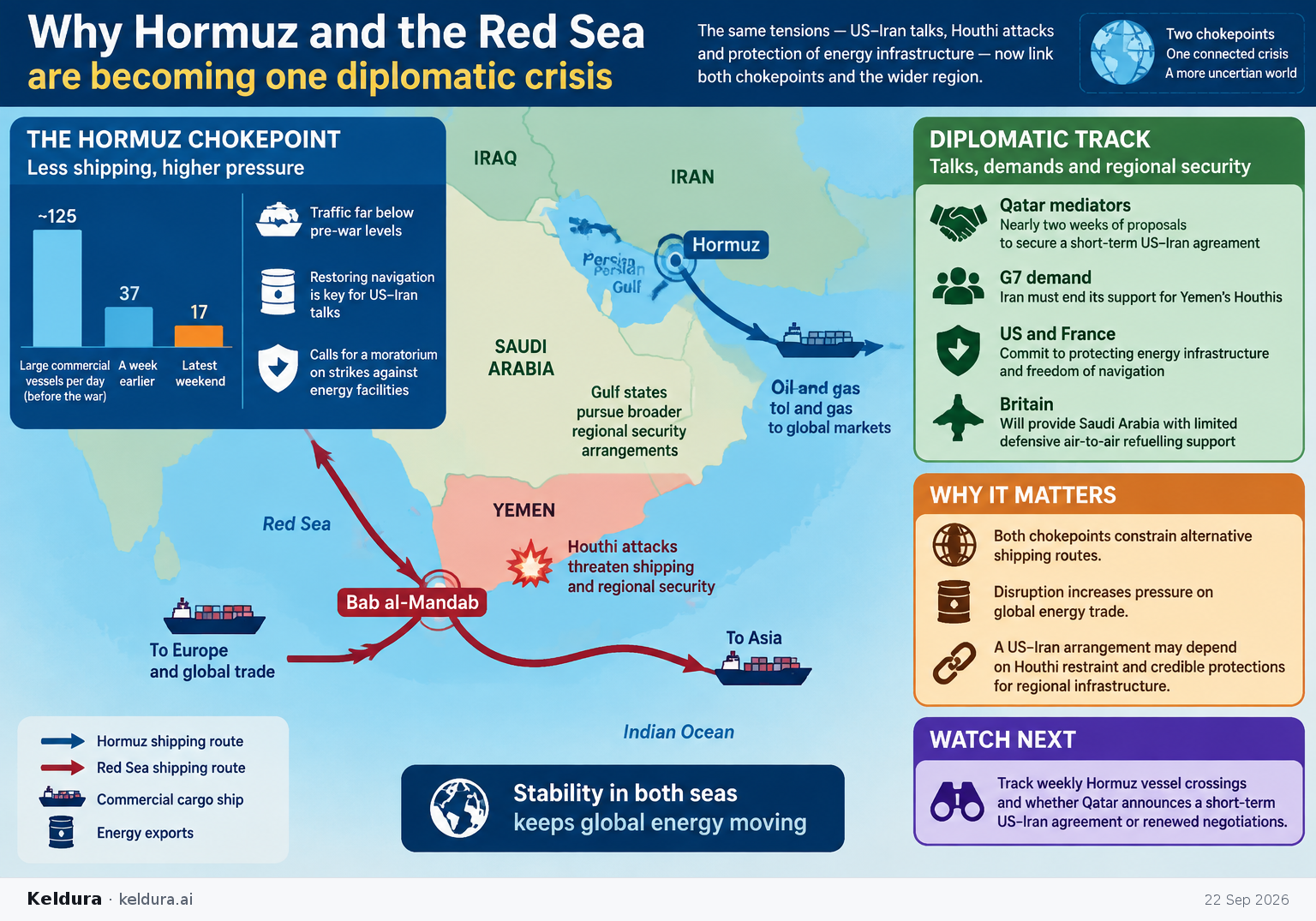
Diplomats gathered in New York are trying to reopen Gulf shipping, restrain Houthi attacks and create a path back to US-Iran negotiations.
Why it matters: Hormuz and Bab al-Mandab sit on separate sides of the Arabian Peninsula, but disruption at both constrains alternative shipping routes and increases pressure on global energy trade. The overlapping c…
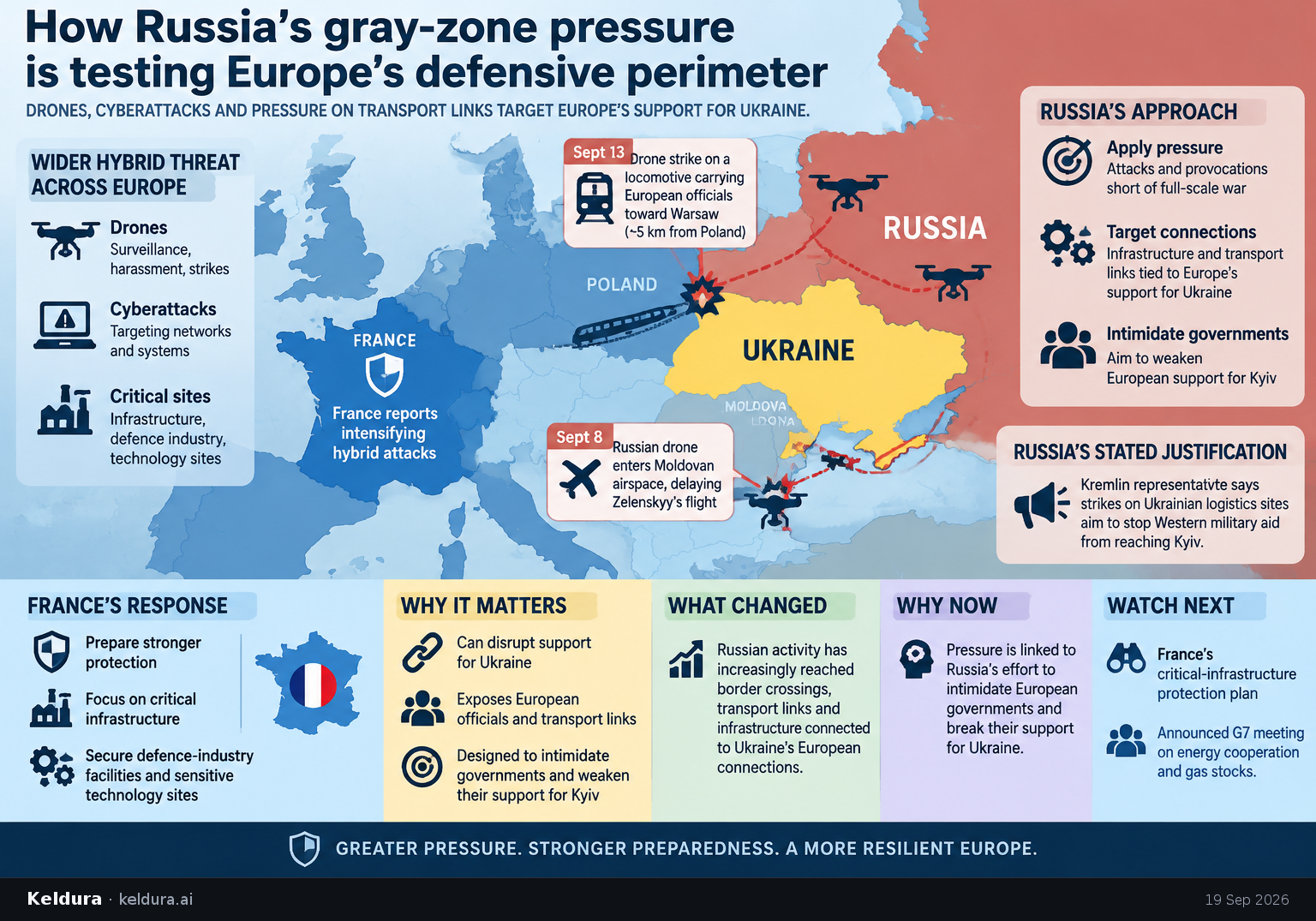
Macron said France had been targeted by Russian hybrid attacks in recent weeks and ordered preparations to protect critical infrastructure.
Why it matters: Pressure on infrastructure and cross-border transport can disrupt support for Ukraine and expose European officials without requiring a conventional attack deep inside NATO territory; Macron said the…
Reported Russian activity has increasingly reached border crossings, transport links and infrastructure associated with Ukraine’s European connections, while France says attacks against Europe have intensified.[3][6]
Why now
Macron linked the pressure to Russia’s effort to intimidate European governments and break their support for Ukraine, while a Kremlin representative described logistics routes as military targets.[3][6]
Watch next
Watch for France’s critical-infrastructure protection plan and the announced G7 meeting on energy cooperation and gas stocks.[3]
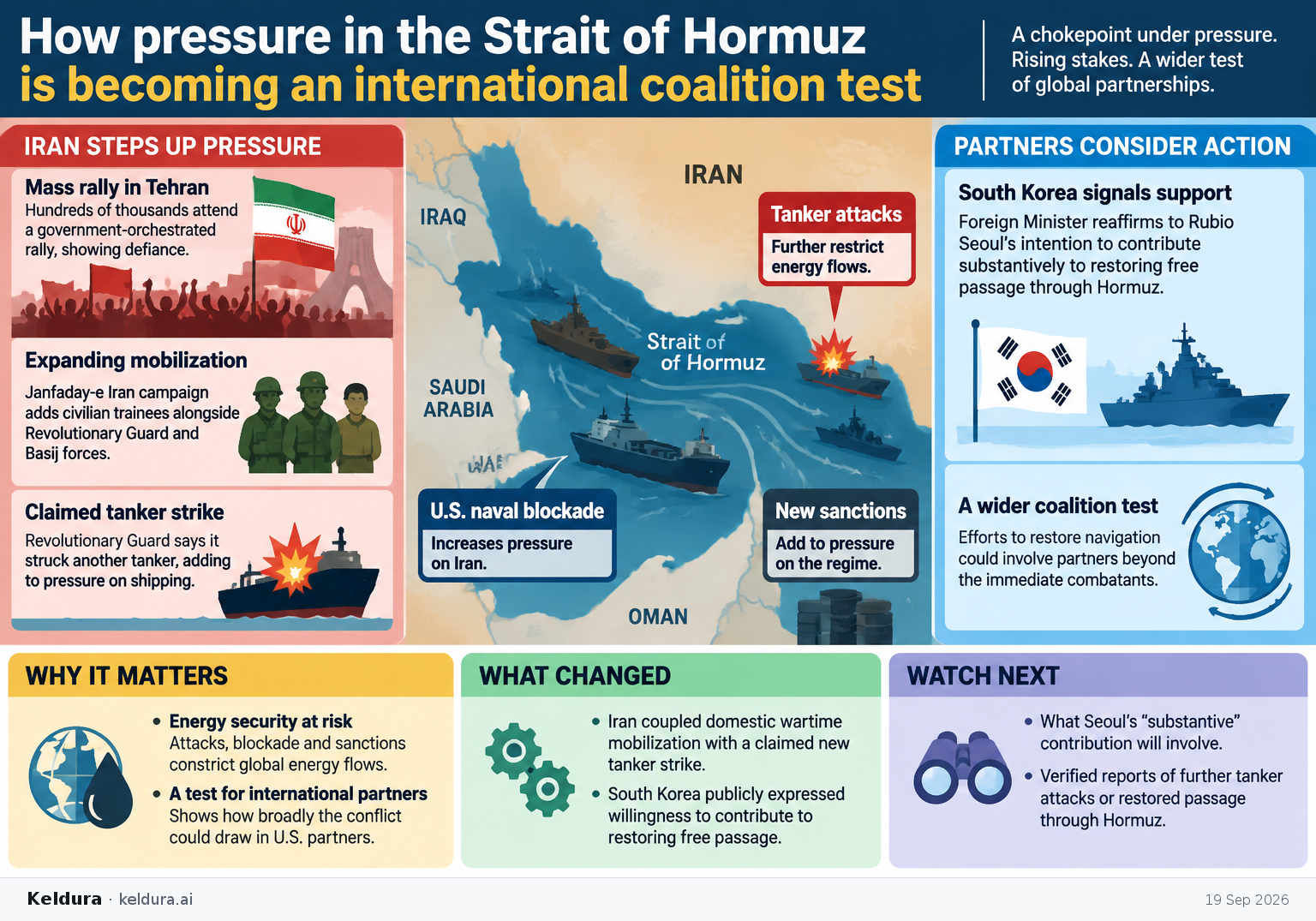
Hundreds of thousands attended a government-orchestrated rally in Tehran, while the Revolutionary Guard said it had struck another tanker.
Why it matters: The combination of tanker attacks, a naval blockade and outside governments considering contributions turns control of Hormuz into both an energy-security problem and a test of how broadly the confli…
Iran coupled domestic wartime mobilization with a claimed new tanker strike, while South Korea publicly expressed willingness to contribute to restoring free passage through Hormuz.[1][7]
Why now
A US naval blockade, new sanctions and attacks on tankers are increasing pressure on Iran while constricting global energy flows through the strait.[7]
Watch next
Watch for Seoul to specify what its “substantive” contribution will involve and for verified reports of further tanker attacks or restored passage through Hormuz.[1][7]
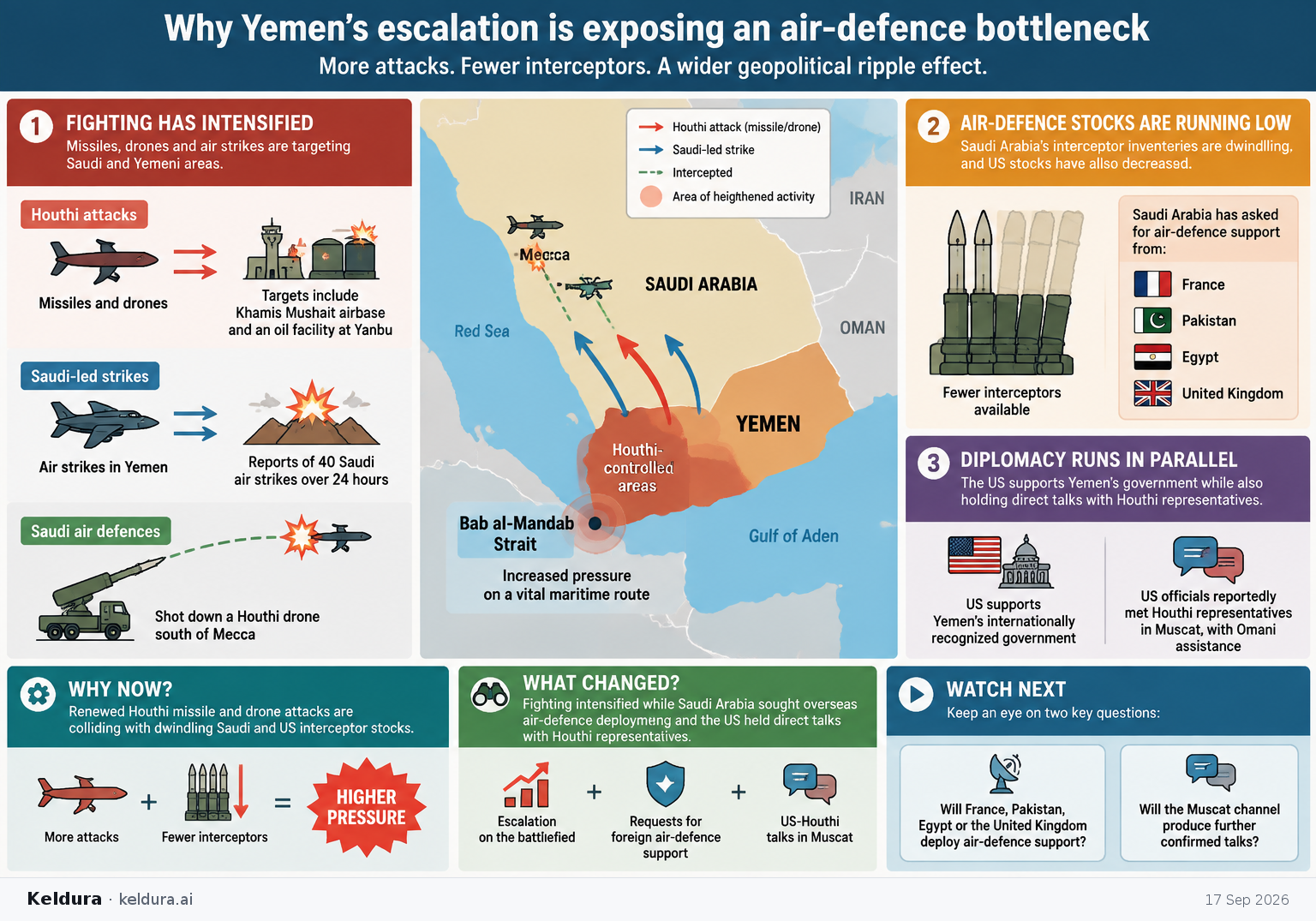
Saudi Arabia has asked France, Pakistan, Egypt and the United Kingdom for air-defence support because its missile interceptors are running.
Why it matters: The conflict now combines military escalation, pressure on the Bab al-Mandab maritime route and scarcity in defensive munitions, while the US simultaneously supports Yemen’s internationally recognize…
Fighting intensified while Saudi Arabia sought overseas air-defence deployments and the US held direct talks with Houthi representatives.[2]
Why now
Renewed Houthi missile and drone attacks are colliding with dwindling Saudi and US interceptor inventories.[2][8]
Watch next
Watch whether France, Pakistan, Egypt or the United Kingdom deploys air-defence support, and whether the Muscat channel produces further confirmed talks.[2]
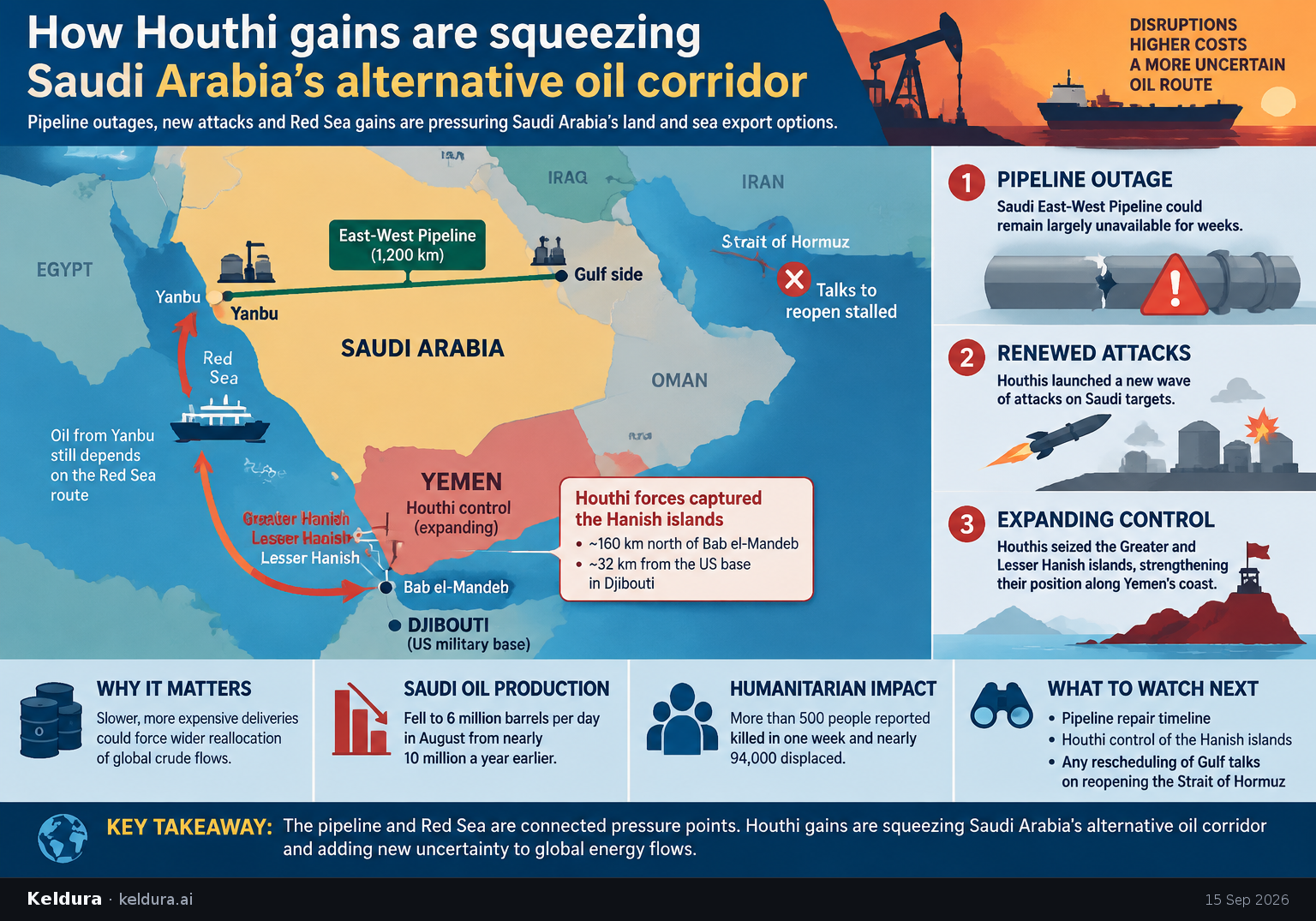
Yemen’s Iran-aligned Houthis launched a new wave of attacks against Saudi Arabia and consolidated positions along Yemen’s western coast.
Why it matters: Saudi Arabia had relied heavily on the 1,200-kilometre pipeline to move crude from the Gulf side to Yanbu after disruption in the Strait of Hormuz; a prolonged outage and insecurity along the Red Sea…
A pipeline outage, renewed strikes and Houthi island gains are simultaneously pressuring Saudi Arabia’s land and Red Sea export options.[3][6]
Why now
Hormuz disruption had already redirected Saudi exports toward the East-West Pipeline and Yanbu, increasing dependence on the route now under pressure.[6]
Watch next
Watch the pipeline’s repair timeline, Houthi control of the Hanish islands and any rescheduling of Gulf talks on reopening the Strait of Hormuz.[3][6]
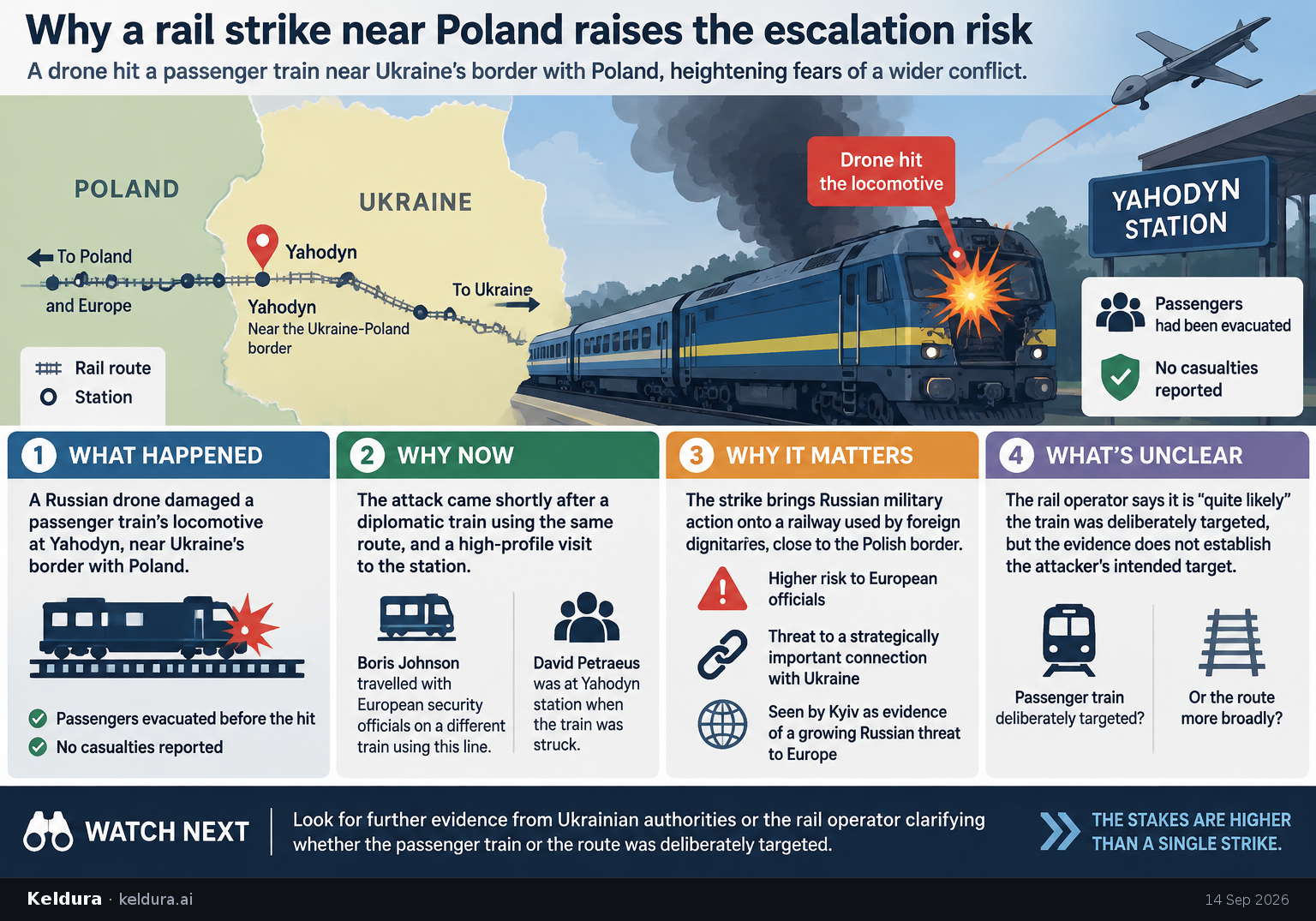
The drone hit the train’s engine at Yahodyn after its passengers had been evacuated, and Ukrainian authorities reported no casualties.
Why it matters: The strike brought Russian military action onto a railway used by foreign dignitaries close to the Polish border, increasing concern about attacks that could endanger European officials or disrupt a…
A Russian drone damaged a passenger train’s locomotive at Yahodyn, near Ukraine’s border with Poland; no casualties were reported.[1]
Why now
The attack occurred shortly after a diplomatic train carrying Boris Johnson and European security officials used the same route, while David Petraeus was at the station.[1][8]
Watch next
Watch for evidence from Ukrainian authorities or the rail operator clarifying whether the passenger train or the route was deliberately targeted.[8]
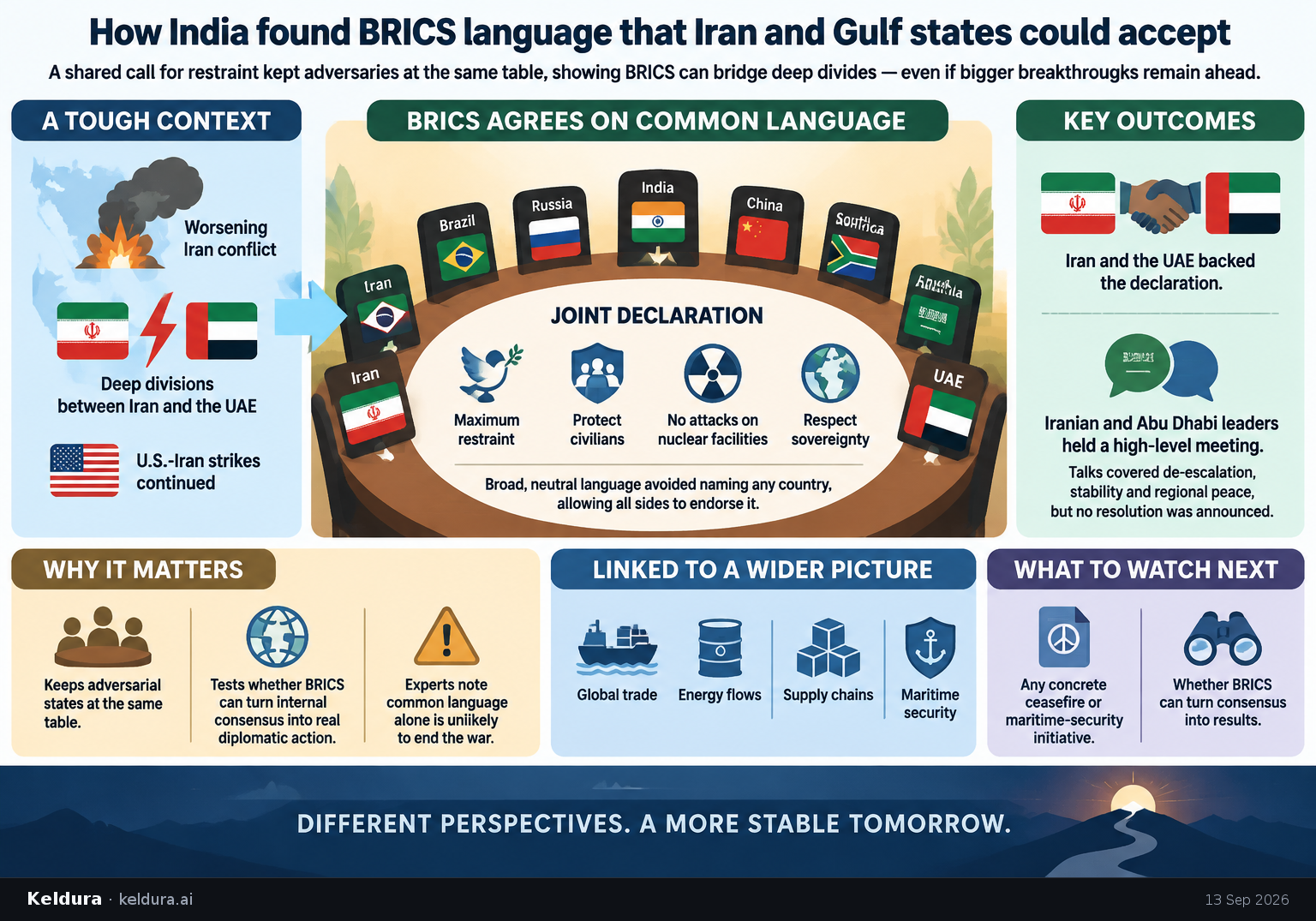
The BRICS members and Saudi Arabia agreed on language urging restraint and avoidance of actions that could further aggravate the conflict.
Why it matters: The agreement demonstrates that BRICS can keep adversarial states at the same negotiating table, but experts cautioned that common language alone was unlikely to alter the war’s trajectory. It also t…
Iran, the UAE and other BRICS participants accepted a joint call for maximum restraint, while the Iranian and Abu Dhabi leaders held a high-level bilateral meeting.[4][7]
Why now
Host India sought consensus as U.S.-Iran strikes continued and divisions between Iran and the UAE threatened to expose the bloc’s diplomatic limits.[7]
Watch next
Watch for any concrete ceasefire or maritime-security initiative following the declaration, particularly after Modi urged BRICS to turn consensus into results and Xi offered China a peacemaking role.[7]
Saudi Arabia closed the 1,200km East-West pipeline, which allows its crude exports to bypass the Strait of Hormuz, after drones launched.
Why it matters: The two developments threaten Saudi export routes on opposite sides of the Arabian Peninsula: the pipeline was carrying an estimated 4% to 5% of global oil supply, while Bab al-Mandab connects the Re…
A drone attack closed Saudi Arabia’s East-West pipeline while Houthi forces captured Yemen’s Red Sea coastline and strategic islands around Bab al-Mandab [3][5].
Why now
The pipeline had become more important as a way around the Strait of Hormuz, while the Houthis completed a rapid coastal offensive amid the wider US-Iran war [1][5].
Watch next
Watch for the pipeline’s reopening, Saudi decisions on retaliation, Iraq’s investigation, and verified changes to commercial navigation through Bab al-Mandab [1][3][5].
Why it matters: Border infrastructure can alter access, patrol patterns and the practical balance of control even without a declared incursion, complicating efforts by two nuclear-armed neighbours to rebuild ties. T…
New imagery documents ongoing roads and construction at multiple frontier sites, including infrastructure within territory claimed by both India and China [6].
Why now
The evidence surfaced as Xi arrived for the Delhi Brics summit and his first India visit since the 2020 Galwan clash [6][7].
Watch next
Watch the Xi-Modi talks, official border statements and subsequent imagery for changes in construction or military access around the identified sites [6][7].
The Kremlin confirmed that Ratcliffe arrived on a US military aircraft and met Naryshkin, but Washington offered no attributable official.
Why it matters: A limited move against NATO territory could test whether the alliance invokes its Article 5 mutual-defence commitment, while the 60-mile Suwalki Gap is the Baltic states’ only land connection to othe…
Ratcliffe made a rare, unannounced Moscow visit and met his Russian counterpart aboard a mission reportedly intended to deliver an escalation warning.[1][4]
Why now
Reports link US concern to pressure on the Kremlin from the stalled Ukraine war and Ukrainian attacks that have disrupted Russian fuel infrastructure.[1][4]
Watch next
Watch for an attributable US account of the meeting and for documented changes in Baltic airspace violations, drone incursions or Russian attacks on Ukraine.[1][4]
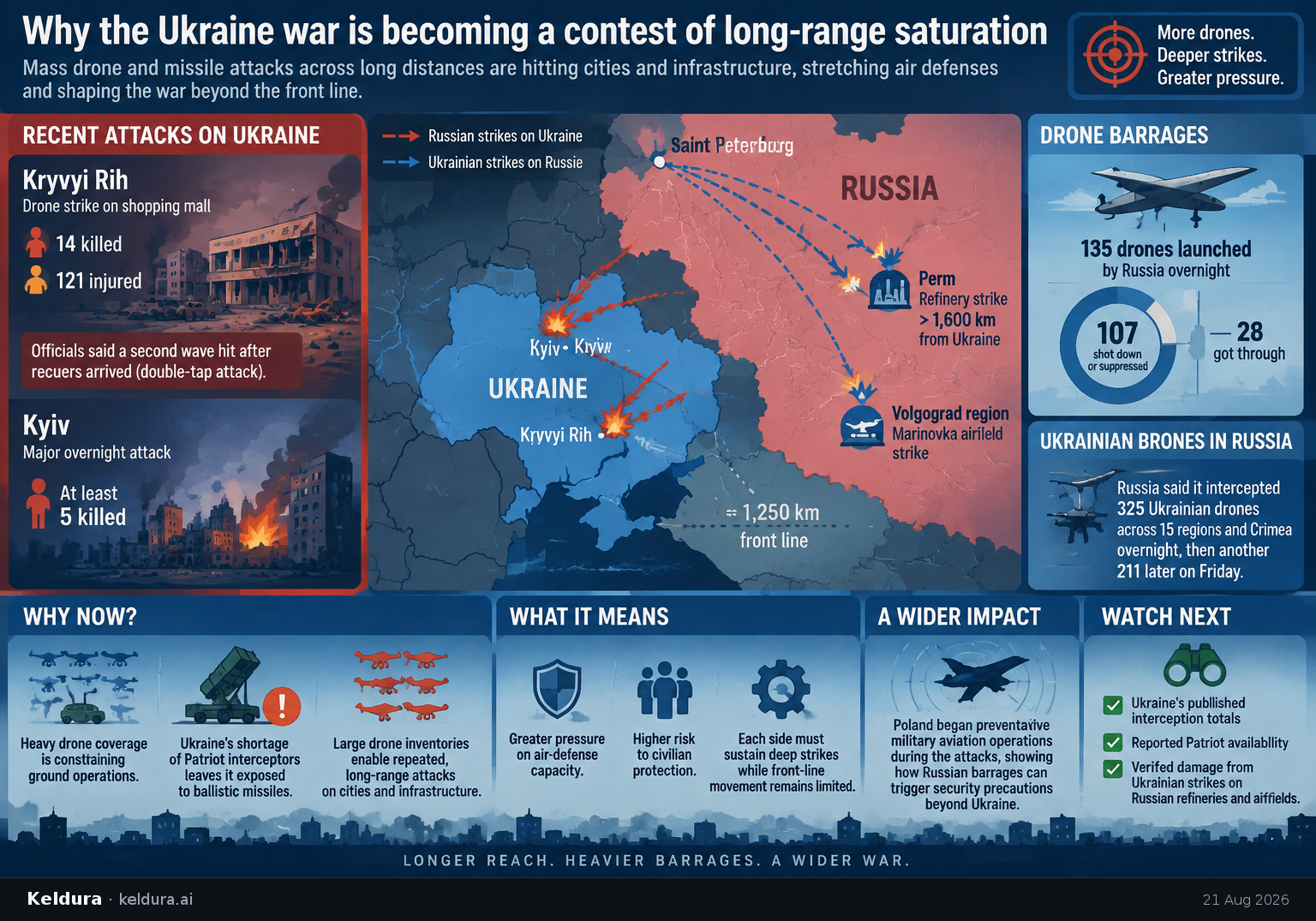
Russian drones struck a Kryvyi Rih shopping center on August 21, killing 14 people a day after another major attack on Kyiv.
Why it matters: Large drone inventories restrict troop movement while enabling repeated attacks on cities and infrastructure, shifting pressure toward air-defense capacity, civilian protection and each side’s abilit…
Russia’s Kryvyi Rih strike killed 14 and injured 121 after another major assault on Kyiv, while Ukraine continued deep attacks inside Russia.[3]
Why now
Heavy drone coverage is constraining ground operations, and Russia is exploiting Ukraine’s shortage of Patriot interceptors for ballistic-missile defense.[3]
Watch next
Track Ukraine’s published interception totals, reported Patriot availability and verified damage from Ukrainian strikes on Russian refineries and airfields.[3]
Qatar said mediators were exchanging ideas and drafts with Washington and Tehran, but no direct US-Iran talks were scheduled.
Why it matters: The strait normally carries a fifth of global oil and gas shipments, and its effective closure since the war began in February has disrupted trade and increased fuel and food prices.
Qatar said indirect mediation was in progressive stages, while Miliband reported a productive US-UK discussion but cautioned that an agreement had not yet been reached.[1][6]
Why now
The strait has been effectively closed since the US-Israel war with Iran began in late February, disrupting a route that normally handles one-fifth of global oil and gas shipments.[6]
Watch next
Watch for Iran, the US or the mediators to publish terms for restoring shipping passage, because no details of a potential agreement have yet been released.[6]
That's the desk. Every cheatsheet here started as a link. Yours can too.