Keldura Daily Open Keldura

Keldura Daily · Cheatsheets

Science & Space cheatsheets.

Every Science & Space cheatsheet Keldura Daily has published, newest first. Each cheatsheet is compiled by Keldura's AI from the sources it cites.

Cheatsheet your own link — free
Latest cheatsheets

Science & Space

Read in Briefings
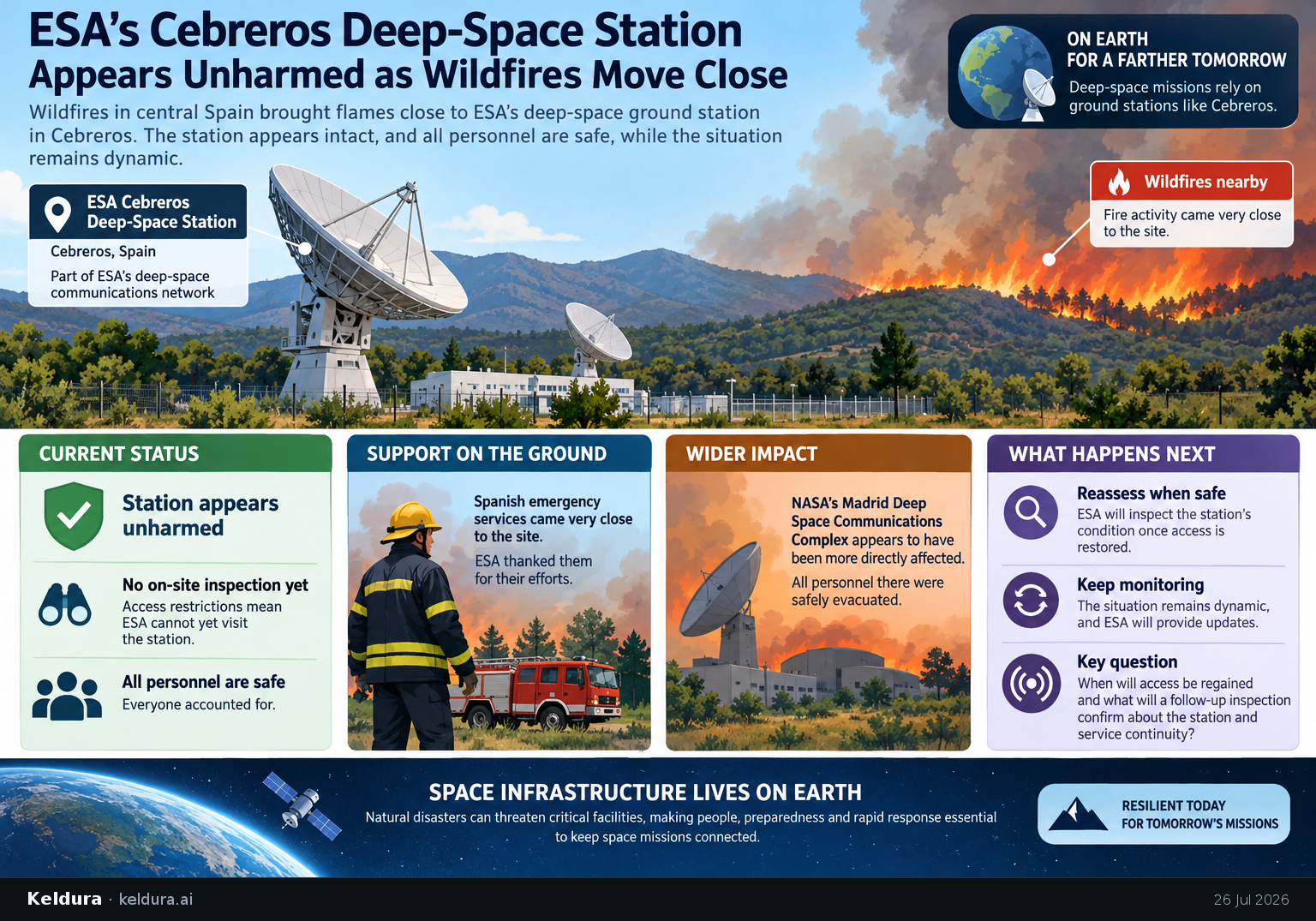
Cheatsheet for ESA says its Cebreros deep-space station appears unharmed as wildfires move close. Text equivalent is attached.

Science & Space

ESA says its Cebreros deep-space station appears unharmed as wildfires move close

ESA said it is closely monitoring wildfires near its deep-space ground station in Cebreros, Spain, and that the station appears to have remained unharmed based on the information currently available.

Why it matters: Cebreros is part of ESA’s deep-space communications infrastructure, so any wildfire threat there is an operational risk as well as a personnel and continuity issue. The statement also underscores how…

Open original · ESA News

Open cheatsheet →1 source Post to X

What changed
Wildfires near Cebreros prompted an ESA status update; the station appears intact but cannot yet be inspected [1].
Why now
Fire activity brought emergency services close to a key deep-space ground station, making operational status and personnel safety urgent [1].
Watch next
Whether ESA regains access for an on-site inspection and issues a follow-up on station condition and service continuity [1].
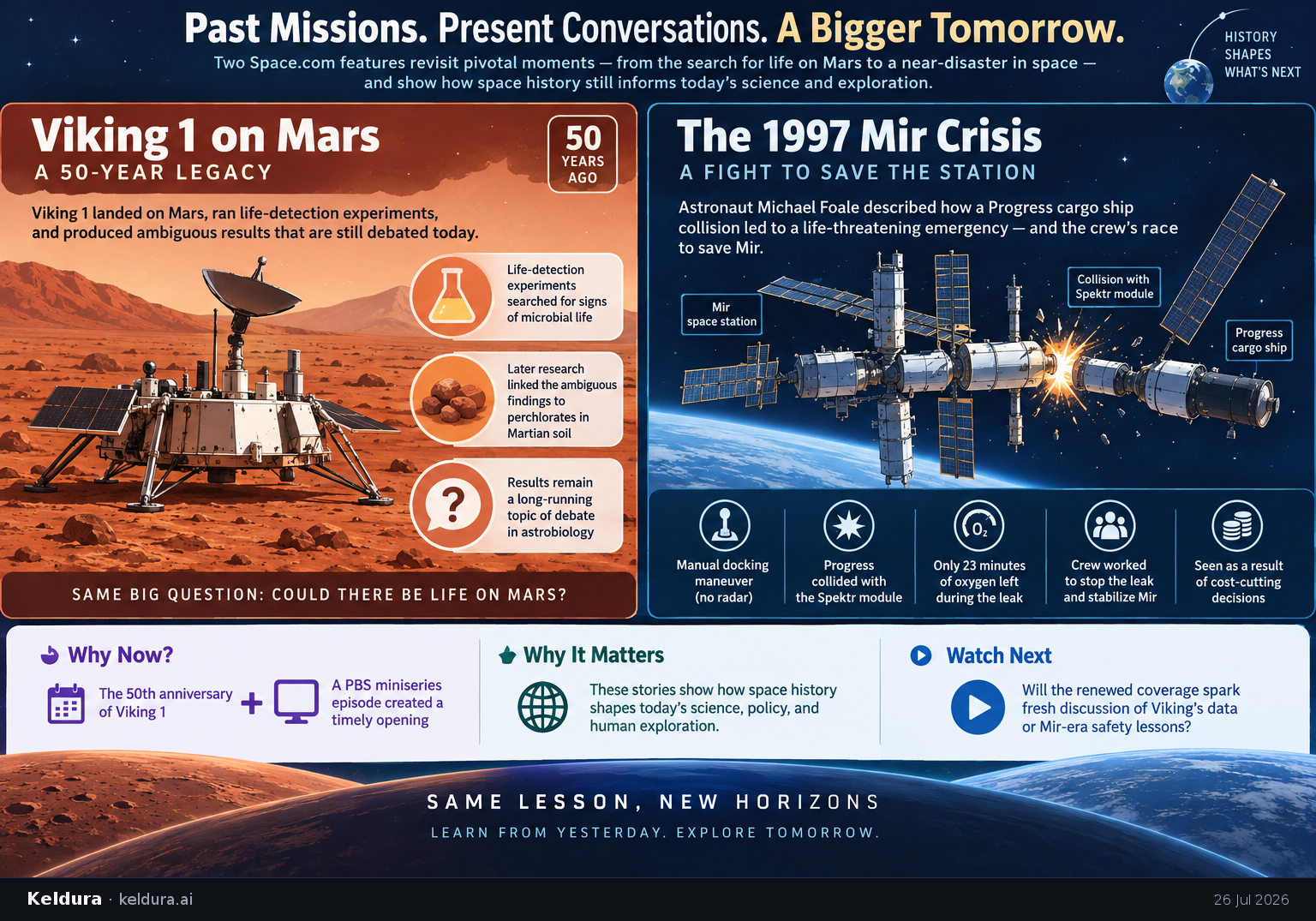
Cheatsheet for Mars memory and space-station risk take center stage in two Space.com features. Text equivalent is attached.

Science & Space

Mars memory and space-station risk take center stage in two Space.com features

Why it matters: Together, these pieces show how space history still shapes present-day science and policy conversations: Viking 1 remains central to Mars astrobiology debates, while Mir remains a case study in stati…

Open original (2 sources): Space.com, Space.com

Open cheatsheet →2 sources Post to X

What changed
Space.com highlighted Viking 1’s 50th anniversary and released an interview focused on the Mir collision crisis [2][3].
Why now
The anniversary and the PBS miniseries episode created a timely opening to revisit Mars life-detection history and station emergency response [2][3].
Watch next
Whether the PBS series and related coverage prompt renewed discussion of Viking data interpretation or Mir-era safety lessons [2][3].
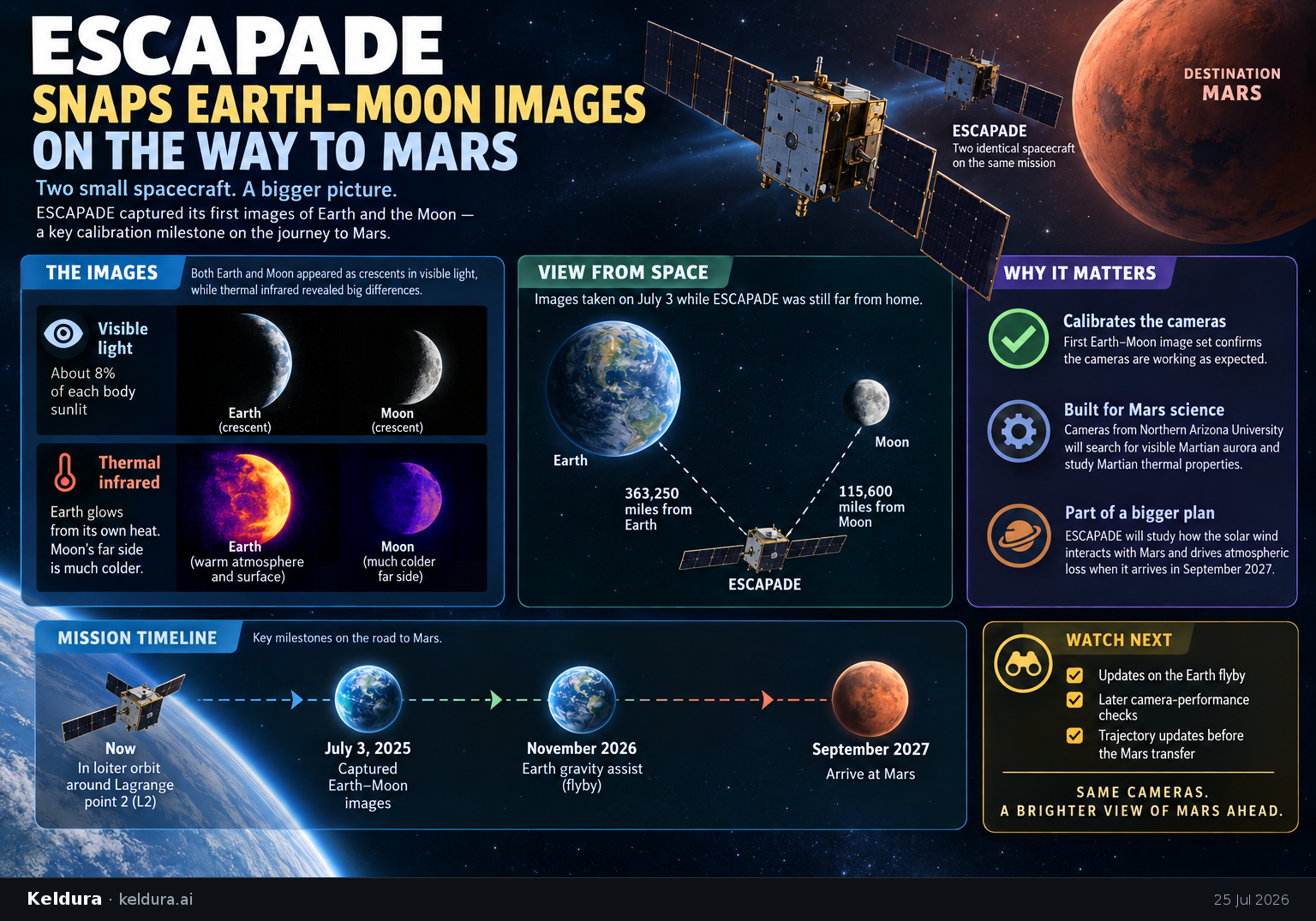
Cheatsheet for ESCAPADE snaps Earth-Moon images on the way to Mars. Text equivalent is attached.

Science & Space

ESCAPADE snaps Earth-Moon images on the way to Mars

NASA says one of the two Mars-bound ESCAPADE spacecraft captured visible-light and thermal-infrared images of Earth and the Moon on July 3 while the probe was still far from home.

Why it matters: The photos are not just a visual milestone; NASA says they serve as an important calibration check for the spacecraft’s cameras before ESCAPADE uses an Earth flyby in November 2026 to head toward Mar…

Open original · NASA News

Open cheatsheet →1 source Post to X

What changed
ESCAPADE returned its first Earth-Moon image set and NASA highlighted it as a camera calibration milestone.[1]
Why now
The mission is in loiter orbit ahead of a planned Earth gravity assist in November 2026 and Mars arrival in September 2027.[1]
Watch next
Look for NASA updates on the Earth flyby and any later camera-performance or trajectory checks before the Mars transfer.[1]
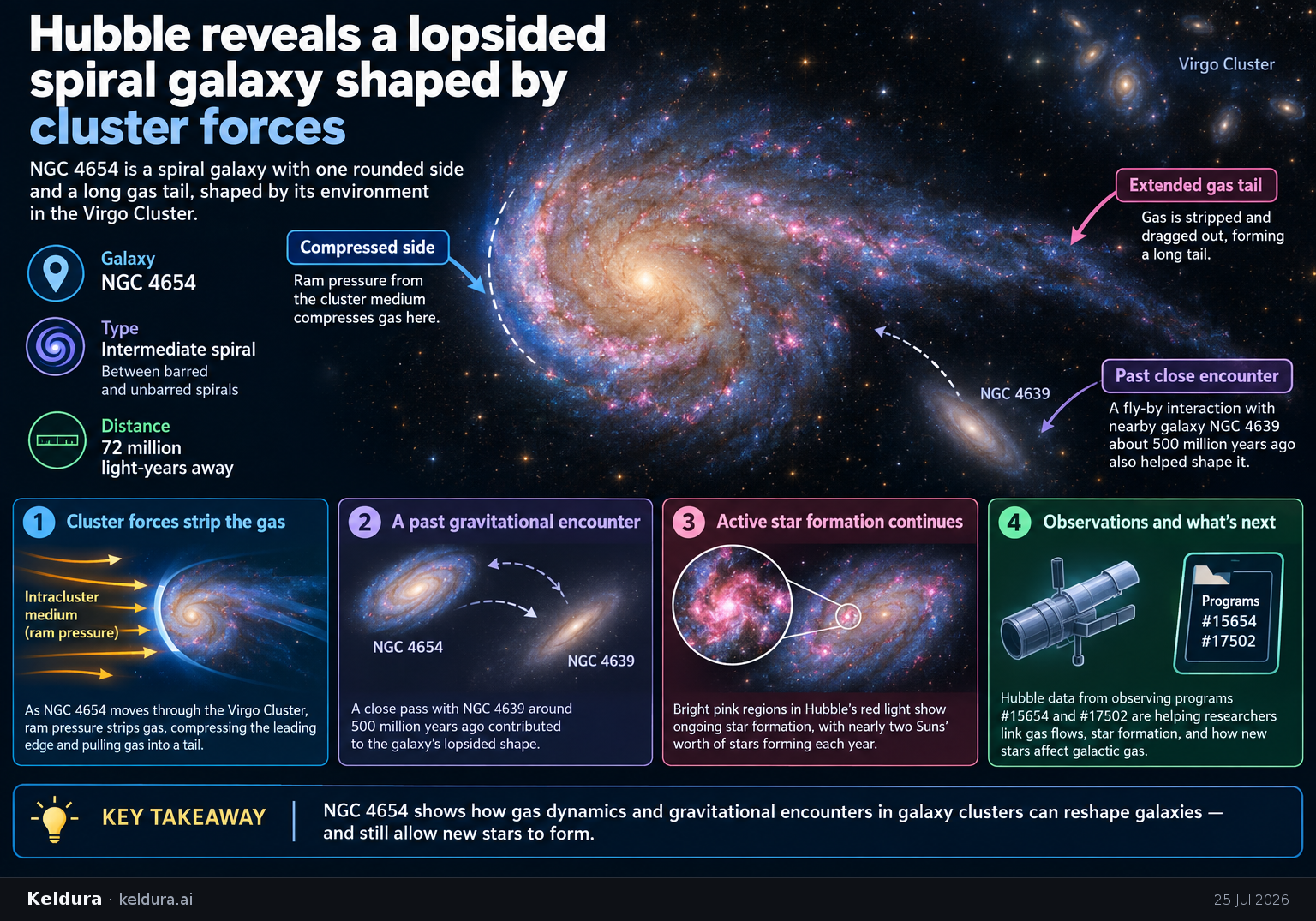
Cheatsheet for Hubble reveals a lopsided spiral galaxy shaped by cluster forces. Text equivalent is attached.

Science & Space

Hubble reveals a lopsided spiral galaxy shaped by cluster forces

A new NASA/ESA Hubble image shows NGC 4654, a spiral galaxy 72 million light-years away in Virgo, with a rounded edge on one side and a long gas tail on the other.

Why it matters: The image is a concrete example of how gas dynamics and gravitational encounters reshape galaxies and influence where stars can form. NASA says the data are helping researchers connect gas flows, sta…

Open original · NASA News

Open cheatsheet →1 source Post to X

What changed
Hubble data exposed a strongly asymmetric spiral galaxy with active star formation despite gas stripping.[2]
Why now
NASA released the image alongside fresh analysis tying its lopsided shape to cluster interactions and past gravitational encounters.[2]
Watch next
Track follow-up work from the two observing programs on how gas moves and where it collapses into new stars.[2]
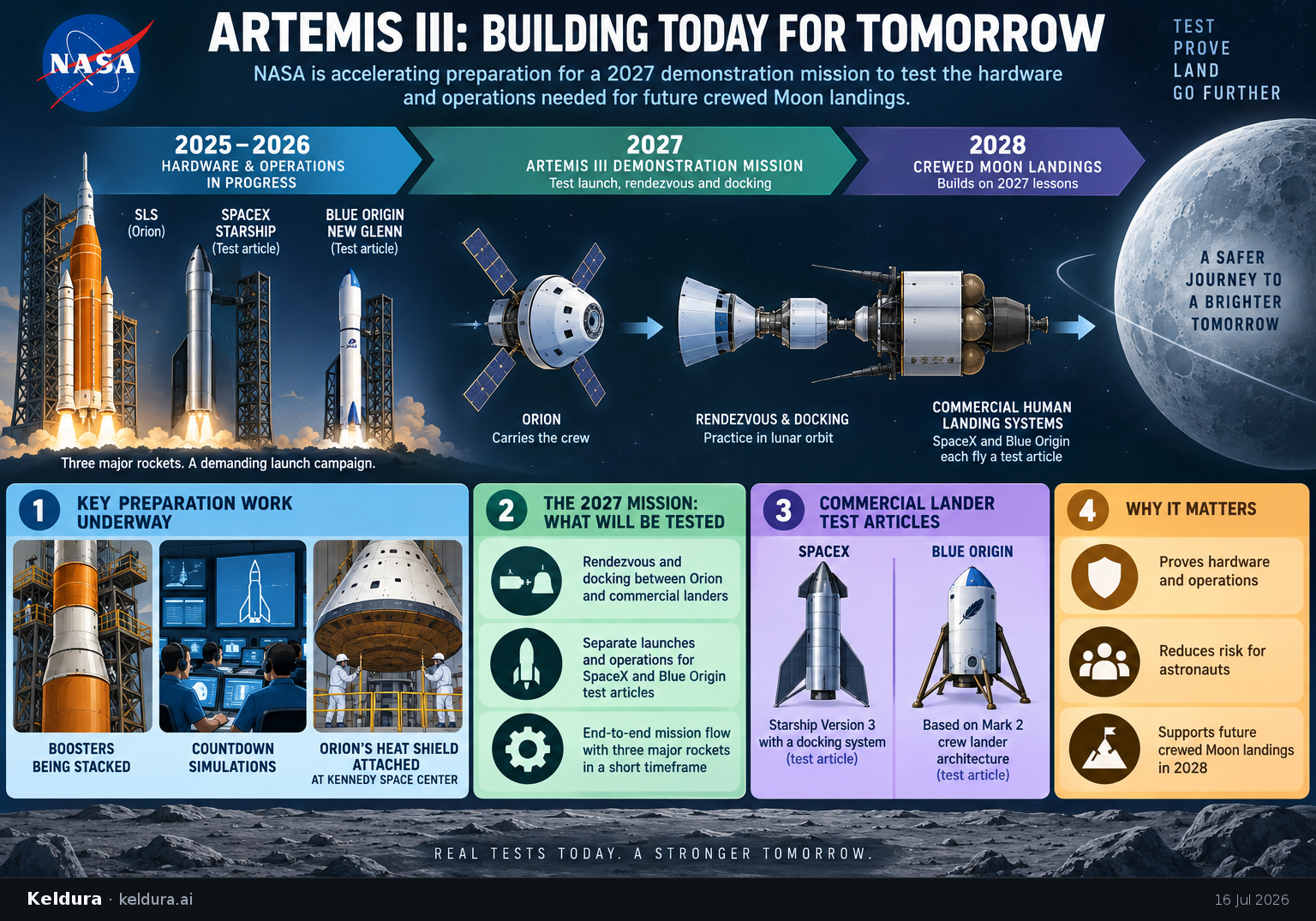
Cheatsheet for NASA is accelerating Artemis III preparation ahead of a 2027 demonstration mission. Text equivalent is attached.

Science & Space

NASA is accelerating Artemis III preparation ahead of a 2027 demonstration mission

NASA says Artemis III is moving into a more active preparation phase, with boosters being stacked, countdown simulations underway, and Orion’s heat shield attached at Kennedy Space Center.

Why it matters: This is a key milestone in NASA’s plan to prove the hardware and operations needed for future crewed lunar landings, while reducing risk through testing in 2027 before astronauts land on the Moon in…

Open original (2 sources): Space.com, NASA News

Open cheatsheet →2 sources Post to X

What changed
NASA says Artemis III hardware and operations are advancing, including booster stacking, countdown simulations, and Orion heat-shield installation; the agency also detailed the 2027 demonstration mission plan [1][5].
Why now
NASA is preparing for a 2027 demo that must validate rendezvous, docking, and launch operations before crewed Moon landings in 2028 [5].
Watch next
Observable milestones include continued Artemis III vehicle integration at Kennedy and further NASA updates on lander test-article readiness and launch sequencing [1][5].
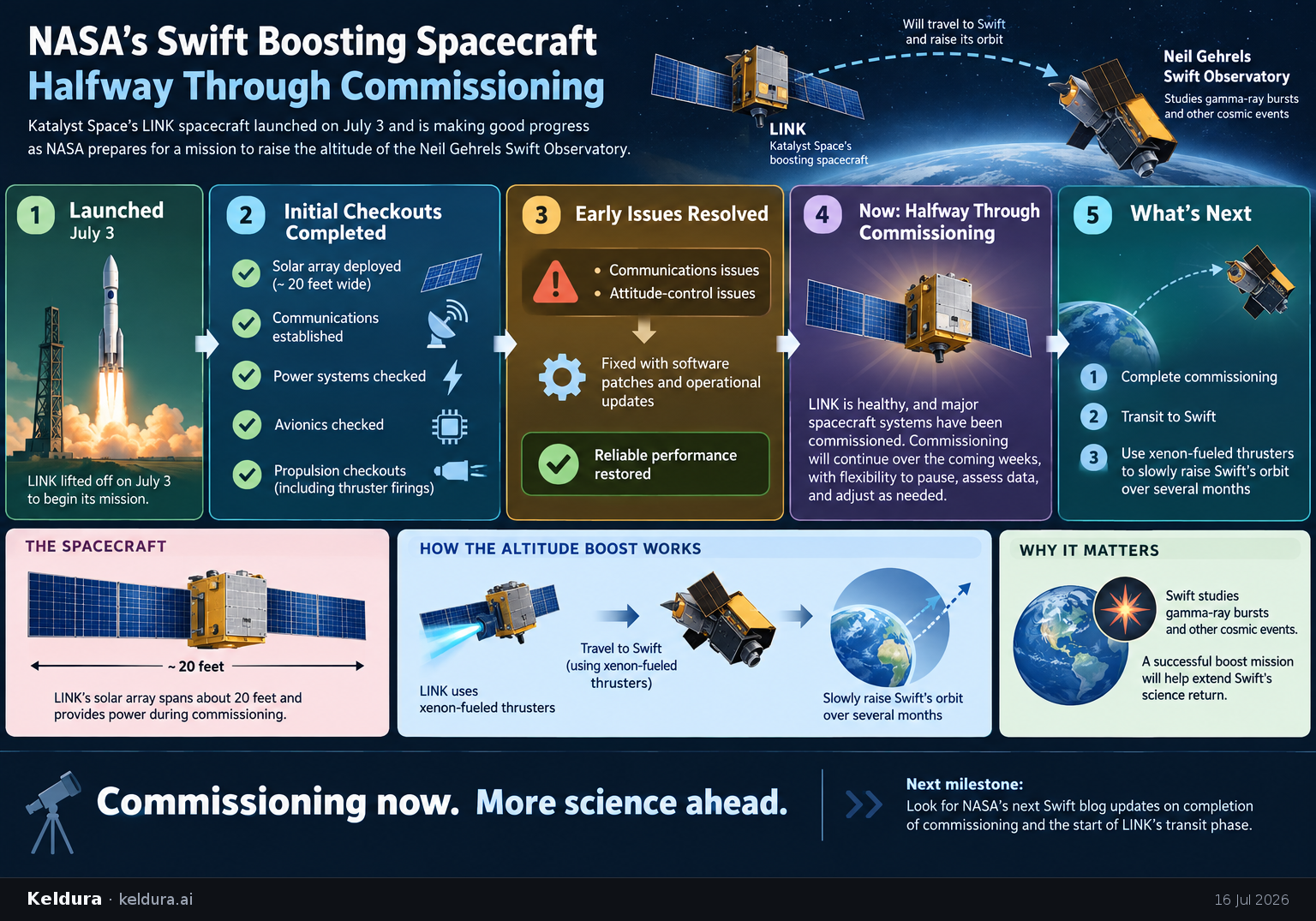
Cheatsheet for NASA’s Swift boosting spacecraft is halfway through commissioning after launch. Text equivalent is attached.

Science & Space

NASA’s Swift boosting spacecraft is halfway through commissioning after launch

Katalyst Space’s LINK spacecraft launched on July 3 and is now about halfway through commissioning as NASA prepares a mission to raise the altitude of the Neil Gehrels Swift Observatory.

Why it matters: Swift is a NASA satellite that studies gamma-ray bursts and other cosmic events, so a successful boost mission would help extend the observatory’s science return. The commissioning progress is import…

Open original · NASA News

Open cheatsheet →1 source Post to X

What changed
LINK has moved from launch and initial checkouts into mid-commissioning, with solar arrays deployed and major spacecraft systems checked out [2].
Why now
The spacecraft must be fully commissioned before it can begin transit to Swift and the orbital altitude boost [2].
Watch next
Look for NASA’s next Swift blog updates on completion of commissioning and the start of LINK’s transit phase [2].
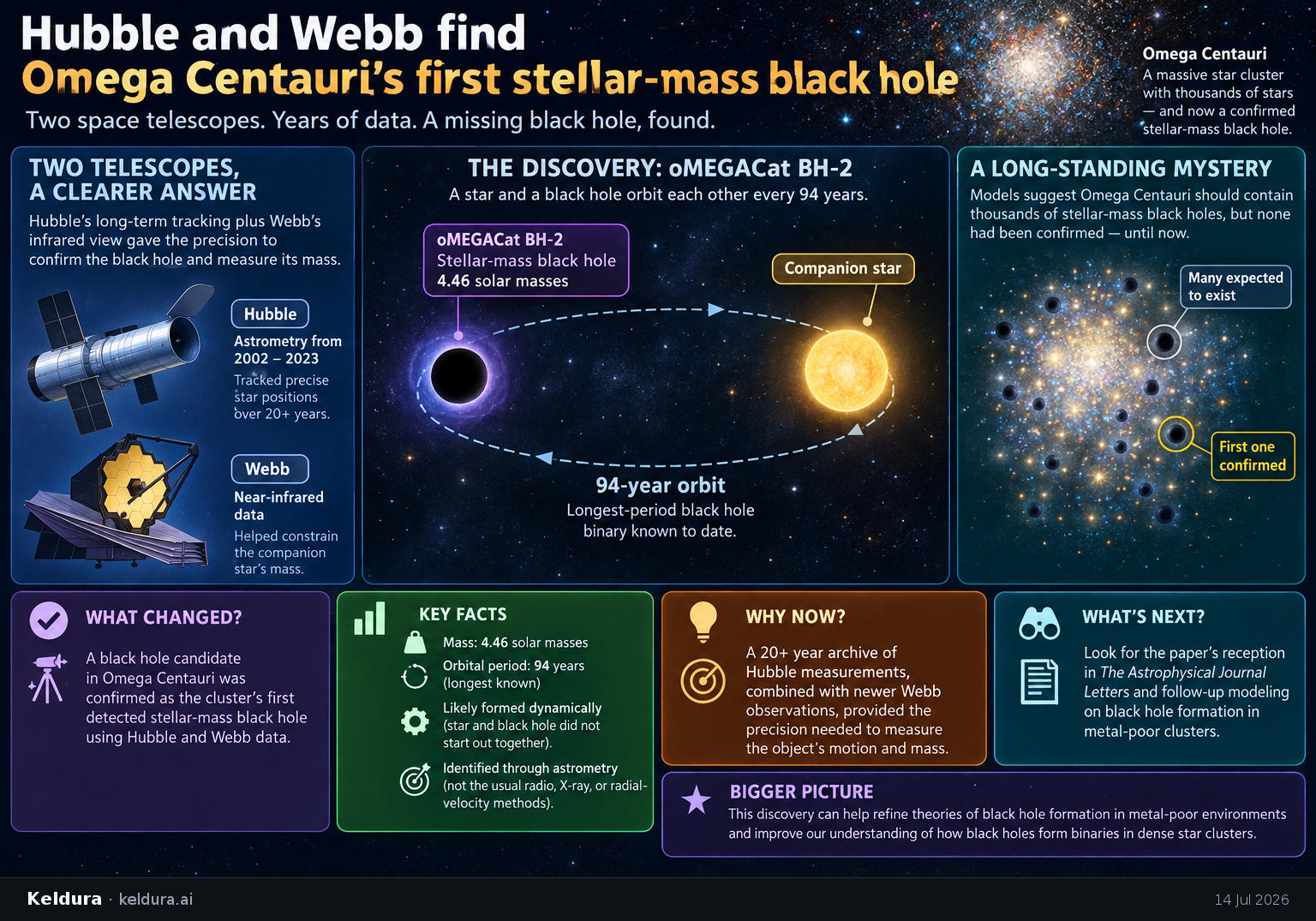
Cheatsheet for Hubble and Webb find Omega Centauri’s first stellar-mass black hole. Text equivalent is attached.

Science & Space

Hubble and Webb find Omega Centauri’s first stellar-mass black hole

Astronomers using more than 20 years of NASA Hubble Space Telescope archival data, plus recent James Webb Space Telescope observations, say they have identified the first stellar-mass black hole in Omega Centauri.

Why it matters: This is a notable step in resolving a long-standing gap in what scientists expected to find inside Omega Centauri, where models suggest thousands of stellar-mass black holes should exist. The result…

Open original · NASA News

Open cheatsheet →1 source Post to X

What changed
A black hole candidate in Omega Centauri was confirmed as the cluster’s first detected stellar-mass black hole using Hubble and Webb data [13].
Why now
A long archive of Hubble measurements plus newer Webb observations gave the precision needed to measure the object’s motion and mass [13].
Watch next
Look for the paper’s reception in The Astrophysical Journal Letters and any follow-up modeling on black hole formation in metal-poor clusters [13].
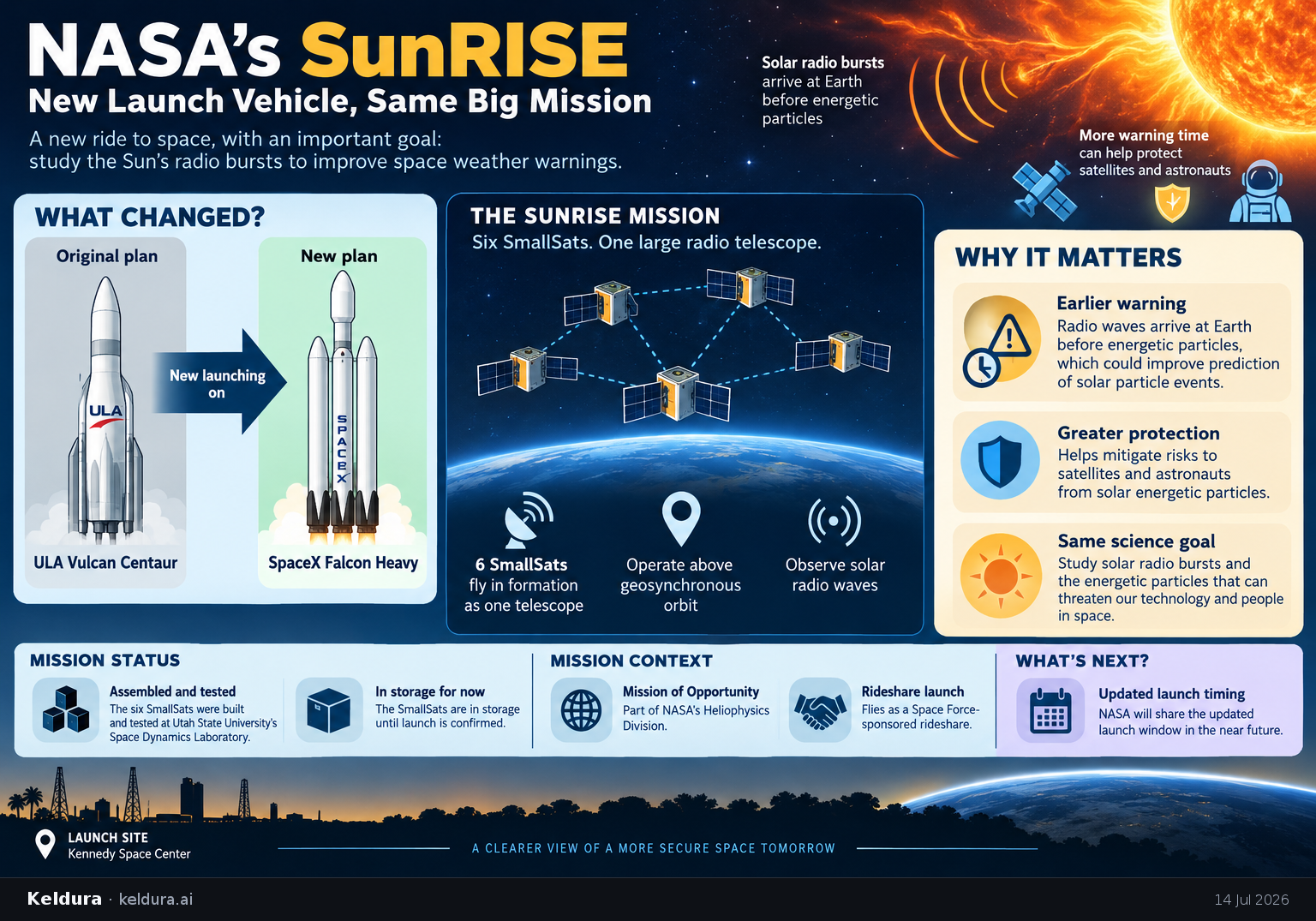
Cheatsheet for NASA changes SunRISE’s launch vehicle to Falcon Heavy. Text equivalent is attached.

Science & Space

NASA changes SunRISE’s launch vehicle to Falcon Heavy

NASA says its SunRISE mission will now launch on a SpaceX Falcon Heavy from Kennedy Space Center, replacing the originally planned United Launch Alliance Vulcan Centaur.

Why it matters: The launch-vehicle switch is a material mission change because it affects how and when SunRISE reaches orbit, while leaving the science goal intact. The mission is aimed at improving prediction and m…
Open original · NASA News

Open cheatsheet →1 source Post to X

What changed
SunRISE’s launch vehicle changed from ULA’s Vulcan Centaur to SpaceX Falcon Heavy [7].
Why now
NASA needed a new launch plan and says updated timing will be announced soon [7].
Watch next
Watch for NASA’s updated launch window and confirmation of launch-period storage-to-launch movement for the six SmallSats [7].

That's the desk. Every cheatsheet here started as a link. Yours can too.

Cheatsheet your own link — free