On August 12, astronomers proposed that an exceptionally bright JWST red dot is a black hole wrapped in a solar-system-sized gas cocoon.
Why it matters: If the interpretation holds, this previously unobserved configuration could help explain the numerous “little red dots” found in JWST imagery and clarify how massive black holes operated only a few h…
A Nature study proposed “black hole star” as a new astrophysical category based on JWST observations of MoM-BH*-1.[7][8]
Why now
JWST’s sensitivity exposed an early-universe source whose extreme brightness, red color and unusual spectrum resisted conventional stellar explanations.[7][8]
Watch next
Researchers can test the model by checking whether additional JWST little red dots share MoM-BH*-1’s hydrogen-rich spectrum, deep Balmer break and black-hole-scale energy output.[7][8]
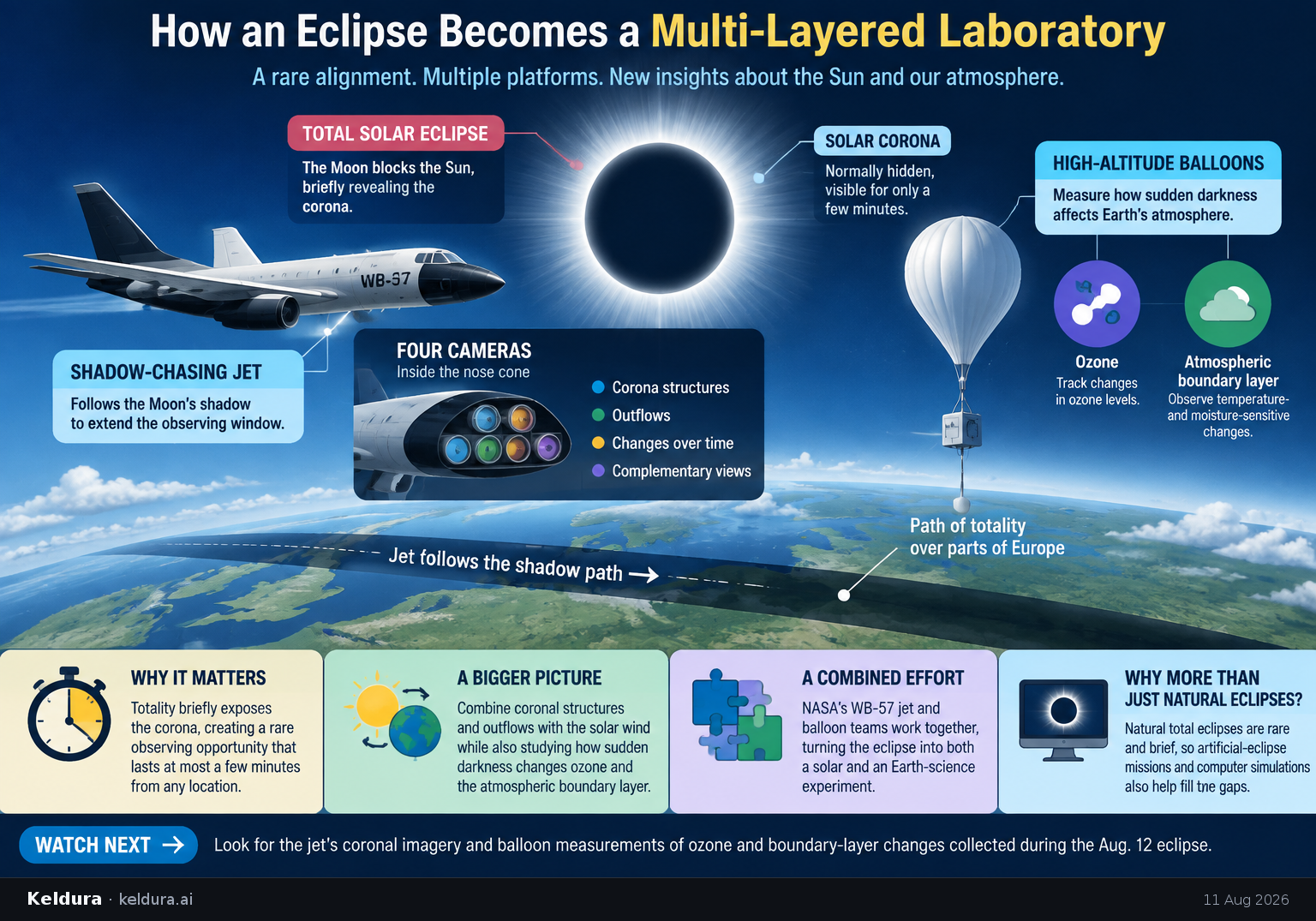
The eclipse over parts of Europe will briefly reveal the normally hidden solar corona, but natural totality lasts only a few minutes.
Why it matters: The combined campaign can connect coronal structures and outflows with the solar wind while examining how sudden darkness changes ozone and Earth’s temperature- and moisture-sensitive atmospheric bou…
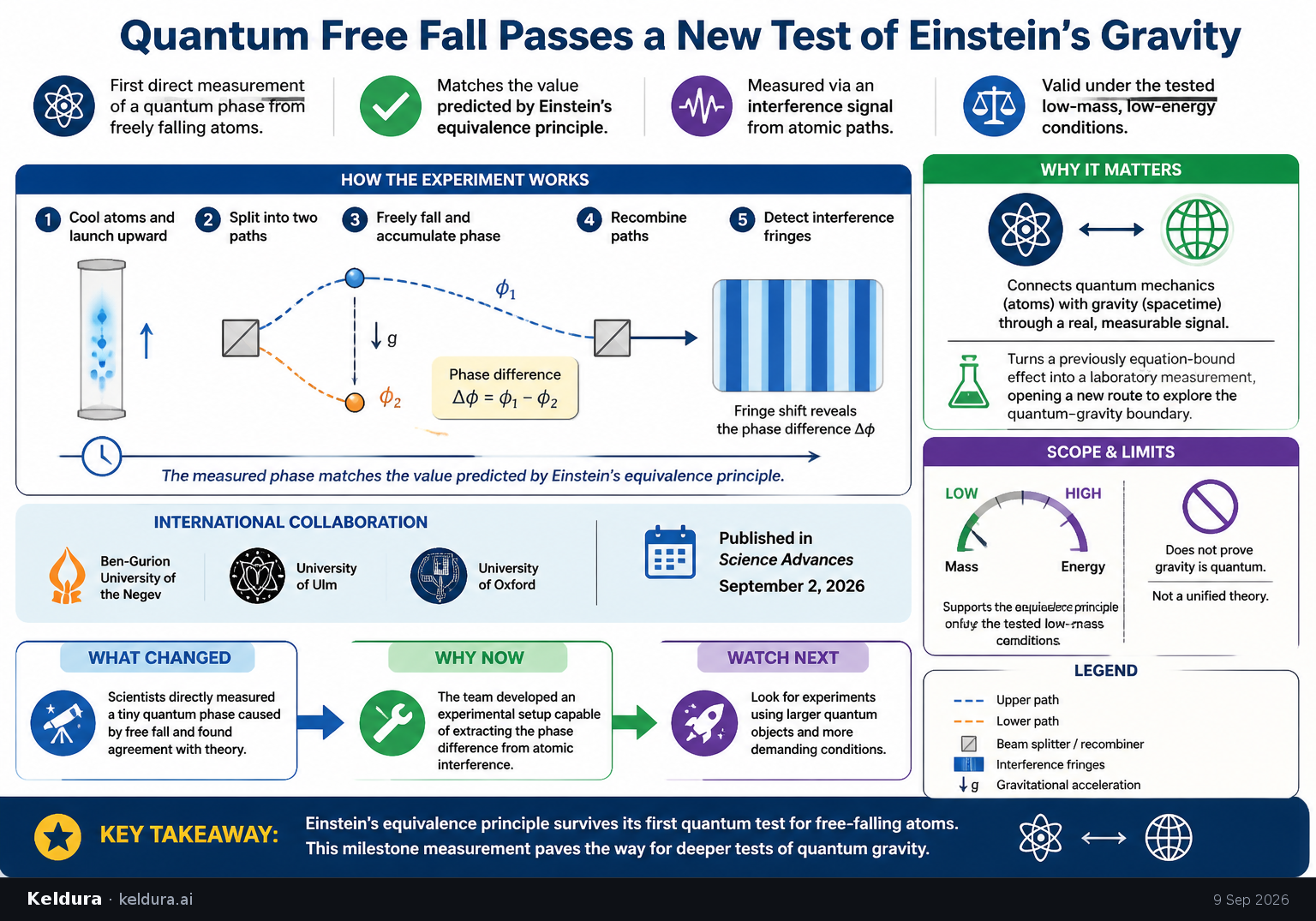
An international team measured a predicted quantum phase associated with freely falling atoms for the first time, and the result matched the value expected from Einstein’s equivalence principle.
Why it matters: The work turns a previously equation-bound effect into a measurable laboratory signal, creating a new experimental route for probing the boundary between quantum mechanics and gravity.
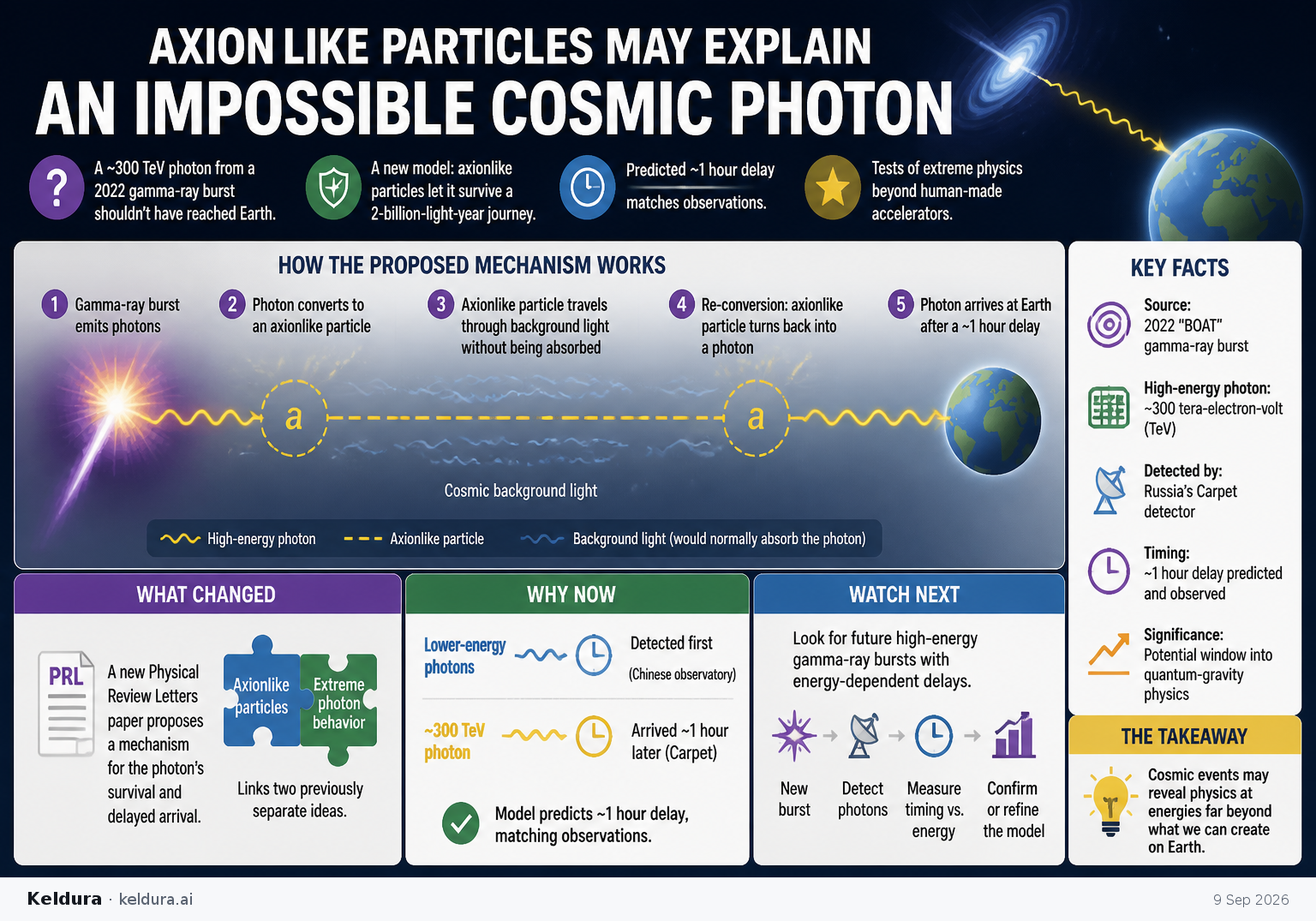
Physicists have proposed that hypothetical axionlike particles could explain how a roughly 300-tera-electron-volt photon from the 2022 “BOAT” gamma-ray burst survived a two-billion-light-year journey to Earth.
Why it matters: If future observations support the scenario, cosmic events could provide tests of quantum-gravity-related physics at energies far beyond those available in terrestrial accelerators.
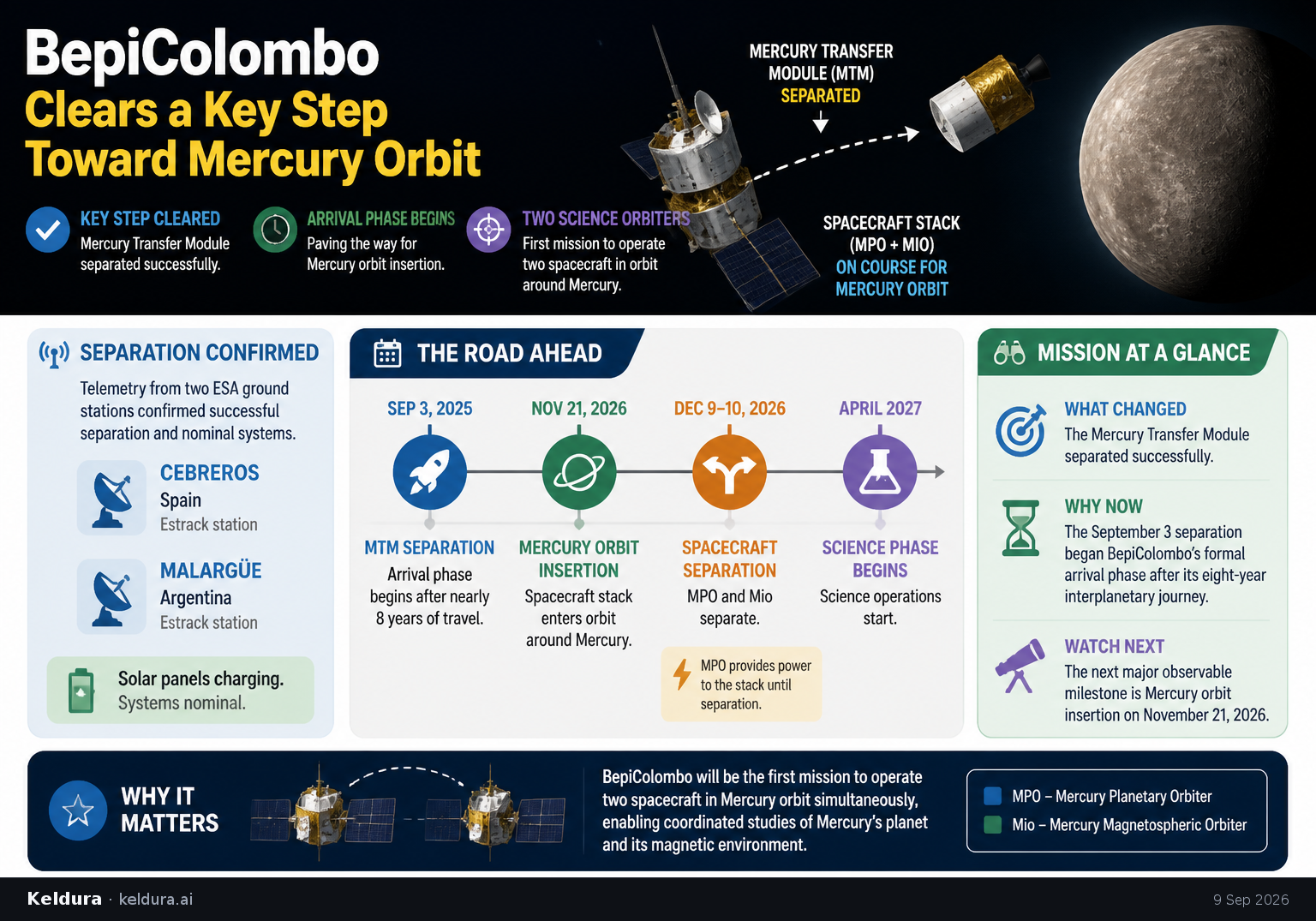
ESA confirmed that BepiColombo’s Mercury Transfer Module separated successfully after nearly eight years of travel through the inner Solar System, with telemetry indicating nominal systems and charging solar panels.
Why it matters: BepiColombo will be the first mission to operate two spacecraft in Mercury orbit simultaneously, enabling coordinated study by the Mercury Planetary Orbiter and Mercury Magnetospheric Orbiter.
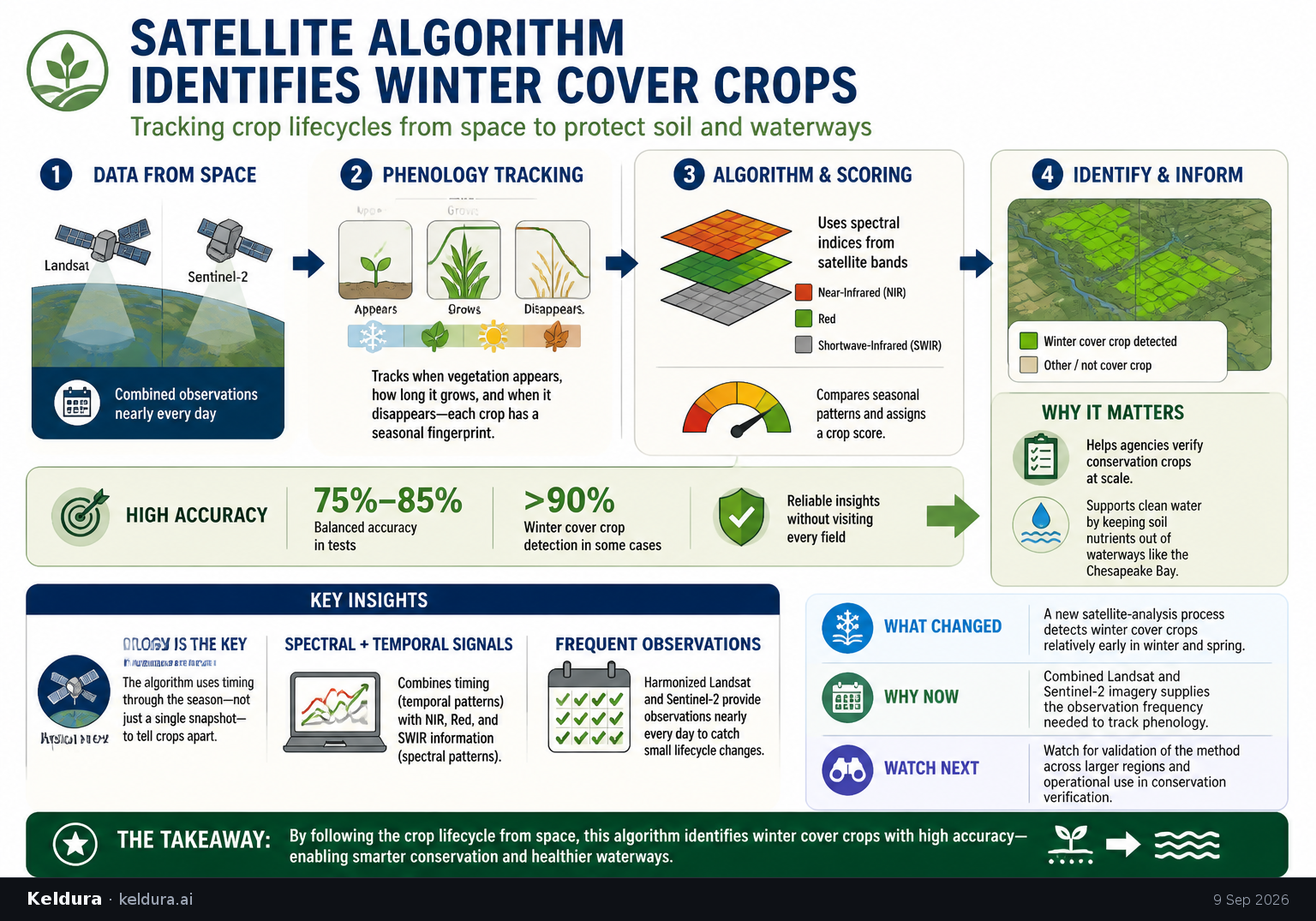
Researchers developed a phenology-based method that combines Harmonized Landsat and Sentinel-2 imagery with field observations and planting records to identify crops remotely.
Why it matters: If deployed at scale, the method could help agencies verify conservation crops without visiting every field and assess practices intended to keep soil nutrients from entering waterways such as the Ch…
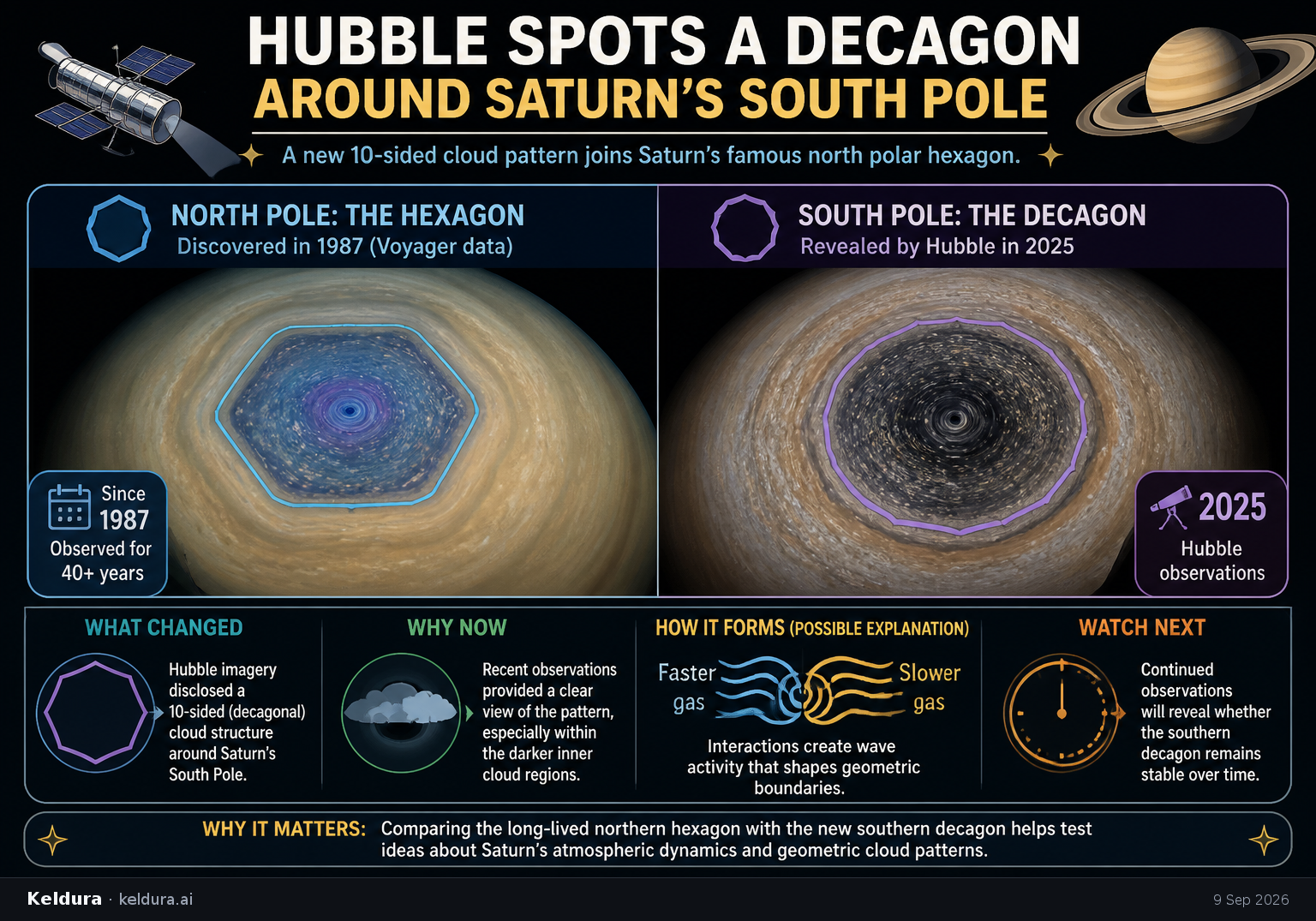
Recent Hubble observations revealed a 10-sided cloud pattern around Saturn’s South Pole, contrasting with the long-known hexagon surrounding its North Pole.
Why it matters: The northern hexagon has remained stable for more than 40 years, making continued observation of the southern decagon useful for determining whether it is similarly persistent and for testing explana…
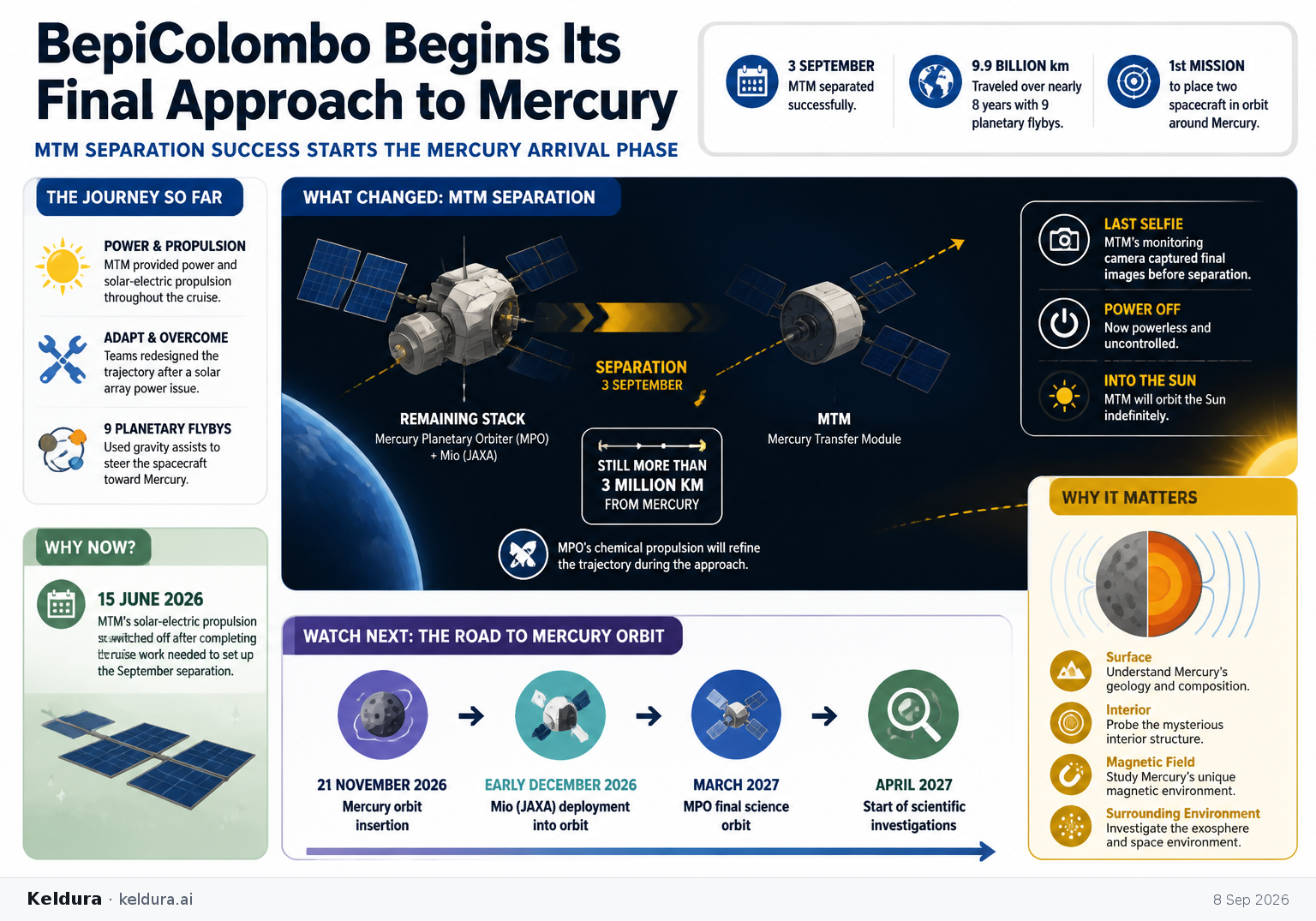
BepiColombo’s Mercury Transfer Module successfully separated from the spacecraft stack on 3 September after nearly eight years, 9.9 billion kilometres and nine planetary flybys.
Why it matters: BepiColombo is designed to become the first mission to place two spacecraft in orbit around Mercury, enabling complementary investigations of the planet’s surface, interior, magnetic field and surrou…
MTM separated successfully, ending its transport role and starting BepiColombo’s Mercury arrival phase.[2][3]
Why now
MTM’s solar-electric propulsion was switched off on 15 June 2026 after completing the cruise work needed to set up the September separation.[3]
Watch next
Mercury orbit insertion is scheduled for 21 November, followed by Mio’s deployment in early December, MPO’s final science orbit in March 2027 and scientific investigations from April 2027.[3]
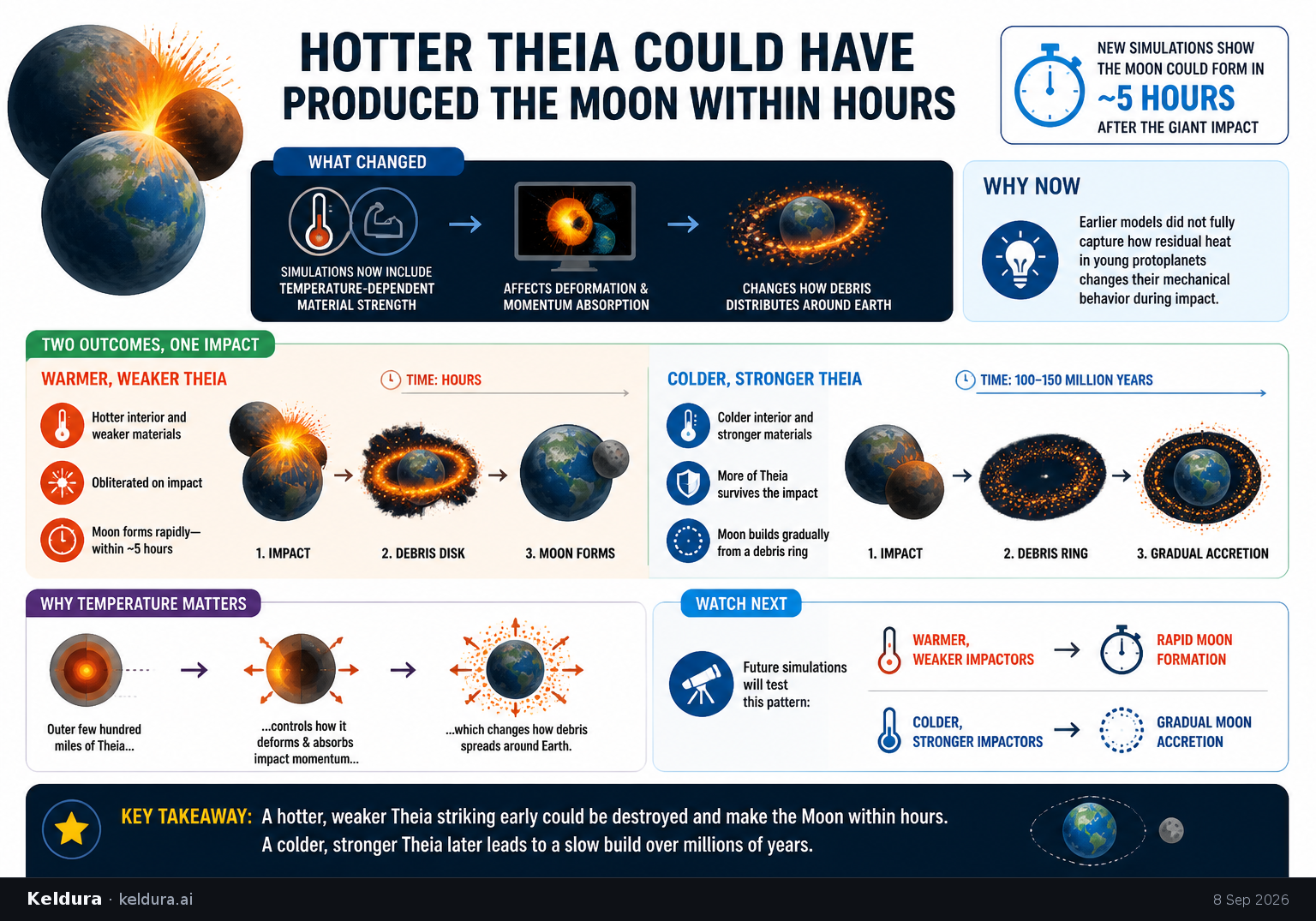
New collision simulations indicate that the Moon could have formed within roughly five hours after a giant impact between the young Earth and the Mars-size protoplanet Theia.
Why it matters: The results potentially strengthen the rapid-formation version of the leading giant-impact hypothesis and show that the thermal state of young worlds can substantially change simulated planetary coll…
Detailed simulations that include temperature-dependent material strength lend support to a Moon forming in hours rather than through prolonged accretion.[1]
Why now
Earlier models did not fully capture how the residual heat of recently formed protoplanets changed their mechanical behavior during the impact.[1]
Watch next
Further model results can be assessed by whether warmer, weaker impactors continue to produce rapid formation while colder, stronger impactors yield gradual accretion.[1]
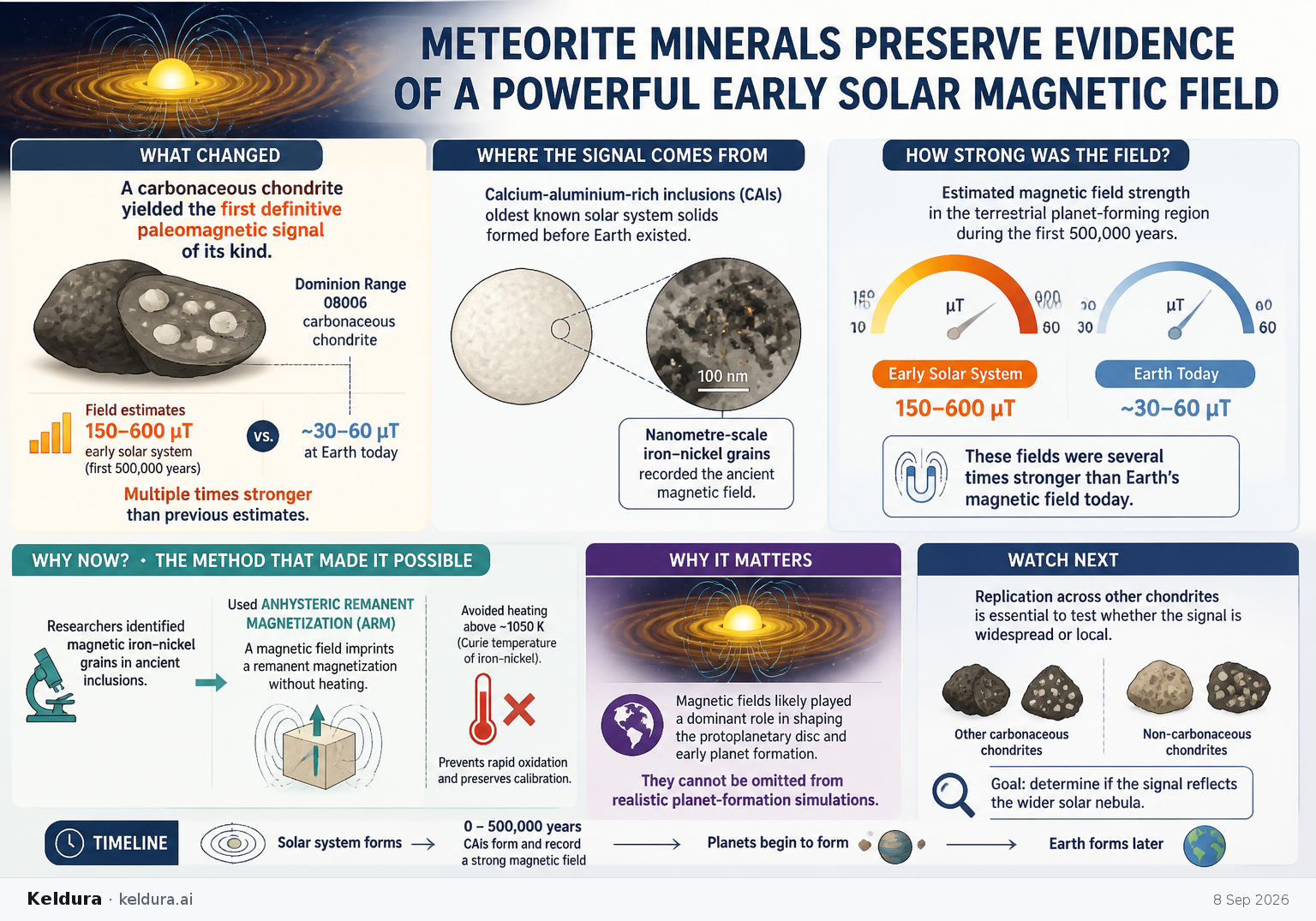
Why it matters: The measurements suggest magnetic fields cannot be omitted from realistic planet-formation simulations and may have been a dominant influence on the evolution of the protoplanetary disc.
A carbonaceous chondrite yielded the first definitive paleomagnetic signal of its kind and field estimates multiple times higher than previous estimates.[4]
Why now
Researchers identified magnetic iron-nickel grains in ancient inclusions and applied a method that avoided damaging laboratory heating.[4]
Watch next
The team is examining other carbonaceous and non-carbonaceous chondrites to test whether the signal is reproducible and reflects the wider solar nebula rather than a localized record.[4]
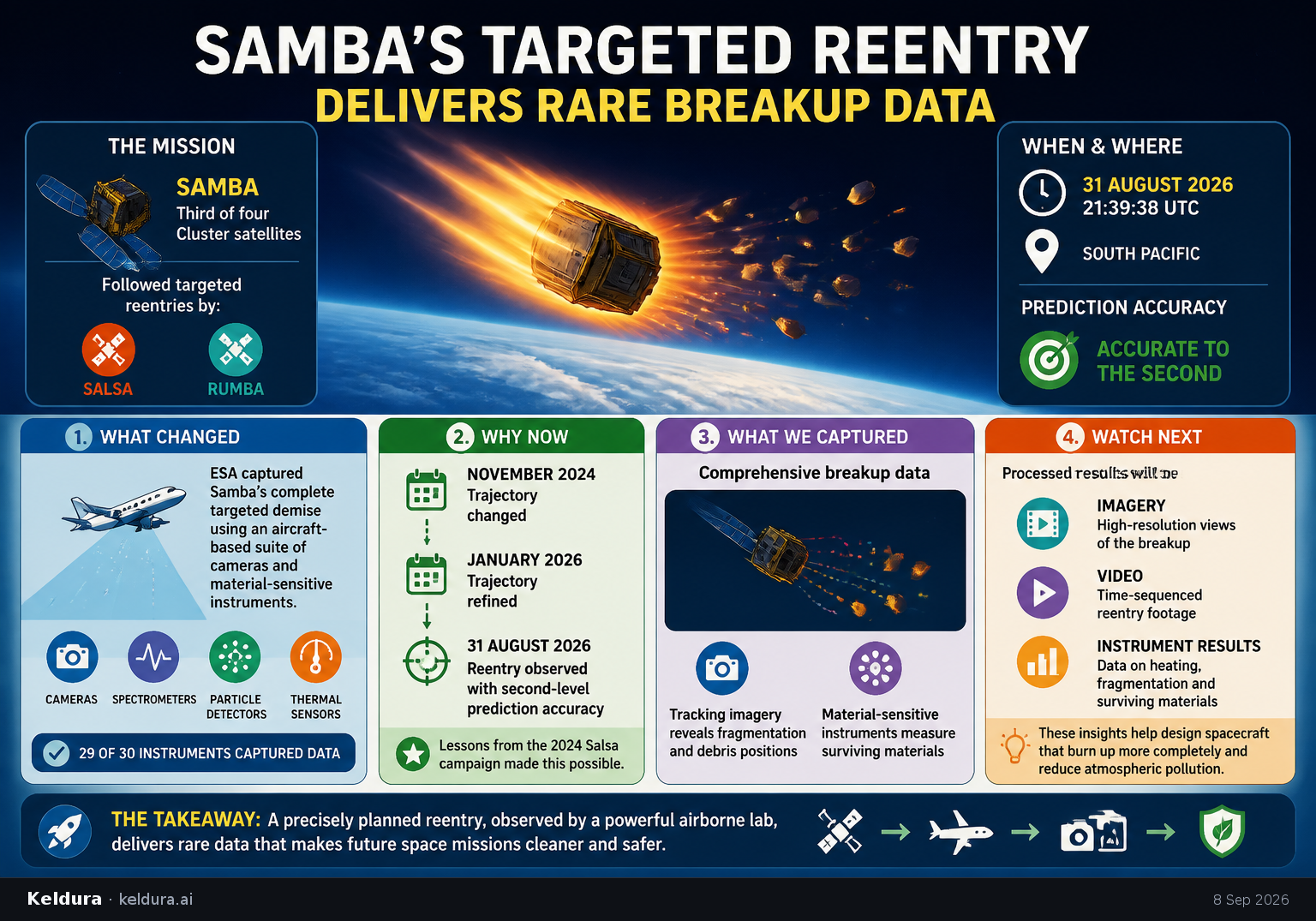
ESA’s Samba satellite reentered over the South Pacific at 21:39:38 UTC on 31 August 2026 after controllers adjusted its trajectory to support a safe, closely observed descent.
Why it matters: Measurements of how satellites heat, fragment and shed surviving materials can help engineers create spacecraft that burn up more completely while reducing atmospheric pollution.
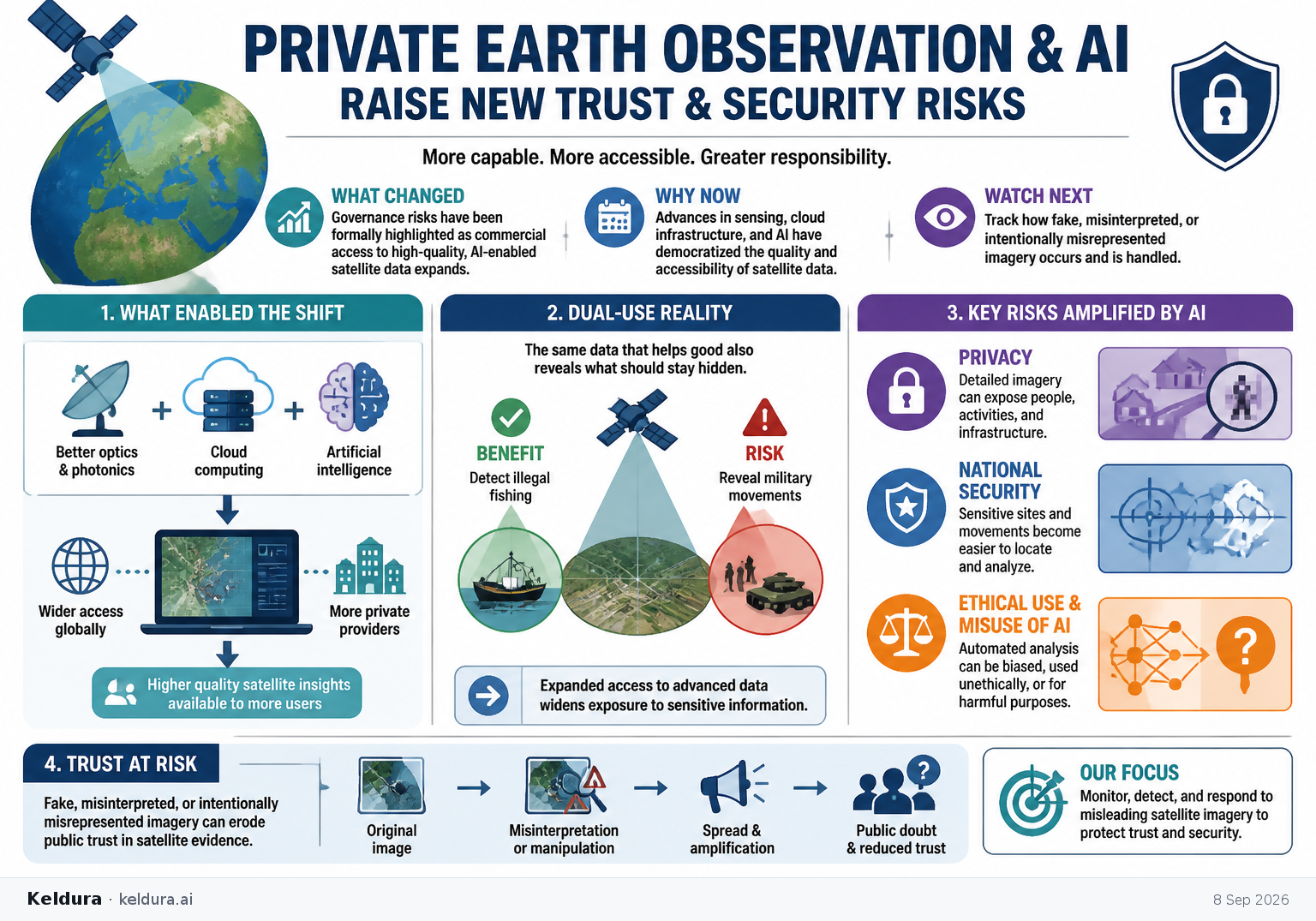
An OECD report says improvements in optics, photonics, cloud computing and artificial intelligence have expanded the quality and accessibility of satellite Earth-observation data.
Why it matters: Earth observation is inherently dual-use: systems that identify illegal fishing can also reveal military troop movements, widening access to strategically sensitive information.