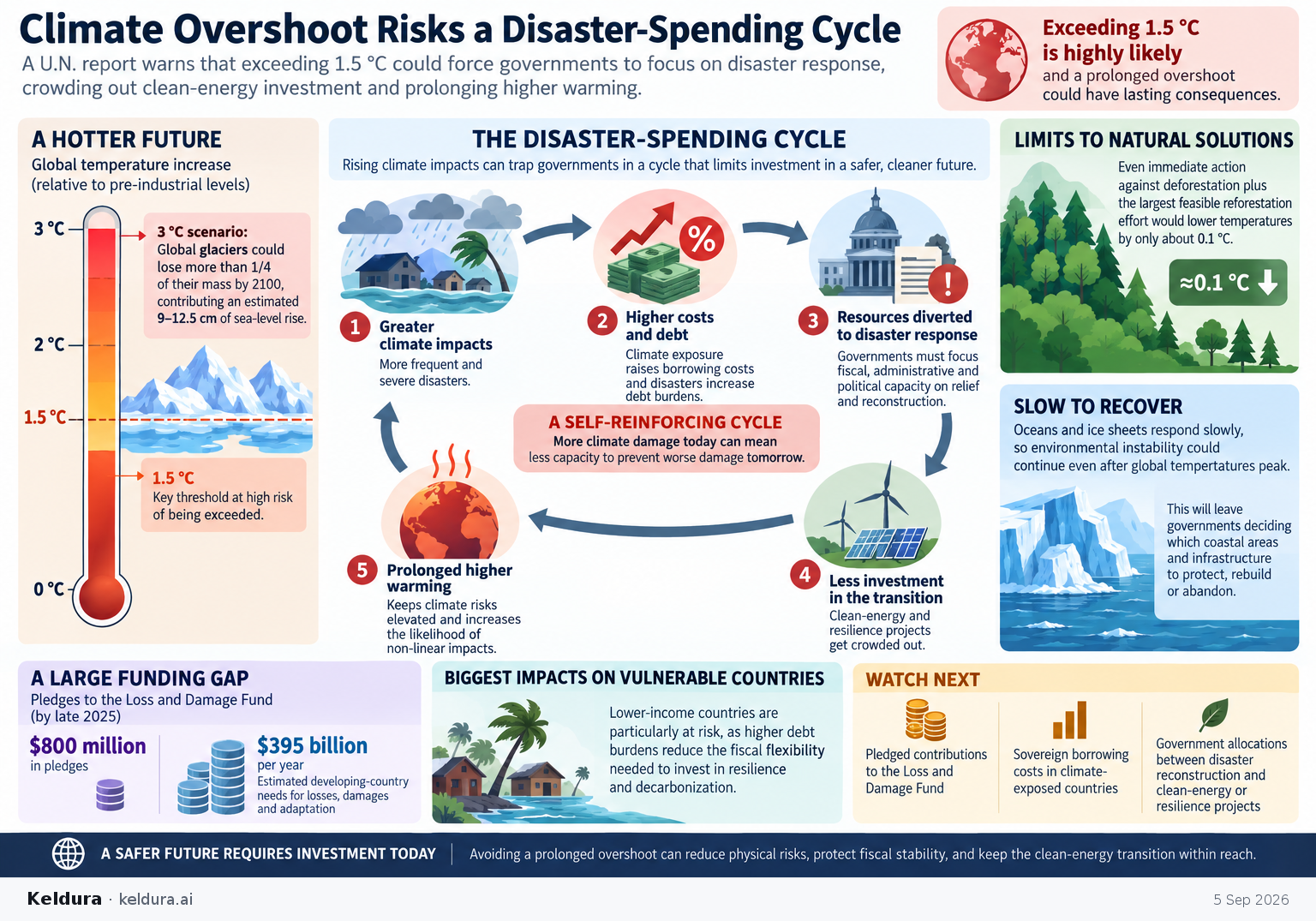
Why it matters: A return below 1.5°C would not reverse all damage incurred during an overshoot, so every fraction of a degree avoided and every year removed from the breach would reduce exposure to long-lasting or i…
Nepal has requested immediate support from the UN climate loss and damage fund after catastrophic floods killed 1,250 people and left an estimated recovery bill of at least US$5 billion.
Why it matters: Nepal’s needs dwarf the fund’s available resources, making the request an early test of whether the international climate-finance system can deliver timely assistance at the scale required after a ma…
Divers and scientists report that soft corals around Jeju are again sagging, collapsing and dying after two years of rising temperatures and harsher weather.
Why it matters: Jeju’s soft corals provide nursery habitat supporting the local marine ecosystem and occupy the northern edge of coral distribution in the East China Sea, making their condition a sensitive indicator…
Nepal has requested immediate support from the UN climate loss and damage fund after floods killed 1,250 people and left an estimated recovery bill of at least US$5 billion.
Why it matters: Nepal’s needs vastly exceed the fund’s available resources, exposing the gap between international climate-finance commitments and the rapid, large-scale assistance vulnerable countries require after…
Nepal sought an urgent payout from the UN loss and damage fund following catastrophic floods and an estimated US$5 billion recovery bill.[1]
Why now
The disaster killed 1,250 people, while climate-linked events such as glacial-lake floods have become more frequent in recent decades.[1]
Watch next
Watch whether the fund convenes before its scheduled December meeting, how much paid financing becomes available, and what climate-finance commitments emerge at COP31 in November.[1]
Forest and peatland fires across Indonesian Borneo have overwhelmed firefighters and generated hazardous haze, with West Kalimantan enduring more than two months without rain amid a powerful El Niño.
Why it matters: The fires have become a cross-border public-health crisis: Indonesia has reported tens of thousands of associated respiratory infections, while Greenpeace estimates that 35 million people nationally…
Divers and scientists say the slumping of soft corals has returned around South Korea’s Jeju island after the phenomenon was first scientifically documented there in 2024.
Why it matters: Jeju’s soft corals serve as nursery habitat and form a foundational part of the marine ecosystem within the UNESCO-listed Jeju Island Biosphere Reserve. Their decline could therefore affect wider mar…
Jeju’s monitored soft-coral communities are exhibiting another slumping event similar to the collapse documented in 2024.[3][6]
Why now
South Korea has experienced a record heatwave and heavy southern rainfall, while prolonged marine heat and changing salinity are being examined as possible triggers.[3][6]
Watch next
Watch September water temperatures, the Oceans Ministry’s damage assessment and quantitative monitoring of coral losses.[3][6]
Why it matters: The proposal could accelerate development across a 23-million-acre Arctic reserve that contains sought-after oil formations but also supports caribou, migratory birds, subsistence activities in Nativ…
Fires burning across Borneo and Sumatra have blanketed parts of Indonesia in thick smog and sent hazardous smoke toward Malaysia, Singapore and the Philippines.
Why it matters: The emergency has become a regional public-health and education crisis: respiratory problems have increased, air quality reached unhealthy or worse levels across multiple countries, and large numbers…
A University of Washington-led analysis found that the Arctic sea-ice melt season has lengthened by about 7.5 days since 1979, mainly because ice now forms later in autumn.
Why it matters: Longer periods of open water amplify warming because dark ocean reflects only about 7% of incoming sunlight, compared with roughly 60% to 90% for bright sea ice; the absorbed heat delays freezing and…
The Arctic melt season is about 7.5 days longer than in 1979, primarily because autumn freeze-up occurs later [2].
Why now
A new review covering roughly five decades of observations assessed not only sea-ice extent but also its thickness, age, structure and snow cover [2].
Watch next
Track the timing of autumn ice formation alongside measurements of perennial-ice thickness and snow cover during forthcoming coordinated polar observations [2].
A new U.N. Environment Programme report says humanity is highly likely to exceed the 1.5-degree Celsius warming threshold.
Why it matters: The report identifies a self-reinforcing risk: more climate damage can increase debt and borrowing costs, weaken governments’ fiscal flexibility and delay decarbonization, thereby prolonging elevated…
UNEP has framed warming overshoot as both a physical climate threat and a fiscal risk capable of delaying the energy transition [4].
Why now
The report says exceeding 1.5 degrees Celsius is highly likely and warns that sustained breaches carry greater, potentially non-linear risks [4].
Watch next
Monitor Loss and Damage Fund contributions, climate-exposed countries’ borrowing costs, and government spending shifts between disaster reconstruction and clean-energy or resilience projects [4].
Canada’s latest federal climate assessment says the country will be about 2.7 C warmer than pre-industrial levels by 2050, close to twice the global average over that period.
Why it matters: The assessment strengthens the economic case for adaptation: Canadian Climate Institute analysis cited alongside the report estimates that every dollar invested in preparing infrastructure, communiti…
The federal government released a second national climate-impact assessment projecting about 2.7 C of warming by 2050 and at least 3.5 C by century’s end under a best-case emissions pathway. [1]
Why now
The assessment was posted ahead of the Labour Day weekend as environmental groups criticized both the low-profile release and the government’s climate record. [1]
Watch next
Watch for federal and provincial adaptation spending on infrastructure and community protection against floods, heat, heavy rain, drought and wildfire. [1]
Why it matters: The report identifies a financial feedback loop in which climate exposure raises borrowing costs, disasters increase debt burdens and governments—particularly in lower-income countries—lose the fisca…
UNEP has framed prolonged temperature overshoot as both a physical climate threat and a fiscal risk that could impede the energy transition. [2]
Why now
The report says exceeding 1.5 C is highly likely while existing international support remains far below developing countries’ estimated loss, damage and adaptation needs. [2]
Watch next
Watch pledged contributions to the Loss and Damage Fund, sovereign borrowing costs in climate-exposed countries, and government allocations between disaster reconstruction and clean-energy or resilience projects. [2]
That's the desk. Every cheatsheet here started as a link. Yours can too.