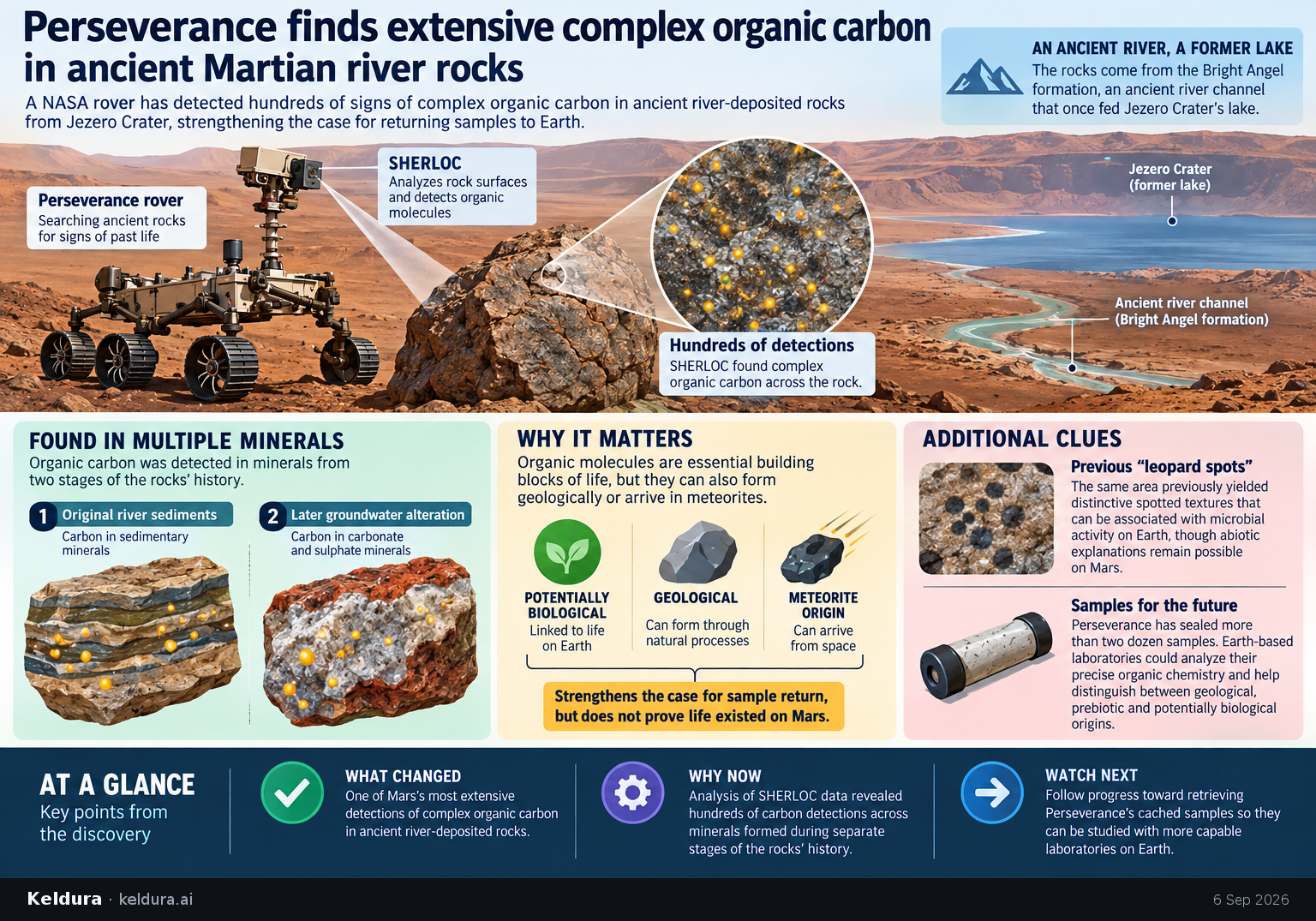
Scientists have confirmed hundreds of detections of macromolecular carbon in two mudstones from the Bright Angel formation, an ancient river channel that once fed Jezero Crater’s lake.
Why it matters: Organic molecules are essential building blocks of life but can also form geologically or arrive in meteorites, so the result strengthens the case for returning Perseverance’s samples to Earth withou…
Researchers confirmed one of Mars’s most extensive detections of complex organic carbon in ancient river-deposited rocks.[2]
Why now
Analysis of SHERLOC observations revealed hundreds of carbon detections distributed across minerals formed during separate stages of the rocks’ history.[2]
Watch next
Watch progress toward retrieving Perseverance’s cached samples, because Earth-based analysis could distinguish geological, prebiotic and potentially biological origins more precisely.[2]
Isar Aerospace’s 28-metre Spectrum rocket reached orbit after launching from Andøya Spaceport in Norway on 5 September, marking the first orbital launch from continental Europe.
Why it matters: The milestone gives Europe a potential route toward launching civilian and military satellites from its own territory, reducing dependence on US providers and Russia’s discontinued Soyuz access while…
NASA’s Innovative Advanced Concepts program has awarded Phase 1 funding to Interworld Slingshot Resource Surveys, a concept for bringing “Landsat-style mineral intelligence” to destinations beyond Earth.
Why it matters: A reusable approach to mapping resources across several worlds could improve advance knowledge of potential landing sites and accessible minerals, although the project remains an early-stage concept…
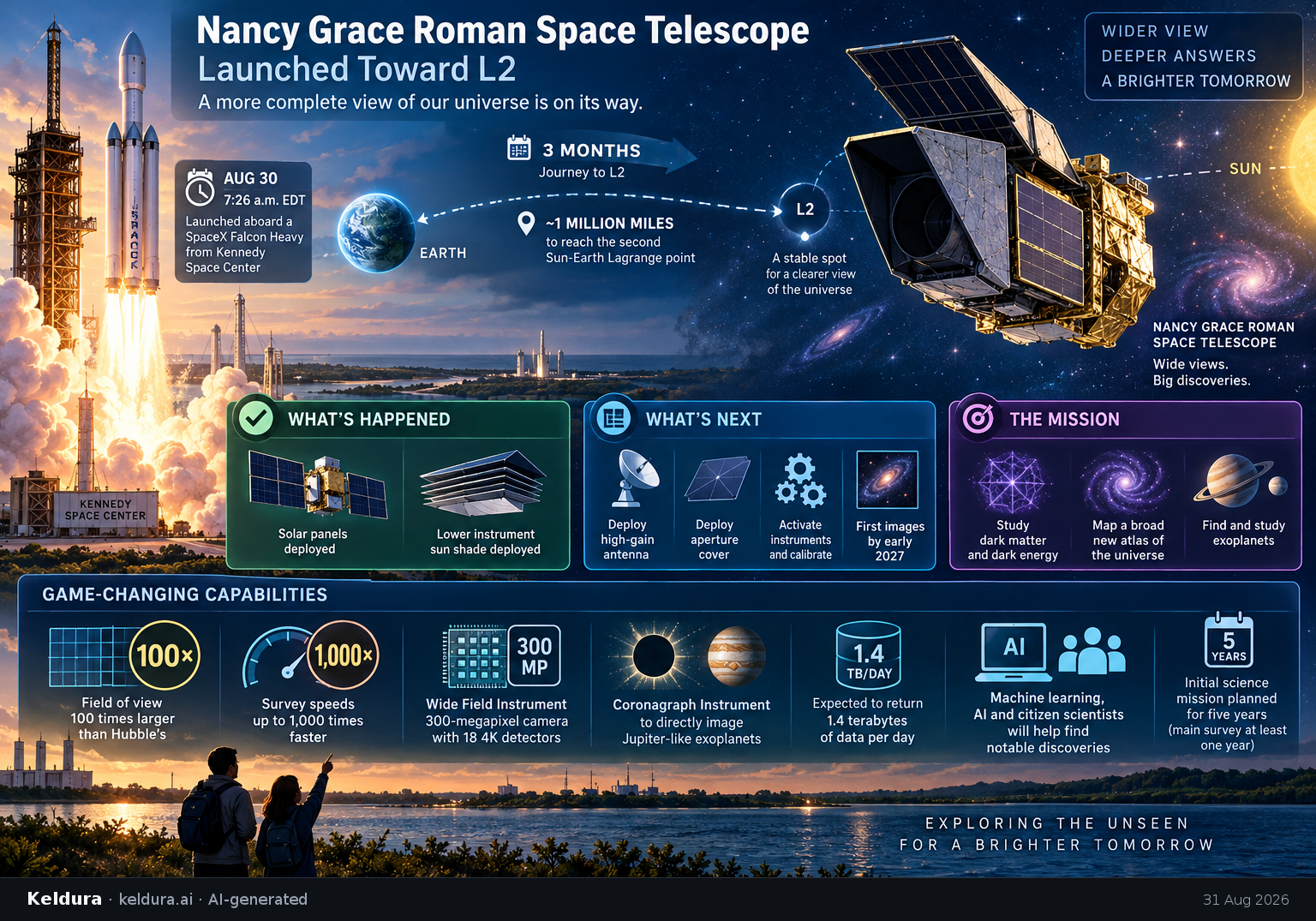
NASA’s Nancy Grace Roman Space Telescope launched aboard a SpaceX Falcon Heavy from Kennedy Space Center at 7:26 a.m.
Why it matters: Roman combines a field of view 100 times larger than Hubble’s with survey speeds up to 1,000 times faster, enabling large-scale studies that complement the narrower views of Hubble and the James Webb…
Roman successfully launched, and NASA confirmed deployment of its solar panels and lower instrument sun shade. [1][5]
Why now
The launch begins a three-month transit and commissioning period involving additional deployments, instrument activation, calibration and two mid-course corrections. [1]
Watch next
Near-term indicators are deployment of the high-gain antenna and aperture cover, activation of the Coronagraph and Wide Field Instrument, and NASA’s planned release of the first images by early 2027. [1][5]
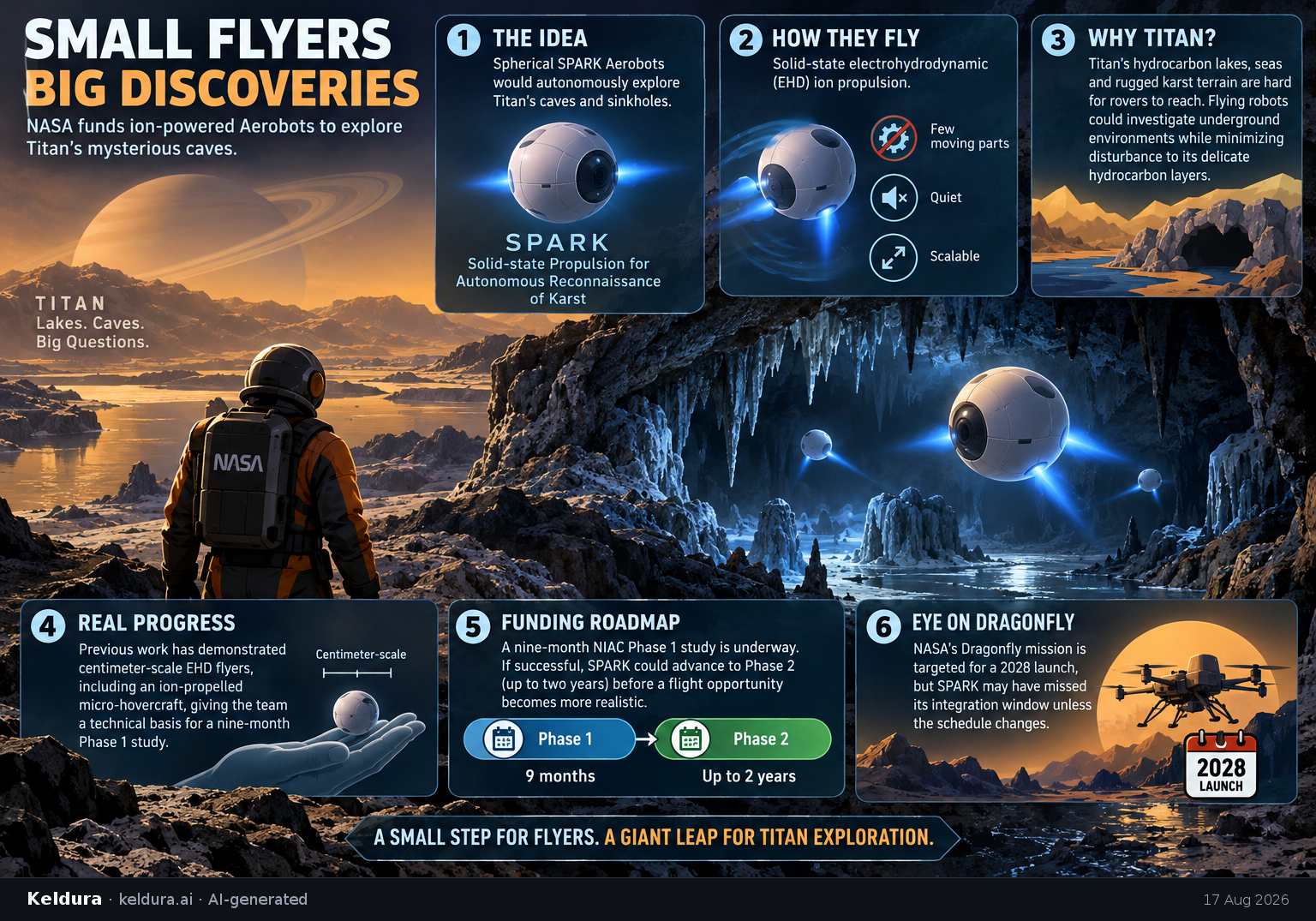
A nine-month Phase 1 grant from NASA Innovative Advanced Concepts will study SPARK, a concept for small spherical flying robots designed to explore Titan’s caves and sinkholes.
Why it matters: Titan’s hydrocarbon lakes, seas and rugged karst terrain are difficult for conventional rovers, so maneuverable flying robots could provide a way to investigate scientifically valuable underground en…
NASA awarded early-stage NIAC funding to study spherical SPARK Aerobots for autonomous reconnaissance of Titan’s caves.[1]
Why now
Prior work has demonstrated centimeter-scale EHD flyers, including an ion-propelled micro-hovercraft, giving the team a technical basis for the nine-month Phase 1 study.[1]
Watch next
Track whether SPARK completes Phase 1 and advances to the up-to-two-year Phase 2, as well as whether Dragonfly’s targeted 2028 launch schedule changes.[1]
The Institute of Geology, Chinese Academy of Geological Sciences unveiled an updated 1:5 million-scale lunar map on Aug.
Why it matters: The initiative shows that competition in lunar and deep-space exploration extends beyond missions to control over technical conventions, intellectual-property frameworks and standards adopted for map…
Chinese researchers released a revised global lunar map with new geologic boundaries and a proprietary cartographic standard.[2]
Why now
Renewed lunar exploration has made technical standards—including mapping and lunar timekeeping—another arena of competition between China and the United States.[2]
Watch next
Observe whether China applies the map’s color scheme, geologic logic and age-based shading standard to maps produced for future planetary missions.[2]
ESA’s second day at ILA Berlin International Airshow 2026 centered on Europe’s priorities in space, including exploration, cybersecurity and the future of the European space sector.
Why it matters: This matters because ESA is clearly linking space policy to Europe’s security, competitiveness and sovereignty, not just to scientific exploration. The focus on autonomy, launch access and secure com…
ESA used ILA 2026 to present AI, security, launch access and astronaut science as one connected European space agenda [1].
Why now
European leaders are explicitly discussing autonomy, resilience and sovereignty as space-sector priorities amid shifting geopolitical and market conditions [1].
Watch next
Look for follow-up on ESA’s AI deployments, launcher ecosystem policy, and any announced cooperation or funding tied to secure connectivity and launch access [1].
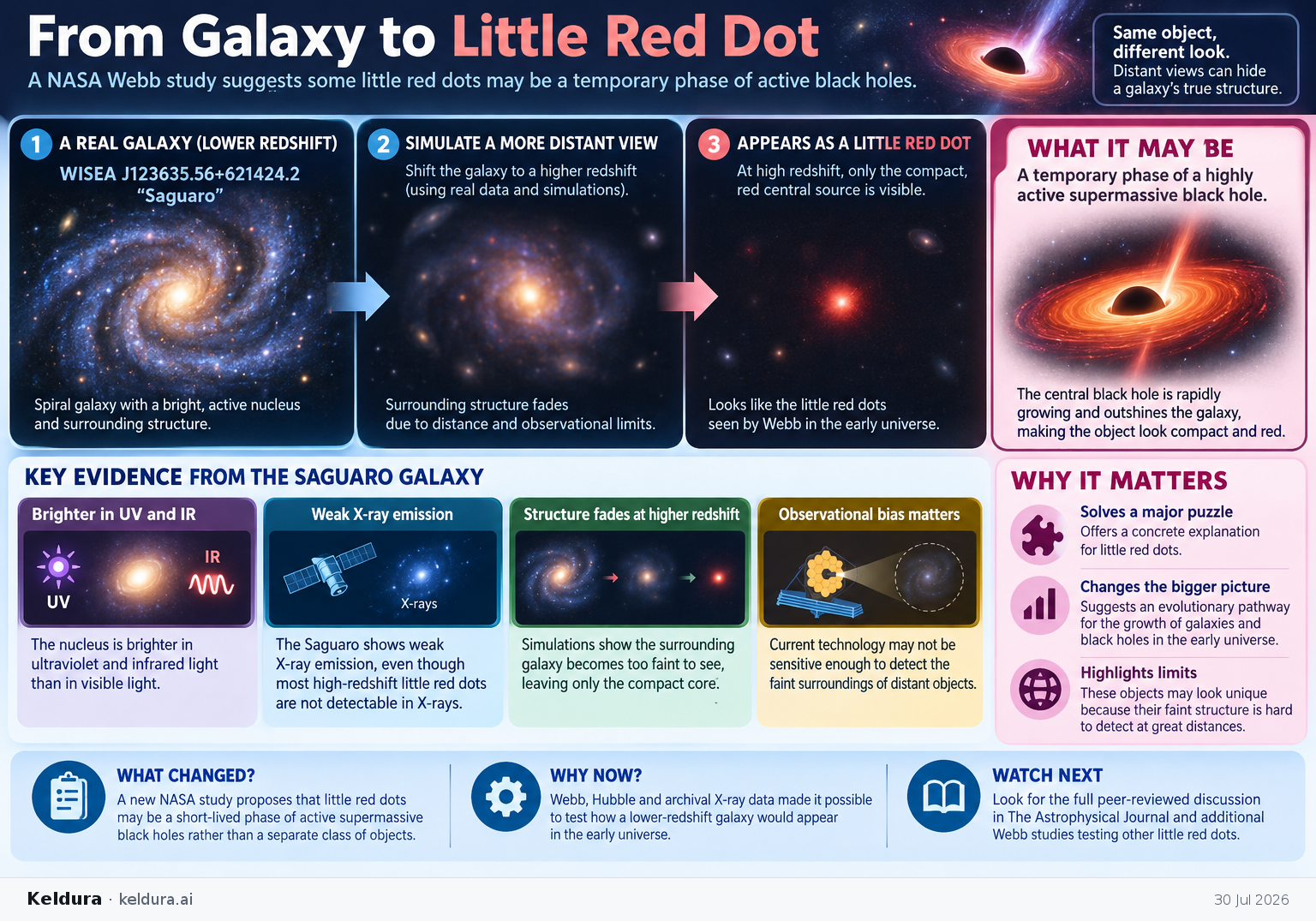
NASA scientists reported a new interpretation of little red dots, based on the spiral galaxy WISEA J123635.56+621424.2, nicknamed the “Saguaro”.
Why it matters: This matters because little red dots have been a major Webb-era puzzle, and the new work offers a concrete evolutionary pathway for objects seen in the early universe. If the interpretation holds, it…
NASA released a Webb-based study proposing that little red dots may be a short-lived phase of active supermassive black holes rather than a wholly separate class [5][6][7].
Why now
Webb, Hubble and archival X-ray data made it possible to test how a lower-redshift galaxy would appear if observed in the early universe [5][6][7].
Watch next
Look for the full peer-reviewed discussion in The Astrophysical Journal and any additional Webb studies testing whether other little red dots show the same hidden-structure pattern [5].
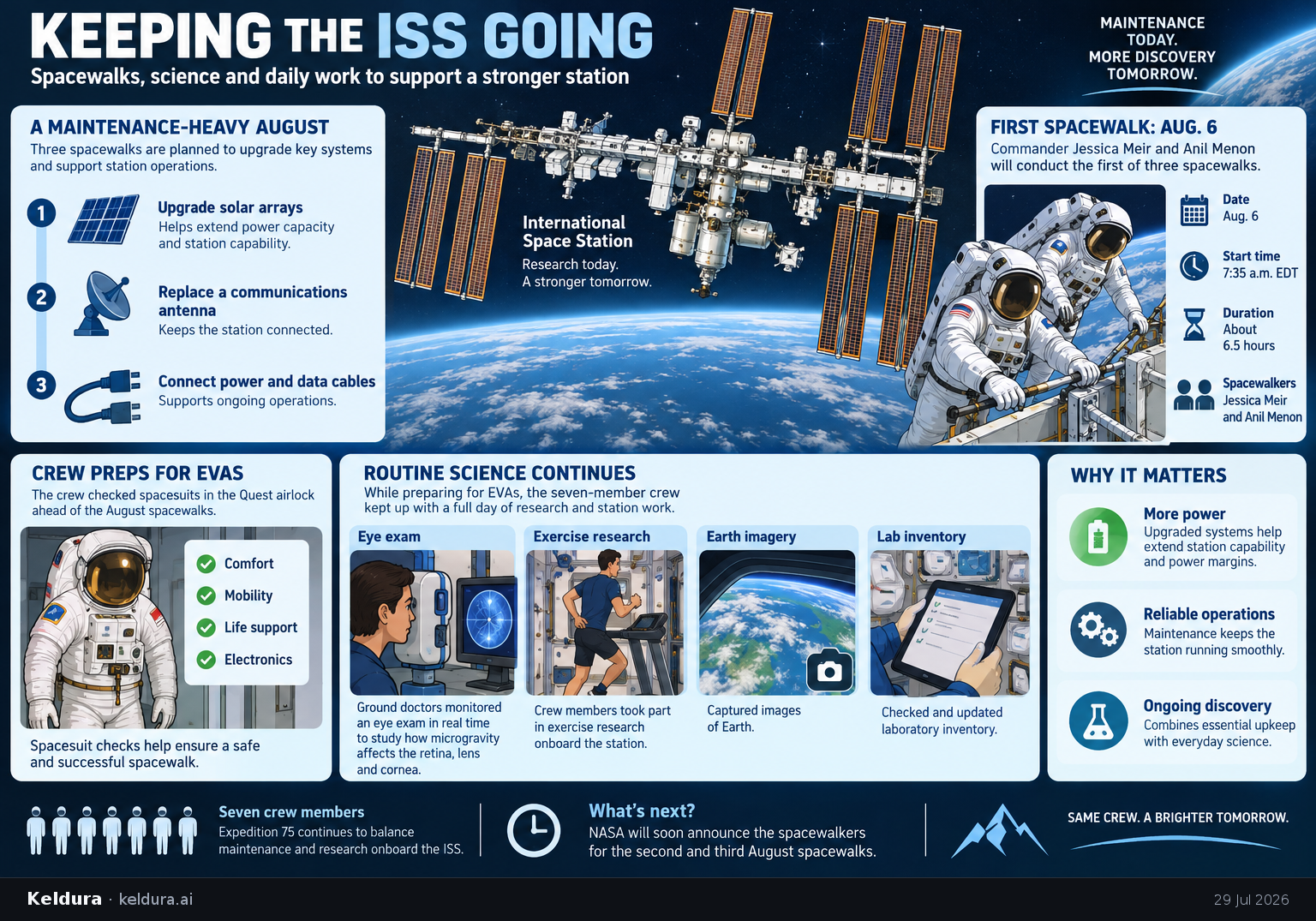
NASA says the seven-member Expedition 75 crew spent Tuesday on spacesuit checks, eye exams, exercise research, Earth imagery, and lab inventory aboard the International Space Station.
Why it matters: The station is entering a maintenance-heavy period that combines operational upkeep with research, showing how human spaceflight depends on both scheduled EVAs and daily onboard science. The work on…
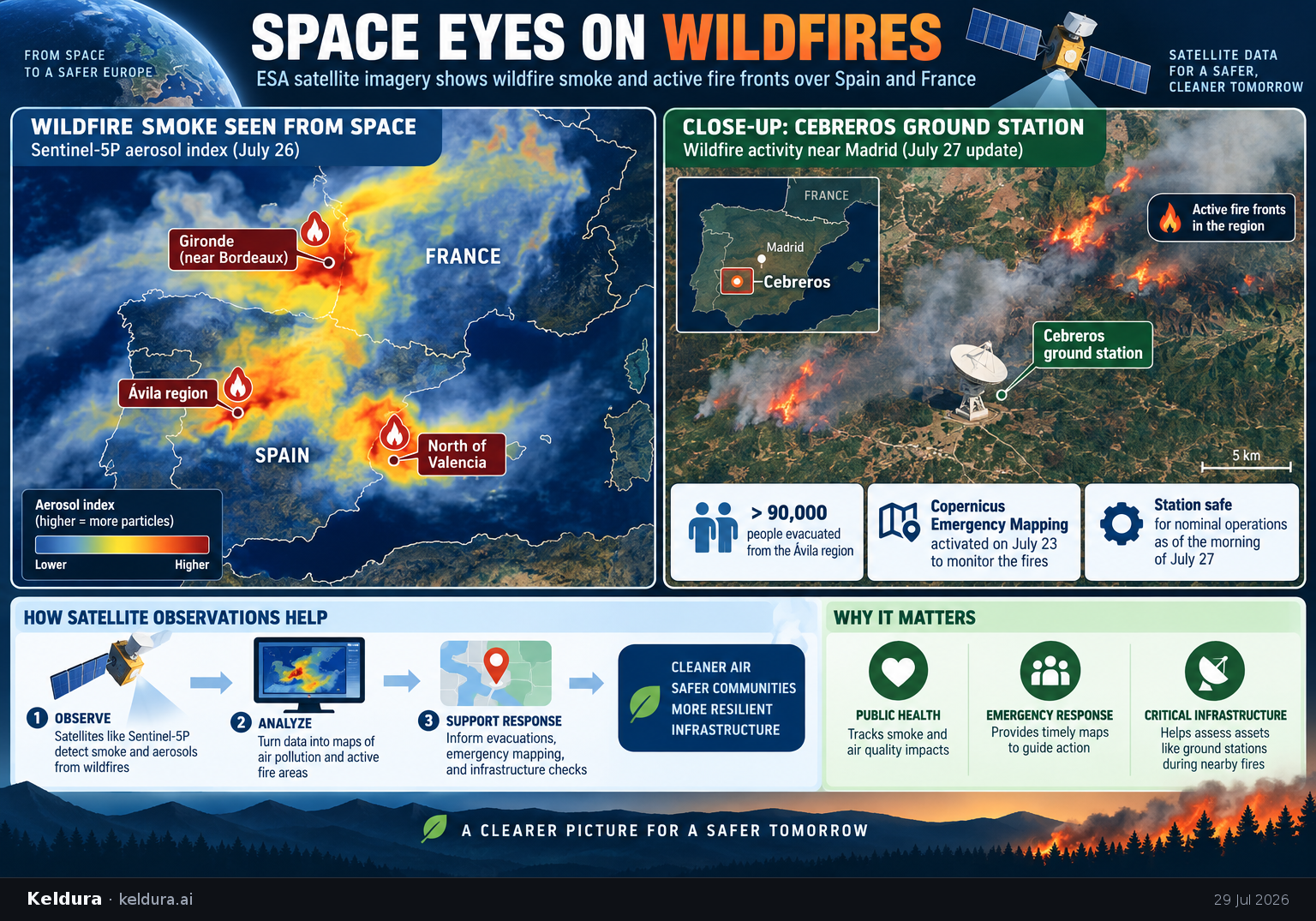
ESA published Copernicus imagery showing aerosol pollution over Spain and France after days of wildfire spread through dry countryside.
Why it matters: These images turn wildfire impacts into measurable atmospheric and infrastructure events, showing how space-based observation supports public health, emergency response, and mission operations on the…
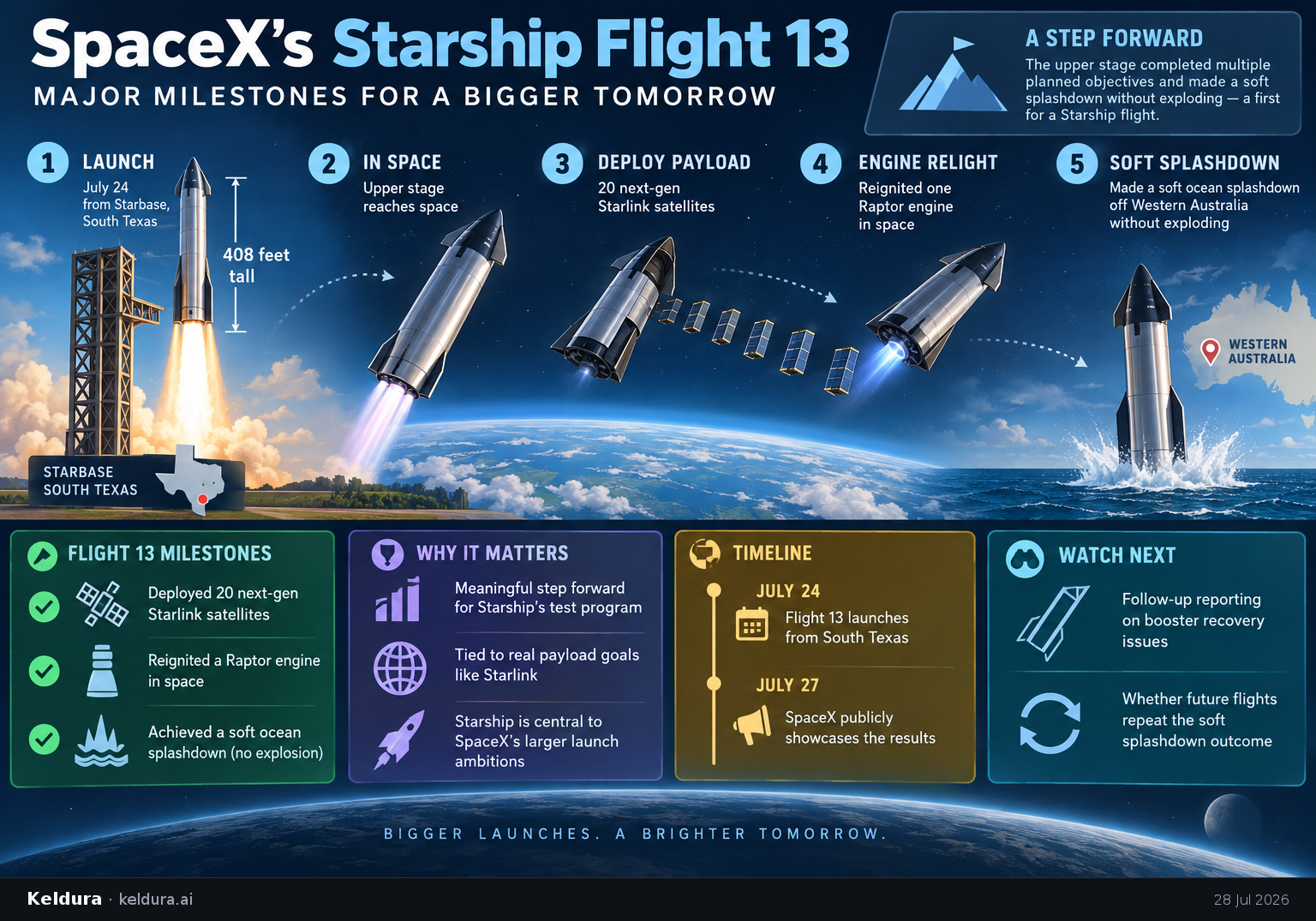
SpaceX’s 13th Starship test flight launched on July 24 from Starbase in South Texas and returned a 408-foot-tall Starship Version 3 vehicle to space.
Why it matters: This flight appears to mark a meaningful step forward for Starship’s test program because the upper stage achieved multiple planned objectives and the splashdown ended without the vehicle exploding,…
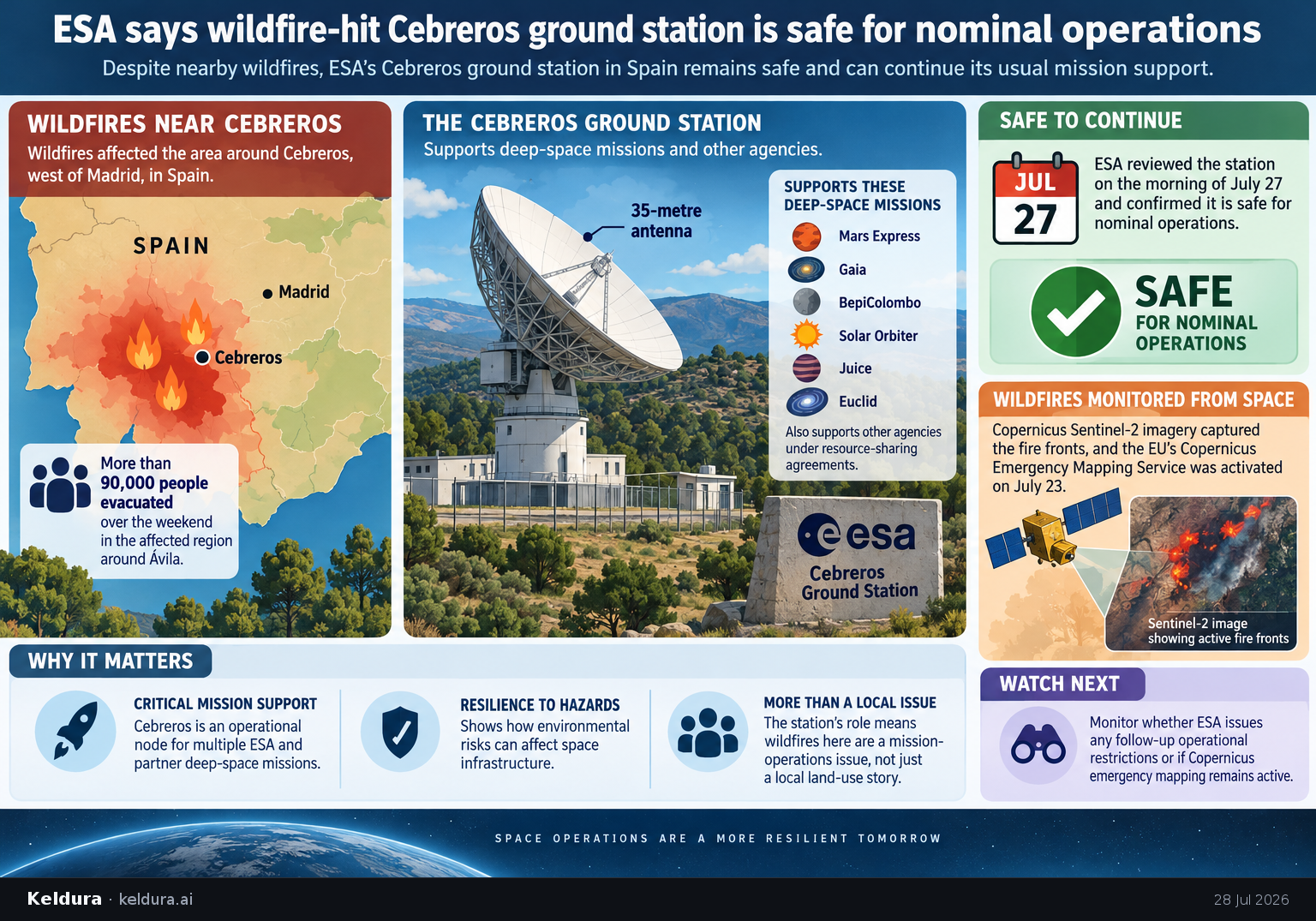
Why it matters: Cebreros is not just a local facility; it is an operational support node for multiple ESA and partner deep-space missions, so wildfire exposure at the site is a mission-operations issue, not only a l…