Every Climate & Environment cheatsheet Keldura Daily has published, newest first. Each cheatsheet is compiled by Keldura's AI from the sources it cites.
India wants to triple clean-power capacity, but can its electricity networks carry the extra generation to consumers?
AP reported on November 14 that India had set a 900-gigawatt clean-power goal for 2035 and approved nearly $20 billion in grid upgrades.
Why it matters: For electricity users, installing generating equipment is not enough: power must reach homes and businesses through the grid. India's target represents enough clean-power capacity to supply more than…
Ireland is offering peatland-restoration expertise abroad, but can a new coalition turn its $100 billion ambition into restored land?
On November 16, The Irish Times reported that Ireland joined a COP31 initiative seeking $100 billion and restoration of at least 30 million hectares by 2030.
Why it matters: Peatlands occupy just 3–4 percent of the planet's land surface but hold as much as one-third of its soil carbon. Draining or degrading them releases that carbon, so protecting these relatively small…
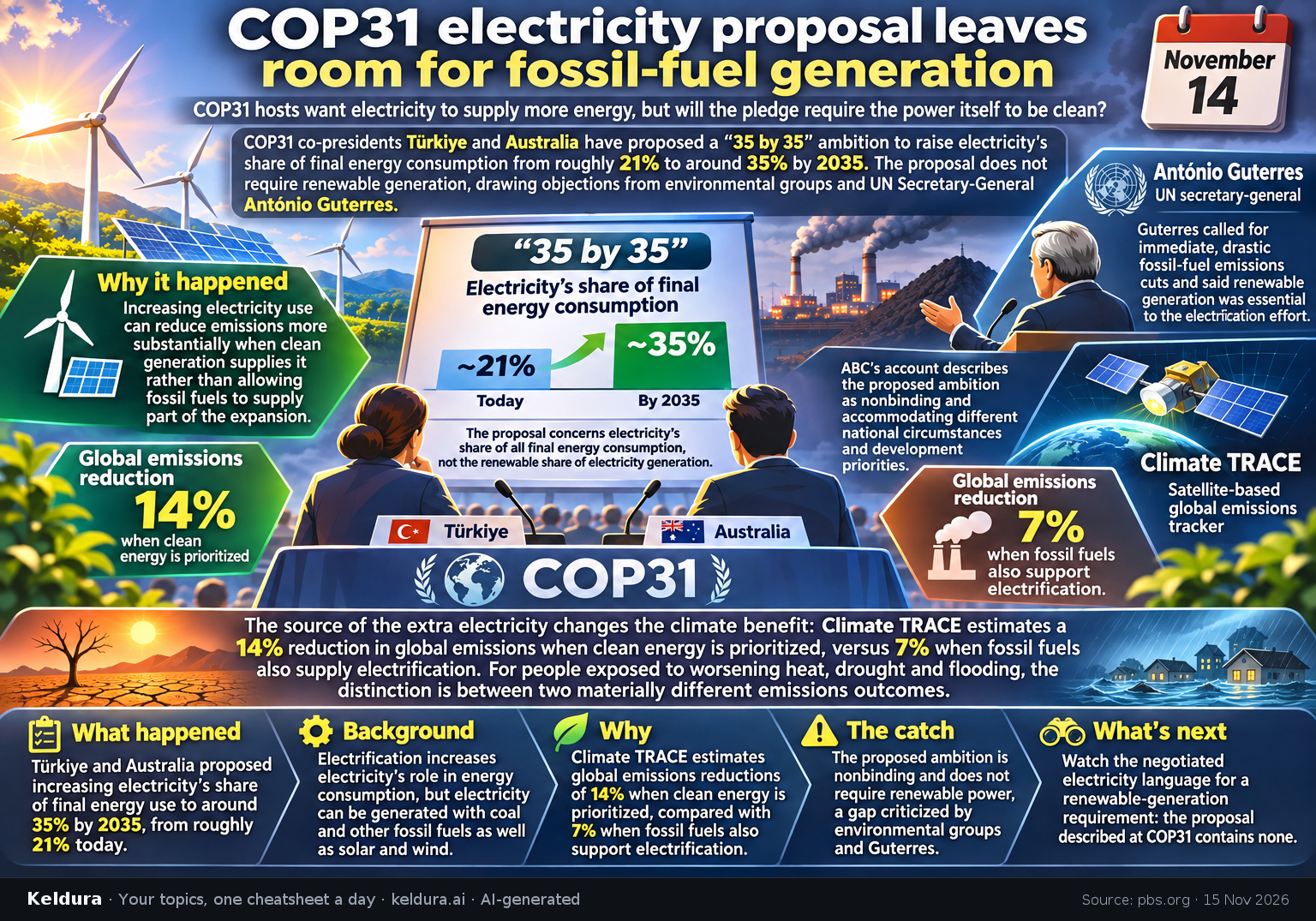
COP31 hosts want electricity to supply more energy, but will the pledge require the power itself to be clean?
By November 14, Türkiye and Australia had proposed raising electricity's share of global final energy use to around 35% by 2035, without requiring renewable generation.
Why it matters: The source of the extra electricity changes the climate benefit: Climate TRACE estimates a 14% reduction in global emissions when clean energy is prioritized, versus 7% when fossil fuels also supply…
Türkiye and Australia proposed increasing electricity's share of final energy use to around 35% by 2035, from roughly 21% today. [8][10]
Background
Electrification increases electricity's role in energy consumption, but electricity can be generated with coal and other fossil fuels as well as solar and wind. [8]
Why
Climate TRACE estimates global emissions reductions of 14% when clean energy is prioritized, compared with 7% when fossil fuels also support electrification. [8]
The catch
The proposed ambition is nonbinding and does not require renewable power, a gap criticized by environmental groups and Guterres. [4][8][10]
What's next
Watch the negotiated electricity language for a renewable-generation requirement: the proposal described at COP31 contains none. [8][10]
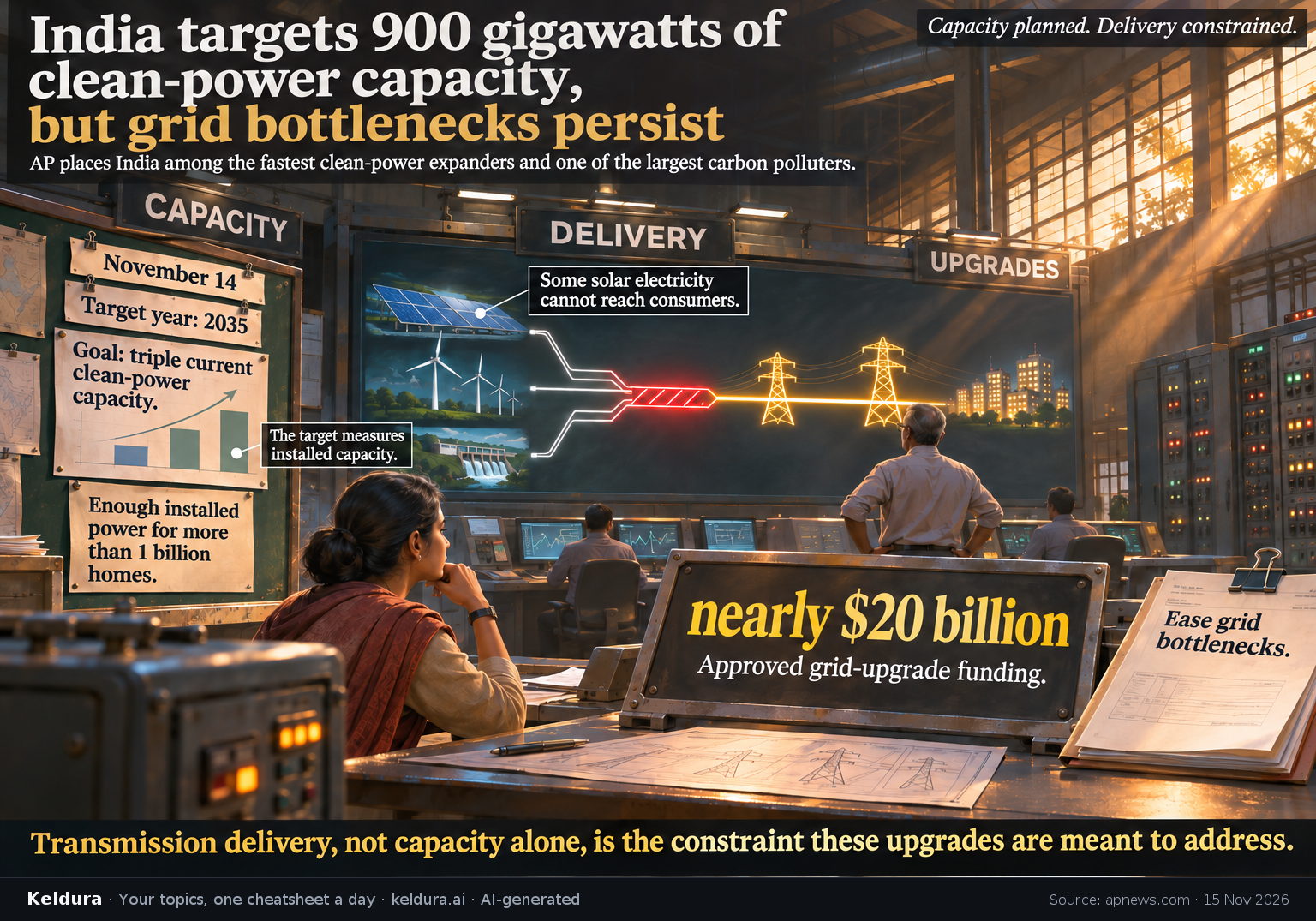
India wants to triple clean-power capacity, but can its grid carry the additional electricity to consumers?
By November 14, India had set a 900-gigawatt clean-power goal for 2035 and approved nearly $20 billion in grid upgrades to ease delivery bottlenecks.
Why it matters: For electricity consumers, building solar and wind capacity is useful only if the power can reach them. India's nearly $20 billion grid approval addresses that delivery problem in the world's most po…
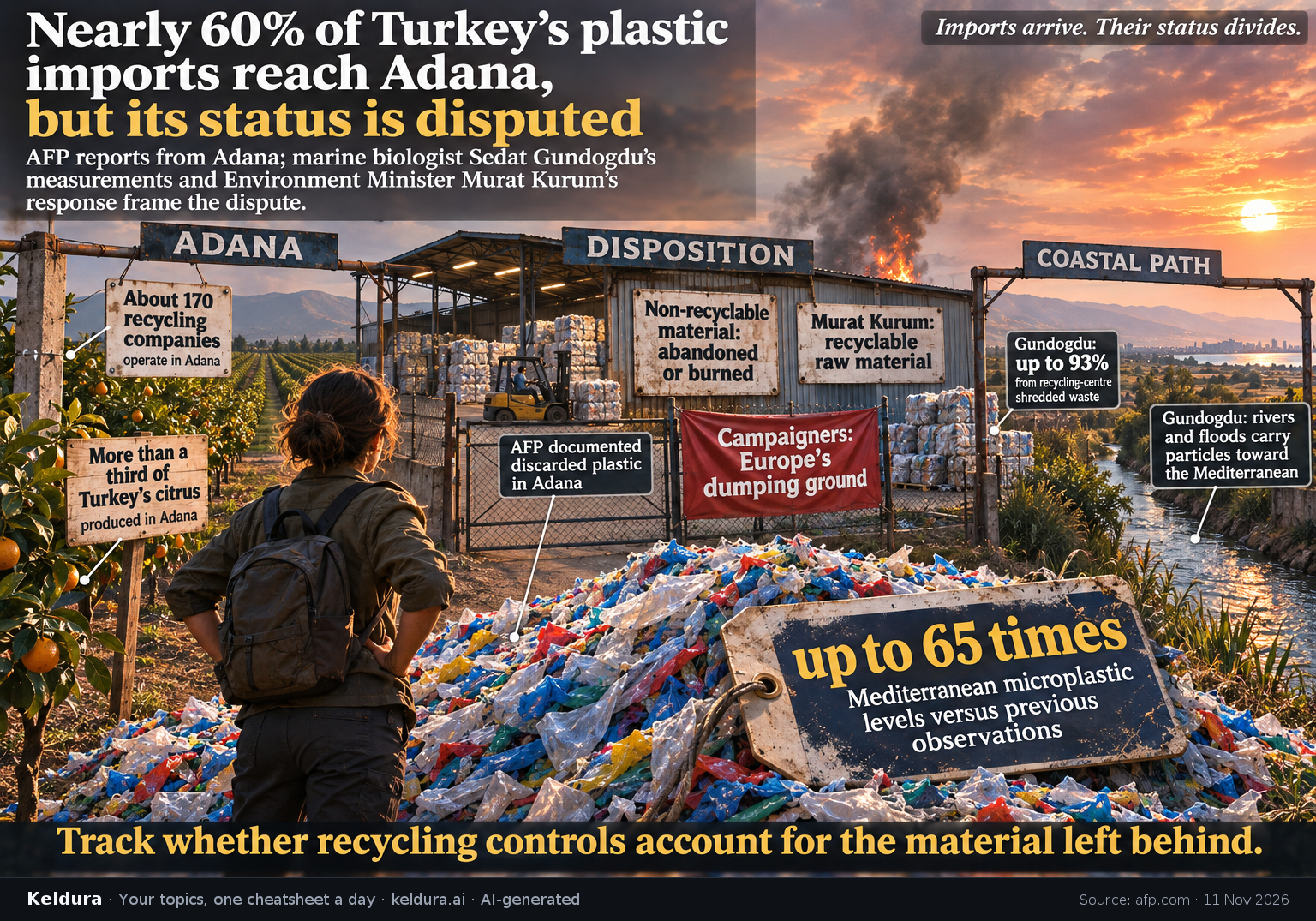
Turkey imports European plastic as recycling material, but who bears the cost when it ends up in canals and fields?
On November 10, AFP reported plastic dumping in Adana after Turkey imported 510,000 tonnes of EU plastic waste and another 140,000 tonnes from Britain in 2025.
Why it matters: Adana produces more than a third of Turkey's citrus fruit, placing waste processing alongside a major food-growing region. Gundogdu told AFP that measured Mediterranean microplastic concentrations re…
AFP documented discarded plastic in Adana, which receives nearly 60% of Turkey's plastic-waste imports from the EU and Britain. [12]
Why
Turkey imports plastic for recycling, but AFP reports that non-recyclable material is abandoned or burned, leaving piles of shredded waste. [12]
Who pays
Waste processing overlaps with farmland producing more than a third of Turkey's citrus; rivers also carry plastic particles toward the Mediterranean. [12]
The catch
Environment Minister Murat Kurum says Turkey imports recyclable raw material, while campaigners describe the country as Europe's dumping ground. [12]
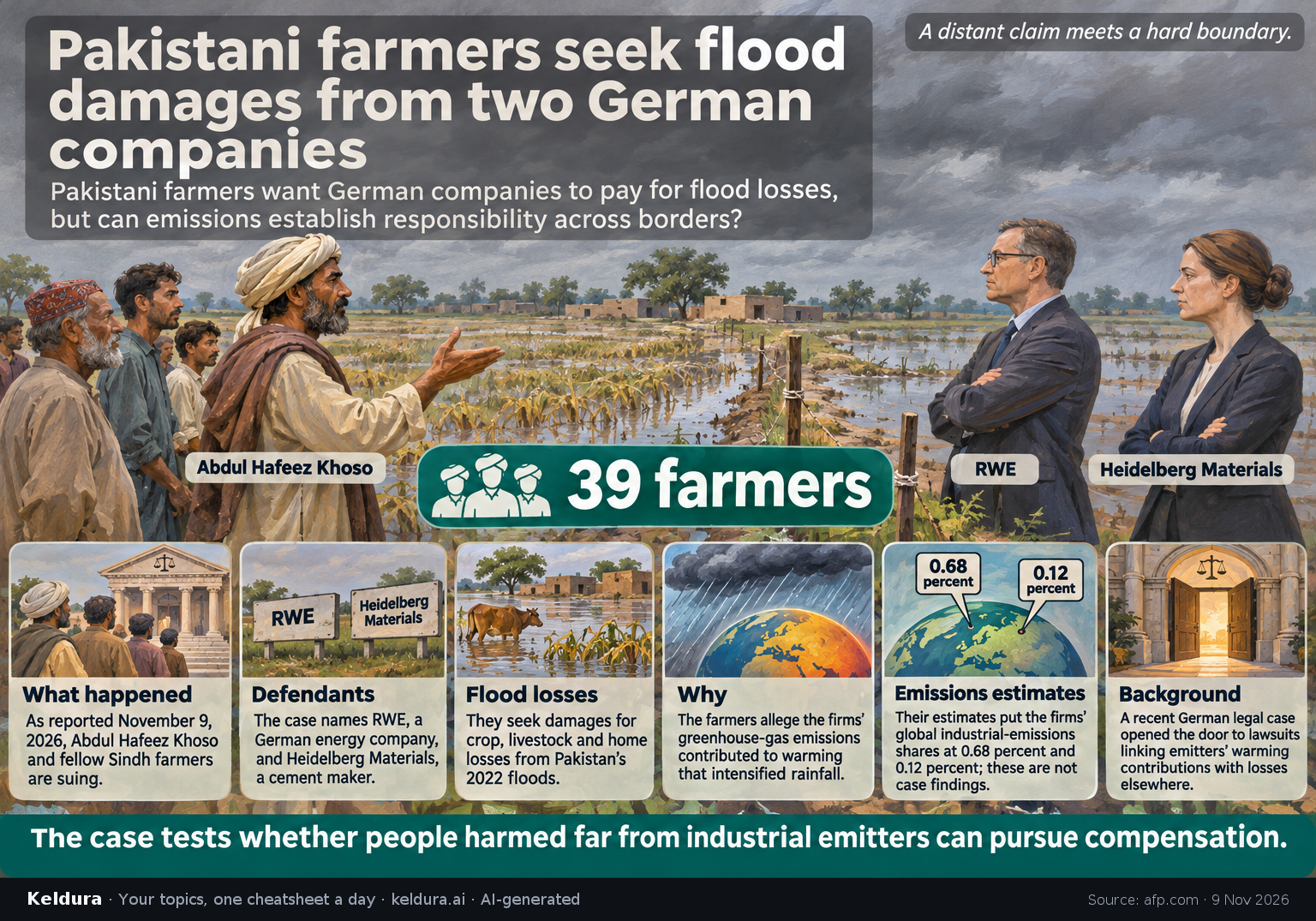
Pakistani farmers want German companies to pay for flood losses, but can emissions establish responsibility across borders?
As reported on November 9, 2026, 39 farmers from Pakistan’s Sindh province are suing RWE and Heidelberg Materials over losses from the 2022 floods.
Why it matters: The farmers are seeking to make companies pay for climate damage far from their headquarters, rather than for specific operations in Pakistan. Their claim tests a route through which people losing ho…
Thirty-nine Sindh farmers are pursuing RWE and Heidelberg Materials for losses from Pakistan’s 2022 floods. [5]
Why
They argue that the firms’ emissions contributed to warming and intensified the rain that destroyed their crops, livestock and homes. [5]
Who pays
The farmers want the German energy and cement companies to pay damages, citing estimated industrial-emissions shares of 0.68 percent and 0.12 percent respectively. [5]
The catch
Both companies deny wrongdoing; the claim rests on responsibility for global emissions, not specific operations in Pakistan. [5]
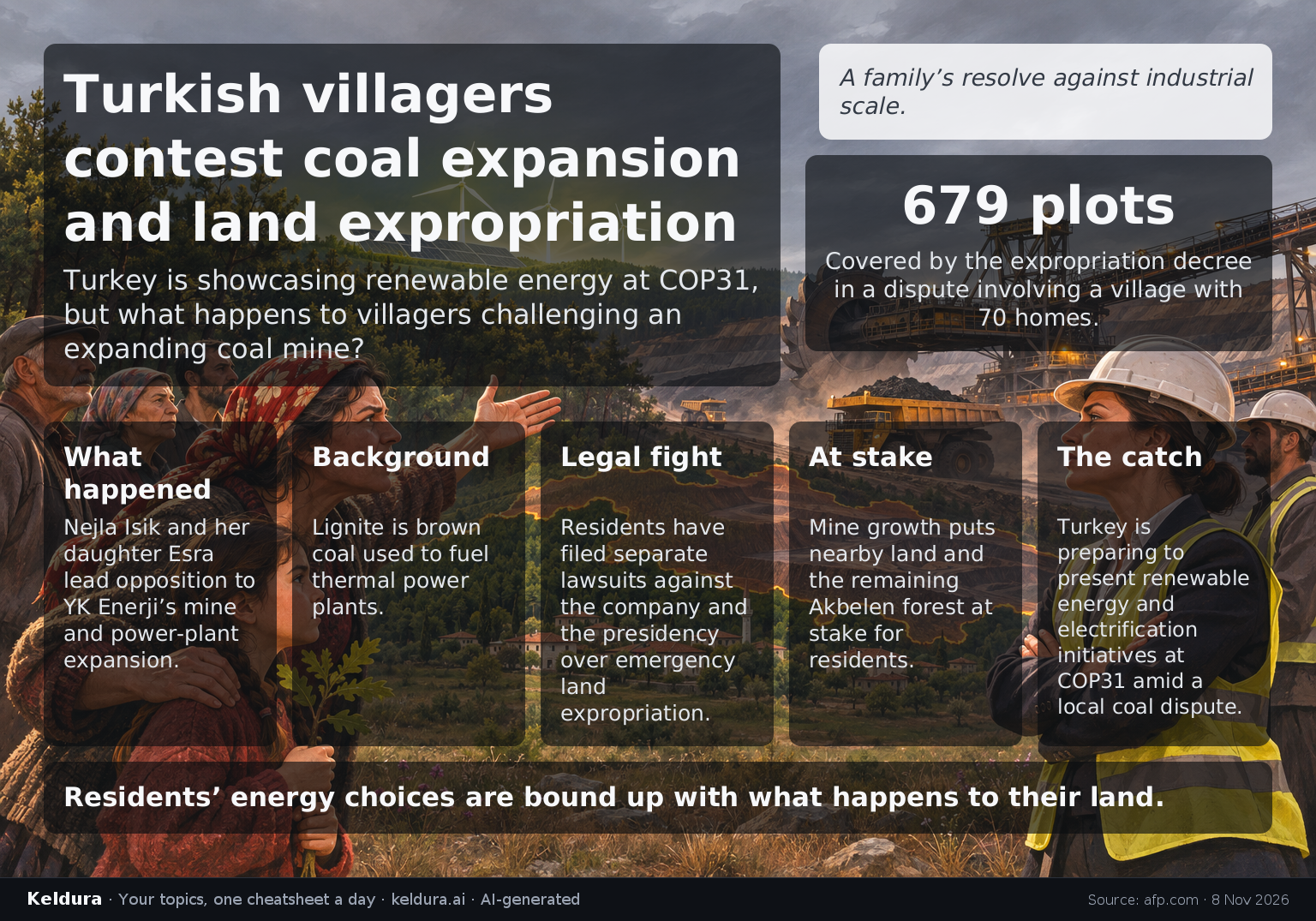
Turkey is showcasing renewable energy at COP31, but what happens to villagers challenging an expanding coal mine?
As reported November 6, Nejla Isik and her daughter Esra are contesting YK Enerji's coal expansion near Ikizkoy, alongside lawsuits over a January decree expropriating 679 plots.
Why it matters: For Ikizkoy's 70 homes, Turkey's energy choices involve nearby land and the remaining Akbelen forest, not just national targets. The dispute gives residents a direct stake in coal expansion as their…
Turkey wants electricity to replace more fossil-fuel use, but where does coal fit in its new energy plan?
On November 6, Turkey unveiled a $500 billion energy roadmap targeting self-sufficiency by 2040, without setting a timetable to exit coal.
Why it matters: The plan would shift more transport and other energy demand onto the electricity system, making the sources of that electricity consequential for emissions. Coal also supports at least 30,000–40,000…
Singapore can now arrest haze-law suspects and restrict companies, but can it overcome the overseas evidence problem?
On November 4, Singapore's parliament strengthened its anti-haze law, increasing daily fines tenfold to nearly US$800,000 and adding arrest powers.
Why it matters: Residents exposed to smoke could benefit if stronger enforcement changes companies' behavior: fires burned more than 1.9 million hectares in Indonesia between January and September. Companies deemed…
Parliament added arrest powers, larger fines and restrictions on designated companies to Singapore's anti-haze law on November 4. [11]
Why
The 2014 law has been difficult to enforce because evidence and defendants can be overseas; four investigations opened in 2015 remain unresolved. [11]
Who pays
Non-compliant companies face nearly US$800,000 in daily fines, while authorities can require companies to fund independent assessors. [11]
The catch
The new powers target an existing cross-border evidence problem; appointing an assessor establishes a way to investigate possible links, not proof of wrongdoing. [11]
Scrap-built turbines can power lights and phones in Gaza, but how much can they replace a shattered electricity grid?
By November 5, Kamal Al-Dabary was building wind turbines from salvaged debris in a Khan Yunis displacement camp to power lights, phones and small appliances.
Why it matters: For families living in tents and shelters, the turbines provide usable electricity without buying a solar panel that Al-Dabary says now costs at least 15,000 shekels, nearly $5,000. This is a small-s…
Singapore is testing less energy-intensive cooling, but can alternatives reduce demand without sacrificing comfort?
On November 1, AFP reported that Singapore was expanding alternative cooling systems, with at least 47 public and private buildings using them by mid-2026.
Why it matters: Cooling accounts for 40–60% of a building's energy consumption, and Singapore's building sector produces one-fifth of its emissions, making cooling equipment a substantial lever for reducing energy d…
At least 33 public and 14 private buildings had adopted alternative cooling technologies by mid-2026. [3]
Why
Cooling consumes 40–60% of building energy, while about 99% of Singapore's private residences have cooling units. [3]
The catch
One building's designers reported savings above 30%; the larger, up-to-48% figure describes potential identified in a government study, not savings already achieved citywide. [3]
What's next
Watch whether adoption expands beyond the mid-2026 baseline of at least 47 buildings as Singapore works toward its 2050 net-zero goal. [3]
Trump says weaker methane rules will cut costs, but what happens to oversight of large leaks?
On October 27, President Donald Trump announced a rollback of Biden-era oil and gas methane regulations at a rally in Lubbock, Texas.
Why it matters: Methane accounts for about a third of warming since the pre-industrial era, according to AFP; the rollback targets emissions across oil and gas production and distribution, not just one type of facil…