Keldura Daily Open Keldura

Keldura Daily · Cheatsheets

Markets & Economy cheatsheets.

Every Markets & Economy cheatsheet Keldura Daily has published, newest first. Each cheatsheet is compiled by Keldura's AI from the sources it cites.

Cheatsheet your own link — free
Latest cheatsheets

Markets & Economy

Read in Briefings
Cheatsheet for What would push the Fed to raise rates in September?. Text equivalent is attached.

Markets & Economy

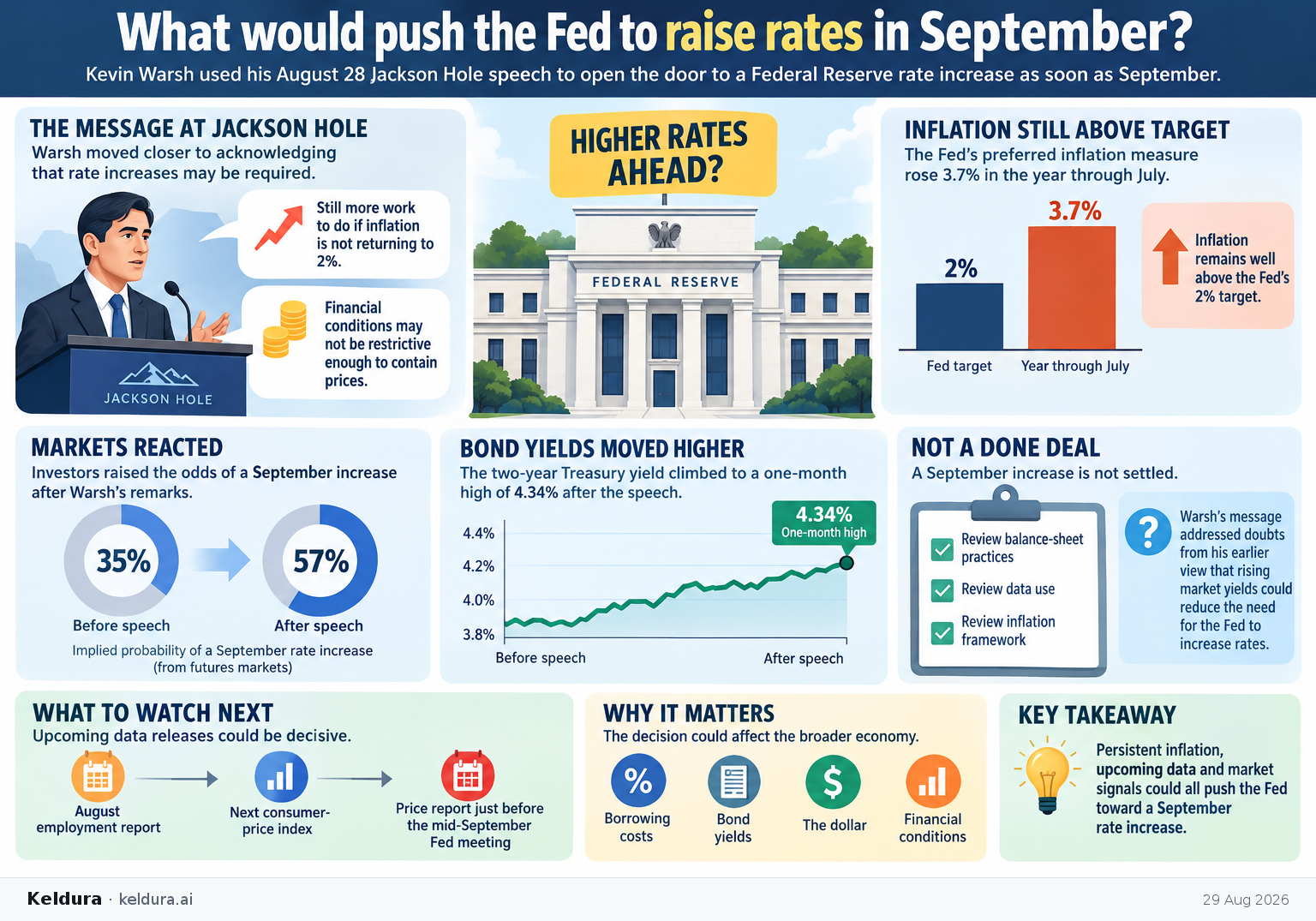
What would push the Fed to raise rates in September?

Kevin Warsh used his August 28 Jackson Hole speech to open the door to a Federal Reserve rate increase as soon as September.

Why it matters: The decision could turn on data released shortly before the meeting, making the August employment report and the next consumer-price reading unusually consequential for borrowing costs, bond yields a…

Open original (2 sources): d2233.cms.socastsrm.com, apnews.com

Open cheatsheet →2 sources Post to X

What changed
Warsh moved closer to acknowledging that rate increases may be required, and markets lifted the implied September-hike probability to 57%.[4]
Why now
The Fed’s preferred inflation measure rose 3.7% in the year through July, remaining well above its 2% target.[4]
Watch next
Watch the August payrolls report, the subsequent consumer-price index and the price report due just before the mid-September Fed meeting.[1][4]
Cheatsheet for How the oil shock is reviving global rate-hike risk. Text equivalent is attached.

Markets & Economy

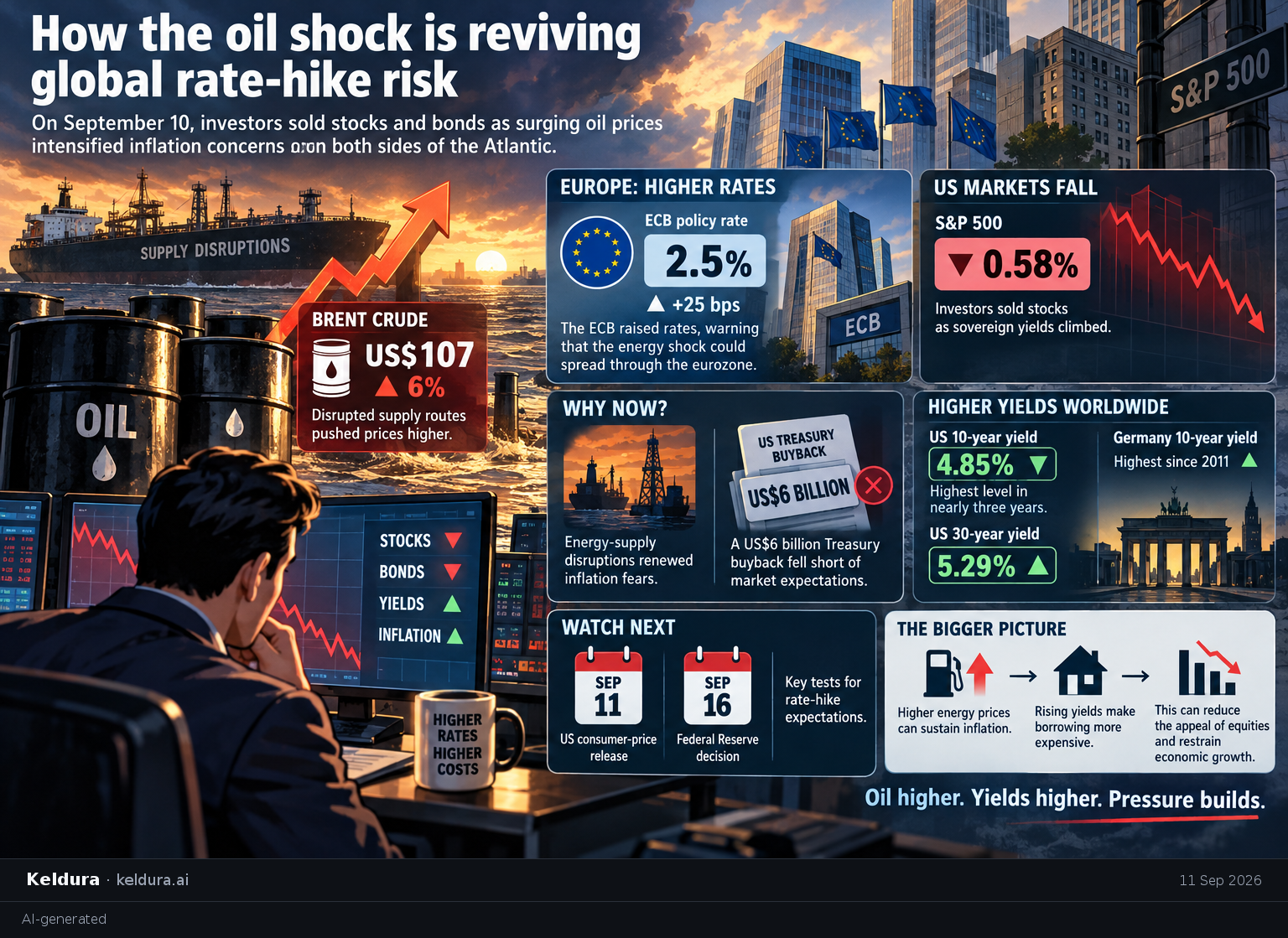
How the oil shock is reviving global rate-hike risk

On September 10, investors sold stocks and bonds as surging oil prices intensified inflation concerns on both sides of the Atlantic.

Why it matters: Higher energy prices can sustain inflation just as rising government-bond yields make mortgages, business loans and other borrowing more expensive; they also reduce the relative appeal of equities an…

Open original (3 sources): straitstimes.com, businesstimes.com.sg, euronews.com

Open cheatsheet →3 sources Post to X

What changed
Brent reached US$107, the ECB lifted rates to 2.5%, and the S&P 500 lost 0.58% as sovereign yields climbed.[1][2]
Why now
Energy-supply disruption renewed inflation fears, while a US$6 billion Treasury buyback fell short of market expectations.[1][5]
Watch next
The August US consumer-price release on September 11 and the Federal Reserve decision on September 16 will provide the next observable tests of rate-hike expectations.[1][2][5]
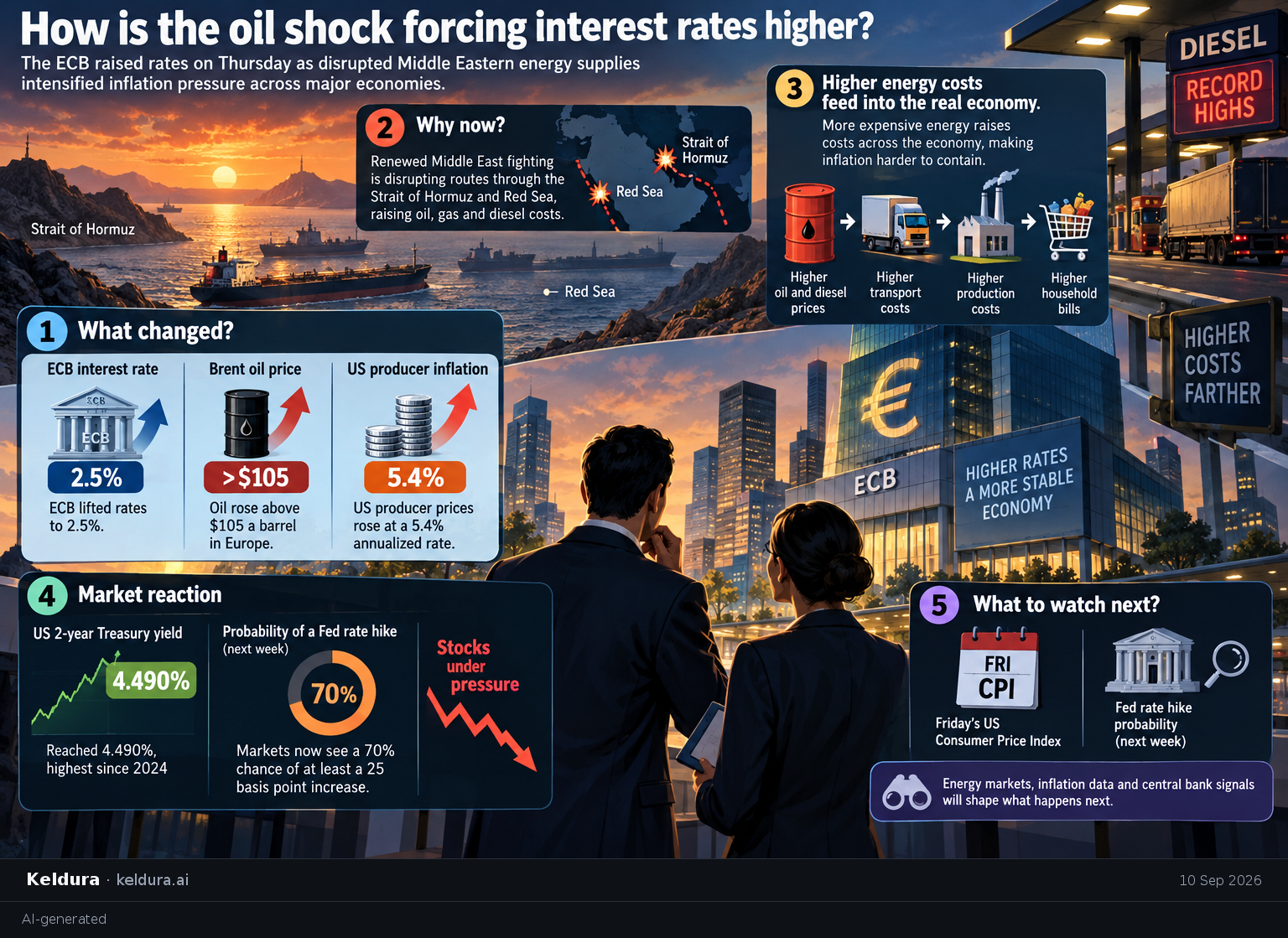
Cheatsheet for How is the oil shock forcing interest rates higher?. Text equivalent is attached.

Markets & Economy

How is the oil shock forcing interest rates higher?

The ECB raised rates on Thursday as disrupted Middle Eastern energy supplies intensified inflation pressure across major economies.

Why it matters: Energy costs flow through transport, manufacturing and household bills, making inflation harder to contain without tighter monetary policy; diesel is particularly consequential because it powers truc…

Open original (3 sources): theguardian.com, investing.com, fortune.com

Open cheatsheet →3 sources Post to X

What changed
The ECB lifted rates to 2.5%, oil exceeded $105 in Europe, and US producer inflation reached a 5.4% annualized rate.[2][3]
Why now
War-related disruption around the Strait of Hormuz and Red Sea is constraining energy flows and raising oil, gas and diesel costs.[2][6]
Watch next
Watch Friday’s US Consumer Price Index and the market-implied probability of a Fed rate increase next week.[2]
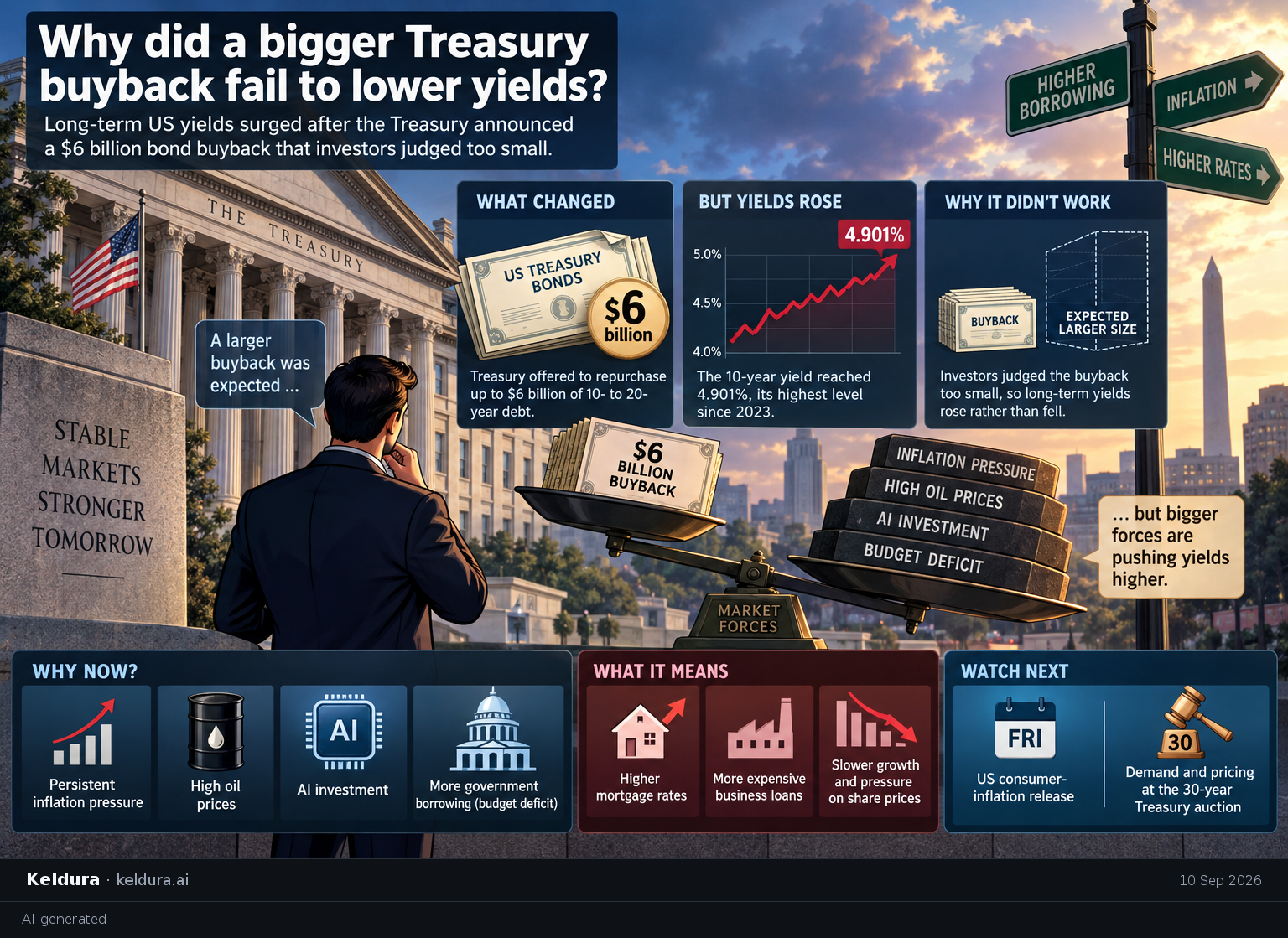
Cheatsheet for Why did a bigger Treasury buyback fail to lower yields?. Text equivalent is attached.

Markets & Economy

Why did a bigger Treasury buyback fail to lower yields?

Long-term US yields surged after the Treasury announced a $6 billion bond buyback that investors judged too small.

Why it matters: Treasury yields serve as reference rates across the US economy, so sustained increases can make mortgages and business loans more expensive, slow growth and weigh on share prices. The reaction also i…

Open original (3 sources): euronews.com, investing.com, bloomberg.com

Open cheatsheet →3 sources Post to X

What changed
Treasury offered to repurchase up to $6 billion of 10- to 20-year debt, but long-term yields rose rather than fell.[2][4]
Why now
Investors are balancing limited liquidity support against inflation pressure, high oil prices and heavy government borrowing.[4]
Watch next
Watch demand and pricing at the approaching 30-year Treasury auction, alongside Friday’s US consumer-inflation release.[4][5]
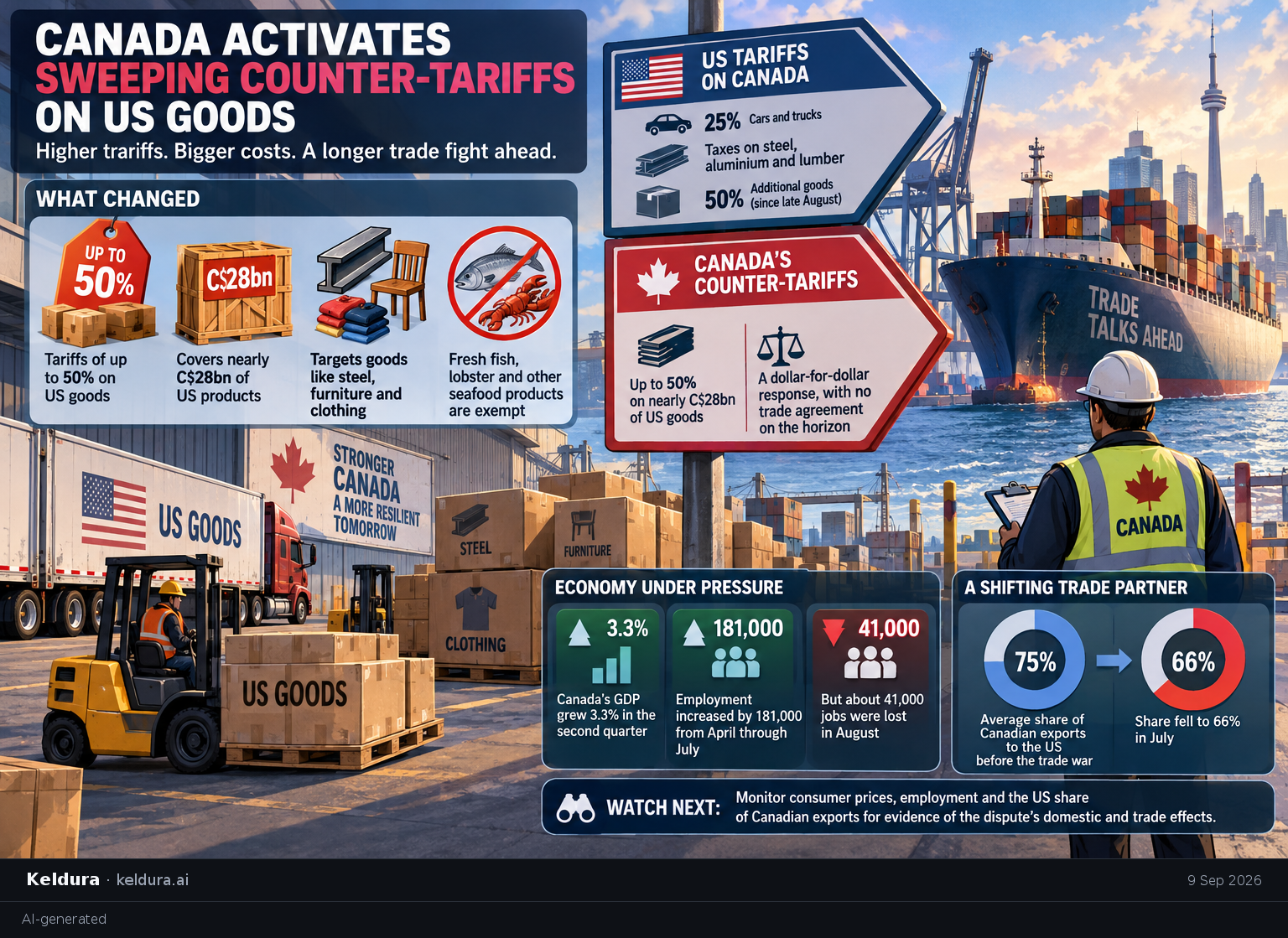
Cheatsheet for Canada Activates Sweeping Counter-Tariffs on US Goods. Text equivalent is attached.

Markets & Economy

Canada Activates Sweeping Counter-Tariffs on US Goods

Canada’s retaliatory tariffs took effect Tuesday, covering nearly C$28bn ($20bn) of US products and reaching rates as high as 50%.

Why it matters: Economists warn that the counter-tariffs will raise Canadian consumer prices for everyday goods, while businesses are preparing for a prolonged dispute with the country’s largest trading partner.

Open original · bbc.com

Open cheatsheet →1 source Post to X

What changed
Canada imposed tariffs of up to 50% on nearly C$28bn of US goods, while exempting seafood products after domestic opposition.[5]
Why now
The measures are a dollar-for-dollar response to US tariffs, with no trade agreement on the horizon.[5]
Watch next
Monitor consumer prices, employment and the US share of Canadian exports for evidence of the dispute’s domestic and trade effects.[5]
Cheatsheet for IMF Review Flags Compounding Risks in the Democratic Republic of the Congo. Text equivalent is attached.

Markets & Economy

IMF Review Flags Compounding Risks in the Democratic Republic of the Congo

Why it matters: The IMF says volatile security conditions in Eastern DRC, substantial humanitarian pressures, the Middle East war and a recent Ebola outbreak are complicating public policy, while political risks are…

Open original · IMF Blog

Open cheatsheet →1 source Post to X

What changed
The IMF released its latest Article IV, lending-program and debt-sustainability assessments for the Democratic Republic of the Congo.[3]
Why now
The review comes as conflict, humanitarian needs, Ebola and rising political tension complicate economic policymaking.[3]
Watch next
Track Eastern DRC security and humanitarian conditions, the Ebola outbreak, and any formal moves affecting the timing or constitutional framework of the 2028 presidential election.[3]
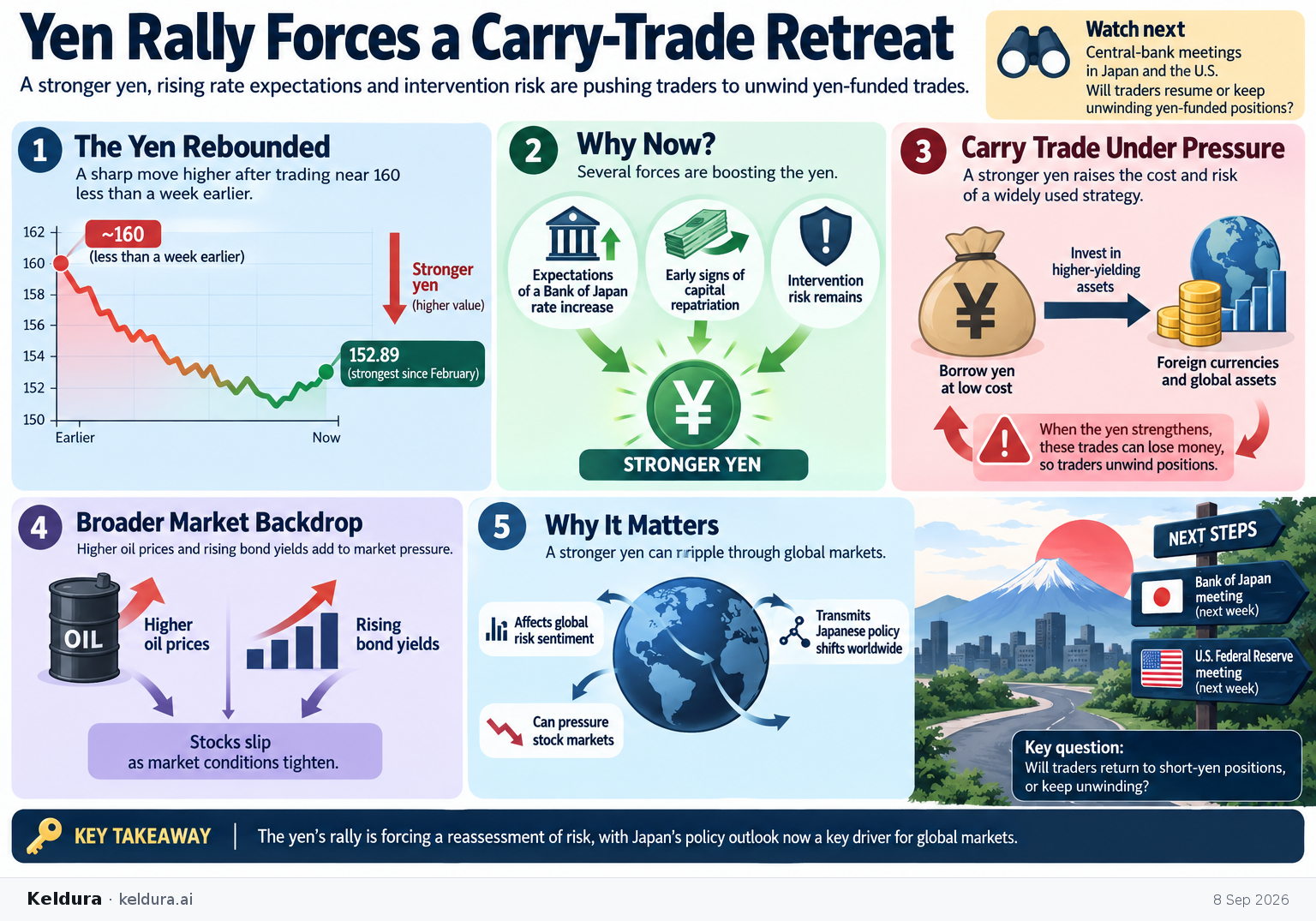
Cheatsheet for Yen Rally Forces a Carry-Trade Retreat. Text equivalent is attached.

Markets & Economy

Yen Rally Forces a Carry-Trade Retreat

The yen strengthened to 152.89 per dollar, its highest level since February, after trading near 160 less than a week earlier.

Why it matters: A stronger yen raises the cost and risk of a strategy widely used to finance investments in higher-yielding currencies and assets, potentially transmitting Japanese policy shifts across global market…

Open original (2 sources): sa.marketscreener.com, swissinfo.ch

Open cheatsheet →2 sources Post to X

What changed
The yen rapidly moved from around 160 to 152.89 per dollar, its strongest level since February.[1]
Why now
Markets are pricing faster Bank of Japan tightening while accounting for capital repatriation and official intervention risk.[1]
Watch next
The observable tests are next week’s central-bank meetings in Japan and the U.S., alongside whether traders resume or continue unwinding yen-funded positions.[1]
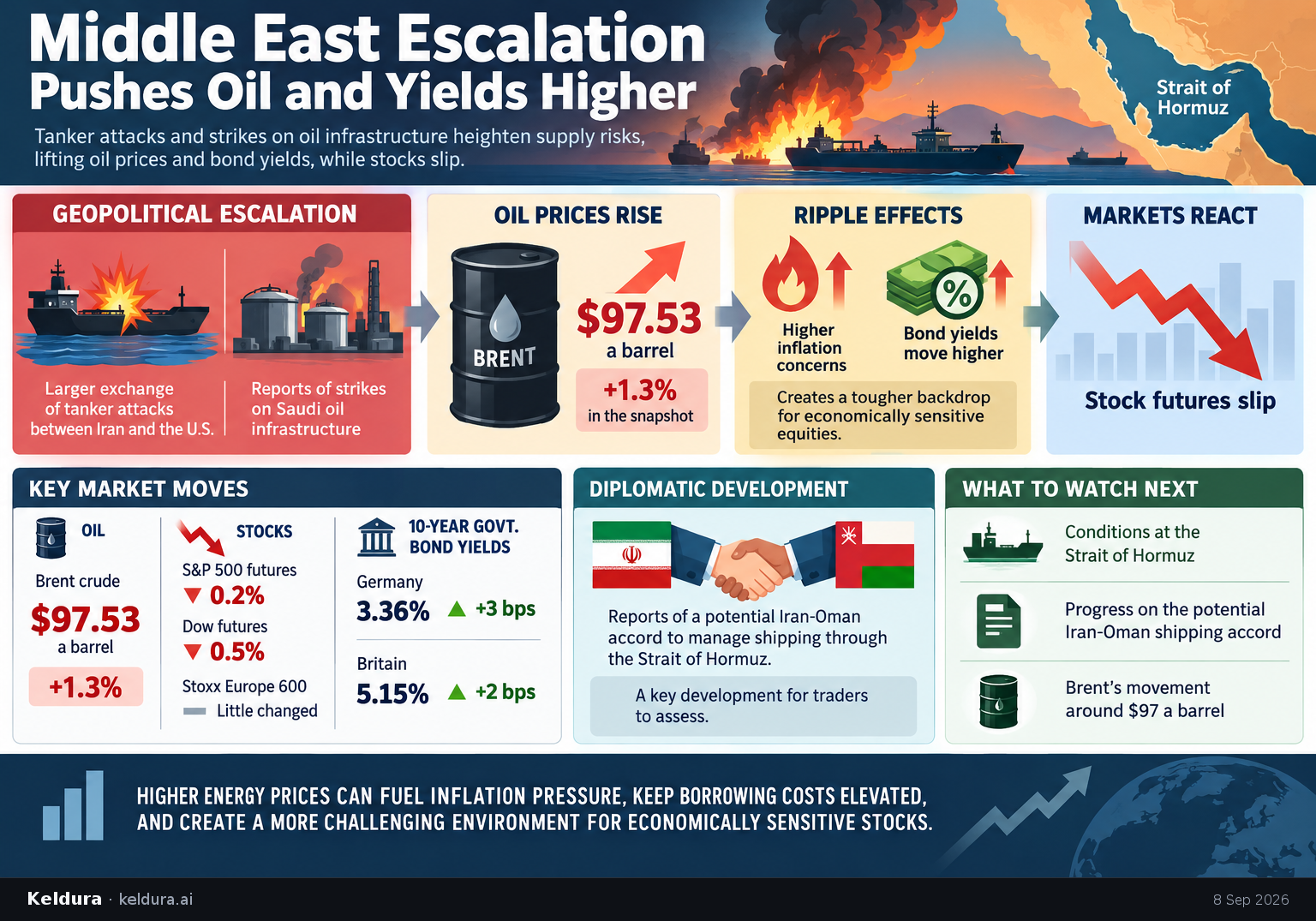
Cheatsheet for Middle East Escalation Pushes Oil and Yields Higher. Text equivalent is attached.

Markets & Economy

Middle East Escalation Pushes Oil and Yields Higher

Brent crude climbed above $97 a barrel after the largest exchange of tanker attacks yet between Iran and the U.S., alongside reports of strikes on Saudi oil infrastructure.

Why it matters: A sustained energy-price increase could intensify inflation pressure and keep borrowing costs elevated, creating a difficult backdrop for economically sensitive equities.

Open original · swissinfo.ch

Open cheatsheet →1 source Post to X

What changed
An escalation involving tanker attacks and reported strikes on oil infrastructure sent Brent above $97 and pressured stocks and bonds.[3]
Why now
Markets are reassessing energy-supply and shipping risks following conflict involving Iran and the U.S.[3]
Watch next
Watch reported conditions at the Strait of Hormuz, progress on the potential Iran-Oman shipping accord and Brent’s movement around $97 a barrel.[3]
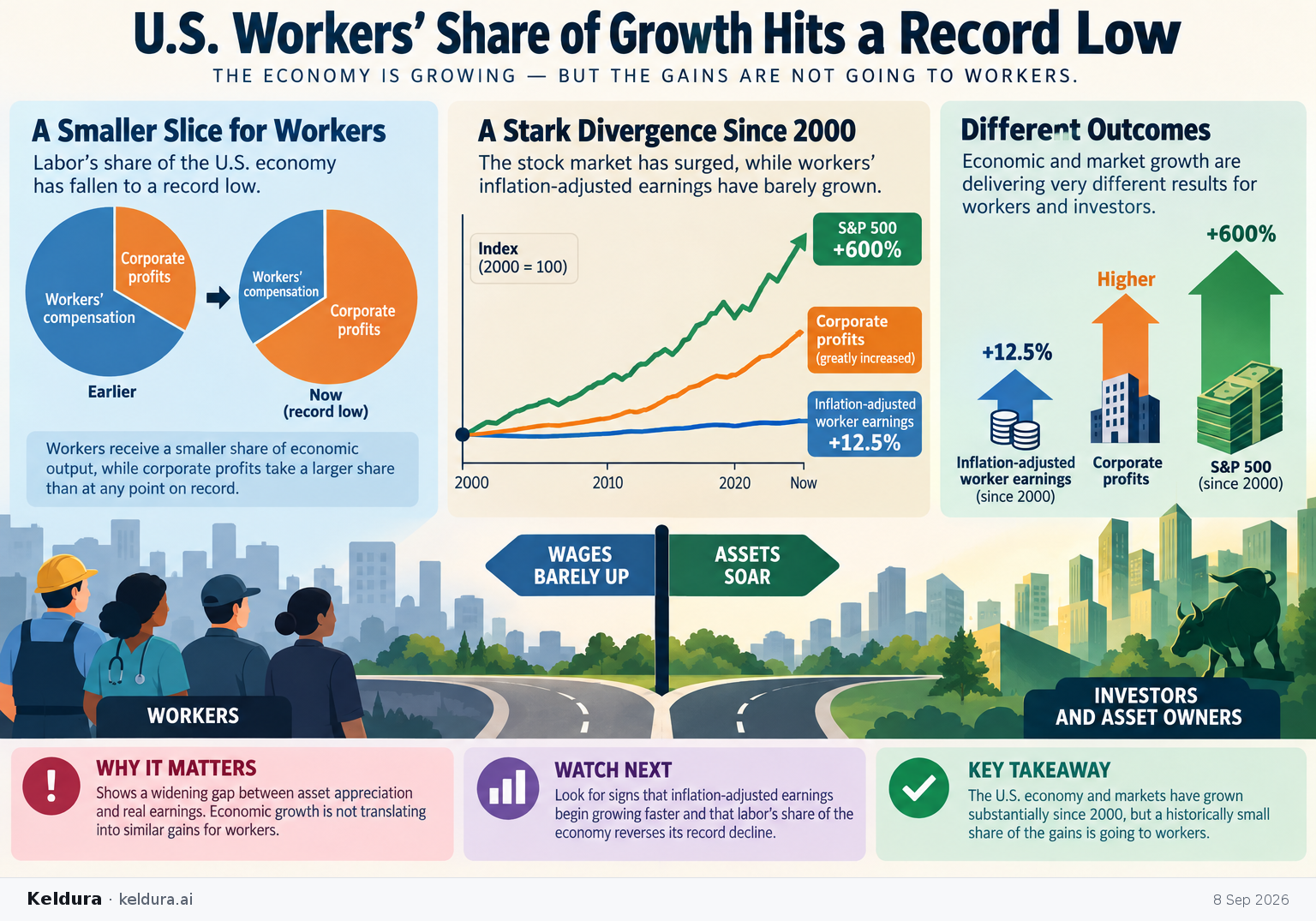
Cheatsheet for U.S. Workers’ Share of Growth Hits a Record Low. Text equivalent is attached.

Markets & Economy

U.S. Workers’ Share of Growth Hits a Record Low

Wages have fallen to their lowest recorded share of the growing U.S.

Why it matters: The widening gap between asset appreciation and real earnings shows that economic and market growth is delivering markedly different outcomes for workers and investors.

Open original · nbcnews.com

Open cheatsheet →1 source Post to X

What changed
Labor’s share of the U.S. economy has reached a record low as corporate profits expanded.[2]
Why now
Worker pay has lagged far behind stock-market gains, with real earnings up 12.5% since 2000 versus roughly 600% for the S&P 500.[2]
Watch next
Track whether inflation-adjusted earnings begin growing faster and whether labor’s measured share of the economy reverses its record decline.[2]
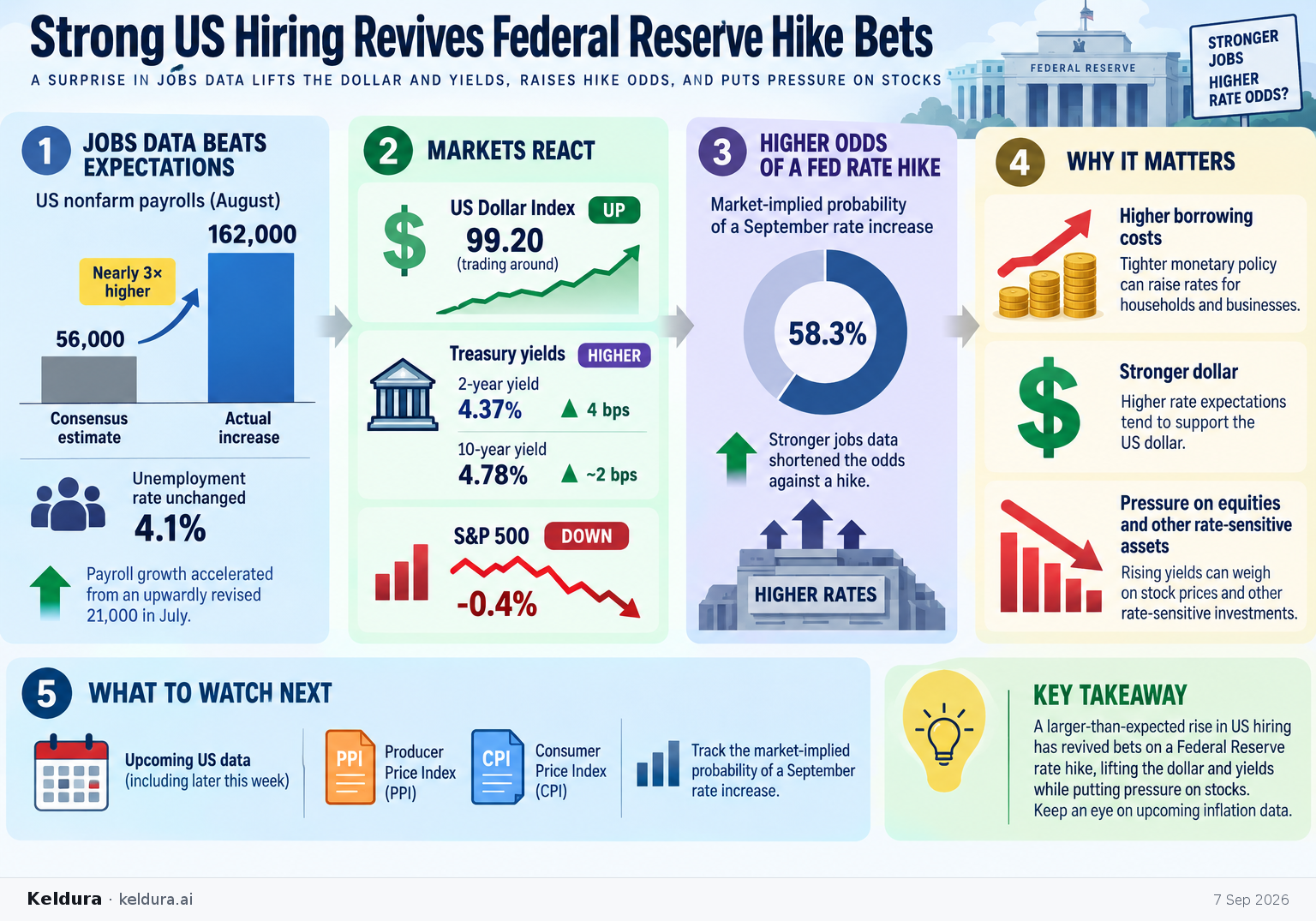
Cheatsheet for Strong US Hiring Revives Federal Reserve Hike Bets. Text equivalent is attached.

Markets & Economy

Strong US Hiring Revives Federal Reserve Hike Bets

US nonfarm payrolls increased by 162,000 in August, exceeding the 56,000 consensus estimate, while unemployment remained at 4.1%.

Why it matters: A renewed possibility of tighter US monetary policy raises borrowing costs and supports the dollar, while putting pressure on equities and other rate-sensitive assets.

Open original (2 sources): fxstreet.com, abc.net.au

Open cheatsheet →2 sources Post to X

What changed
A large upside payroll surprise pushed the dollar and Treasury yields higher and increased market pricing for a Federal Reserve hike.[2][8]
Why now
August payrolls rose almost three times as much as economists expected, while unemployment held steady.[2][8]
Watch next
Track the forthcoming US PPI and CPI releases and the market-implied probability of a September rate increase.[2]
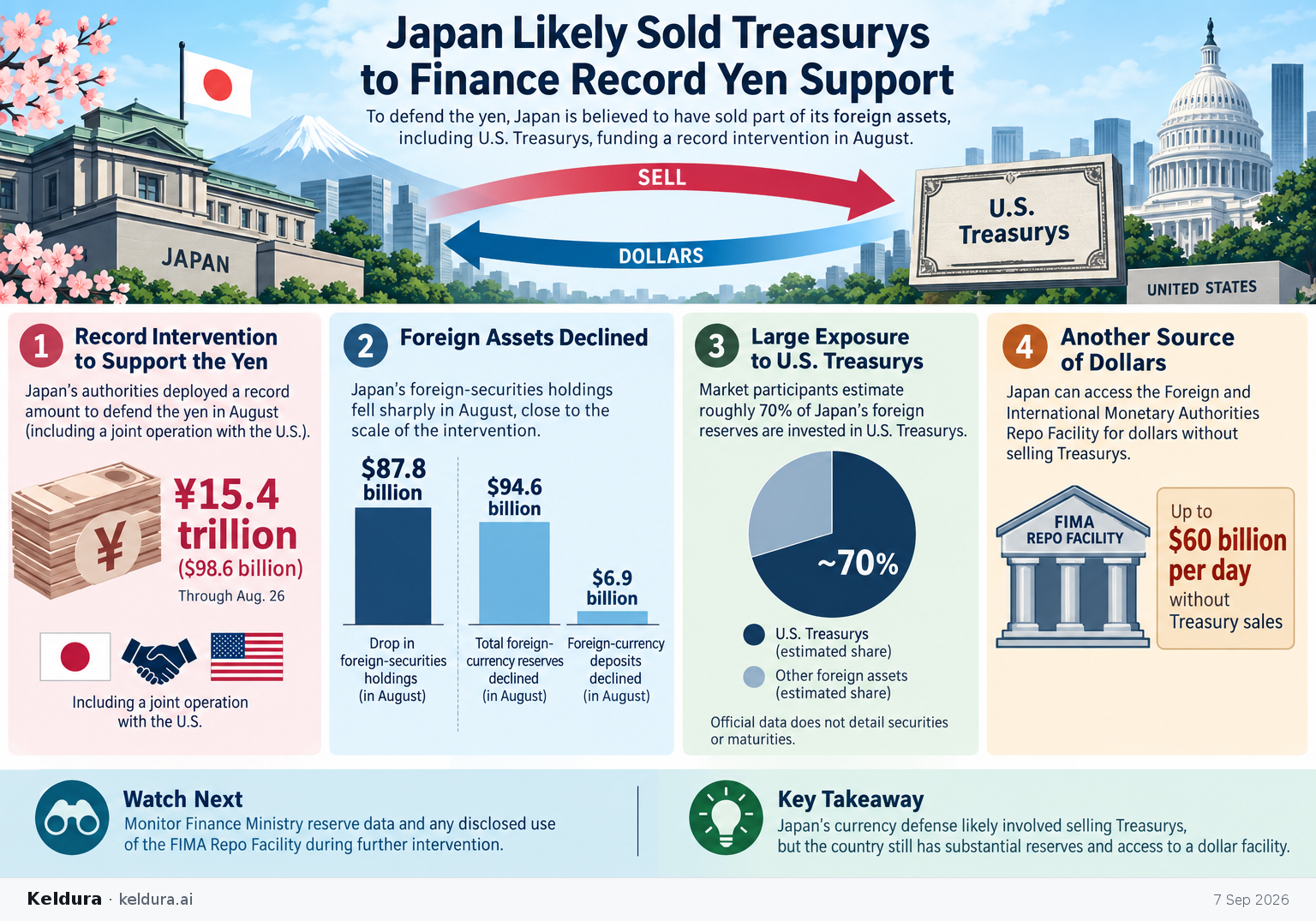
Cheatsheet for Japan Likely Sold Treasurys to Finance Record Yen Support. Text equivalent is attached.

Markets & Economy

Japan Likely Sold Treasurys to Finance Record Yen Support

Japan’s foreign-securities holdings fell by $87.8 billion in August, close to the scale of its recent intervention to support the yen.

Why it matters: Selling reserve assets can transmit Japan’s currency defense into the US Treasury market, although Tokyo retains substantial reserves and has access to a facility designed to provide dollars without…

Open original · japantimes.co.jp

Open cheatsheet →1 source Post to X

What changed
Japan’s foreign-securities holdings recorded an $87.8 billion monthly decline following record yen intervention.[3]
Why now
Authorities deployed ¥15.4 trillion through Aug. 26 to support the yen, including a joint operation with the US.[3]
Watch next
Monitor Finance Ministry reserve data and any disclosed use of the Foreign and International Monetary Authorities Repo Facility during further intervention.[3]
Cheatsheet for Chip Stocks Drive a 3% KOSPI Rebound. Text equivalent is attached.

Markets & Economy

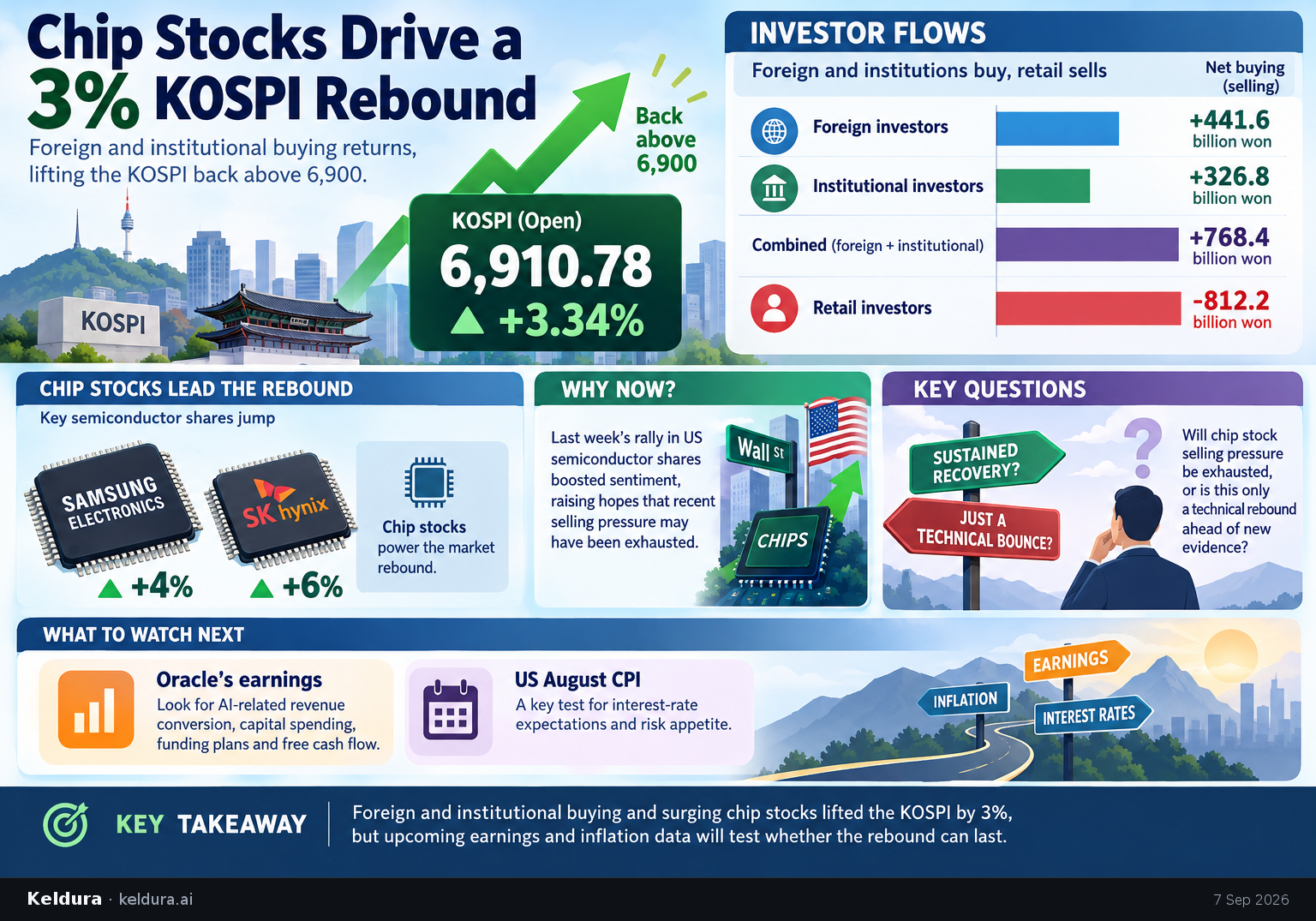
Chip Stocks Drive a 3% KOSPI Rebound

The KOSPI opened 3.34% higher at 6,910.78 as foreign and institutional investors jointly returned to net buying.

Why it matters: The rally tests whether selling pressure in Korean chip stocks has been exhausted or whether the move is only a technical rebound ahead of fresh evidence on AI demand, inflation and interest rates.
Open original · en.sedaily.com

Open cheatsheet →1 source Post to X

What changed
The KOSPI reclaimed 6,900 as foreign and institutional investors bought simultaneously and chip shares surged.[7]
Why now
Last week’s rally in US semiconductor shares encouraged the view that recent selling pressure may have been exhausted.[7]
Watch next
Monitor Oracle’s earnings, its AI-related revenue and cash-flow metrics, and the US August CPI release.[7]

That's the desk. Every cheatsheet here started as a link. Yours can too.

Cheatsheet your own link — free