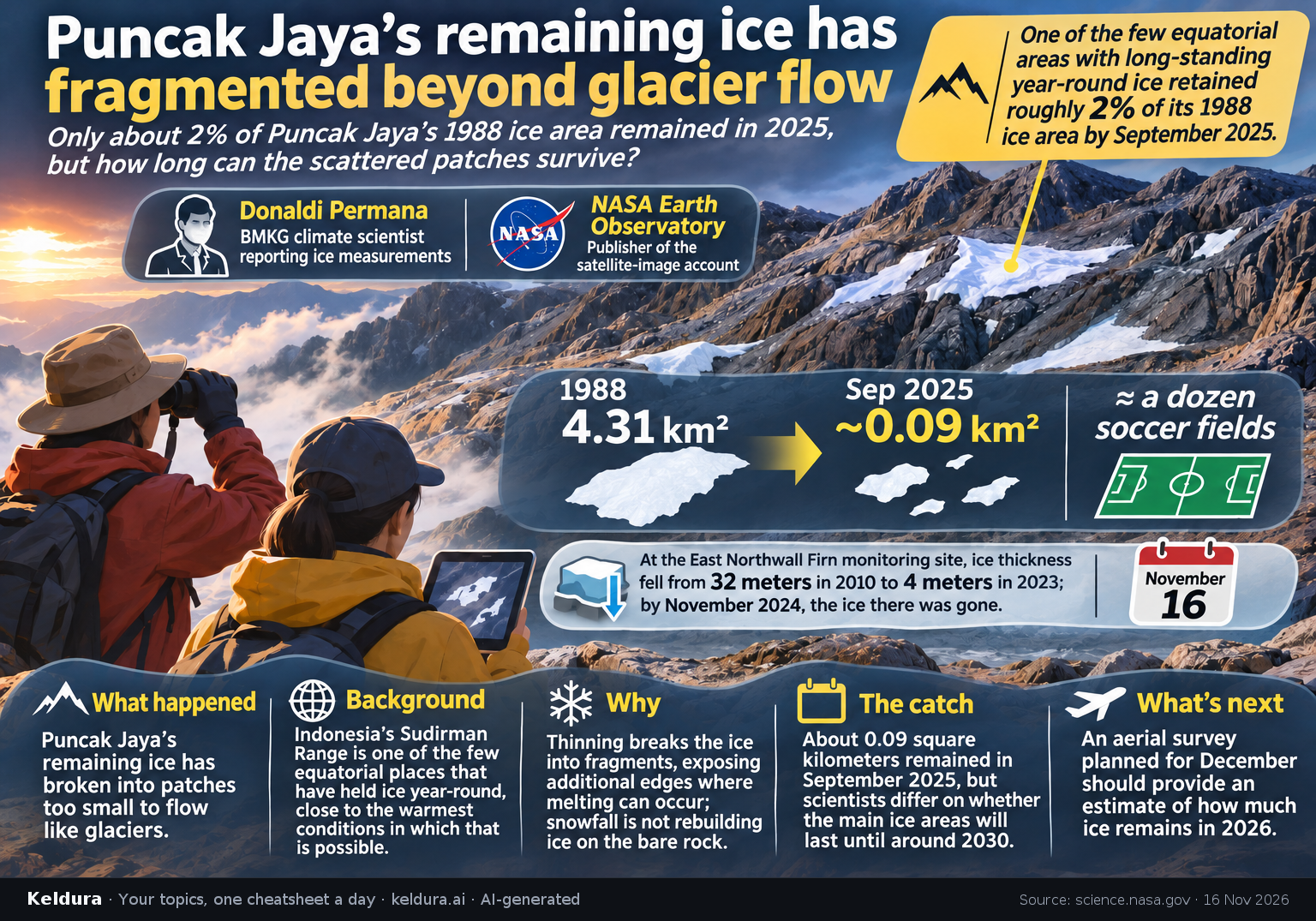
Only about 2% of Puncak Jaya’s 1988 ice area remained in 2025, but how long can the scattered patches survive?
On November 16, NASA described Puncak Jaya’s ice as patches too small to flow as glaciers, following a measured decline to 0.09 square kilometers by September 2025.
Why it matters: Readers can see a concrete measure of change in a rare equatorial ice system: an area of 4.31 square kilometers in 1988 had contracted to roughly a dozen soccer fields by September 2025. Scientists u…
Puncak Jaya’s remaining ice has broken into patches too small to flow like glaciers. [3]
Background
Indonesia’s Sudirman Range is one of the few equatorial places that have held ice year-round, close to the warmest conditions in which that is possible. [3]
Why
Thinning breaks the ice into fragments, exposing additional edges where melting can occur; snowfall is not rebuilding ice on the bare rock. [3]
The catch
About 0.09 square kilometers remained in September 2025, but scientists differ on whether the main ice areas will last until around 2030. [3]
What's next
An aerial survey planned for December should provide an estimate of how much ice remains in 2026. [3]
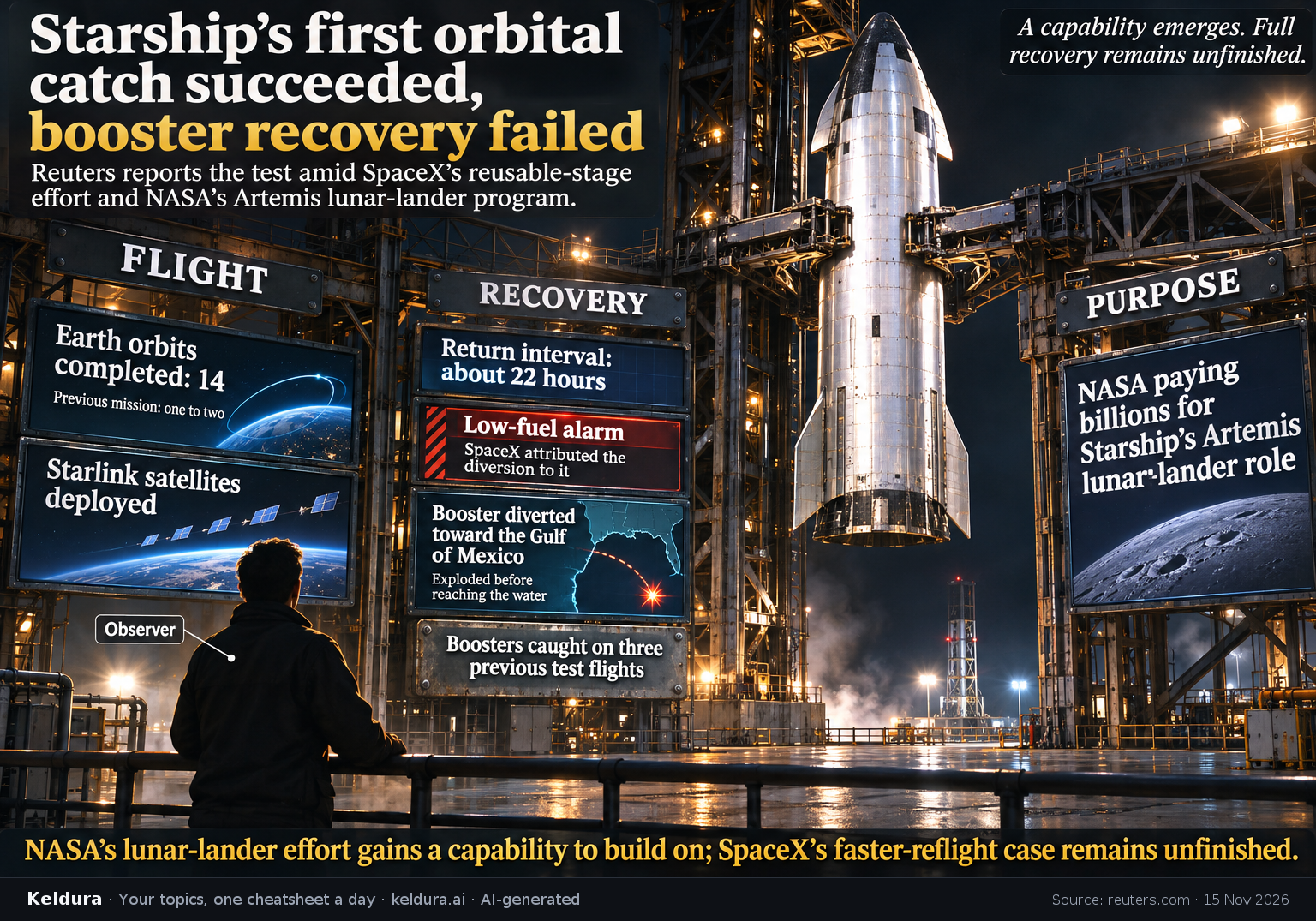
SpaceX caught its spacecraft after an orbital flight, but what still stands between that feat and full rocket reuse?
On November 14, 2026, SpaceX caught Starship’s upper stage at Starbase, Texas, after 14 Earth orbits, but its booster had exploded following launch the previous day.
Why it matters: NASA is paying billions of dollars for Starship to carry Artemis astronauts to the lunar surface, while SpaceX needs it to expand Starlink. Recovering the spacecraft gives both projects a demonstrate…
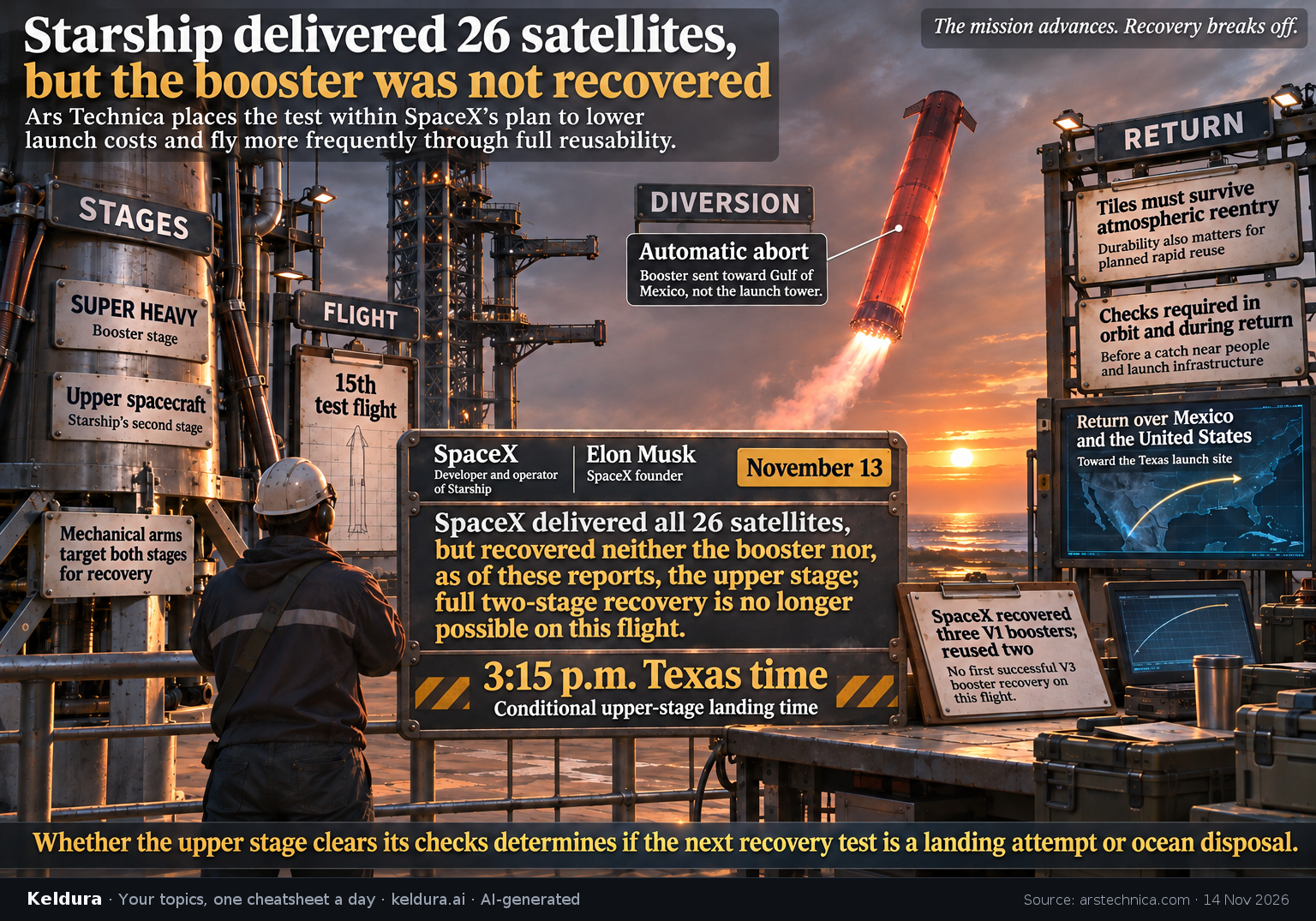
Starship delivered its satellites, but can its upper stage return from orbit into the launch tower’s arms?
On November 13, SpaceX launched Starship’s 15th test from Texas and deployed 26 Starlink satellites, but aborted recovery of its Super Heavy booster.
Why it matters: Recovering hardware is central to SpaceX’s plan to reduce launch costs and fly more frequently; losing the booster means this flight cannot demonstrate recovery of both stages. The upper stage must a…
Starship deployed 26 satellites, but an automatic abort sent its booster toward the Gulf of Mexico instead of the launch tower. [6][8]
Background
Starship has two stages: the Super Heavy booster and an upper spacecraft; SpaceX wants to recover both using the launch tower’s mechanical arms. [2][8]
Why
SpaceX is developing full reusability to lower spaceflight costs and support more frequent launches. [2][8]
The catch
The upper stage must pass checks in orbit and during return before SpaceX will risk a catch near people and launch infrastructure. [6]
What's next
A successful series of checks would allow a November 14 landing at about 3:15 p.m. Texas time, or 21:15 UTC; otherwise, SpaceX has earlier ocean-disposal options. [6]
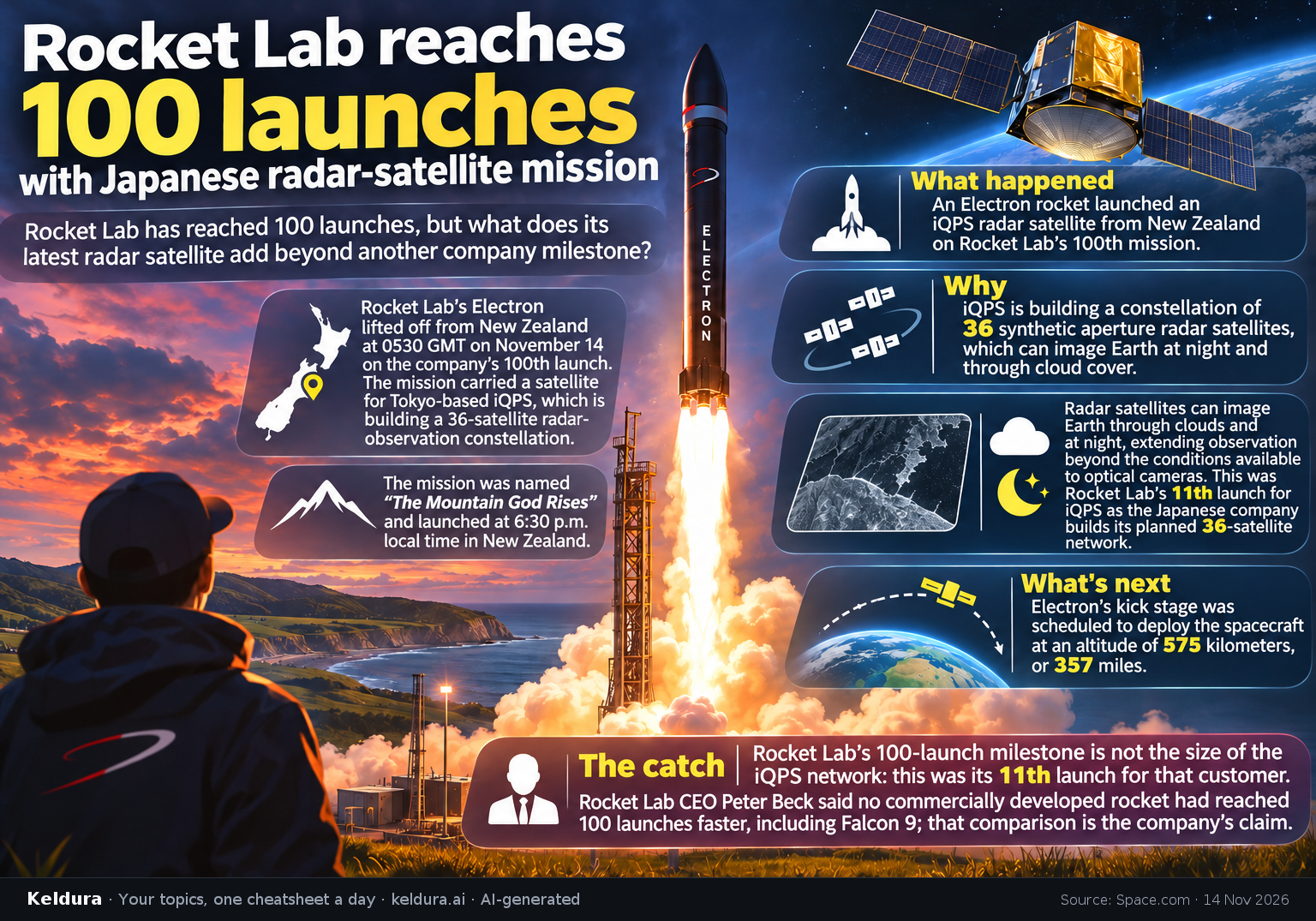
Rocket Lab has reached 100 launches, but what does its latest radar satellite add beyond another company milestone?
On November 14, Rocket Lab launched an Electron rocket carrying an iQPS Earth-observing satellite from New Zealand, marking the company’s 100th mission.
Why it matters: Radar satellites can image Earth through clouds and at night, extending observation beyond the conditions available to optical cameras. This was Rocket Lab’s 11th launch for iQPS as the Japanese comp…
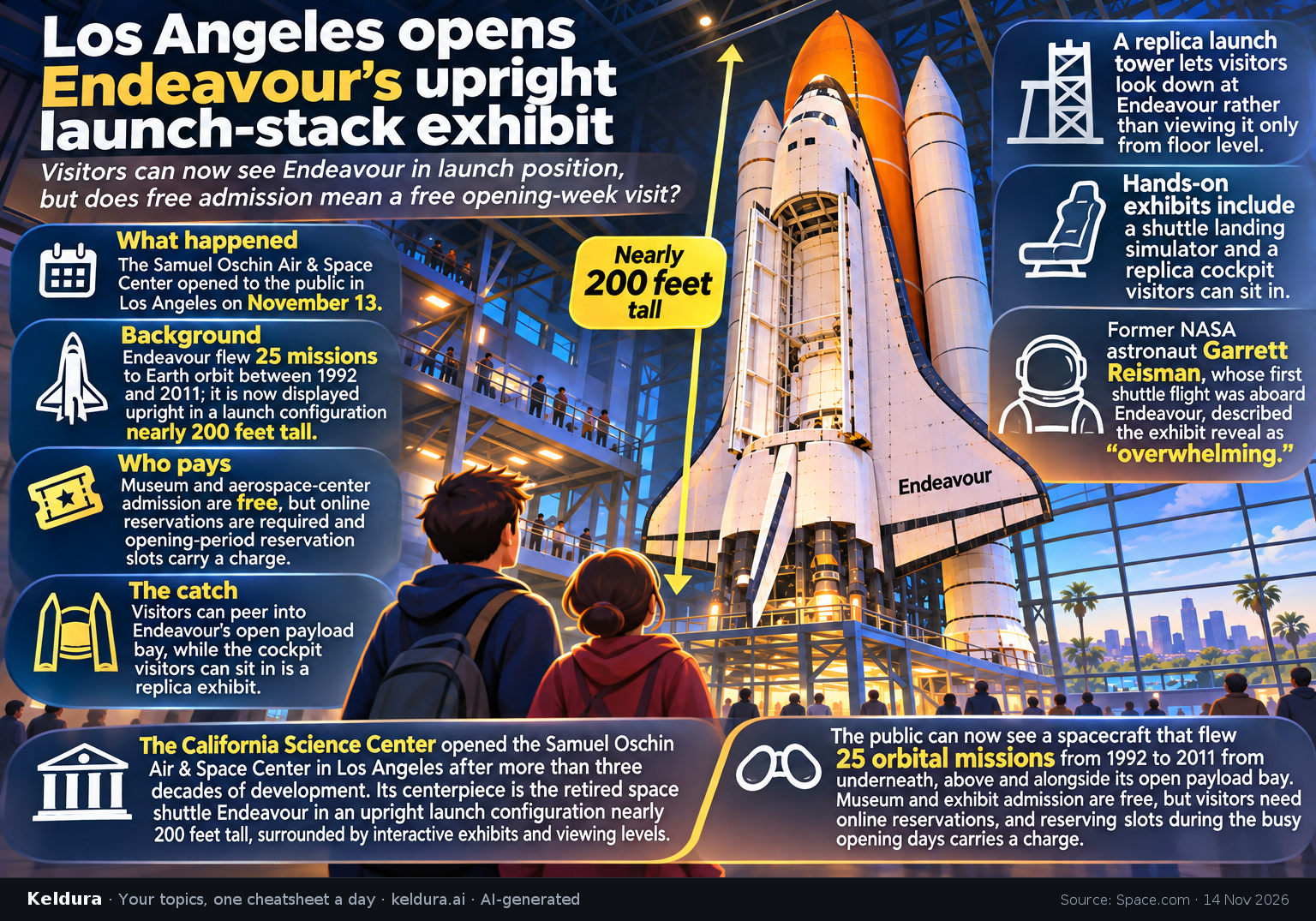
Visitors can now see Endeavour in launch position, but does free admission mean a free opening-week visit?
On November 13, the California Science Center opened its Samuel Oschin Air & Space Center, displaying Endeavour upright in a nearly 200-foot-tall launch configuration.
Why it matters: The public can now see a spacecraft that flew 25 orbital missions from 1992 to 2011 from underneath, above and alongside its open payload bay. Museum and exhibit admission are free, but visitors need…
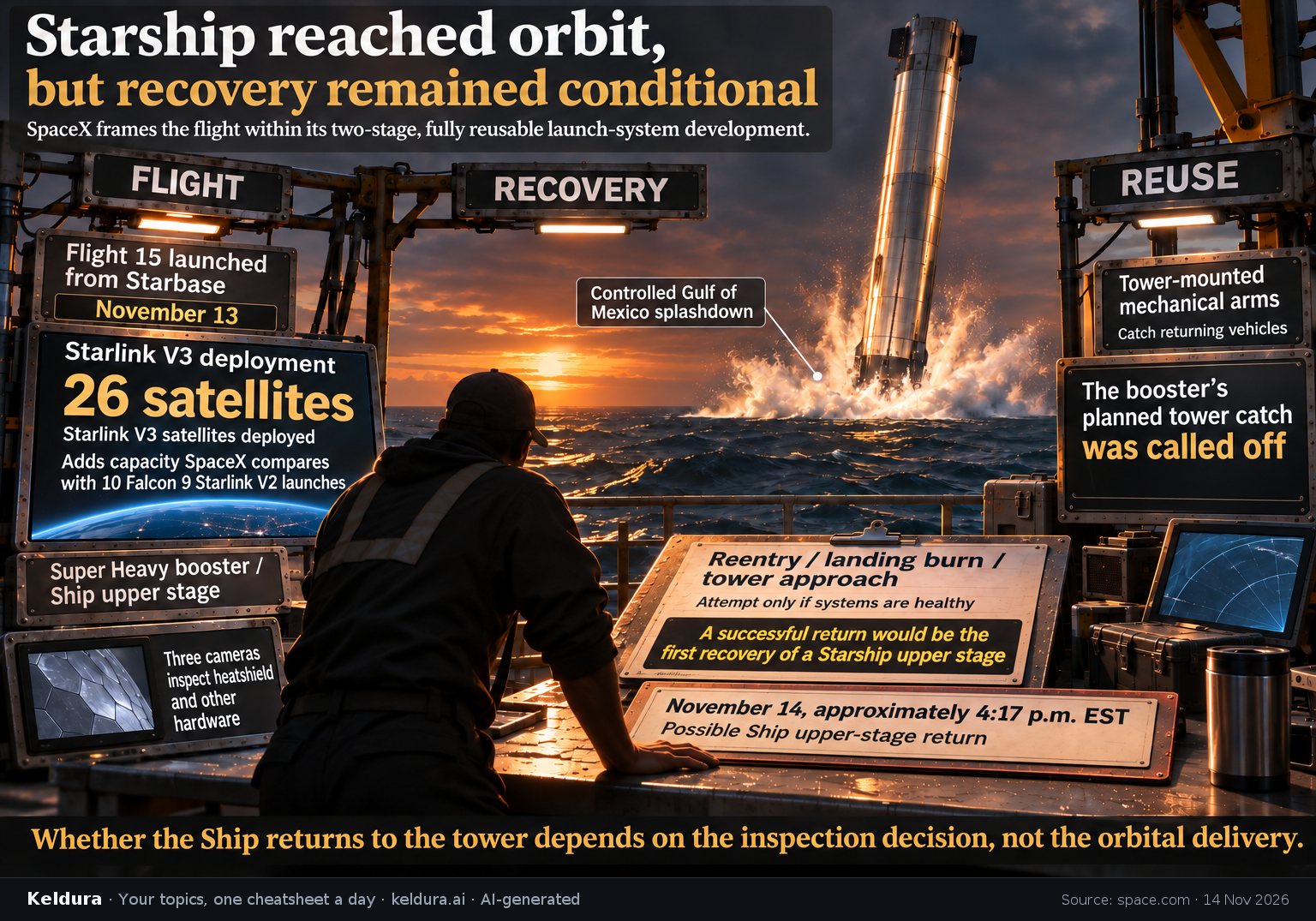
Starship reached orbit again, but can its upper stage return safely to the same launch tower?
On November 13, SpaceX launched Starship Flight 15 from Texas, deployed 26 satellites and called off the booster's planned tower catch.
Why it matters: Recovering the upper stage would give SpaceX its first recovered Starship spacecraft, a concrete step toward its goal of a fully reusable launch system. The flight also delivered satellites that Spac…
Flight 15 launched from Starbase on November 13, reached orbit and deployed 26 satellites; its booster splashed down about 6.5 minutes after liftoff. [3]
Background
Starship has two stages: the Super Heavy booster and the Ship upper stage. SpaceX is developing tower-mounted mechanical arms to catch returning vehicles as part of a fully reusable system. [3]
The catch
SpaceX said it would attempt the upper-stage return only if systems needed for reentry, the landing burn and tower approach were healthy; ocean-return options remained available. [3]
What's next
The planned upper-stage return was November 14 at approximately 4:17 p.m. EST, potentially producing the first recovery of a Starship upper stage. [3]
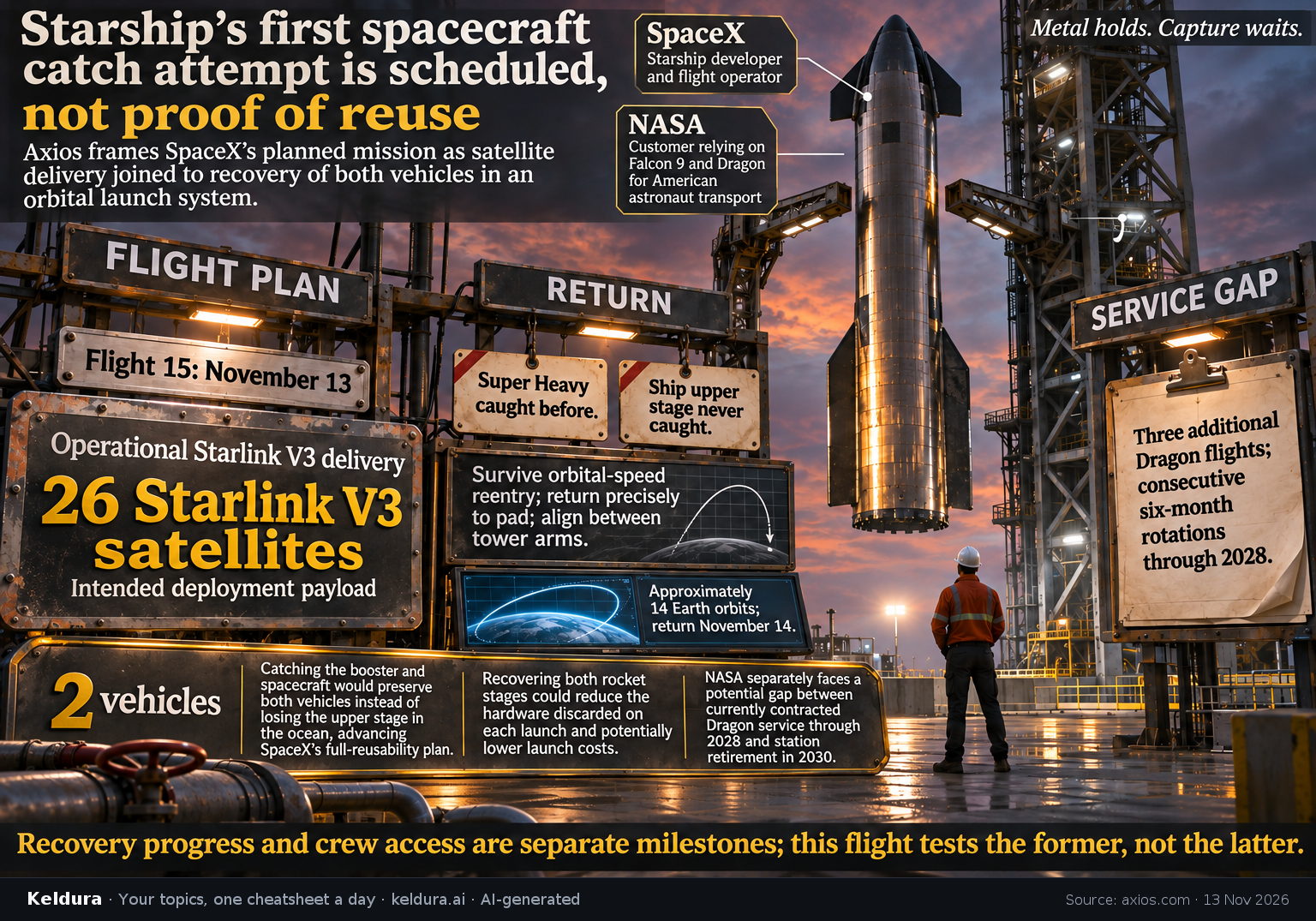
SpaceX has caught its booster before, but can it also recover the spacecraft after a full day in orbit?
SpaceX scheduled Starship's 15th flight for November 13, 2026, from South Texas, with its first spacecraft catch attempt planned after roughly 22 hours in orbit.
Why it matters: Recovering both rocket stages could reduce the hardware discarded on each launch and potentially lower launch costs. NASA also has a transition problem to watch: SpaceX intends to retire Falcon 9, wh…
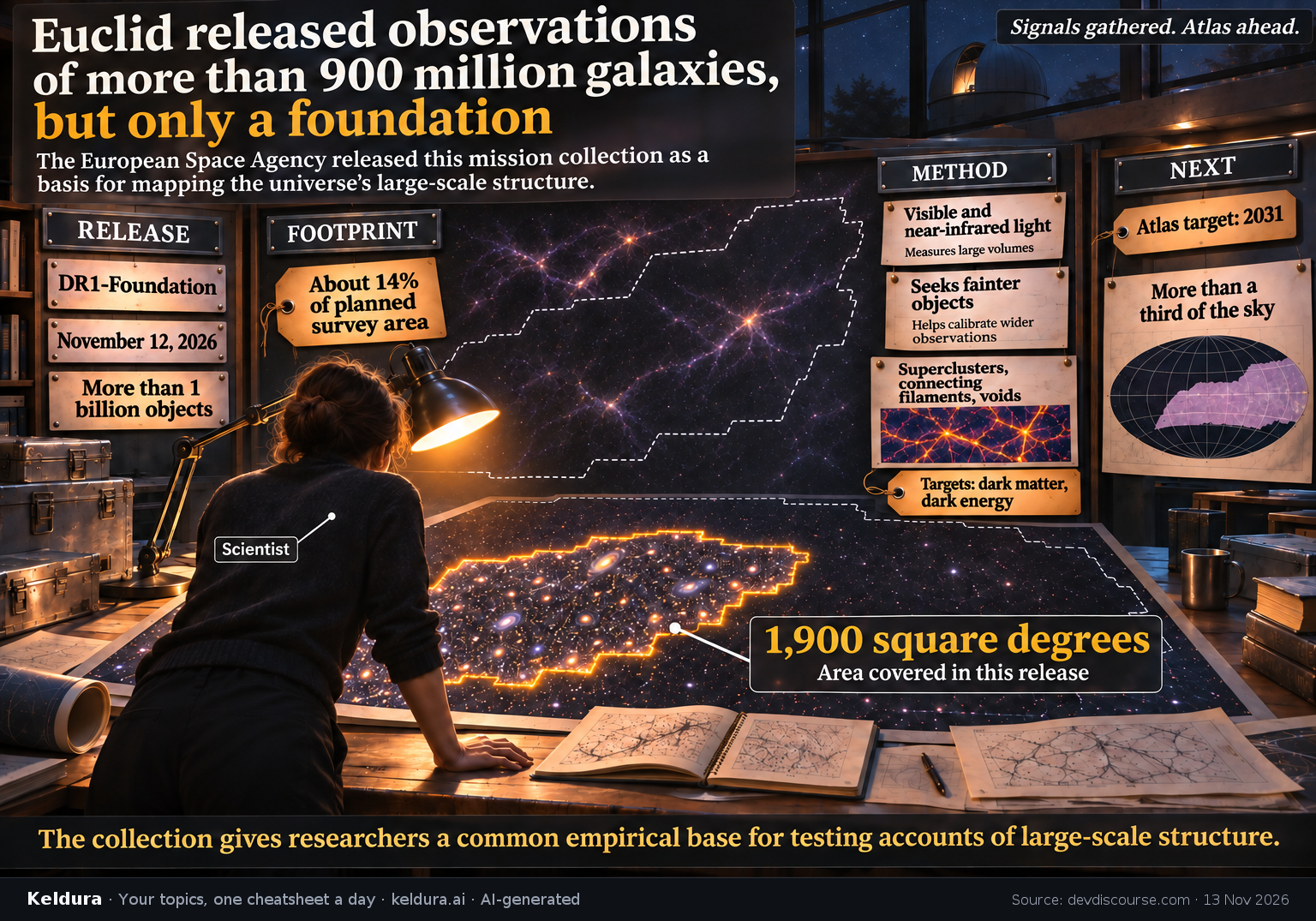
Euclid has released observations of more than 900 million galaxies, but what can this first slice reveal about the unseen universe?
On November 12, 2026, the European Space Agency released Euclid observations of more than 900 million galaxies across a sky area equivalent to about 9,500 full moons.
Why it matters: Researchers now have a common dataset covering more than 900 million galaxies for testing explanations of the universe's large-scale structure. It also supports work beyond cosmology: Euclid's deeper…
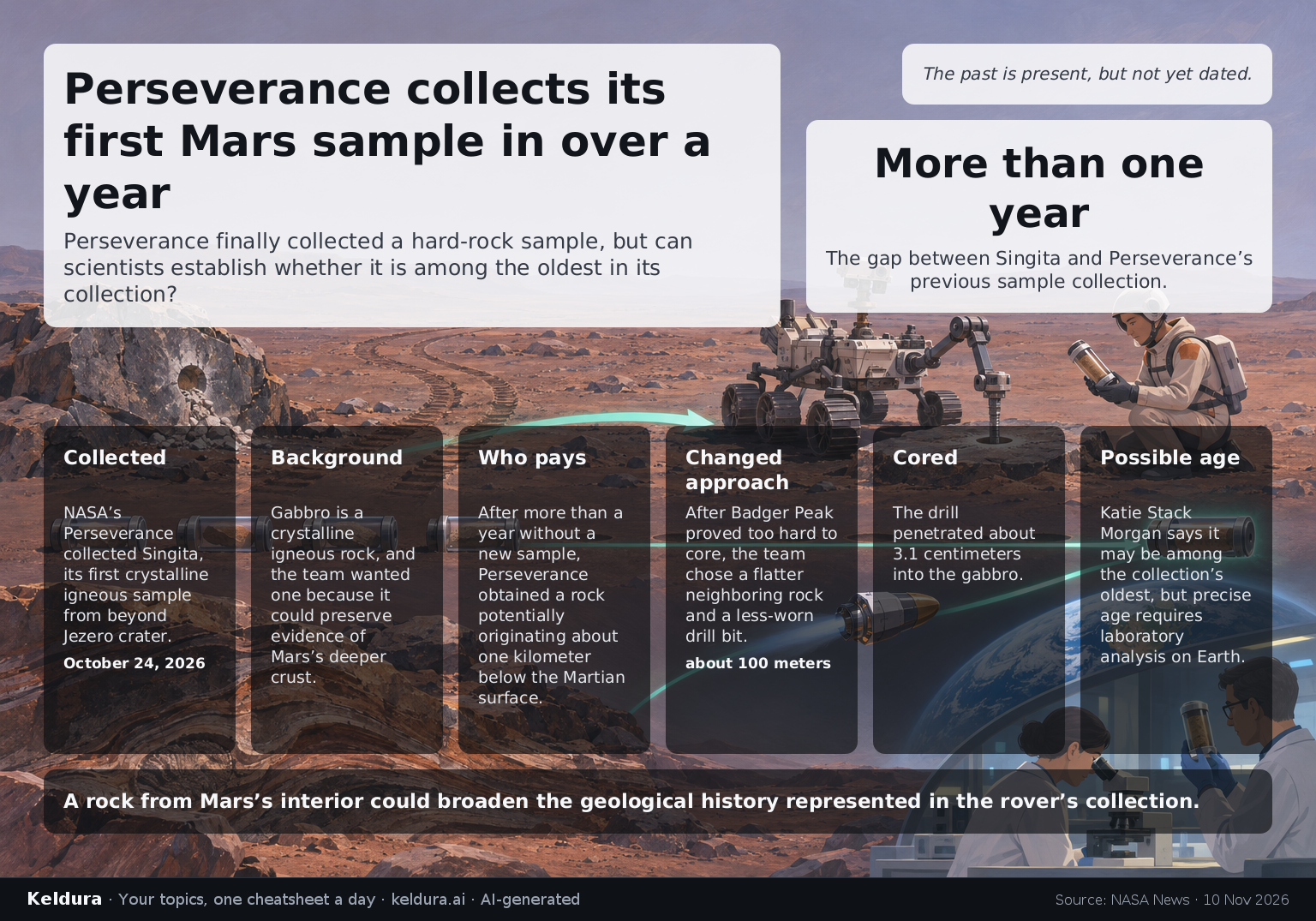
Perseverance finally collected a hard-rock sample, but can scientists establish whether it is among the oldest in its collection?
On October 24, 2026, NASA’s Perseverance rover collected the Singita rock sample on Mars, its first sample in more than a year.
Why it matters: Singita gives scientists a physical sample of material likely formed deep inside Mars, rather than only observations of its surface. It is Perseverance’s first crystalline igneous sample from beyond…
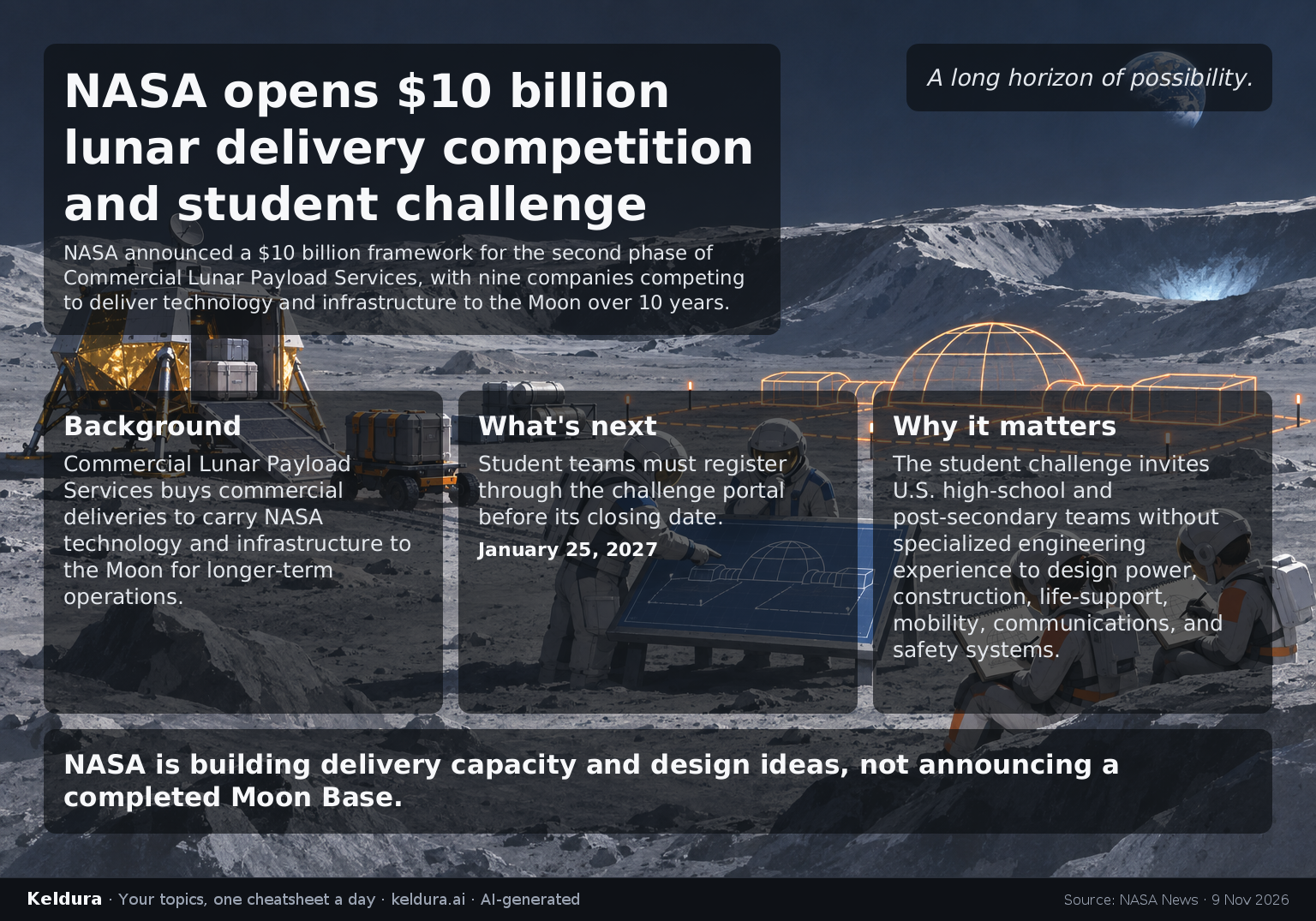
NASA announced a $10 billion framework for the second phase of Commercial Lunar Payload Services, with nine companies competing to deliver technology and infrastructure to the Moon over 10 years.
On November 7–8, NASA announced a $10 billion, 10-year lunar delivery framework and opened a $1 million Moon Base Student Challenge.
Why it matters: A sustained lunar presence requires more than astronaut transport: NASA is seeking delivery services and designs for power, construction, life support, mobility, communications, and safety. U.S. high…
NASA announced a $10 billion lunar delivery framework and opened a separate $1 million Moon Base Student Challenge. [11][12]
Background
Commercial Lunar Payload Services buys delivery services to the Moon. Its second phase is intended to carry NASA technology and infrastructure needed for longer-term lunar operations. [12]
Why
NASA’s planned South Pole base needs power, construction, life support, mobility, communications, and astronaut safety systems—the student challenge’s six design categories. [11]
The catch
Nine companies are competing within the delivery framework; the announcement is not a completed lunar infrastructure network or a single-company $10 billion award. [12]
What's next
Student teams must register through NASA STEM Gateway by January 25, 2027. [11]
NASA is recruiting for future Moon missions, but what does it take to join a corps with only 32 active astronauts?
On November 7, NASA opened recruitment for its next astronaut class, with applications due December 3 and final selection expected in late 2027.
Why it matters: For eligible U.S. citizens, this is a concrete application window rather than a general invitation to consider a space career: completed materials are due at 11:59 p.m. EST on December 3. The last cl…
NASA opened applications for its next astronaut class to support its expanding lunar exploration program. [5][7]
Why
The agency has 32 active astronauts and is preparing for lunar surface work, Moon Base operations and eventual crewed Mars missions. [5][7]
The catch
Applicants must be U.S. citizens and meet NASA’s education requirements; the previous round selected 10 candidates from more than 8,000 applications. [5]
What's next
Applications close at 11:59 p.m. EST on December 3, and NASA expects to make its final selection in late 2027. [5]
AST SpaceMobile wants its own rocket to launch phone-service satellites, but can Blacklift meet its 2028 target?
On November 6, AST SpaceMobile announced a $1.3 billion agreement with Firefly Aerospace for engines and support for its proposed Blacklift rocket, targeting a 2028 debut.
Why it matters: BlueBird satellites are designed to deliver internet service directly to cell phones, so AST SpaceMobile's ability to put them in orbit affects deployment of that service. Blacklift would give the co…
AST SpaceMobile announced Blacklift and a $1.3 billion agreement with Firefly Aerospace covering engine licensing, engines and engineering support. [4][8]
Background
AST SpaceMobile's BlueBird satellites provide internet service directly to cell phones; the company wants Blacklift to launch those satellites rather than depend entirely on outside rocket providers. [2][8]
Why
The proposed rocket would carry five BlueBird satellites per flight, giving AST SpaceMobile dedicated capacity to expand its constellation. [4]
Who pays
AST SpaceMobile will provide $800 million upfront in equal parts cash and stock, plus $250 million for engines and $250 million for engineering services. [4]
What's next
The announced first-flight target is 2028; Firefly's initial engine package covers the first three rockets. [4][8]
That's the desk. Every cheatsheet here started as a link. Yours can too.