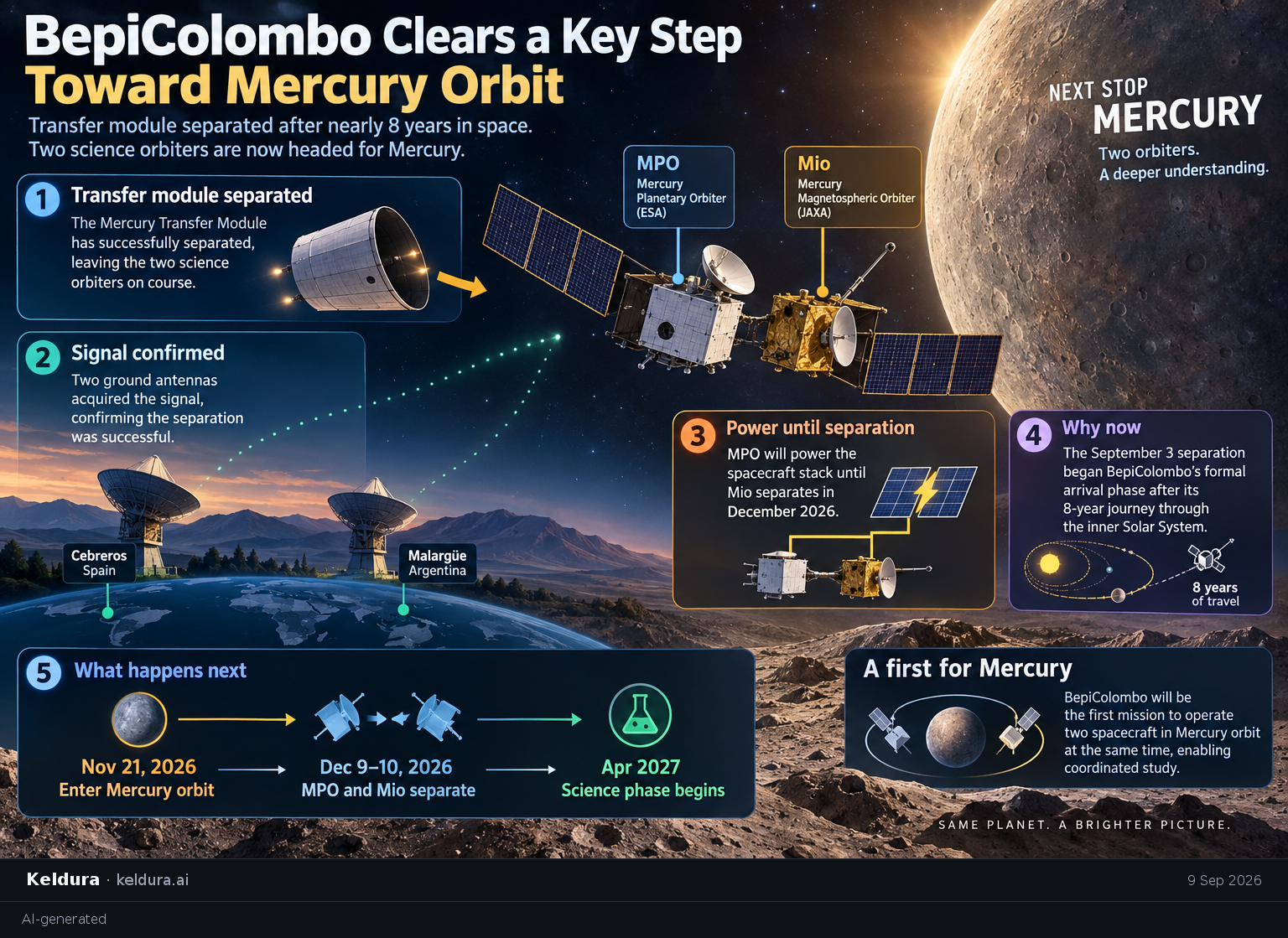
ESA confirmed that BepiColombo’s Mercury Transfer Module separated successfully after nearly eight years of travel through the inner Solar System, with telemetry indicating nominal systems and charging solar panels.
Why it matters: BepiColombo will be the first mission to operate two spacecraft in Mercury orbit simultaneously, enabling coordinated study by the Mercury Planetary Orbiter and Mercury Magnetospheric Orbiter.
Researchers developed a phenology-based method that combines Harmonized Landsat and Sentinel-2 imagery with field observations and planting records to identify crops remotely.
Why it matters: If deployed at scale, the method could help agencies verify conservation crops without visiting every field and assess practices intended to keep soil nutrients from entering waterways such as the Ch…
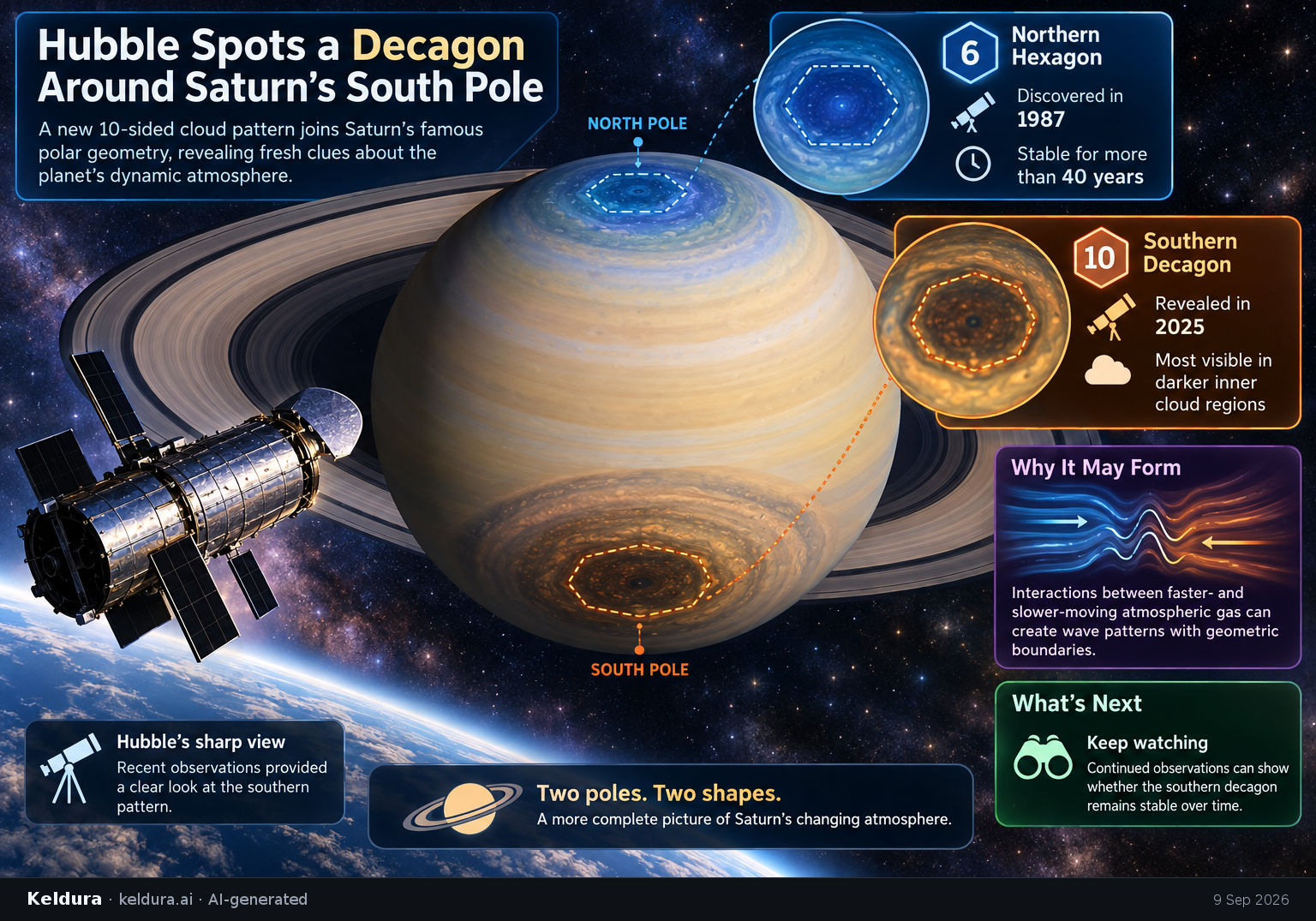
Recent Hubble observations revealed a 10-sided cloud pattern around Saturn’s South Pole, contrasting with the long-known hexagon surrounding its North Pole.
Why it matters: The northern hexagon has remained stable for more than 40 years, making continued observation of the southern decagon useful for determining whether it is similarly persistent and for testing explana…
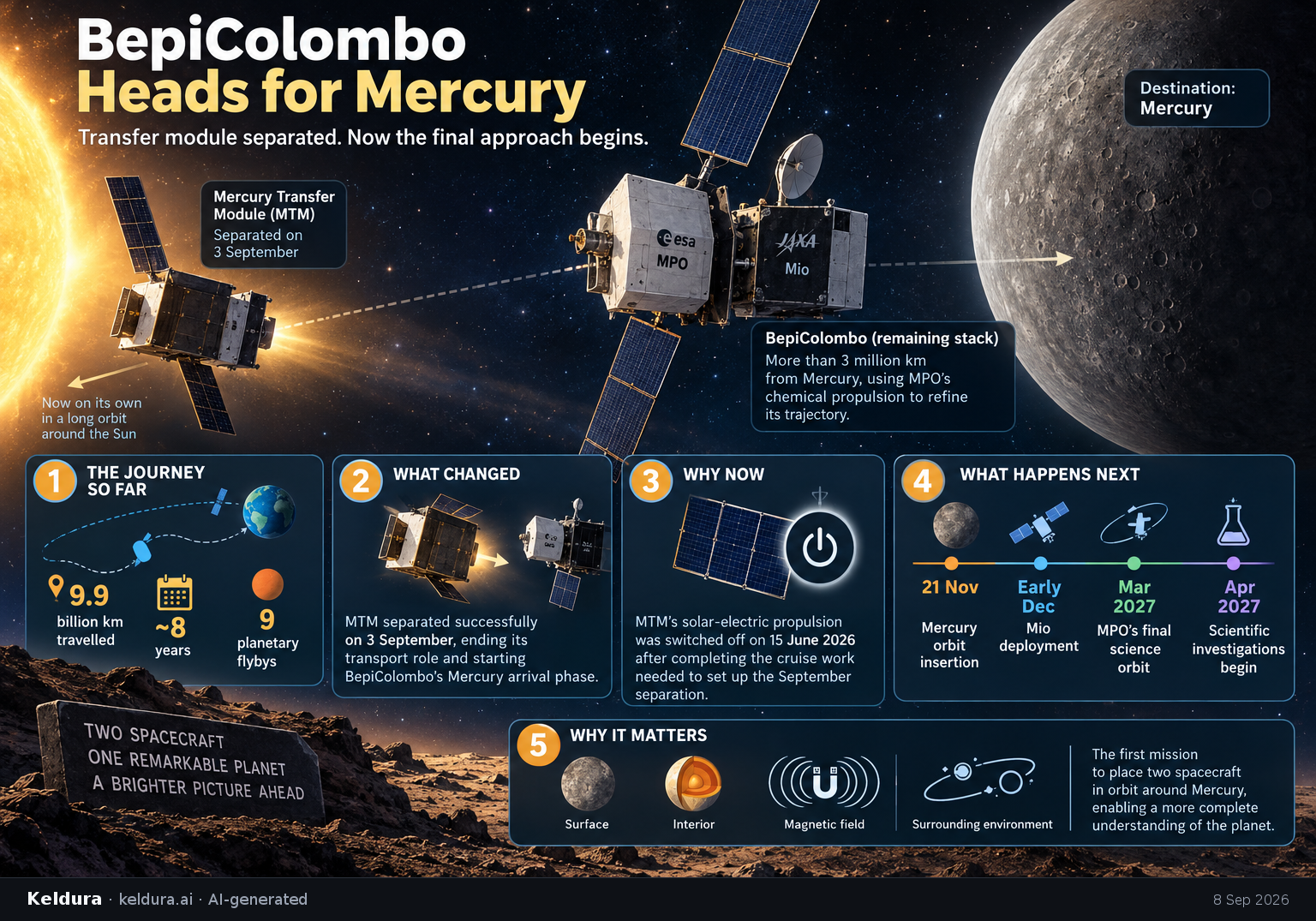
BepiColombo’s Mercury Transfer Module successfully separated from the spacecraft stack on 3 September after nearly eight years, 9.9 billion kilometres and nine planetary flybys.
Why it matters: BepiColombo is designed to become the first mission to place two spacecraft in orbit around Mercury, enabling complementary investigations of the planet’s surface, interior, magnetic field and surrou…
MTM separated successfully, ending its transport role and starting BepiColombo’s Mercury arrival phase.[2][3]
Why now
MTM’s solar-electric propulsion was switched off on 15 June 2026 after completing the cruise work needed to set up the September separation.[3]
Watch next
Mercury orbit insertion is scheduled for 21 November, followed by Mio’s deployment in early December, MPO’s final science orbit in March 2027 and scientific investigations from April 2027.[3]
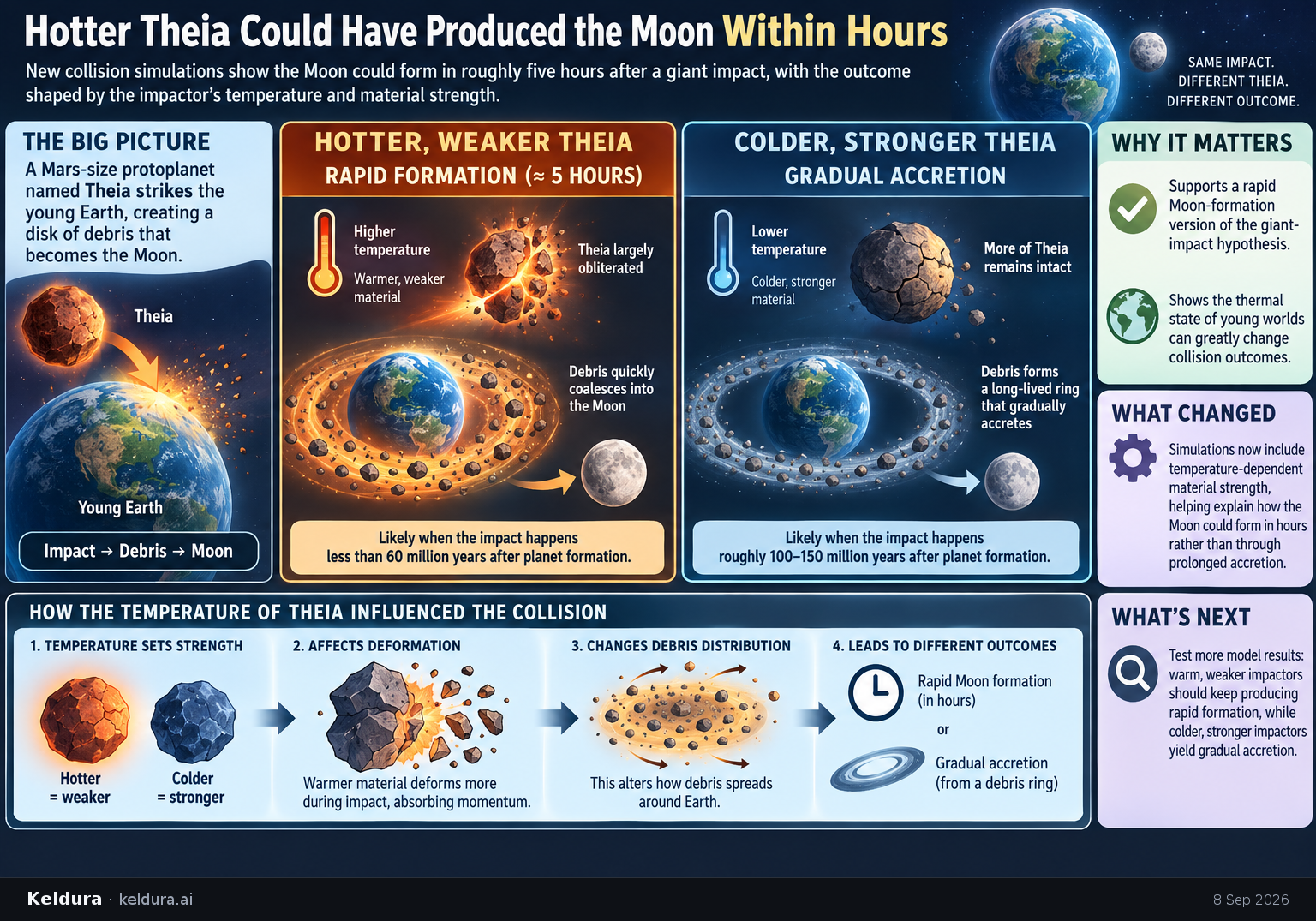
New collision simulations indicate that the Moon could have formed within roughly five hours after a giant impact between the young Earth and the Mars-size protoplanet Theia.
Why it matters: The results potentially strengthen the rapid-formation version of the leading giant-impact hypothesis and show that the thermal state of young worlds can substantially change simulated planetary coll…
Detailed simulations that include temperature-dependent material strength lend support to a Moon forming in hours rather than through prolonged accretion.[1]
Why now
Earlier models did not fully capture how the residual heat of recently formed protoplanets changed their mechanical behavior during the impact.[1]
Watch next
Further model results can be assessed by whether warmer, weaker impactors continue to produce rapid formation while colder, stronger impactors yield gradual accretion.[1]
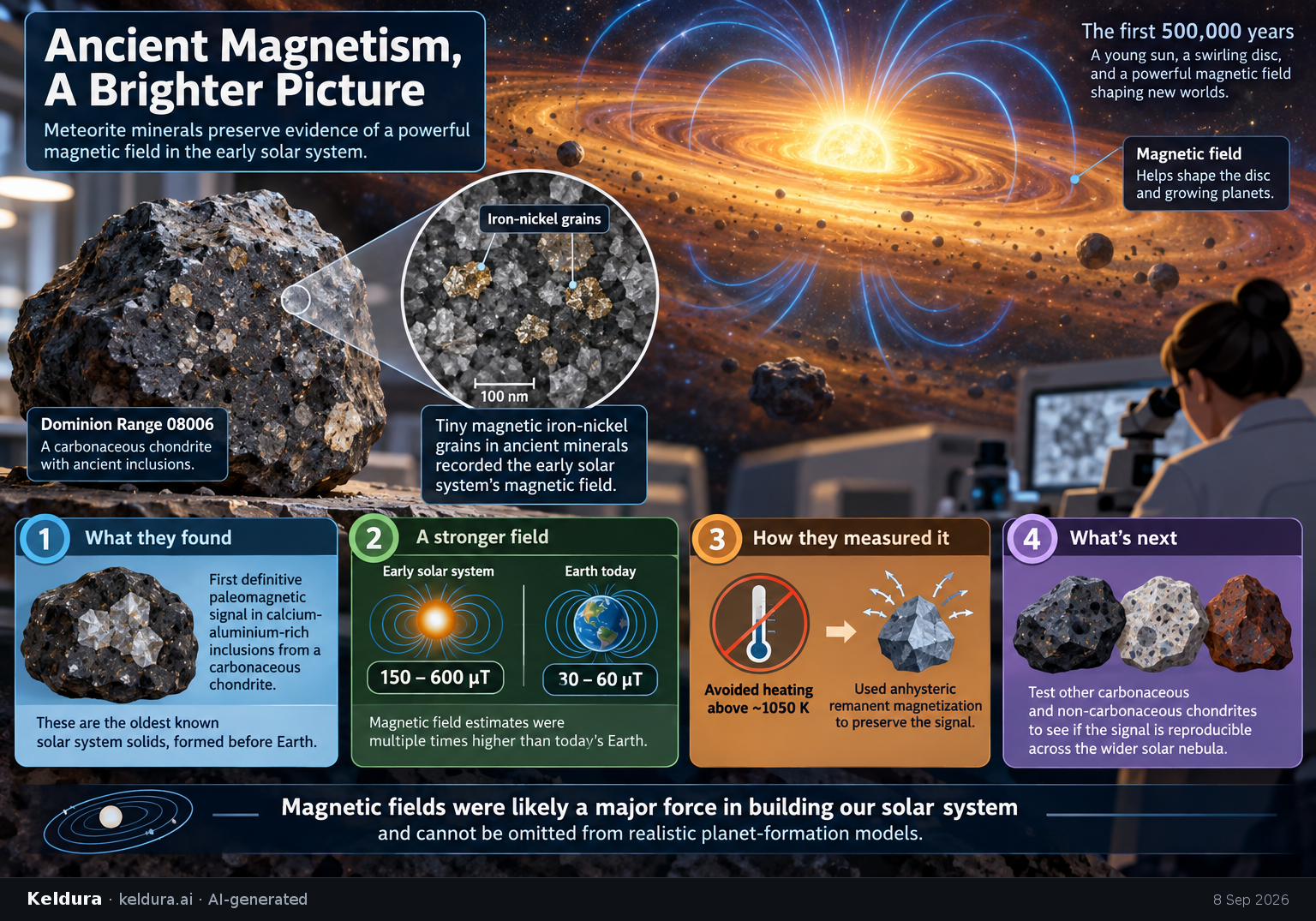
Why it matters: The measurements suggest magnetic fields cannot be omitted from realistic planet-formation simulations and may have been a dominant influence on the evolution of the protoplanetary disc.
A carbonaceous chondrite yielded the first definitive paleomagnetic signal of its kind and field estimates multiple times higher than previous estimates.[4]
Why now
Researchers identified magnetic iron-nickel grains in ancient inclusions and applied a method that avoided damaging laboratory heating.[4]
Watch next
The team is examining other carbonaceous and non-carbonaceous chondrites to test whether the signal is reproducible and reflects the wider solar nebula rather than a localized record.[4]
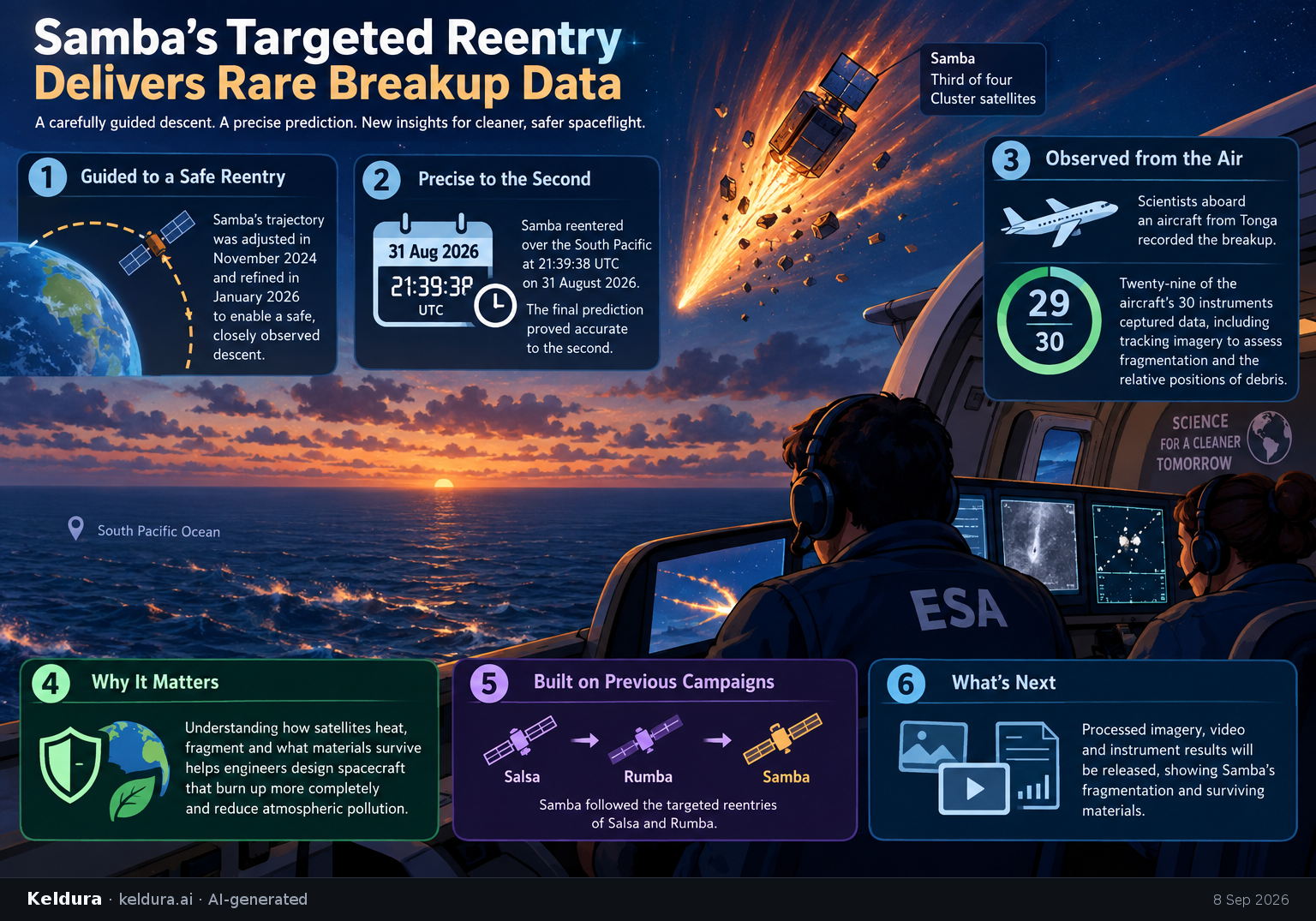
ESA’s Samba satellite reentered over the South Pacific at 21:39:38 UTC on 31 August 2026 after controllers adjusted its trajectory to support a safe, closely observed descent.
Why it matters: Measurements of how satellites heat, fragment and shed surviving materials can help engineers create spacecraft that burn up more completely while reducing atmospheric pollution.
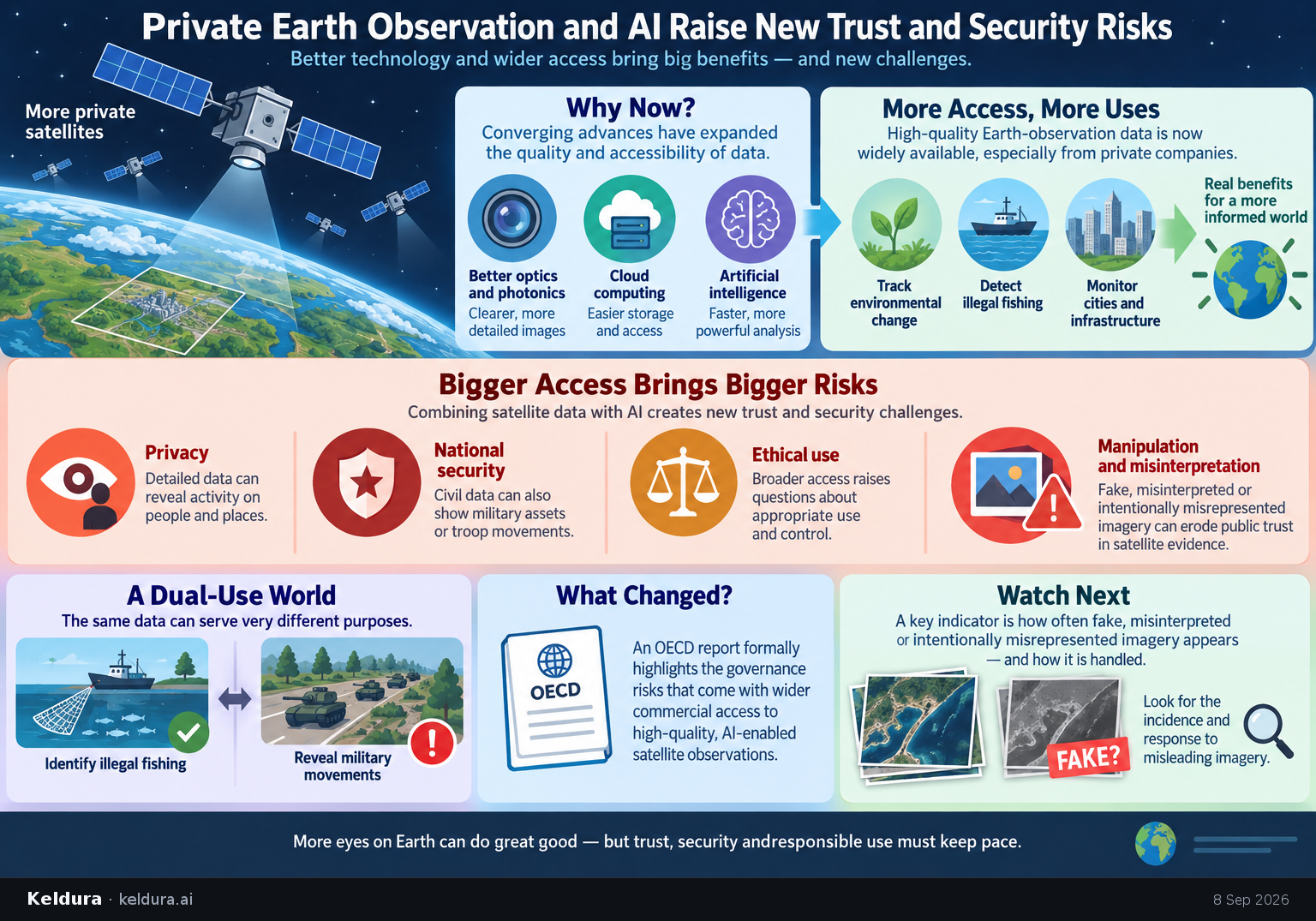
An OECD report says improvements in optics, photonics, cloud computing and artificial intelligence have expanded the quality and accessibility of satellite Earth-observation data.
Why it matters: Earth observation is inherently dual-use: systems that identify illegal fishing can also reveal military troop movements, widening access to strategically sensitive information.
Why it matters: The successful flight gives Europe a new privately developed launch option as governments seek greater autonomy, lower costs and competition with established providers such as Arianespace and non-Eur…
Spectrum successfully reached orbit from Norway, establishing Isar as the first European fully commercial launch-vehicle developer to achieve orbit.[1][3]
Why now
This was Spectrum’s second flight and fulfilled the European Launcher Challenge requirement to achieve an orbital launch no later than 2027.[1]
Watch next
Track Isar’s launch cadence, progress toward producing more than 30 rockets annually and development of its planned Canadian launch site.[5][6]
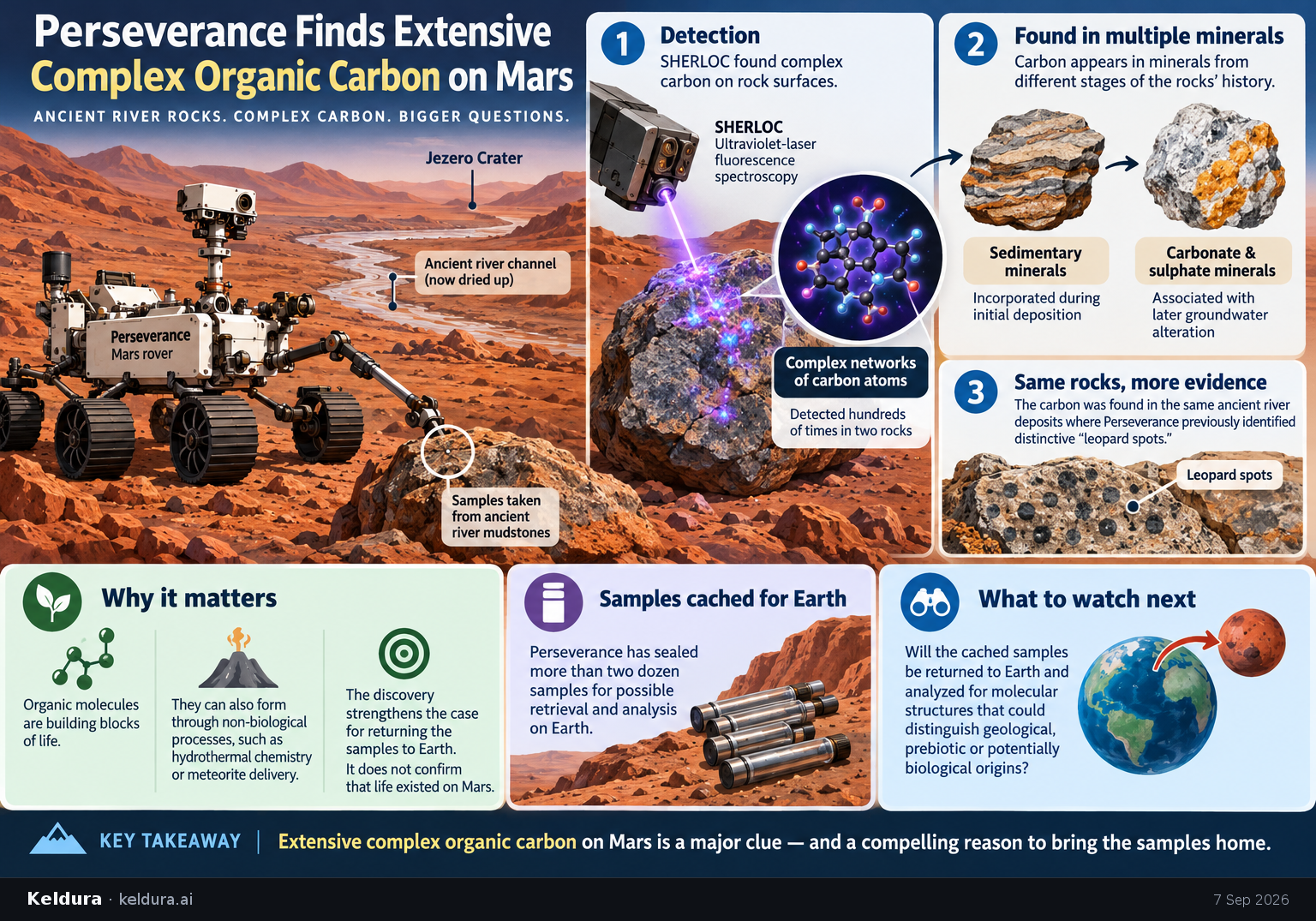
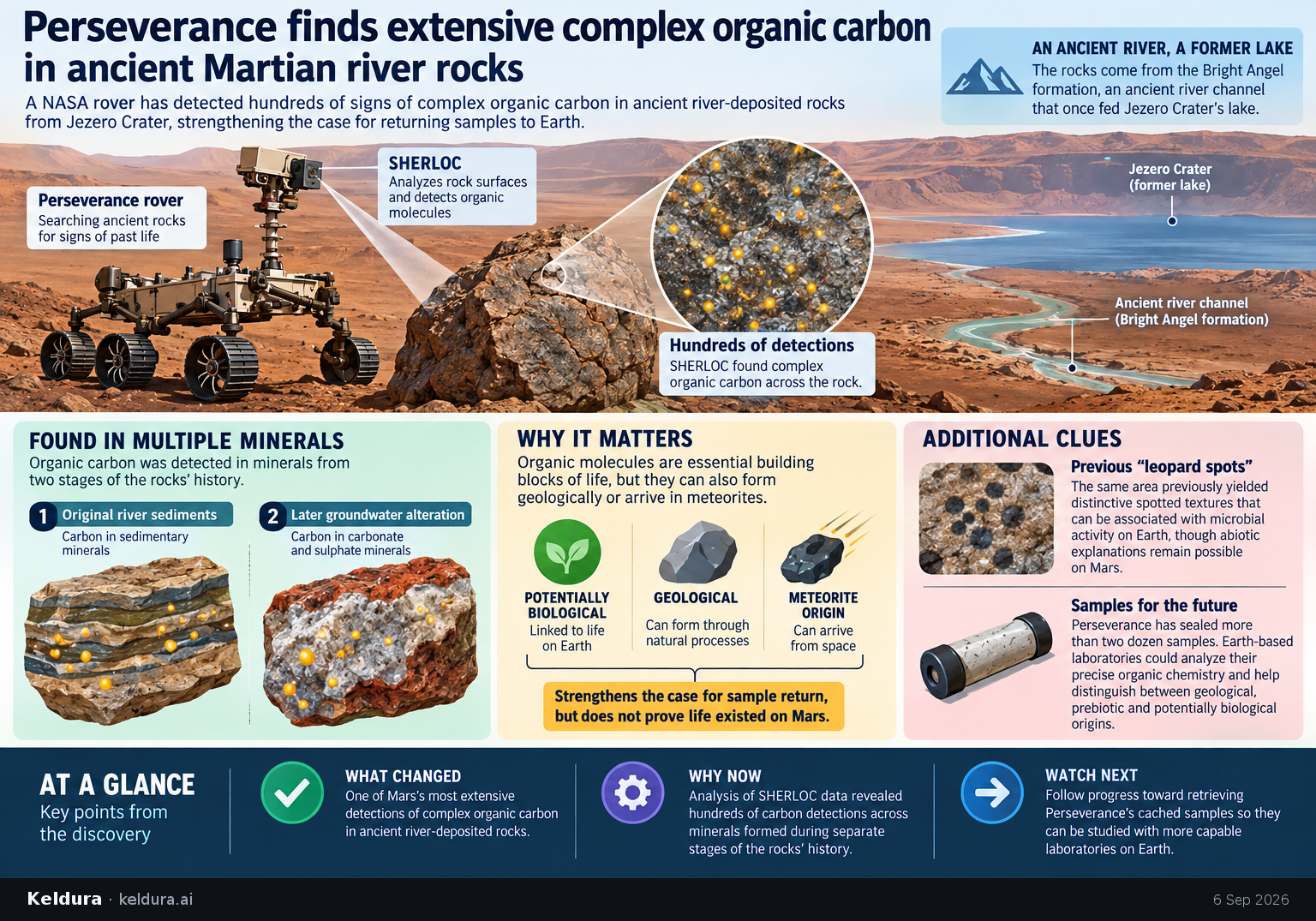
Why it matters: Organic molecules are building blocks of life but can also arise from hydrothermal chemistry or meteorite delivery, so the discovery strengthens the case for returning Perseverance’s cached samples t…
Researchers confirmed widespread macromolecular carbon in two ancient Martian river rocks sampled by Perseverance.[4]
Why now
Analysis of hundreds of SHERLOC detections showed complex carbon associated with minerals formed during at least two stages of the rocks’ history.[4]
Watch next
Watch whether the cached samples are returned to Earth and analyzed for molecular structures that could distinguish geological, prebiotic or potentially biological origins.[4]
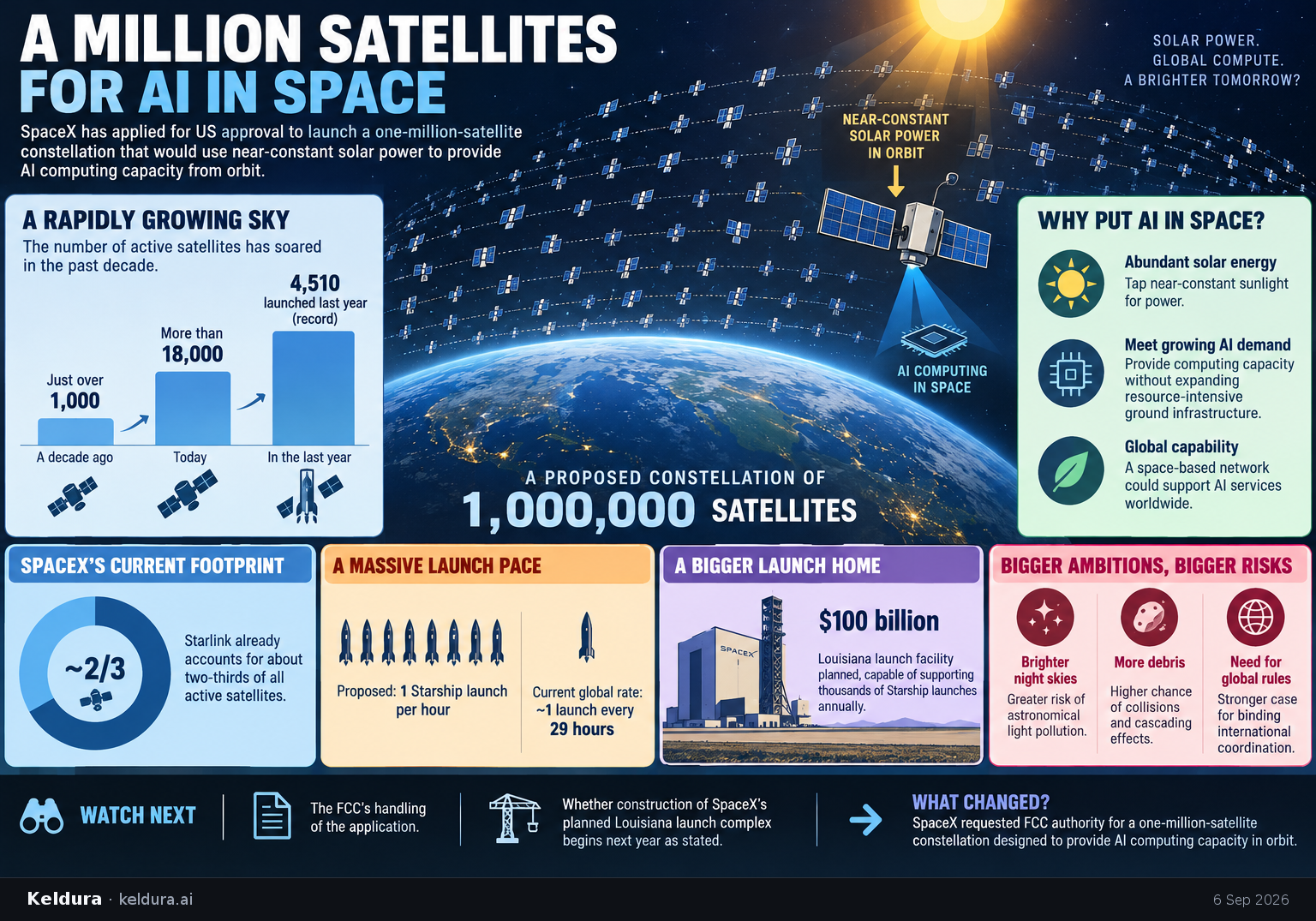
SpaceX has applied to the US Federal Communications Commission to launch one million satellites that would use near-constant solar power to provide processing capacity for artificial intelligence.
Why it matters: A constellation on this scale would dramatically increase pressure on low Earth orbit, sharpening concerns about astronomical light pollution, debris and cascading collisions while strengthening the…
Scientists have confirmed hundreds of detections of macromolecular carbon in two mudstones from the Bright Angel formation, an ancient river channel that once fed Jezero Crater’s lake.
Why it matters: Organic molecules are essential building blocks of life but can also form geologically or arrive in meteorites, so the result strengthens the case for returning Perseverance’s samples to Earth withou…
Researchers confirmed one of Mars’s most extensive detections of complex organic carbon in ancient river-deposited rocks.[2]
Why now
Analysis of SHERLOC observations revealed hundreds of carbon detections distributed across minerals formed during separate stages of the rocks’ history.[2]
Watch next
Watch progress toward retrieving Perseverance’s cached samples, because Earth-based analysis could distinguish geological, prebiotic and potentially biological origins more precisely.[2]
That's the desk. Every cheatsheet here started as a link. Yours can too.