Keldura Daily Open Keldura

Keldura Daily · Cheatsheets

Science & Space cheatsheets.

Every Science & Space cheatsheet Keldura Daily has published, newest first. Each cheatsheet is compiled by Keldura's AI from the sources it cites.

Cheatsheet your own link — free
Latest cheatsheets

Science & Space

Read in Briefings

Science & Space

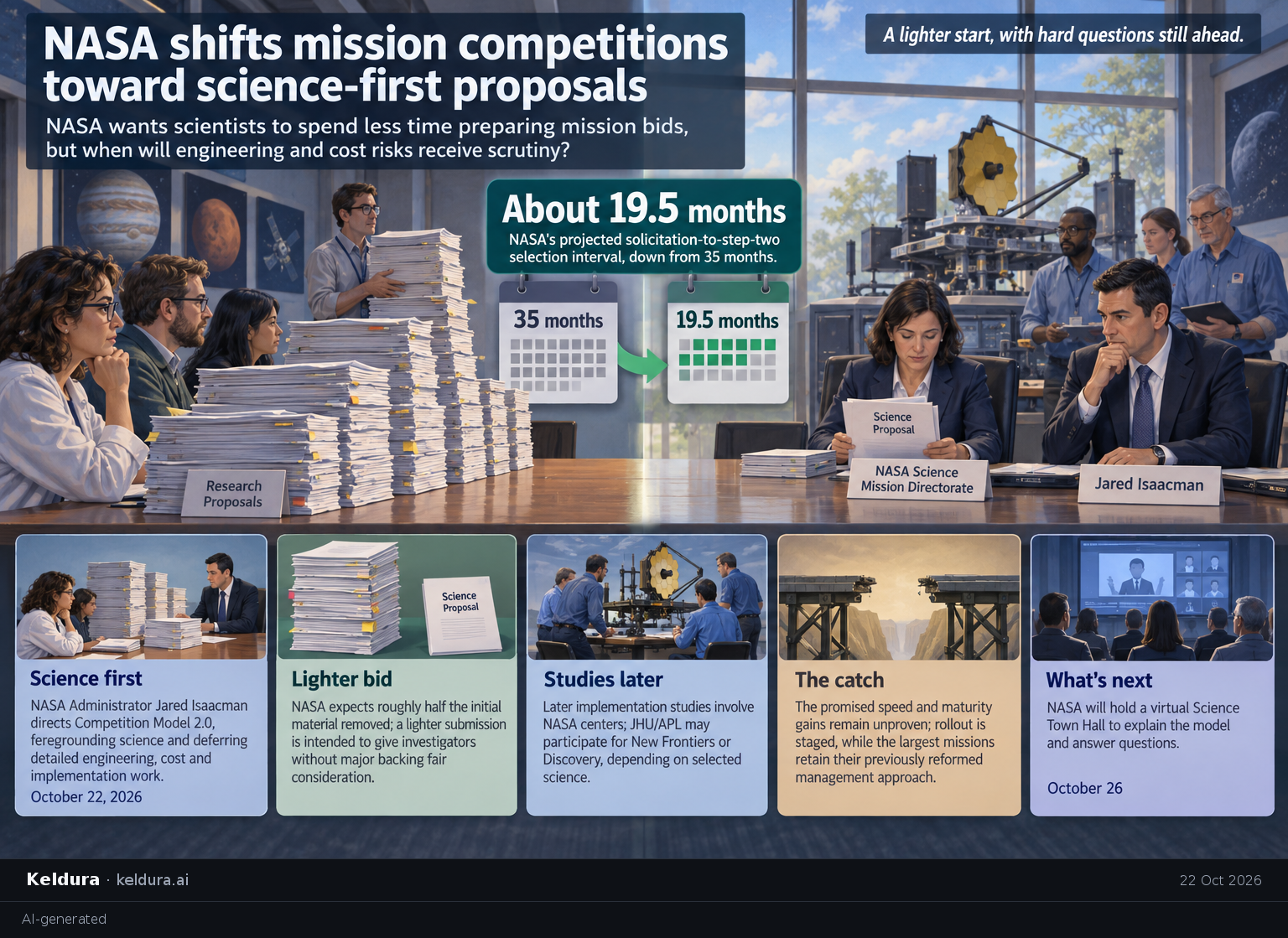
NASA shifts mission competitions toward science-first proposals

NASA wants scientists to spend less time preparing mission bids, but when will engineering and cost risks receive scrutiny?

Cheatsheet for NASA shifts mission competitions toward science-first proposals. Text equivalent is attached.

Why it matters: Preparing a mission proposal consumes researchers' time and resources before they know whether their idea will advance. NASA says a lighter initial submission should give investigators without major…

Open original · science.nasa.gov

Open cheatsheet → Post to X

What happened
NASA outlined a science-first competition model that delays detailed engineering, cost, and implementation work until needed for selection. [5]
Why
NASA says the existing process takes years and imposes excessive proposal burdens, contract-management challenges, and uncertainty. [5]
The catch
The shorter timeline is NASA's stated expectation, not a demonstrated result; implementation will be staged, and the largest missions retain their existing approach. [5]
What's next
NASA will hold a virtual Science Town Hall on October 26 to explain Competition Model 2.0 and answer questions. [5]

Science & Space

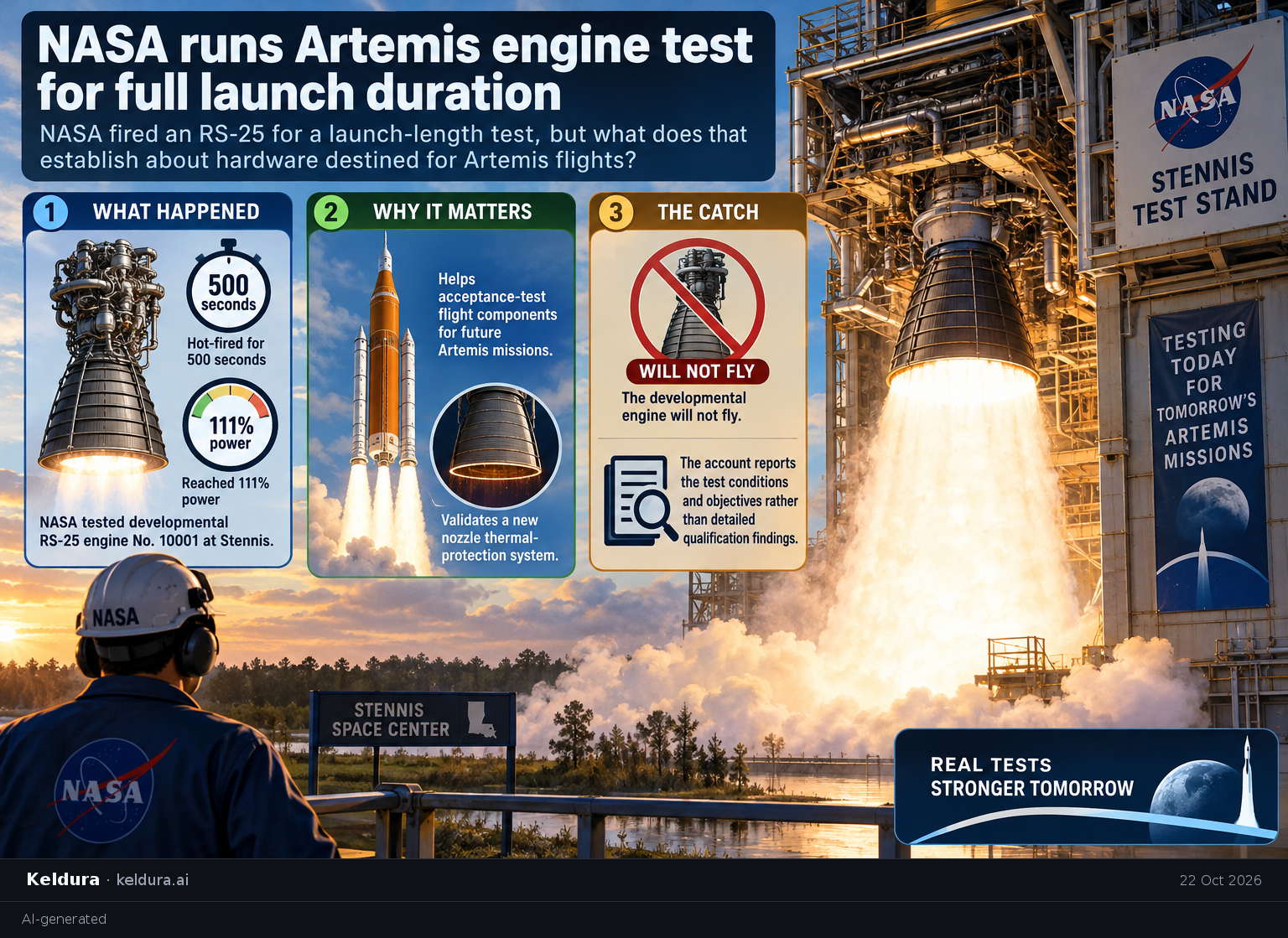
NASA runs Artemis engine test for full launch duration

NASA fired an RS-25 for a launch-length test, but what does that establish about hardware destined for Artemis flights?

Cheatsheet for NASA runs Artemis engine test for full launch duration. Text equivalent is attached.

Why it matters: The test exposes hardware to launch-relevant operating conditions before flight. Four RS-25 engines provide up to 2 million pounds of combined thrust on each SLS launch, making component acceptance a…

Open original · NASA News

Open cheatsheet → Post to X

What happened
NASA hot-fired developmental RS-25 engine No. 10001 for 500 seconds and reached 111% power at Stennis. [7]
Why
The objectives were to acceptance-test flight components for future Artemis missions and validate new nozzle thermal protection. [7]
The catch
The developmental engine will not fly; the account reports the test conditions and objectives rather than detailed qualification findings. [7]

Science & Space

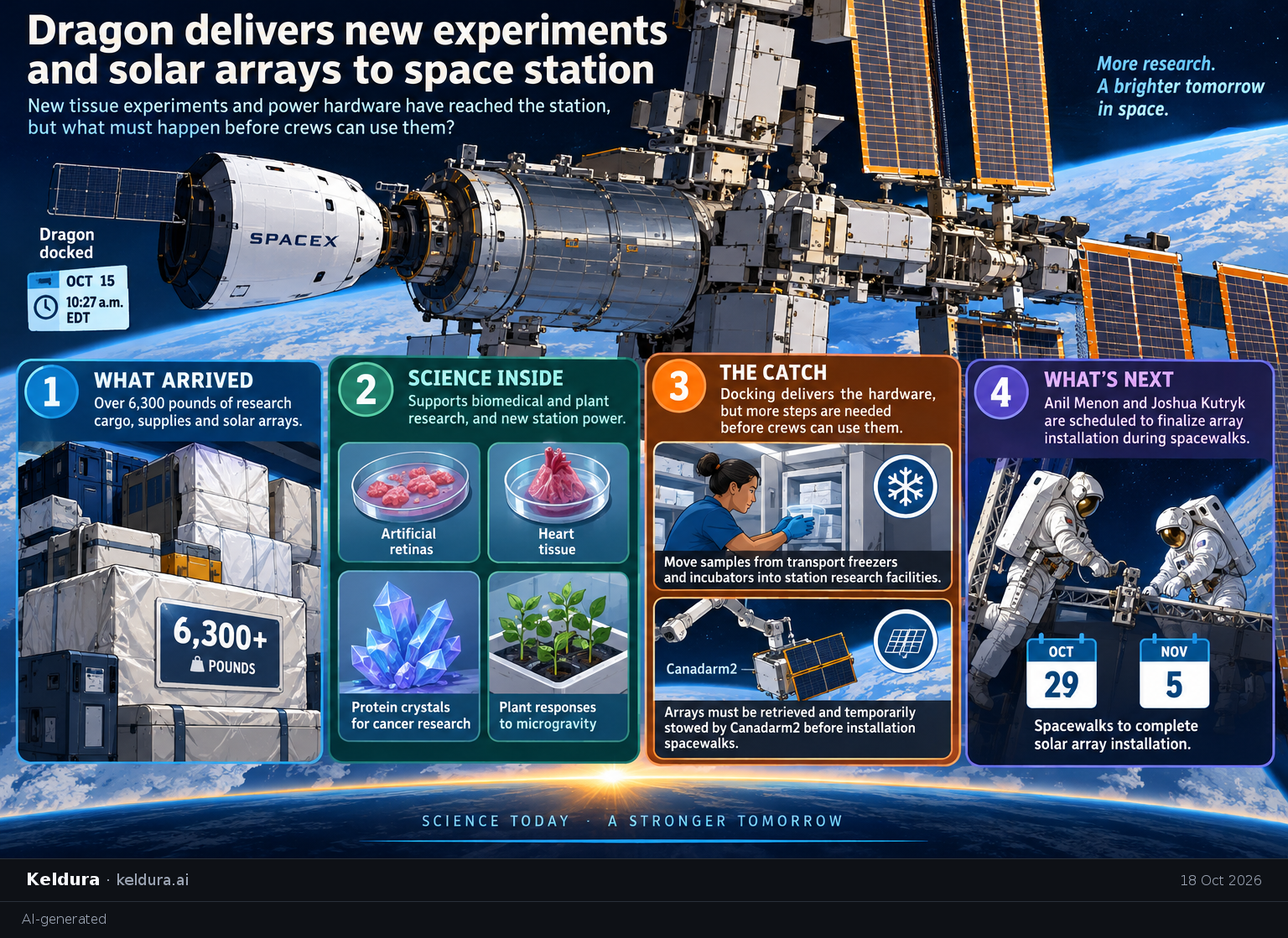
Dragon delivers new experiments and solar arrays to space station

New tissue experiments and power hardware have reached the station, but what must happen before crews can use them?

Cheatsheet for Dragon delivers new experiments and solar arrays to space station. Text equivalent is attached.

Why it matters: The delivery supports research into artificial retinas, heart tissue, protein crystals for cancer treatment research and plant responses to microgravity, alongside hardware intended to increase the s…

Open original · NASA News

Open cheatsheet → Post to X

What happened
Dragon arrived with over 6,300 pounds of research cargo, supplies and solar arrays. [9]
Why
The cargo supports biomedical and plant research, while the arrays will augment station power generation. [9]
The catch
Docking delivers the hardware, but samples need laboratory transfer and the arrays require robotic handling and spacewalks. [9]
What's next
Anil Menon and Joshua Kutryk are scheduled to finalize array installation during spacewalks on October 29 and November 5. [9]

Science & Space

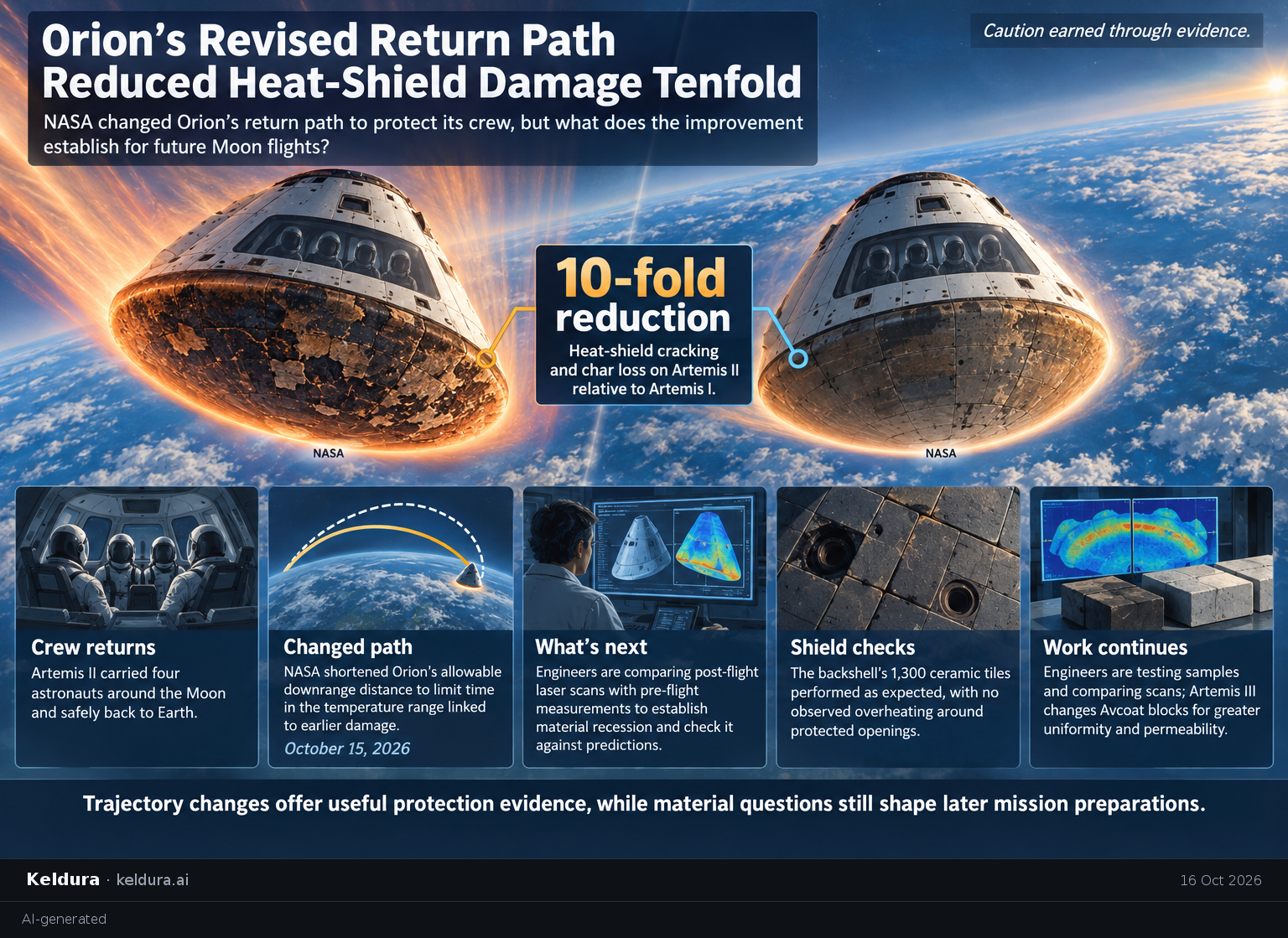
Orion’s Revised Return Path Reduced Heat-Shield Damage Tenfold

NASA changed Orion’s return path to protect its crew, but what does the improvement establish for future Moon flights?

Cheatsheet for Orion’s Revised Return Path Reduced Heat-Shield Damage Tenfold. Text equivalent is attached.

Why it matters: The result gives NASA flight evidence that changing Orion’s trajectory can reduce the heat-shield damage seen on Artemis I while protecting a crew. It also informs later missions, although Artemis II…

Open original · NASA News

Open cheatsheet → Post to X

What happened
NASA found tenfold less heat-shield cracking and char loss on Artemis II than on Artemis I, with nine char-loss spots versus 103. [1]
Why
A shorter allowable reentry downrange distance limited time in the temperature range associated with the earlier damage. [1]
The catch
The shield still experienced some char loss, and Artemis III uses additional design changes to improve Avcoat uniformity and permeability. [1]
What's next
Engineers are comparing post-flight laser scans with pre-flight measurements to establish material recession and check it against predictions. [1]

Science & Space

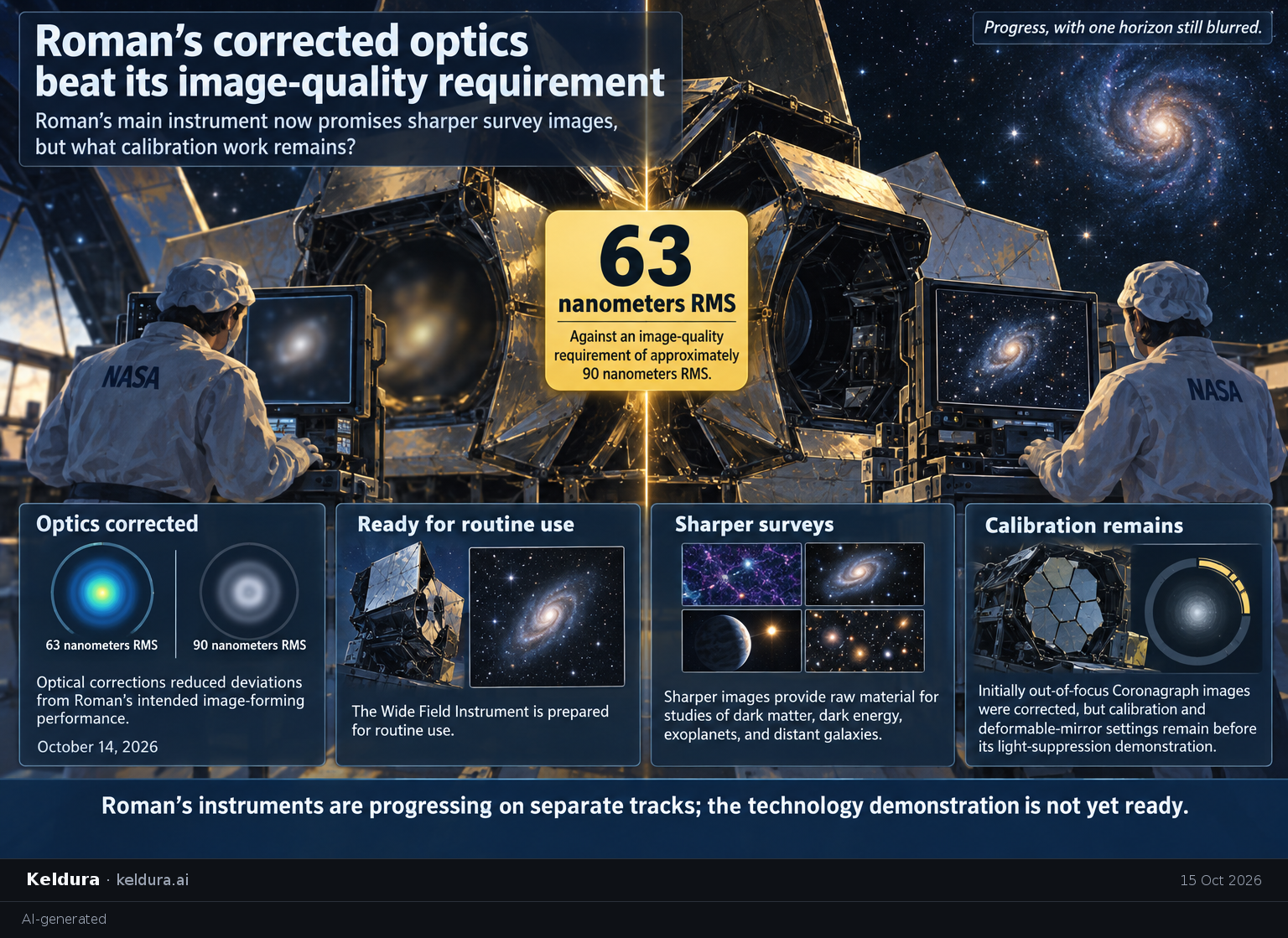
Roman’s corrected optics beat its image-quality requirement

Roman’s main instrument now promises sharper survey images, but what calibration work remains?

Cheatsheet for Roman’s corrected optics beat its image-quality requirement. Text equivalent is attached.

Why it matters: Sharper images improve the raw material for Roman’s broad cosmic surveys, which are intended to investigate dark matter, dark energy, exoplanets, and distant galaxies.

Open original · NASA News

Open cheatsheet → Post to X

What happened
Corrections brought Roman’s Wide Field Instrument to 63 nanometers RMS optical error, below its approximately 90-nanometer requirement. [5]
Why
The work fine-tuned the observatory’s vision and prepared its primary instrument for routine use. [5]
The catch
The Coronagraph Instrument still needs calibration and mirror-setting work before its planned light-suppression demonstration in the coming weeks. [5]

Science & Space

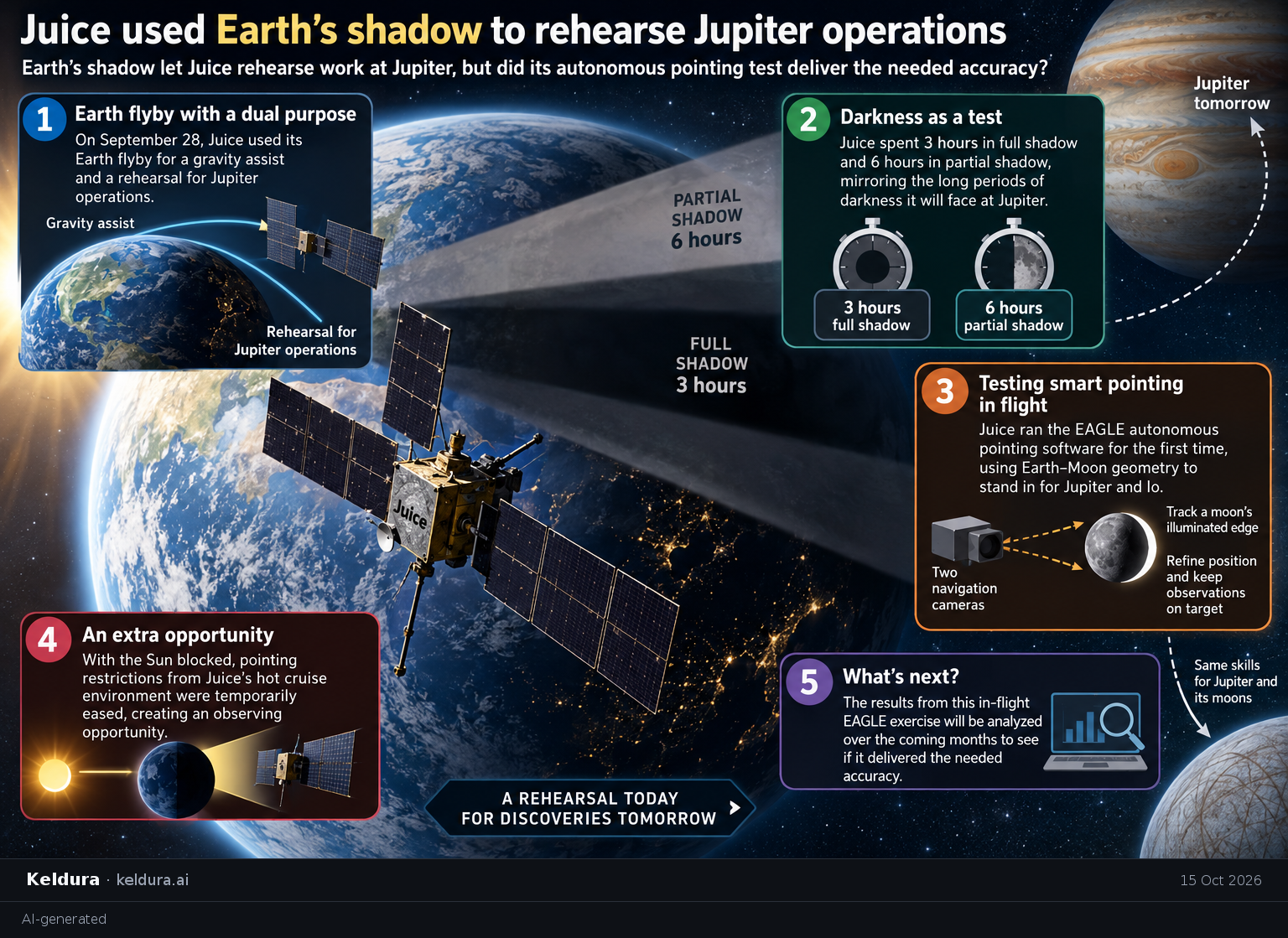
Juice used Earth’s shadow to rehearse Jupiter operations

Earth’s shadow let Juice rehearse work at Jupiter, but did its autonomous pointing test deliver the needed accuracy?

Cheatsheet for Juice used Earth’s shadow to rehearse Jupiter operations. Text equivalent is attached.

Why it matters: Juice will need to conduct science through long periods of darkness at Jupiter and keep instruments accurately pointed during close moon flybys. This encounter provided a rehearsal years before arriv…

Open original · ESA News

Open cheatsheet → Post to X

What happened
The September 28 Earth flyby served as both a gravity assist and a rehearsal for Jupiter operations. [3]
Why
Three hours in full shadow and six in partial shadow offered conditions resembling the darkness Juice will encounter at Jupiter. [3]
The catch
The first in-flight EAGLE exercise has taken place, but its results will be analyzed over the coming months. [3]

Science & Space

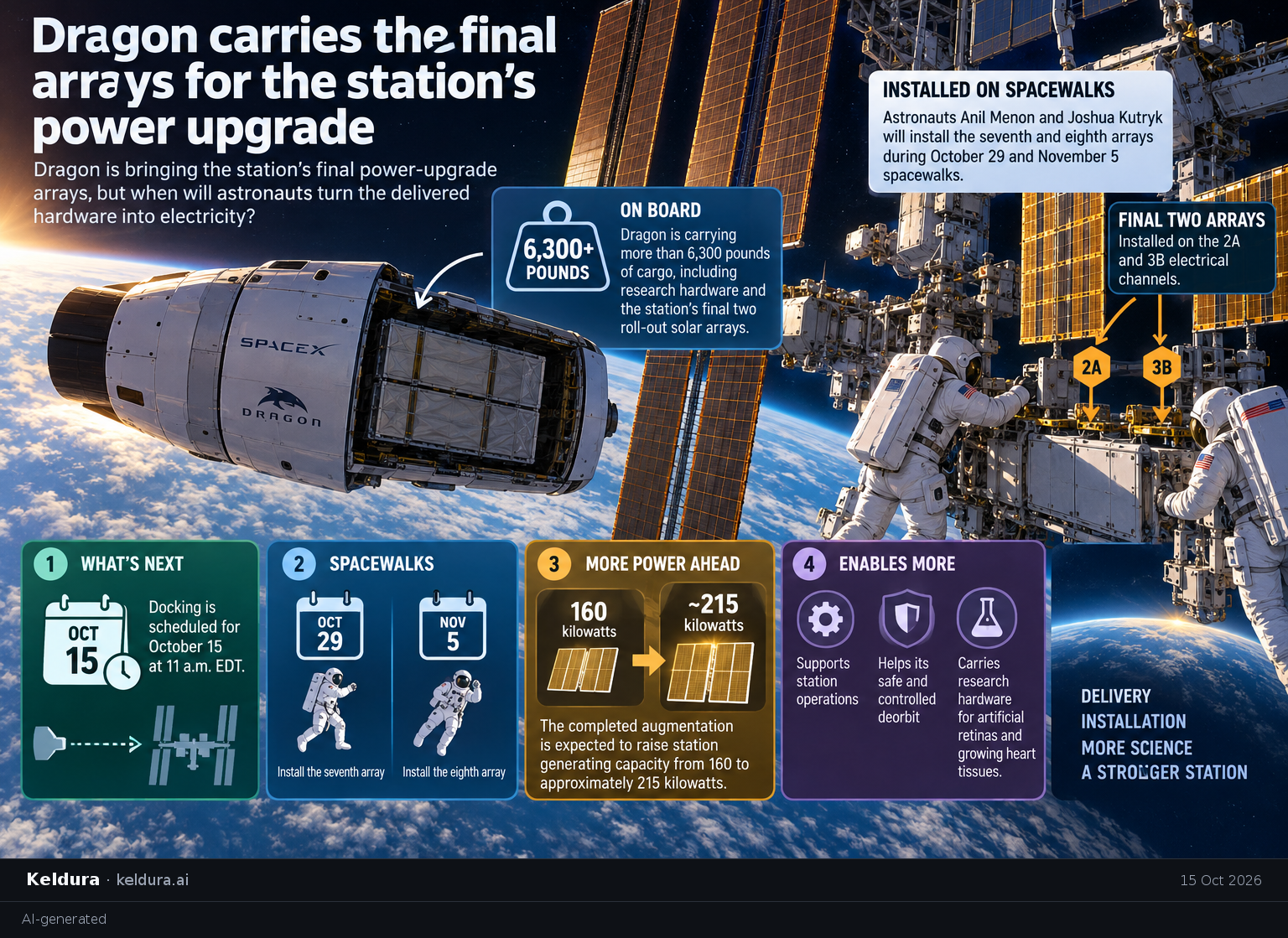
Dragon carries the final arrays for the station’s power upgrade

Dragon is bringing the station’s final power-upgrade arrays, but when will astronauts turn the delivered hardware into electricity?

Cheatsheet for Dragon carries the final arrays for the station’s power upgrade. Text equivalent is attached.

Why it matters: The additional electricity will support station operations, including its safe and controlled deorbit. The same delivery also carries research hardware for work on artificial retinas and growing hear…

Open original (2 sources): NASA News, NASA News

Open cheatsheet → Post to X

What happened
Dragon is carrying more than 6,300 pounds of cargo, including research hardware and the station’s final two roll-out solar arrays. [7][9]
Why
The completed augmentation is expected to raise station generating capacity from 160 to approximately 215 kilowatts. [7]
What's next
Docking is scheduled for October 15 at 11 a.m. EDT, followed by array-installation spacewalks on October 29 and November 5. [7][9]

Science & Space

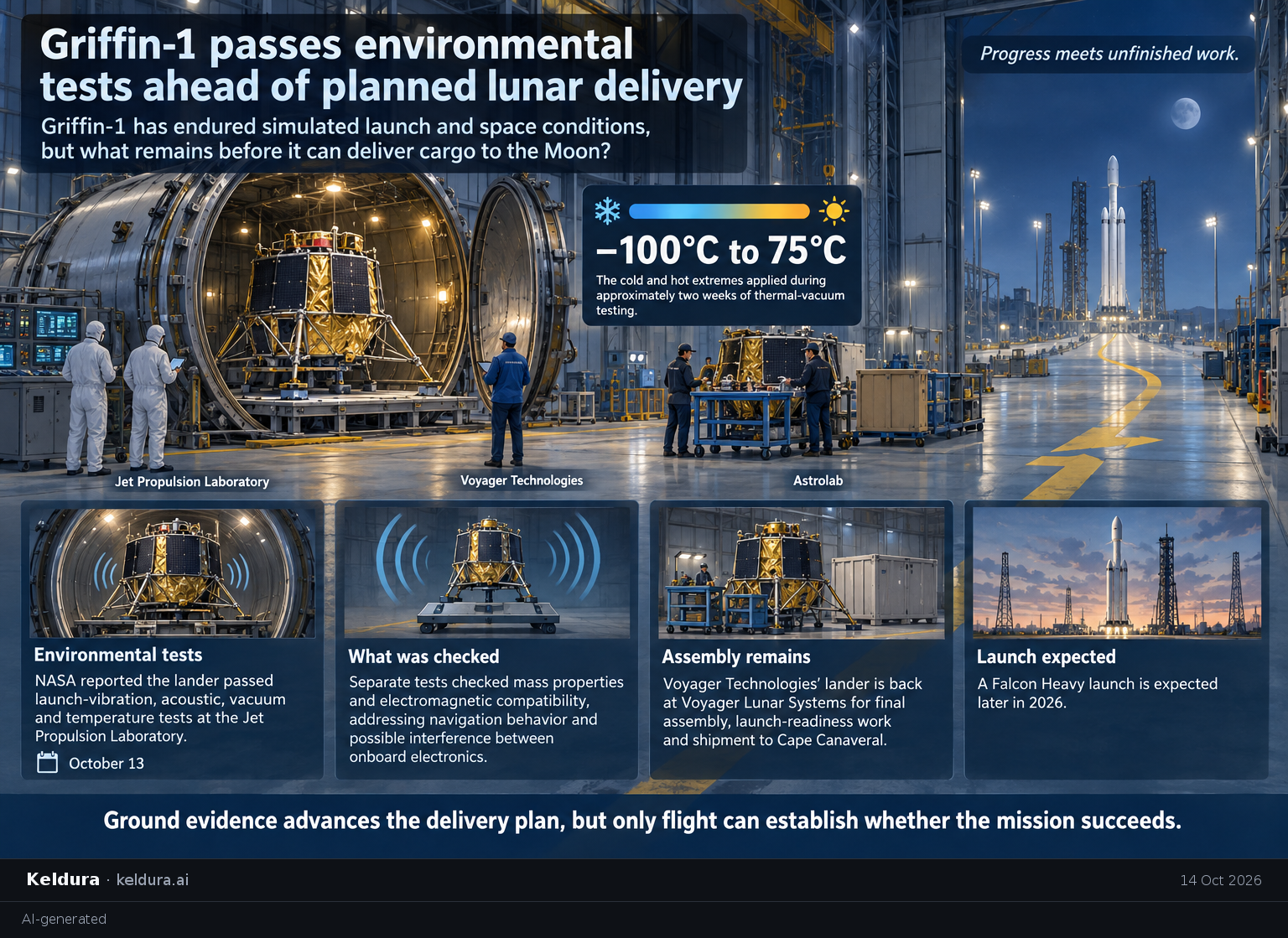
Griffin-1 passes environmental tests ahead of planned lunar delivery

Griffin-1 has endured simulated launch and space conditions, but what remains before it can deliver cargo to the Moon?

Cheatsheet for Griffin-1 passes environmental tests ahead of planned lunar delivery. Text equivalent is attached.

Why it matters: The tests provide evidence that the spacecraft can withstand conditions on its journey, a necessary step before attempting lunar cargo delivery. Its planned payload includes Astrolab’s FLIP rover and…

Open original · NASA News

Open cheatsheet → Post to X

What happened
Griffin-1 passed launch and space-environment tests at NASA’s Jet Propulsion Laboratory. [11]
Why
Engineers tested whether the lander could withstand vibration, acoustic loads, vacuum, and temperature extremes during its lunar mission. [11]
The catch
The spacecraft is back at Voyager Lunar Systems for final assembly; the successful tests do not mean it has launched or landed. [11]
What's next
NASA identifies launch-readiness operations and shipment to Cape Canaveral as the next steps, with a Falcon Heavy launch expected later in 2026. [11]

Science & Space

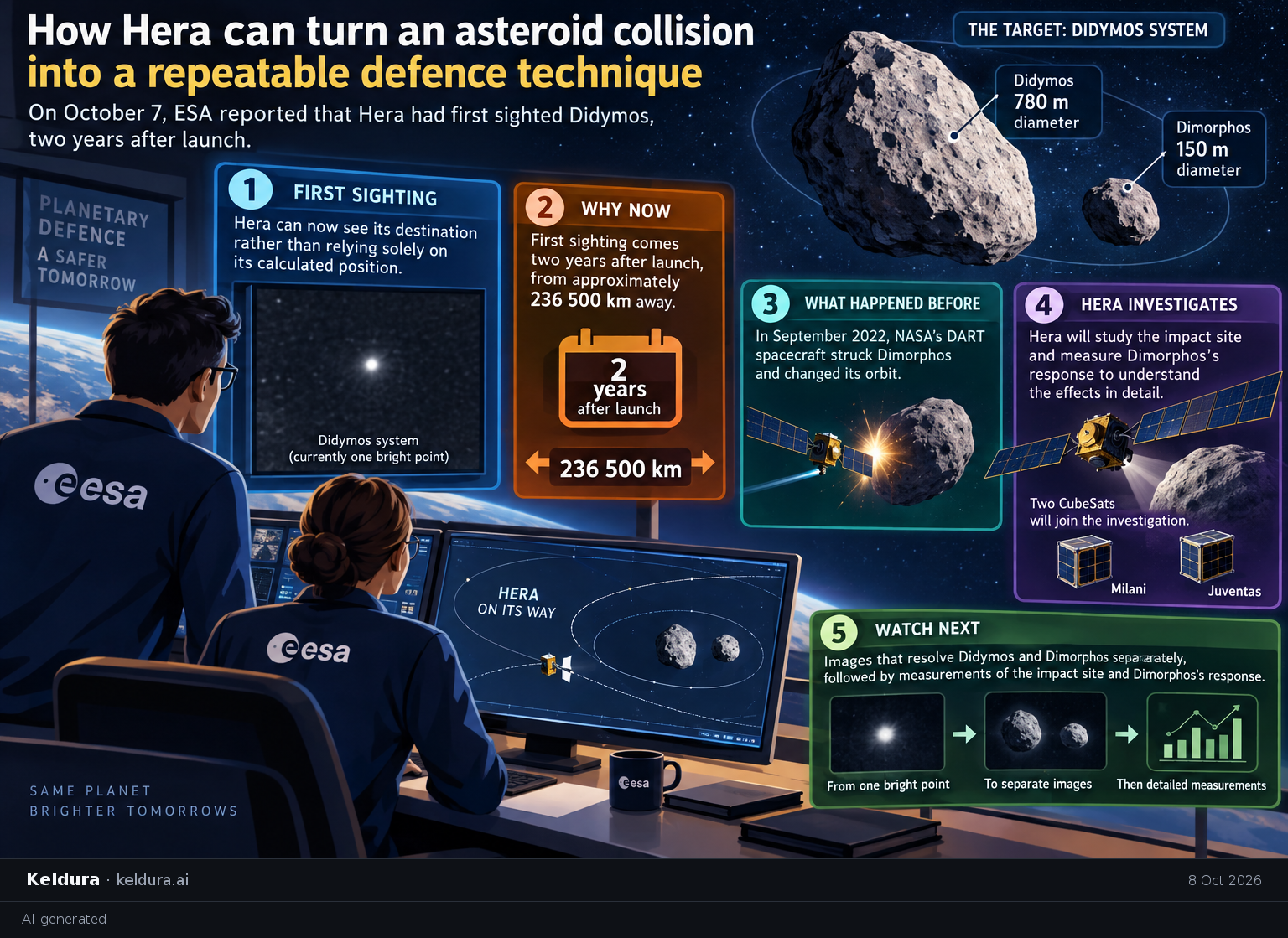
How Hera can turn an asteroid collision into a repeatable defence technique

On October 7, ESA reported that Hera had first sighted Didymos, two years after launch.

Cheatsheet for How Hera can turn an asteroid collision into a repeatable defence technique. Text equivalent is attached.

Why it matters: Demonstrating that a collision can change an asteroid’s orbit is different from understanding its effects well enough to repeat the technique. Hera’s close-up measurements are intended to bridge that…

Open original (2 sources): ESA News, ESA News

Open cheatsheet → Post to X

What changed
Hera can now see its destination rather than relying solely on its calculated position. [5]
Why now
The first sighting comes exactly two years after launch, at approximately 236 500 km from the system. [5]
Watch next
Images that resolve Didymos and Dimorphos separately, followed by measurements of the impact site and Dimorphos’s response. [5]

Science & Space

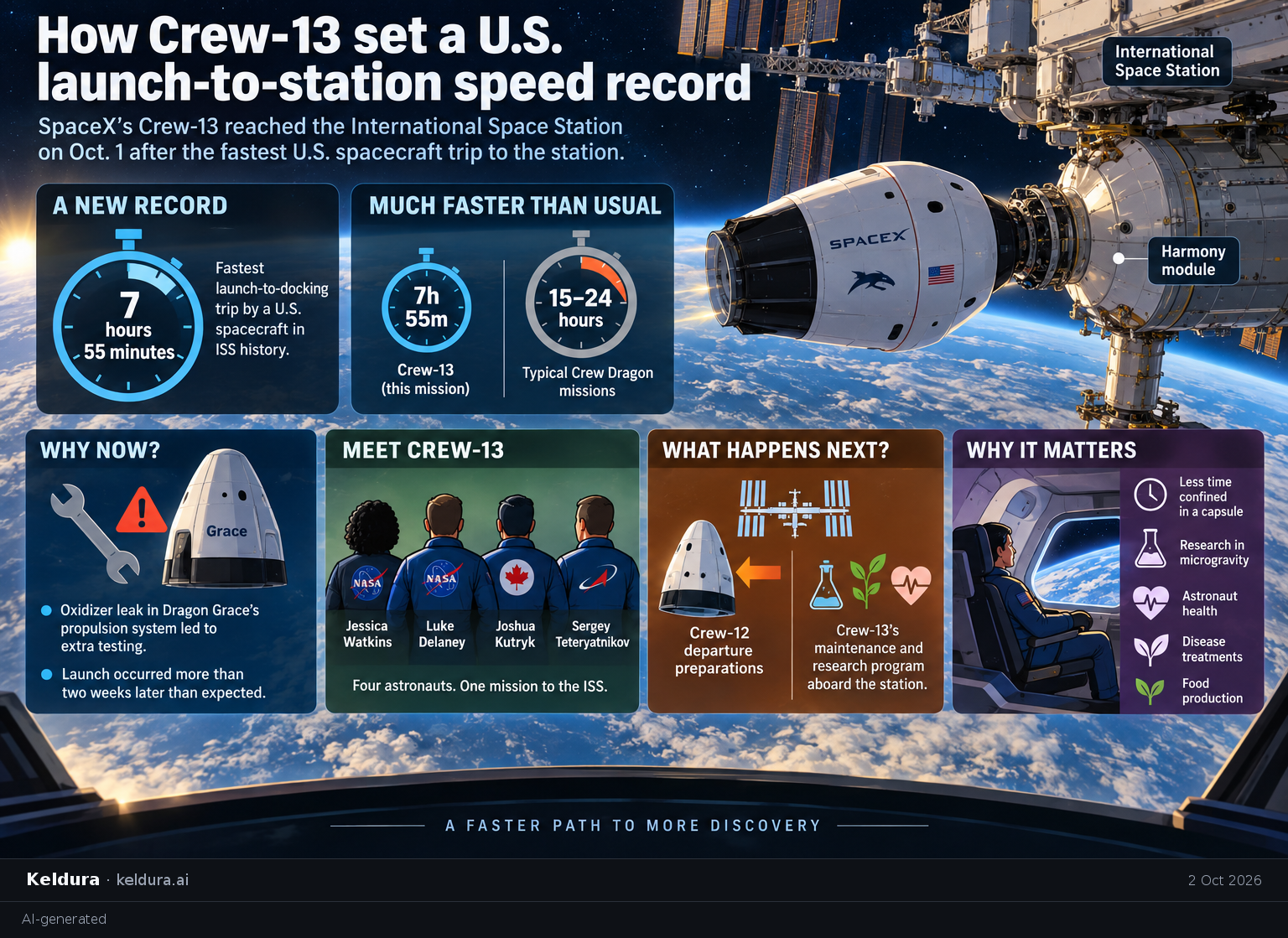
How Crew-13 set a U.S. launch-to-station speed record

SpaceX’s Crew-13 reached the International Space Station on Oct. 1 after the fastest U.S. spacecraft trip to the station.

Cheatsheet for How Crew-13 set a U.S. launch-to-station speed record. Text equivalent is attached.

Why it matters: A shorter rendezvous reduces the time astronauts spend confined in a capsule, while Crew-13’s roughly six-month stay will support station maintenance and research into microgravity, astronaut health,…

Open original (2 sources): NASA News, Space.com

Open cheatsheet → Post to X

What changed
Crew-13 completed the fastest launch-to-docking trip by a U.S. spacecraft in ISS history: 7 hours and 55 minutes.[3]
Why now
The mission flew after extra testing prompted by an oxidizer leak and a delay of more than two weeks.[6]
Watch next
Crew-12’s departure preparations and Crew-13’s planned maintenance and research program aboard the station.[6]

Science & Space

How Smile will turn auroras into a map of space weather

Smile reached its science orbit on June 20 after launching on May 19, and its four instruments have now completed the commissioning needed.

Cheatsheet for How Smile will turn auroras into a map of space weather. Text equivalent is attached.

Why it matters: Space weather can affect electronic infrastructure on Earth and in orbit, so observing both the solar wind and Earth’s large-scale response could improve researchers’ understanding of how geomagnetic…

Open original (4 sources): ESA News, ESA News, ESA News, ESA News

Open cheatsheet → Post to X

What changed
Smile completed commissioning and was approved to begin science operations on September 23.[4]
Why now
The spacecraft has tested its four-instrument toolkit after reaching its target science orbit on June 20.[4]
Watch next
Watch for coordinated measurements from the soft X-ray imager, ultraviolet aurora imager, magnetometer, and light ion analyser during solar and geomagnetic activity.[4]

Science & Space

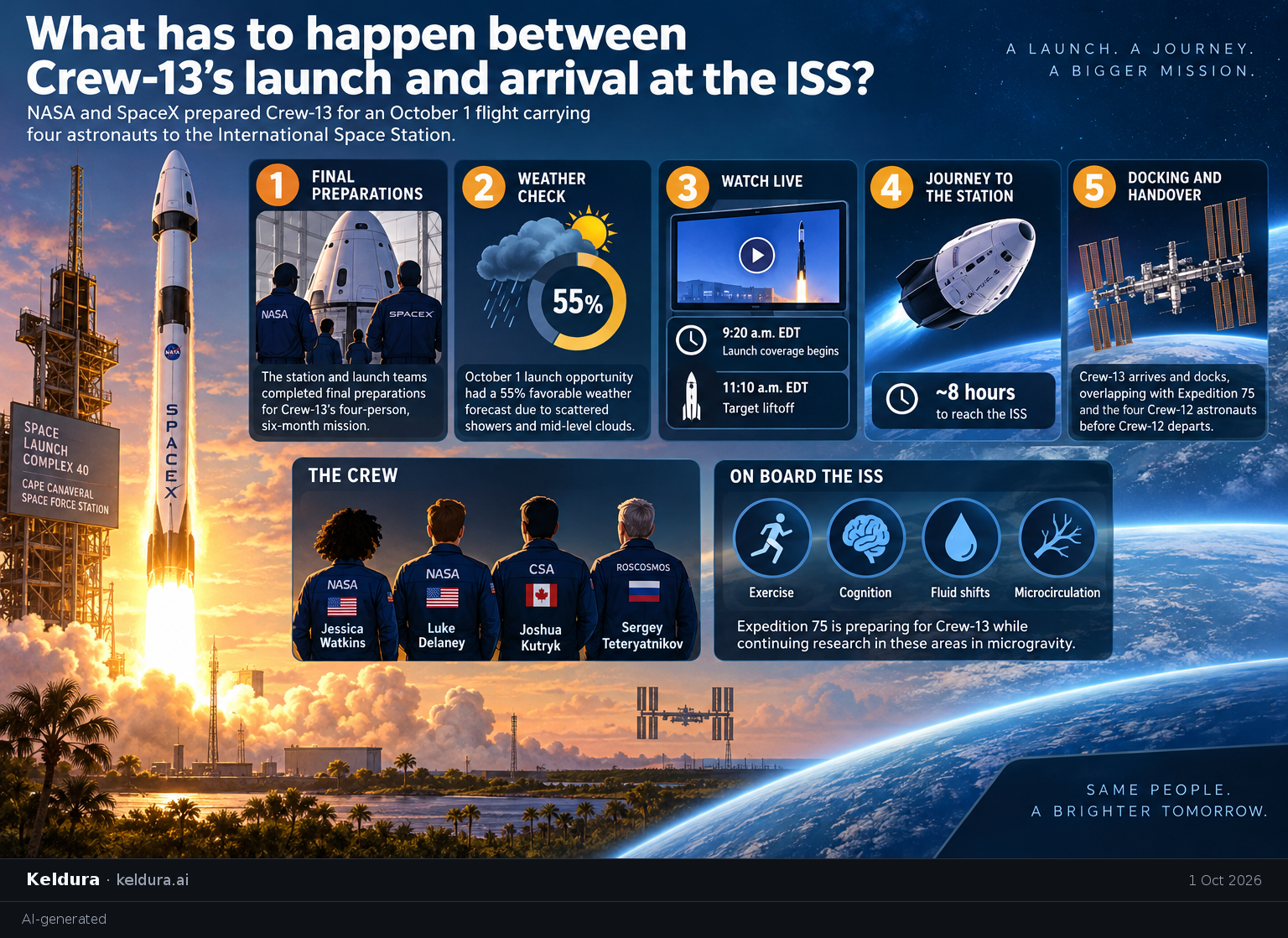
What has to happen between Crew-13’s launch and arrival at the ISS?

NASA and SpaceX prepared Crew-13 for an October 1 flight carrying four astronauts to the International Space Station.

Cheatsheet for What has to happen between Crew-13’s launch and arrival at the ISS?. Text equivalent is attached.

Why it matters: Crew-13’s arrival would overlap with the existing Expedition 75 residents and the four Crew-12 astronauts before Crew-12 departs, making launch, docking, handover, and return a linked sequence rather…
Open original (4 sources): Space.com, NASA News, Space.com, NASA News

Open cheatsheet → Post to X

What changed
The station and launch teams entered final preparations for Crew-13’s four-person, six-month mission.[1][2]
Why now
The October 1 launch opportunity faced a 55% favorable-weather forecast because of showers and mid-level clouds.[7]
Watch next
Watch the launch weather decision, the 11:10 a.m. EDT liftoff target, and docking roughly eight hours later.[2][7]

That's the desk. Every cheatsheet here started as a link. Yours can too.

Cheatsheet your own link — free