Keldura Daily Open Keldura

Keldura Daily · Cheatsheets

The signal, not the scroll.

Every cheatsheet Keldura Daily has published, newest first: the news hook, why it matters, and the sources it came from. Each cheatsheet is compiled by Keldura's AI from the sources it cites.

Latest cheatsheets

All sections

Read in Briefings
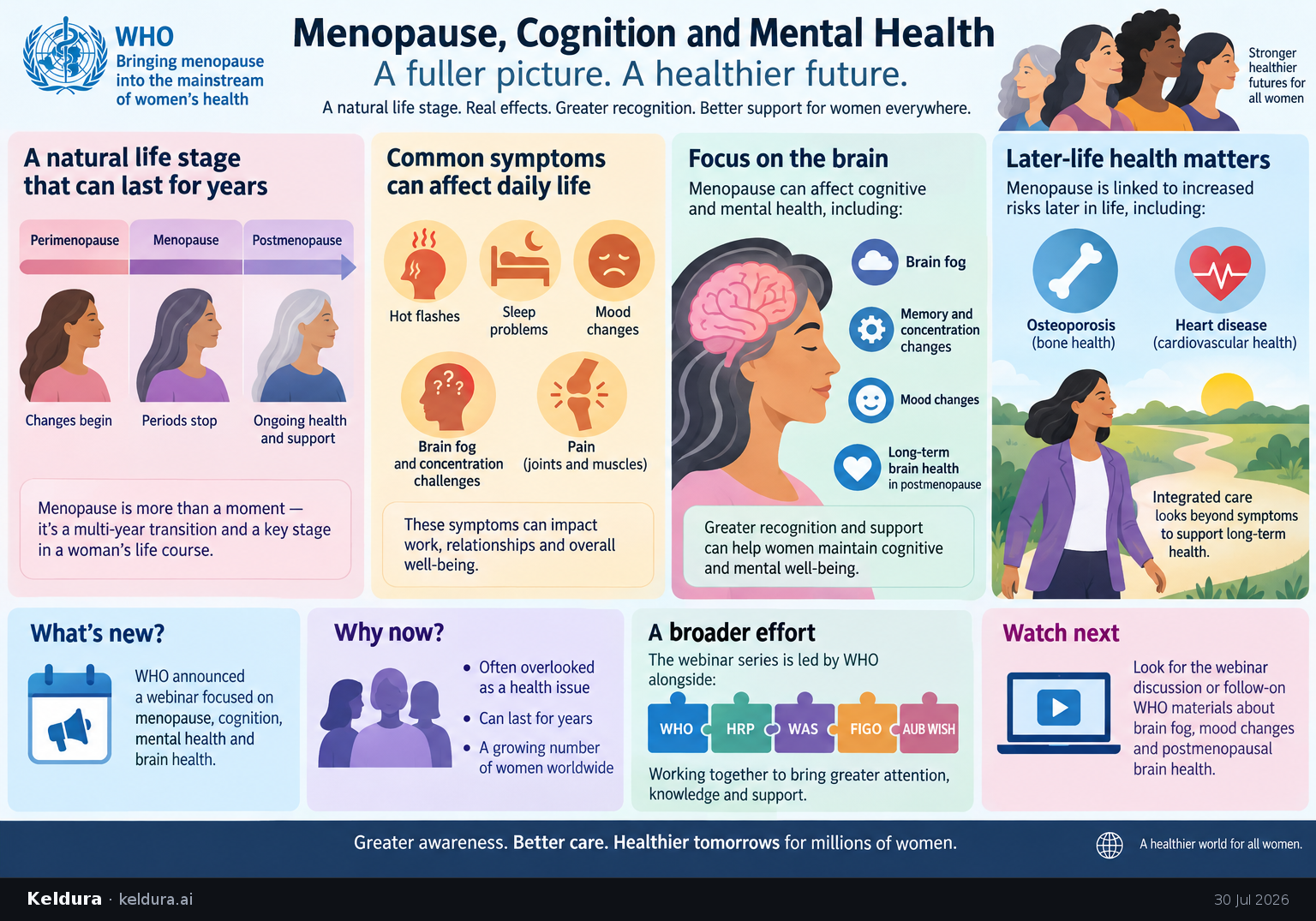
Cheatsheet for WHO is putting menopause, cognition, and mental health into the mainstream of women’s health. Text equivalent is attached.

Health & Medicine

WHO is putting menopause, cognition, and mental health into the mainstream of women’s health

WHO says the second webinar in its series on menopause will address the effects of menopause on cognition and mental health, including brain fog, mood changes, and brain health in the postmenopausal years.

Why it matters: This matters because WHO is explicitly treating menopause as a life-course health issue rather than a narrow reproductive milestone, which can shape clinical priorities, public health messaging, and…

Open original · World Health Organization News

Open cheatsheet →1 source Post to X

What changed
WHO announced a webinar focused on menopause, cognition, mental health, and brain health [1].
Why now
WHO says menopause is often overlooked, can last for years, and affects a growing number of women worldwide [1].
Watch next
Look for the webinar discussion or follow-on WHO materials that elaborate on brain fog, mood changes, and postmenopausal brain health [1].
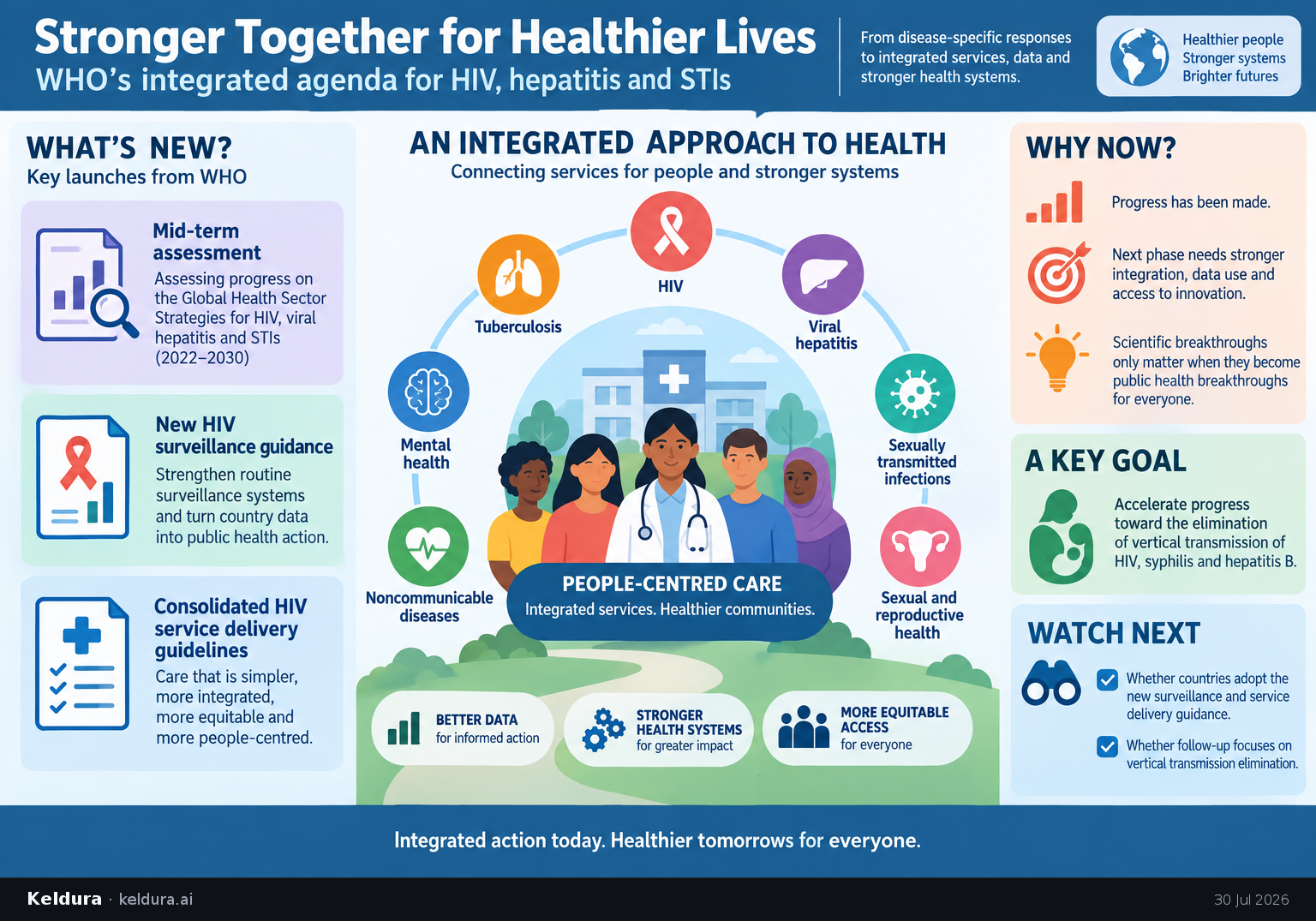
Cheatsheet for WHO is pushing a broader HIV, hepatitis, and STI integration agenda. Text equivalent is attached.

Health & Medicine

WHO is pushing a broader HIV, hepatitis, and STI integration agenda

Why it matters: This matters because it shows WHO moving from disease-specific responses toward more integrated service delivery, data systems, and health-system strengthening.

Open original · World Health Organization News

Open cheatsheet →1 source Post to X

What changed
WHO launched a mid-term assessment and released new HIV surveillance and service delivery guidance [3].
Why now
WHO says progress has been made, but the next phase needs stronger integration, data use, and access to innovation [3].
Watch next
Monitor whether countries adopt the new surveillance and service delivery guidance and whether WHO follow-up centers on vertical transmission elimination [3].
Cheatsheet for ISS crew prepares for August spacewalks while routine science continues. Text equivalent is attached.

Science & Space

ISS crew prepares for August spacewalks while routine science continues

NASA says the seven-member Expedition 75 crew spent Tuesday on spacesuit checks, eye exams, exercise research, Earth imagery, and lab inventory aboard the International Space Station.

Why it matters: The station is entering a maintenance-heavy period that combines operational upkeep with research, showing how human spaceflight depends on both scheduled EVAs and daily onboard science. The work on…

Open original · NASA News

Open cheatsheet →1 source Post to X

What changed
NASA moved crew prep for three August spacewalks into the foreground, with spacesuit checkout and mission planning underway [1].
Why now
The station needs solar array, antenna, and power/data upgrades, so EVA readiness is time-sensitive [1].
Watch next
NASA says it will soon announce the spacewalkers for the second and third August spacewalks [1].
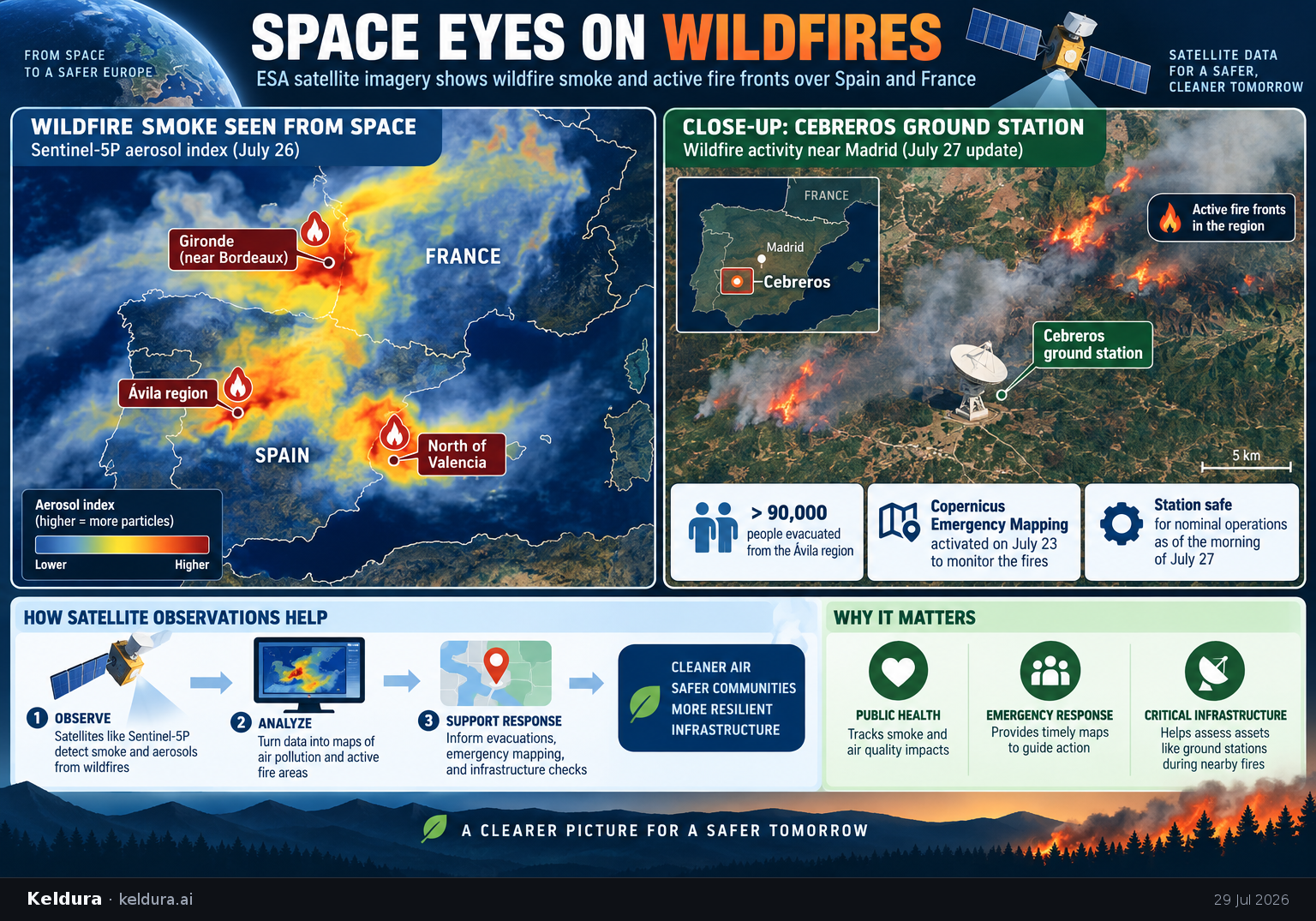
Cheatsheet for ESA satellite imagery shows wildfire smoke and active fire fronts over Spain and France. Text equivalent is attached.

Science & Space

ESA satellite imagery shows wildfire smoke and active fire fronts over Spain and France

ESA published Copernicus imagery showing aerosol pollution over Spain and France after days of wildfire spread through dry countryside.

Why it matters: These images turn wildfire impacts into measurable atmospheric and infrastructure events, showing how space-based observation supports public health, emergency response, and mission operations on the…

Open original (2 sources): ESA News, ESA News

Open cheatsheet →2 sources Post to X

What changed
ESA released satellite views of wildfire smoke and a separate image of the Cebreros station area under fire conditions [2][8].
Why now
Wildfires in Spain and France have produced widespread smoke and evacuations, prompting emergency mapping and atmospheric monitoring [2][8].
Watch next
Look for additional Copernicus wildfire products or ESA updates on the operational status of affected ground assets [8].
Cheatsheet for SpaceX’s Starship Flight 13 reaches several major test milestones. Text equivalent is attached.

Science & Space

SpaceX’s Starship Flight 13 reaches several major test milestones

SpaceX’s 13th Starship test flight launched on July 24 from Starbase in South Texas and returned a 408-foot-tall Starship Version 3 vehicle to space.

Why it matters: This flight appears to mark a meaningful step forward for Starship’s test program because the upper stage achieved multiple planned objectives and the splashdown ended without the vehicle exploding,…

Open original · Space.com

Open cheatsheet →1 source Post to X

What changed
Starship Flight 13 completed deployment, engine relight, and soft splashdown milestones [1].
Why now
The test flew on July 24 and SpaceX publicly showcased the results on July 27 [1].
Watch next
Look for follow-up Starship test reporting on booster recovery issues and whether future flights repeat the soft splashdown outcome [1].
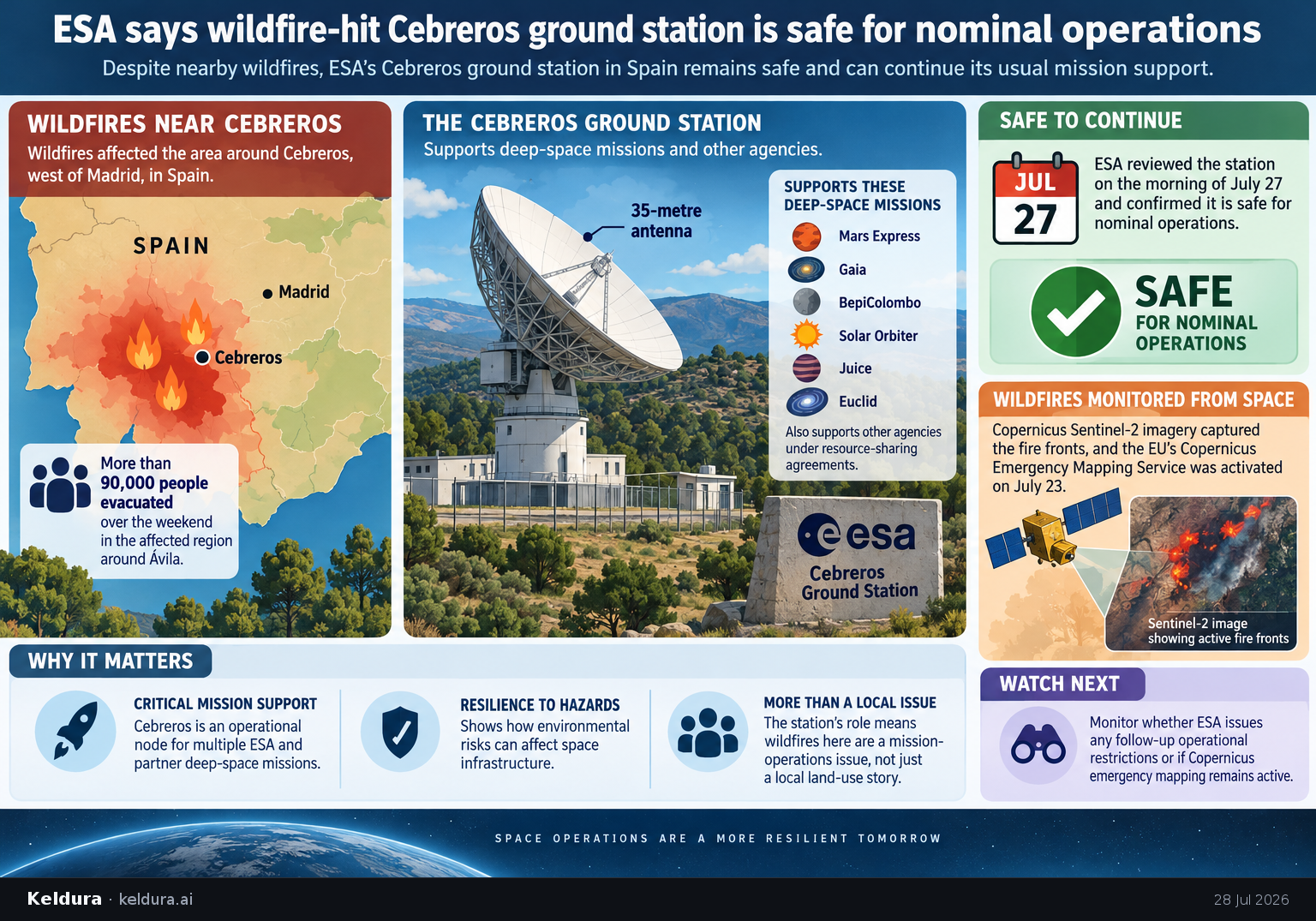
Cheatsheet for ESA says wildfire-hit Cebreros ground station is safe for nominal operations. Text equivalent is attached.

Science & Space

ESA says wildfire-hit Cebreros ground station is safe for nominal operations

Why it matters: Cebreros is not just a local facility; it is an operational support node for multiple ESA and partner deep-space missions, so wildfire exposure at the site is a mission-operations issue, not only a l…

Open original · ESA News

Open cheatsheet →1 source Post to X

What changed
ESA confirmed the Cebreros ground station remained safe for nominal operations despite nearby wildfires [2].
Why now
Wildfire monitoring and evacuations in central Spain prompted immediate review of the site [2].
Watch next
Monitor whether ESA issues any follow-up operational restrictions or if Copernicus emergency mapping remains active [2].
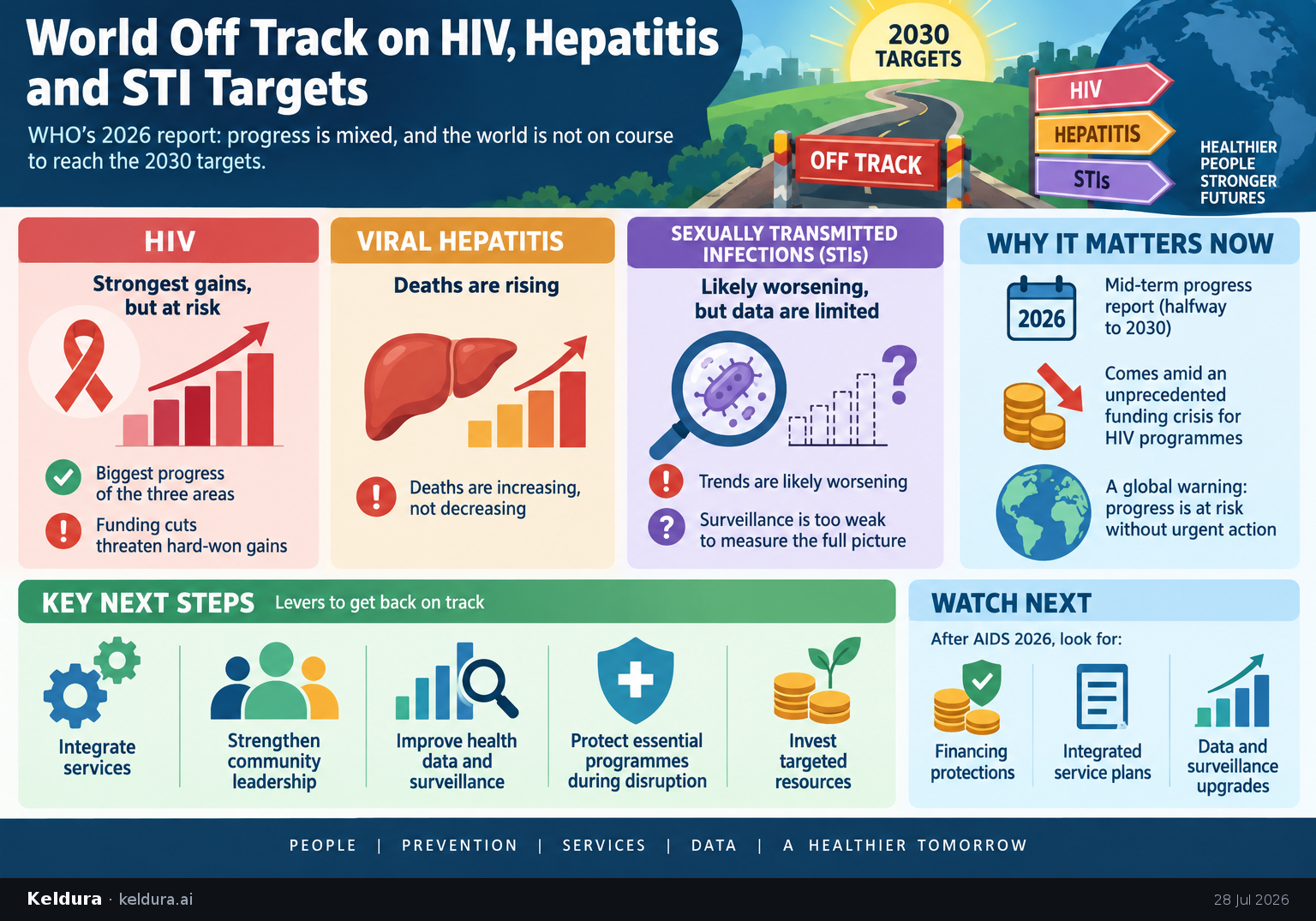
Cheatsheet for WHO says the world is off track on HIV, hepatitis and STI targets, even as HIV gains are threatened. Text equivalent is attached.

Health & Medicine

WHO says the world is off track on HIV, hepatitis and STI targets, even as HIV gains are threatened

WHO’s 2026 mid-term progress report says progress is mixed and the world is off track to reach the 2030 targets for HIV, viral hepatitis and STIs.

Why it matters: This is a broad warning that the global response is no longer just about scale-up; it is about protecting hard-won gains from financing shocks and service disruption. The report points to integration…

Open original (2 sources): World Health Organization News, World Health Organization News

Open cheatsheet →2 sources Post to X

What changed
WHO released its 2026 mid-term progress report and says progress is mixed across HIV, viral hepatitis and STIs. [4]
Why now
The report marks the halfway point to the 2030 targets and comes amid an unprecedented funding crisis for HIV programmes. [5][4]
Watch next
Look for whether countries announce financing protections, integrated service plans, or data/surveillance upgrades after AIDS 2026. [4][5]
Cheatsheet for Expedition 74 trio returns to Earth after 241 days in orbit. Text equivalent is attached.

Science & Space

Expedition 74 trio returns to Earth after 241 days in orbit

NASA says Soyuz MS-28 brought NASA astronaut Chris Williams and Roscosmos cosmonauts Sergey Kud‑Sverchkov and Sergei Mikaev back to Earth after an eight-month mission aboard the International Space Station.

Why it matters: This is a concrete end-of-mission milestone for ISS operations, marking crew rotation, post-flight recovery, and the handoff between Expedition 74 and Expedition 75. It also shows continuing U.S.-Rus…

Open original (2 sources): NASA News, Space.com

Open cheatsheet →2 sources Post to X

What changed
Soyuz MS-28 landed and returned the Expedition 74 trio from the ISS.[2][5]
Why now
Their planned return followed the completion of an eight-month research mission and station crew transition activities.[2][5]
Watch next
Post-landing medical checks, recovery transport to Karaganda, and Williams’s transfer to NASA’s Johnson Space Center.[2]
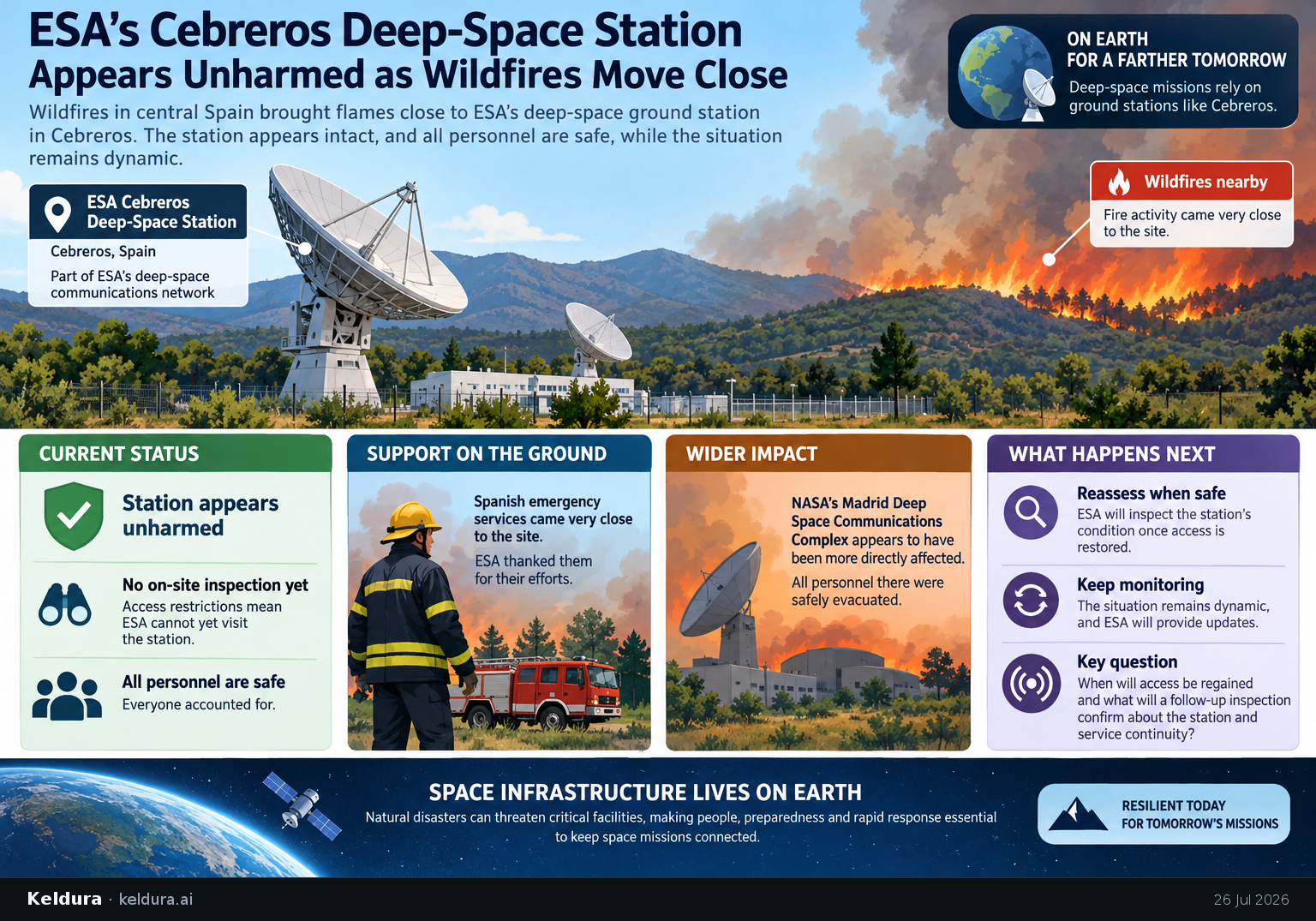
Cheatsheet for ESA says its Cebreros deep-space station appears unharmed as wildfires move close. Text equivalent is attached.

Science & Space

ESA says its Cebreros deep-space station appears unharmed as wildfires move close

ESA said it is closely monitoring wildfires near its deep-space ground station in Cebreros, Spain, and that the station appears to have remained unharmed based on the information currently available.

Why it matters: Cebreros is part of ESA’s deep-space communications infrastructure, so any wildfire threat there is an operational risk as well as a personnel and continuity issue. The statement also underscores how…

Open original · ESA News

Open cheatsheet →1 source Post to X

What changed
Wildfires near Cebreros prompted an ESA status update; the station appears intact but cannot yet be inspected [1].
Why now
Fire activity brought emergency services close to a key deep-space ground station, making operational status and personnel safety urgent [1].
Watch next
Whether ESA regains access for an on-site inspection and issues a follow-up on station condition and service continuity [1].
Cheatsheet for Mars memory and space-station risk take center stage in two Space.com features. Text equivalent is attached.

Science & Space

Mars memory and space-station risk take center stage in two Space.com features

Why it matters: Together, these pieces show how space history still shapes present-day science and policy conversations: Viking 1 remains central to Mars astrobiology debates, while Mir remains a case study in stati…

Open original (2 sources): Space.com, Space.com

Open cheatsheet →2 sources Post to X

What changed
Space.com highlighted Viking 1’s 50th anniversary and released an interview focused on the Mir collision crisis [2][3].
Why now
The anniversary and the PBS miniseries episode created a timely opening to revisit Mars life-detection history and station emergency response [2][3].
Watch next
Whether the PBS series and related coverage prompt renewed discussion of Viking data interpretation or Mir-era safety lessons [2][3].
Cheatsheet for ESCAPADE snaps Earth-Moon images on the way to Mars. Text equivalent is attached.

Science & Space

ESCAPADE snaps Earth-Moon images on the way to Mars

NASA says one of the two Mars-bound ESCAPADE spacecraft captured visible-light and thermal-infrared images of Earth and the Moon on July 3 while the probe was still far from home.

Why it matters: The photos are not just a visual milestone; NASA says they serve as an important calibration check for the spacecraft’s cameras before ESCAPADE uses an Earth flyby in November 2026 to head toward Mar…

Open original · NASA News

Open cheatsheet →1 source Post to X

What changed
ESCAPADE returned its first Earth-Moon image set and NASA highlighted it as a camera calibration milestone.[1]
Why now
The mission is in loiter orbit ahead of a planned Earth gravity assist in November 2026 and Mars arrival in September 2027.[1]
Watch next
Look for NASA updates on the Earth flyby and any later camera-performance or trajectory checks before the Mars transfer.[1]
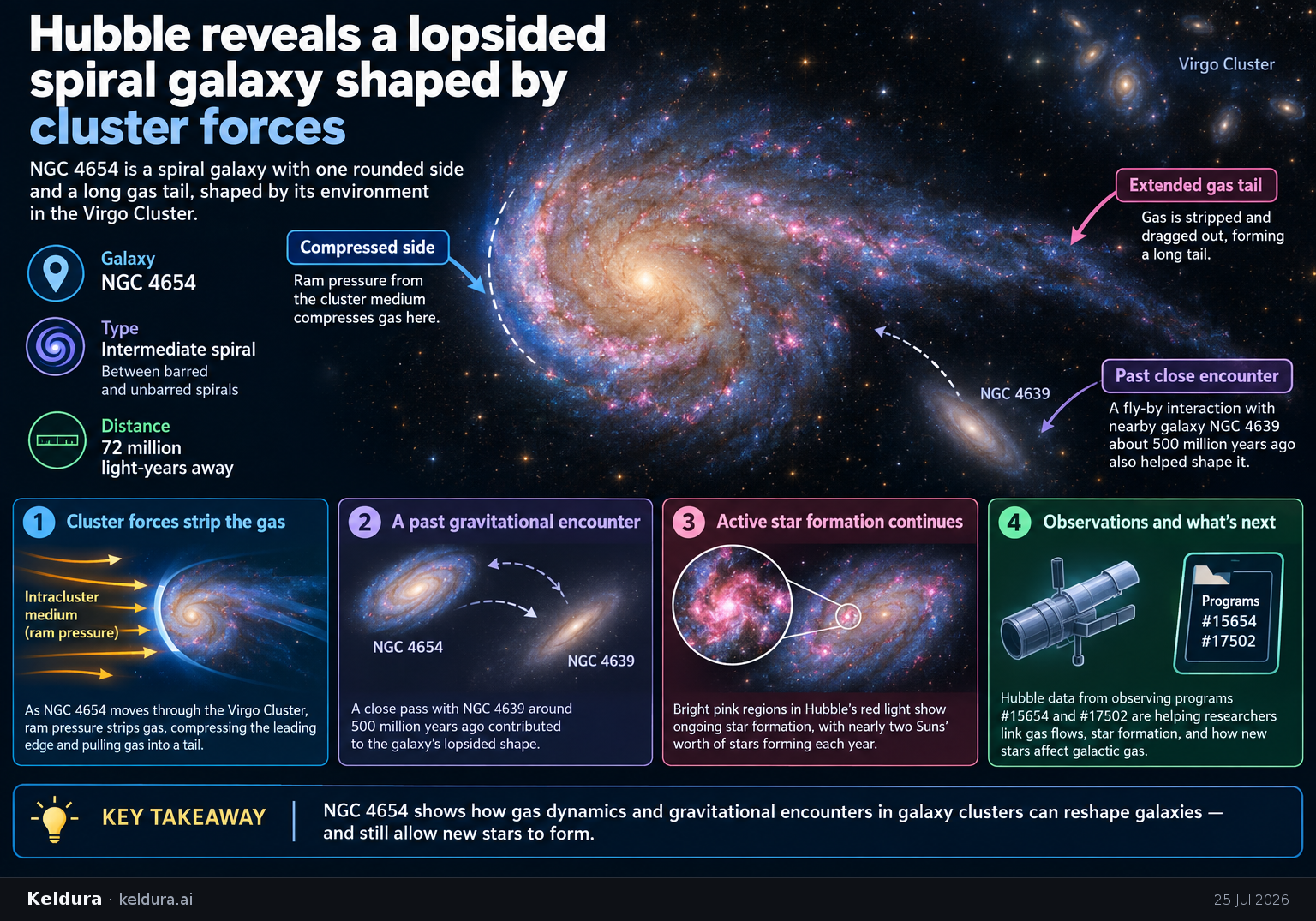
Cheatsheet for Hubble reveals a lopsided spiral galaxy shaped by cluster forces. Text equivalent is attached.

Science & Space

Hubble reveals a lopsided spiral galaxy shaped by cluster forces

A new NASA/ESA Hubble image shows NGC 4654, a spiral galaxy 72 million light-years away in Virgo, with a rounded edge on one side and a long gas tail on the other.

Why it matters: The image is a concrete example of how gas dynamics and gravitational encounters reshape galaxies and influence where stars can form. NASA says the data are helping researchers connect gas flows, sta…
Open original · NASA News

Open cheatsheet →1 source Post to X

What changed
Hubble data exposed a strongly asymmetric spiral galaxy with active star formation despite gas stripping.[2]
Why now
NASA released the image alongside fresh analysis tying its lopsided shape to cluster interactions and past gravitational encounters.[2]
Watch next
Track follow-up work from the two observing programs on how gas moves and where it collapses into new stars.[2]

That's the desk. Every cheatsheet here started as a link. Yours can too.

Cheatsheet your own link — free